Peptide Reconstitution & Storage: A Detailed Research Handling Guide
Lyophilized peptides are often far more stable in their dry state than after they have been placed into solution—but stability is never determined by temperature alone. This guide explains peptide reconstitution from a laboratory-handling perspective, including vial preparation, condensation control, solvent selection, gentle dissolution, bacteriostatic-water storage, temporary refrigerated storage, frozen storage, freeze-thaw avoidance, troubleshooting, and the important limits of long-term stability claims.
Article Contents
- What reconstitution actually means
- Why lyophilization improves stability
- Before reconstitution
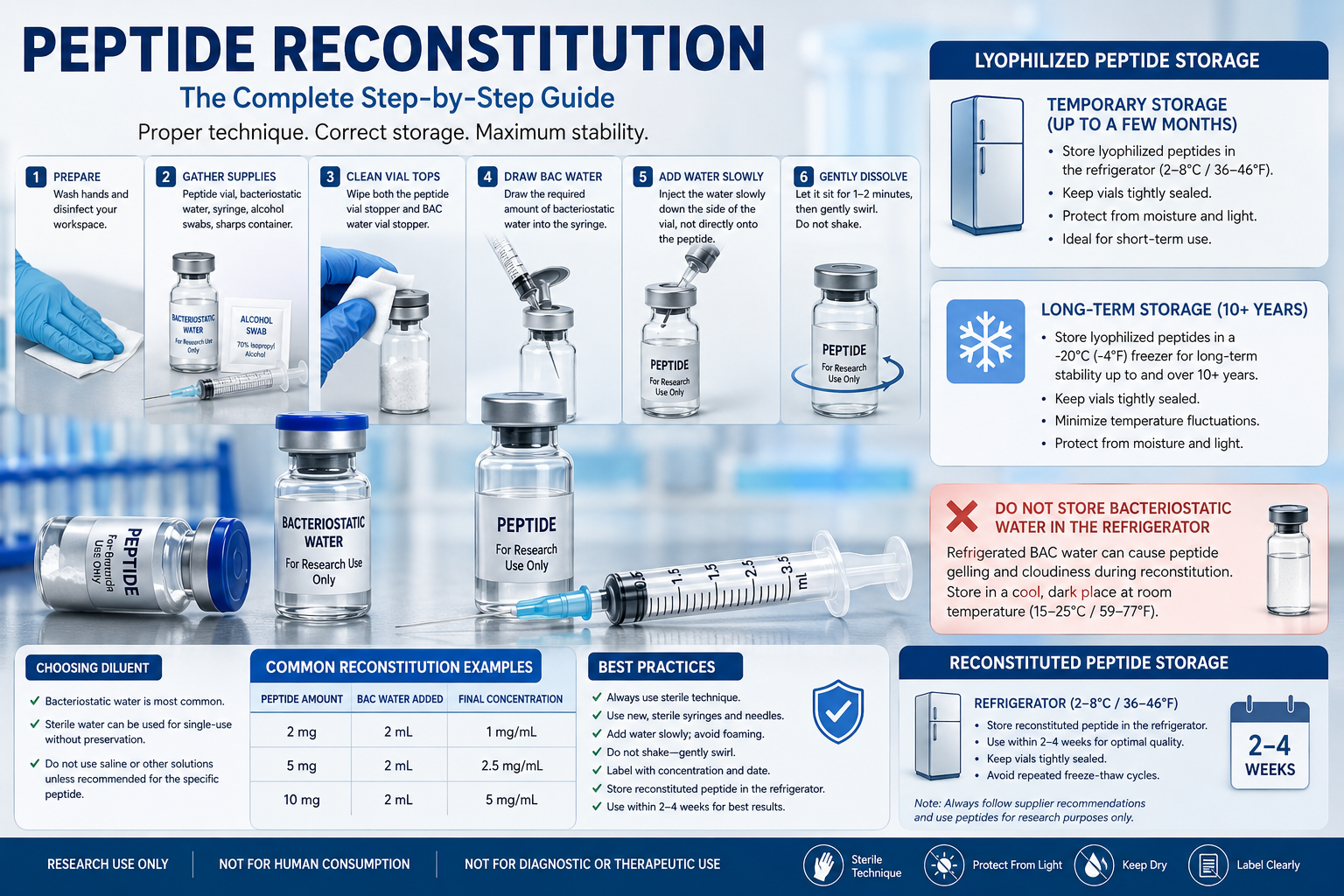
- Step-by-step laboratory workflow
- Choosing a reconstitution solvent
- Bacteriostatic water storage
- Gentle dissolution and mixing
- Expected appearance and inspection
- Short-term lyophilized storage
- Long-term frozen storage
- What “10+ years” really means
- Condensation and moisture control
- Freeze-thaw cycles
- Cloudiness, gelling, foam and particles
- Storage comparison table
- Frequently asked questions
- References
What Peptide Reconstitution Actually Means
Reconstitution is the controlled process of returning a dried or lyophilized peptide to solution by adding an appropriate solvent. The goal is not merely to make the visible powder disappear. A successful laboratory reconstitution should preserve the identity and integrity of the material while creating a homogeneous solution that is compatible with the intended analytical or experimental procedure.
Different peptides can behave very differently in solution. Amino-acid sequence, charge, hydrophobicity, counter-ion, concentration, pH, ionic strength, excipients, oxidation sensitivity, temperature and solvent composition can all influence solubility and stability. For this reason, there is no single reconstitution solvent, storage temperature, mixing method or post-reconstitution shelf life that is correct for every peptide.
Why Lyophilization Usually Improves Peptide Stability
Lyophilization, commonly called freeze-drying, removes most of the water from a frozen preparation under reduced pressure. Removing bulk water can substantially slow many hydrolytic and solution-phase degradation reactions. That is why research peptides are frequently supplied in a dry lyophilized form and why the dry material generally tolerates storage better than an aqueous solution.
Lyophilization does not make a peptide chemically immortal. Residual moisture, oxygen, light, heat, container permeability, repeated temperature cycling and sequence-specific degradation pathways can still affect the material. Methionine, cysteine and tryptophan residues may be susceptible to oxidation; asparagine and glutamine can participate in deamidation pathways; and other sequences may have their own liabilities.
Residual or absorbed water can accelerate chemical change and reduce long-term stability.
Oxidation-sensitive sequences may degrade faster with prolonged air exposure.
Lower temperature generally slows degradation, but does not establish a universal expiration period.
Some peptides and formulation components are photosensitive and should be protected from unnecessary light exposure.
Before Reconstitution: Inspect, Identify and Plan
Good reconstitution begins before a solvent touches the vial. Confirm the vial identity, lot or batch number, labeled amount, documentation and storage history. If the material arrived cold or has been stored in a refrigerator or freezer, do not immediately open a cold vial in warm, humid room air.
Pre-reconstitution checklist
- Confirm the product name, sequence or identifier and batch or lot number.
- Review the supplier’s recommended solvent and storage specifications.
- Inspect the vial and stopper for cracks, broken seals, leakage or obvious compromise.
- Observe the lyophilized cake or powder without assuming every peptide must look identical.
- Check whether the peptide has special pH, oxidation, light or solubility requirements.
- If removed from cold storage, keep the vial closed while it reaches approximately room temperature.
- Prepare the work area and all necessary laboratory materials before opening the vial.
- Use clean technique appropriate for the intended research application.
Step-by-Step Peptide Reconstitution Workflow for Laboratory Research
The following workflow describes general laboratory handling. It intentionally does not specify human doses, injection technique or administration. Product-specific instructions always take priority.
There Is No Universal Reconstitution Solvent
One of the most common reconstitution mistakes is assuming that every lyophilized peptide should be dissolved in the same liquid. MilliporeSigma’s peptide handling guidance explicitly notes that there is no universal solvent capable of dissolving all lyophilized peptides while preserving integrity and compatibility.
Water-soluble peptides may dissolve readily in an aqueous vehicle. Other peptides may be acidic, basic or strongly hydrophobic and may require a different solvent system or a carefully adjusted pH. A solvent that makes a peptide appear to dissolve may still be chemically unsuitable for the intended experiment.
| Factor | Why it matters | Potential consequence |
|---|---|---|
| Peptide charge | Influences aqueous solubility at a given pH. | Poor dissolution or precipitation. |
| Hydrophobicity | Hydrophobic sequences may resist aqueous dissolution. | Cloudiness, films, aggregates or incomplete dissolution. |
| pH | Can alter ionization, solubility and degradation rate. | Improved solubility—or accelerated degradation if poorly chosen. |
| Ionic strength | Can affect electrostatic interactions and aggregation. | Changes in clarity or solubility. |
| Temperature | Changes dissolution kinetics and intermolecular interactions. | Temporary cloudiness, slow dissolution or altered aggregation behavior. |
Bacteriostatic Water: Storage and Temperature Matter
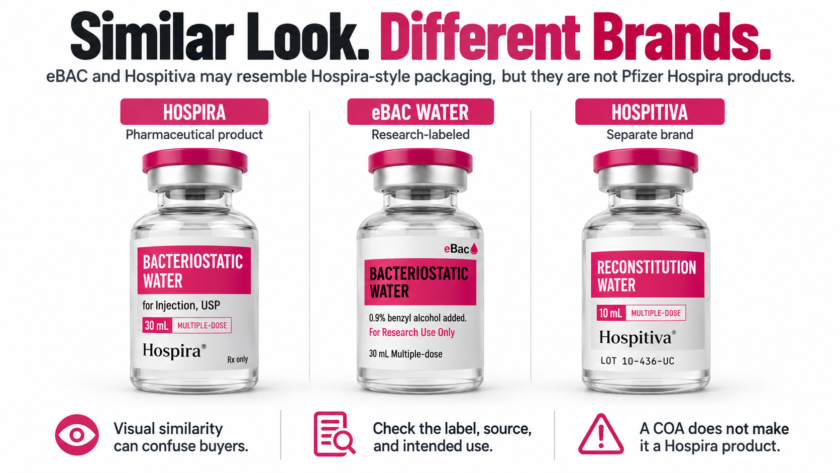
Bacteriostatic Water for Injection, USP is sterile water containing benzyl alcohol as a preservative. For the Hospira product, current labeling instructs storage at 20–25°C (68–77°F), USP controlled room temperature. That is the storage condition that should be followed for that specific product unless its current labeling says otherwise.
For that reason, a general practice of placing an unopened Hospira bacteriostatic-water vial in a refrigerator is not supported by its labeled storage instructions. Store it as directed by the manufacturer, protected from inappropriate environmental exposure. Other brands may have different instructions, especially after first puncture, so the label on the exact product always controls.
Very cold diluent can also change the way some peptide preparations behave during the first moments of dissolution. Temperature can affect solubility, viscosity, aggregation and dissolution rate. If a peptide becomes temporarily cloudy or slow to dissolve when very cold diluent is used, that observation does not by itself prove contamination or degradation—but it should not be ignored either.
Gentle Dissolution Is Usually Better Than Aggressive Agitation
A peptide does not need to be violently shaken to be considered reconstituted. In many cases, gentle contact with an appropriate solvent followed by time is enough. Excessive shaking can create persistent foam and makes visual inspection more difficult. For sensitive molecules or peptide-protein preparations, excessive mechanical stress can also be undesirable.
A practical laboratory approach is to let the solvent wet the cake, allow the material to hydrate, and use gentle swirling or rolling if additional mixing is necessary. If dissolution remains incomplete, the appropriate response is not automatically “shake harder.” Re-evaluate solvent choice, pH, concentration and peptide-specific solubility information.
What Should a Reconstituted Peptide Look Like?
There is no universal visual appearance for every peptide solution. Many are clear and colorless, while others can have an expected tint because of the peptide itself, formulation components or concentration. A dry lyophilized cake can be compact, fluffy, crystalline, collapsed or irregular without that appearance alone proving a quality problem.
What matters is whether the observed appearance is consistent with the specific material’s documented characteristics and whether unexpected particles, haze, precipitate, gel formation or discoloration persist after the preparation has had adequate time to equilibrate.
Temporary Storage of Lyophilized Peptides: Refrigeration Can Be Appropriate, but It Is Product-Specific
For temporary storage over weeks to a few months, refrigerated storage may be acceptable for some lyophilized peptide preparations when supported by the supplier’s specifications. However, several major peptide manufacturers recommend −20°C or colder for long-term storage of lyophilized custom peptides rather than relying on refrigeration alone.
The distinction matters because “a few months in a refrigerator” cannot be assigned to every peptide as a guaranteed stability period. Stability is influenced by sequence, formulation, residual moisture, closure integrity and prior handling. If a peptide’s documentation specifies frozen storage, that instruction should take precedence even for temporary storage.
Long-Term Storage: −20°C / −4°F Is Common, but −80°C Provides a Larger Stability Margin
A conventional laboratory freezer at approximately −20°C (−4°F) is a widely recommended storage condition for many lyophilized peptides. MilliporeSigma recommends −20°C or colder for lyophilized material, while Thermo Fisher instructs storage at −20°C or −80°C for its custom lyophilized peptides.
For particularly long storage horizons, MilliporeSigma notes that −80°C is preferable when available. Lower temperature generally slows many degradation processes and can provide a larger stability margin, particularly when the material will not be accessed frequently.
Best practices for frozen lyophilized peptide storage
- Keep vials tightly closed and protected from moisture.
- Protect from unnecessary light exposure.
- Use a freezer with stable temperature rather than one subject to frequent warming cycles.
- Avoid storage in frequently opened door compartments when temperature stability matters.
- Maintain batch identification and storage records.
- Minimize the number of times a vial is removed from cold storage.
- Allow a cold vial to warm while still sealed before opening.
- If repeated access is necessary, consider validated aliquoting strategies where appropriate.
Can a Lyophilized Peptide Be Stored for 10+ Years at −4°F?
Possibly for some preparations—but a decade cannot be promised as a universal shelf life. A freezer at −4°F is approximately −20°C, which is a commonly recommended long-term storage temperature for lyophilized peptides. That fact does not establish that every peptide remains within specification for ten years or more.
Thermo Fisher states that its lyophilized peptides protected by argon in the original unopened container have a shelf life greater than 24 months at −20°C, while explicitly noting that shelf life is sequence-dependent and may be shorter for some sequences. Other supplier guidance recommends −20°C or preferably −80°C for minimizing degradation, but does not provide a universal ten-year expiration claim.
For a true 10-year storage claim, the strongest evidence would be peptide-specific real-time stability data demonstrating that identity, purity, content and other relevant attributes remain within specification after that period in the actual container-closure system.
| Statement | How defensible is it? | Better wording |
|---|---|---|
| “All peptides last 10+ years at −4°F.” | Not supported as a universal claim. | −20°C can be appropriate for long-term storage, but actual shelf life is peptide- and formulation-specific. |
| “Freezing slows degradation.” | Generally well supported. | Cold storage slows many degradation pathways, especially when moisture and freeze-thaw cycling are controlled. |
| “−80°C is preferable for very long storage.” | Supported by major peptide handling guidance. | When available and compatible with the container system, −80°C offers a larger stability margin for extended storage. |
Condensation: One of the Most Overlooked Storage Problems
A frozen vial can be perfectly cold and still be mishandled when it is opened. Warm room air contains water vapor. When that air contacts a cold surface, moisture can condense. Introducing moisture into a lyophilized product can reduce the advantage gained by freeze-drying.
That is why a cold vial should generally be allowed to equilibrate toward room temperature while it remains sealed. Once the exterior and vial contents have warmed sufficiently, opening the container presents less risk of atmospheric moisture condensing into the dry material.
Avoid this cycle
Freezer → immediate opening → humid room air enters → condensation forms → vial is returned to freezer. Repeating that pattern can expose a supposedly “dry” peptide to moisture again and again.
Avoid Repeated Freeze-Thaw Cycles
Repeated temperature cycling is discouraged by major peptide suppliers for both lyophilized peptides and peptide solutions. For solutions, freeze-thaw cycles can create concentration gradients as ice forms, change pH locally, promote aggregation and repeatedly expose the molecule to physical stress.
For dry lyophilized material, repeatedly removing a vial from the freezer and opening it can also increase exposure to atmospheric moisture and oxygen. If a laboratory repeatedly needs small portions of the same stock, an appropriate aliquoting strategy can reduce repeated cycling.
Troubleshooting Reconstitution: Cloudiness, Gelling, Foam, Particles and Slow Dissolution
| Observation | Possible explanation | Research response |
|---|---|---|
| Temporary haze after adding cold diluent | Temperature-dependent solubility, slow hydration or microbubbles. | Allow equilibration and compare with the documented appearance before drawing conclusions. |
| Persistent cloudiness | Poor solvent compatibility, pH issue, aggregation, precipitation or contamination. | Review solvent, pH, concentration, temperature and source documentation; do not assume normality. |
| Gel-like material | Peptide self-association, high local concentration, solvent/pH incompatibility or sequence-specific behavior. | Do not simply shake harder. Investigate formulation and peptide-specific solubility. |
| Foam | Aggressive shaking or rapid liquid introduction. | Allow foam to settle; use gentler mixing in future preparations. |
| Small bubbles | Entrained air during reconstitution. | Allow the vial to rest before evaluating clarity. |
| Visible foreign particle or fiber | Container, stopper, handling or environmental contamination. | Quarantine and investigate rather than assuming the particle is peptide. |
| Material remains on vial wall | Incomplete wetting or limited solubility. | Allow time and gentle rolling; verify that the chosen solvent is suitable. |
Peptide and Diluent Storage: Practical Comparison
| Material / state | General storage principle | Important limitation |
|---|---|---|
| Lyophilized peptide, short holding period | Refrigerated storage may be acceptable for some preparations if allowed by the product documentation. | Not a universal multi-month guarantee. |
| Lyophilized peptide, long-term | −20°C (−4°F) or colder is commonly recommended. | Exact shelf life is sequence- and formulation-specific. |
| Lyophilized peptide, very long-term | −80°C is often preferred when available. | Even −80°C does not prove indefinite stability. |
| Peptide in solution | Usually less stable than dry material; conditions depend on sequence and solvent. | Do not assign a universal post-reconstitution expiration. |
| Hospira Bacteriostatic Water for Injection, USP | 20–25°C (68–77°F) controlled room temperature per current labeling. | Other manufacturers may label their products differently; follow the exact vial’s instructions. |
Common Peptide Storage Mistakes
-
Opening frozen vials immediately
Raises the risk of condensation and moisture uptake. -
Repeatedly cycling the same vial
Creates avoidable temperature, oxygen and moisture exposure. -
Assuming every peptide lasts a decade
Temperature recommendations are not equivalent to validated expiration dating. -
Refrigerating every diluent by habit
Follow the storage labeling of the exact diluent product. -
Using one solvent for everything
Peptide charge, pH and hydrophobicity can make a solvent inappropriate. -
Shaking until the solution foams
Foam is not evidence of successful dissolution. -
Ignoring unexplained haze
Persistent cloudiness should be investigated rather than automatically dismissed. -
Relying on freezer temperature alone
Moisture, oxygen, light and container integrity also influence stability.
Frequently Asked Questions
Can lyophilized peptides be kept in the refrigerator for a few months?
Sometimes, if the specific product’s documentation permits refrigerated storage. However, major custom-peptide suppliers commonly recommend −20°C or colder for longer-term storage. Do not assume that every peptide has a guaranteed multi-month refrigerator shelf life.
Is −4°F the same as −20°C?
Approximately. −4°F equals −20°C. That temperature is commonly recommended for frozen storage of lyophilized research peptides, although some suppliers prefer −80°C for longer-term preservation.
Does −4°F guarantee 10 years of peptide stability?
No. It is a common long-term storage temperature, not a universal ten-year expiration claim. A 10-year claim requires peptide-specific stability data under the actual formulation, packaging and storage conditions.
Should bacteriostatic water be kept in the refrigerator?
Follow the exact manufacturer’s labeling. Hospira Bacteriostatic Water for Injection, USP is labeled for storage at 20–25°C (68–77°F). Other brands may provide different instructions, particularly after first puncture.
Can very cold diluent make a peptide cloudy?
Temperature can affect solubility, viscosity, aggregation and dissolution rate, so temporary haze or slower dissolution can occur with some formulations. Persistent cloudiness should still be investigated because it can also have other causes.
Should I shake a peptide vial to make it dissolve faster?
Aggressive shaking is usually unnecessary and can create foam. Gentle wetting, swirling or rolling is generally preferable unless a validated peptide-specific procedure states otherwise.
Why should a frozen vial warm before opening?
Keeping the vial sealed while it warms reduces the chance that humid room air will condense inside the vial and introduce moisture into the lyophilized material.
Is a reconstituted peptide always less stable than the lyophilized form?
As a general rule, lyophilized peptides are more stable than their solution counterparts because removing water slows many degradation pathways. Actual solution stability still depends strongly on sequence, pH, solvent, temperature and formulation.
Peptide Reconstitution & Storage: Final Guidance
Successful peptide reconstitution is a controlled laboratory process, not simply the addition of water to powder. Begin with the correct peptide identity and documentation, protect lyophilized material from moisture, let cold vials equilibrate while sealed, choose a solvent appropriate for the sequence, add it gently, minimize unnecessary agitation, inspect the final preparation and use storage conditions supported by peptide-specific data.
For lyophilized peptides, −20°C (−4°F) or colder is widely recommended for longer-term storage, while −80°C is often preferred when extended preservation is important. Short-term refrigeration may be acceptable for some materials, but it should not replace a manufacturer’s frozen-storage requirement. Likewise, −20°C should not be translated into an automatic “10+ year” shelf life without real stability evidence.
For bacteriostatic water, use the storage instructions printed for the exact product. Hospira’s current Bacteriostatic Water for Injection, USP labeling specifies controlled room temperature at 20–25°C (68–77°F). Avoid creating a universal refrigerator rule from another brand’s instructions.
Above all, stability should be treated as a measurable quality attribute. Temperature, time, moisture, oxygen, formulation, container closure and peptide sequence all matter. When the storage horizon becomes very long, validated stability testing—not assumption—is the strongest evidence that a peptide still meets specification.
Authoritative References & Further Reading
- MilliporeSigma. Handling and Storage Guidelines for Peptides and Proteins. Recommends lyophilized storage at −20°C or preferably −80°C and avoiding repeated freeze-thaw cycles.
- MilliporeSigma. Synthetic Peptide Handling & Storage Protocol. Discusses −20°C or colder long-term storage, protection from light and allowing cold vials to reach room temperature before opening to reduce moisture uptake.
- MilliporeSigma. Peptide Stability and Potential Degradation Pathways. Reviews sequence-dependent degradation and the greater stability of lyophilized material compared with solution.
- Thermo Fisher Scientific. Custom Peptide Synthesis Services — FAQ. Notes >24-month shelf life at −20°C for certain unopened argon-protected lyophilized custom peptides while emphasizing sequence dependence.
- Thermo Fisher Scientific / Invitrogen. Custom Peptide Storage and Dissolution. Provides storage and solvent-selection guidance for research peptides.
- DailyMed / Hospira. Bacteriostatic Water for Injection, USP. Current labeling specifies storage at 20–25°C (68–77°F), USP controlled room temperature.