
:root { --ink:#16202a; --muted:#5c6975; --line:#dce3e8; --panel:#f6f8fa; --accent:#174f69; --accent2:#0b6b62; --warning:#7a4a00; --warning
Afamelanotide Scientific Overview: Structure, Mechanism, Research, and Testing
For example, Afamelanotide scientific overview content should distinguish the approved SCENESSE implant from unregulated products sold under the Melanotan I name. This linear α-MSH analog that primarily activates MC1R and increases eumelanin production.
What Is Melanotan I?
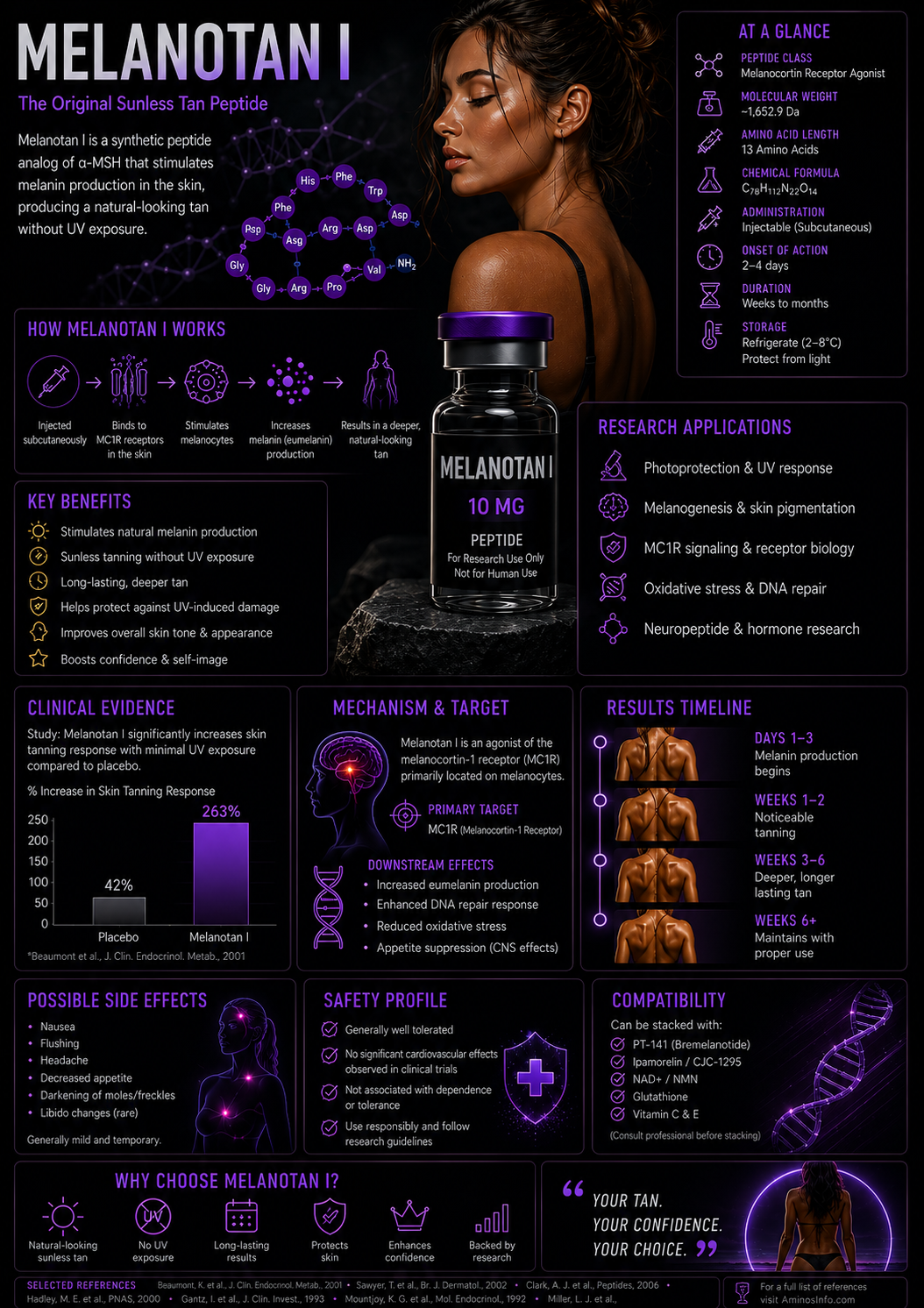
Moreover, Melanotan I is the historical name commonly used for [Nle4, D-Phe7]-α-MSH, a synthetic linear analog of the naturally occurring peptide α-melanocyte-stimulating hormone (α-MSH). The drug name afamelanotide refers to this active peptide when developed as a regulated pharmaceutical ingredient.
Next, afamelanotide activates the melanocortin 1 receptor (MC1R), especially on melanocytes. This increases production of eumelanin, the brown-black form of melanin associated with skin pigmentation and partial protection against light-induced cellular stress.
Importantly, the approved product SCENESSE® is a 16 mg controlled-release subcutaneous implant indicated in the United States to increase pain-free light exposure in adults with a history of phototoxic reactions from erythropoietic protoporphyria. The European Union has authorized it for adults with EPP since 2014.
Synthetic linear α-MSH analog
Melanocortin 1 receptor (MC1R)
SCENESSE® controlled-release implant
Increasing pain-free light exposure in adults with EPP
13 amino-acid residues
Pigmentation, photobiology, DNA repair, photosensitivity disorders
🧬 Molecular Structure
In addition, Afamelanotide is a linear, acetylated, C-terminally amidated 13-residue peptide modeled on human α-MSH. Two substitutions distinguish it from the endogenous hormone:
- Norleucine at position 4 First, replaces methionine, reducing susceptibility to oxidation.
- D-phenylalanine at position 7 Next, replaces L-phenylalanine, increasing resistance to enzymatic degradation and strengthening melanocortin activity.
By contrast, afamelanotide is not cyclized like Melanotan II. Its linear structure retains the full 13-residue α-MSH framework while improving chemical and biological stability.
🧪 Amino-Acid Sequence
Ac-Ser-Tyr-Ser-Nle-Glu-His-D-Phe-Arg-Trp-Gly-Lys-Pro-Val-NH₂
| Position | Residue | Structural relevance |
|---|---|---|
| N-terminus | Acetyl group | For example, Protects the N-terminus and mirrors α-MSH terminal modification. |
| 4 | Norleucine (Nle) | Meanwhile, Oxidation-resistant replacement for methionine. |
| 7 | D-phenylalanine (D-Phe) | Likewise, Improves proteolytic stability and receptor potency. |
| C-terminus | Amide (NH₂) | In addition, Protects the C-terminus and supports biological activity. |
⚛️ Molecular Weight and 🧫 Formula
| Free-base molecular formula | Moreover, C78H111N21O19 |
|---|---|
| Average molecular weight | Approximately 1,646.8 g/mol |
| Exact mass | Approximately 1,645.84 Da |
| Common scientific name | By contrast, [Nle4, D-Phe7]-α-MSH |
| Other names | For example, NDP-α-MSH, Melanotan I, afamelanotide |
Moreover, the acetate salt used in some pharmaceutical descriptions has a different formula and higher total molecular weight than the free peptide. COA results should identify which chemical form is being reported.
📅 Discovery Timeline
1950s–1960s: α-MSH biology emerges
First, researchers identified melanocyte-stimulating hormones as peptide products of the proopiomelanocortin pathway and established their role in pigmentation.
1980s: Researchers design stable α-MSH analogs
Next, medicinal chemists developed substitutions intended to increase the potency and duration of α-MSH. The Nle4 and D-Phe7 substitutions produced NDP-α-MSH, later known as Melanotan I or afamelanotide.
1990s: Human pigmentation studies
Then, early human studies showed that repeated subcutaneous administration could increase pigmentation for prolonged periods and supported further pharmacokinetic and photobiology research.
2000s: Photosensitivity-disorder development
Afterward, clinical development increasingly focused on EPP, a rare disorder in which protoporphyrin IX accumulation produces painful phototoxic reactions after light exposure.
2014: European authorization
However, In 2014, the European Commission authorized SCENESSE for adults with EPP.
October 8, 2019: U.S. approval
Finally, the FDA approved SCENESSE to increase pain-free light exposure in adult patients with a history of phototoxic reactions from EPP.
Present research direction
Meanwhile, afamelanotide remains an important clinical and research tool in EPP, pigmentation biology, MC1R signaling, photoprotection, DNA repair, and selected dermatologic disorders. Proposed uses outside approved labeling require separate clinical evidence and regulatory review.
📖 Research History
Importantly, the scientific importance of afamelanotide extends beyond visible tanning. α-MSH signaling regulates melanocyte differentiation, pigment synthesis, cellular stress responses, and aspects of DNA repair. Afamelanotide was designed to reproduce those signals more reliably than endogenous α-MSH, which is rapidly degraded.
Next, early clinical research assessed pigmentation and pharmacokinetics. Later work in EPP demonstrated that the peptide could improve patients’ ability to tolerate light. This benefit is clinically important because EPP phototoxicity is not a typical sunburn: affected patients may experience severe burning pain after exposure to visible light as well as sunlight.
Therefore, afamelanotide development helped establish MC1R as a viable therapeutic target. It also demonstrated why receptor selectivity, formulation, controlled release, medical supervision, and disease-specific clinical trials matter when translating a research peptide into an approved medicine.
🧠 Mechanism of Action
First, afamelanotide acts primarily as an agonist of MC1R, a G-protein-coupled receptor found on melanocytes. Receptor activation increases intracellular cyclic AMP and initiates transcriptional programs involved in eumelanin synthesis.
1. MC1R activation
Next, afamelanotide binds MC1R and stabilizes an active receptor state. MC1R couples mainly to the stimulatory G protein Gs.
2. cAMP production
Then, activated Gs stimulates adenylyl cyclase, increasing intracellular cyclic adenosine monophosphate (cAMP).
3. PKA and transcription-factor signaling
Afterward, cAMP activates protein kinase A (PKA), which supports CREB signaling and increases expression and activity of microphthalmia-associated transcription factor (MITF).
4. Melanogenic-enzyme expression
Moreover, MITF regulates tyrosinase, tyrosinase-related protein 1, and dopachrome tautomerase. These enzymes control key steps in melanin synthesis.
5. Eumelanin production and transfer
Finally, melanin is packaged into melanosomes and transferred to neighboring keratinocytes. Eumelanin absorbs and scatters light and may reduce oxidative and phototoxic stress, but it does not create complete immunity to ultraviolet injury.
6. Additional cellular effects
In addition, MC1R signaling has also been associated with anti-inflammatory signaling and enhanced cellular responses to UV-induced DNA damage. These effects remain mechanistically important but should not be translated into unsupported claims that afamelanotide prevents skin cancer in the general population.
🎯 Receptor Profile
| Receptor | Principal biology | Relevance to afamelanotide |
|---|---|---|
| MC1R | Meanwhile, Pigmentation, melanocyte signaling, stress responses | Likewise, Primary therapeutic target and dominant mechanism. |
| MC2R | ACTH-dependent adrenal steroidogenesis | In addition, Not a principal target; MC2R is uniquely ACTH-dependent. |
| MC3R | Moreover, Energy balance and central signaling | By contrast, Far less clinically prominent than with broad agonists such as MT-II. |
| MC4R | For example, Appetite, autonomic regulation, sexual signaling | Meanwhile, afamelanotide shows less prominent central activity than Melanotan II and primarily supports peripheral MC1R effects. |
| MC5R | Likewise, Exocrine and peripheral-tissue signaling | In addition, Not considered the primary basis of approved clinical effects. |
Potential Benefits and Research Areas
Approved benefit in EPP
For example, in adults with EPP, SCENESSE increases to increase pain-free light exposure. The benefit is related to increased eumelanin and possibly other MC1R-mediated protective responses. It is not described in the FDA label as a cure for EPP.
Pigmentation research
Moreover, researchers use afamelanotide to study melanocyte signaling, melanosome biology, eumelanin production, pigment distribution, and variation in response among different MC1R genotypes.
Photobiology and DNA-damage research
In addition, research investigates whether α-MSH analogs can reduce UV-induced oxidative stress, improve DNA-repair signaling, and provide additional protection in people at unusually high risk of phototoxic injury.
Other dermatologic research
Likewise, researchers have explored afamelanotide experimentally in conditions such as vitiligo and other pigmentary or photosensitivity disorders. These areas should be distinguished from its approved EPP indication.
Skin-cancer prevention research
However, mechanistic research suggests that MC1R activation and eumelanin may reduce certain forms of UV-related cellular damage. However, afamelanotide should not be described as an approved skin-cancer-prevention drug, and tanning should never be presented as a substitute for sunscreen, protective clothing, or medical surveillance.
Administration and Approved Formulation
Importantly, SCENESSE is a controlled-release 16 mg implant that a trained healthcare professional inserts subcutaneously by a trained healthcare professional. The approved labeling—not online peptide instructions—governs patient selection, administration intervals, contraindications, warnings, and monitoring.
By contrast, unregulated powders, vials, nasal products, or cosmetic injections marketed as “Melanotan I” are not automatically equivalent to the approved implant. Differences may include identity, salt form, concentration, excipients, release profile, sterility, and impurity burden.
Safety and Adverse Effects
First, the FDA label lists adverse reactions and monitoring requirements for the approved implant. Clinically relevant considerations include:
- First, Implant-site reactions and local discoloration
- Next, Nausea, headache, fatigue, dizziness, or upper-respiratory symptoms reported in clinical use
- Also, Generalized increase in pigmentation
- Moreover, Darkening of freckles and pre-existing nevi
- In addition, The need for periodic full-body skin examinations
However, long-term or cosmetic use of unapproved preparations cannot be assumed to share the safety profile of the regulated implant. Contamination, incorrect concentration, nonsterile manufacture, degradation, and substitution with another melanocortin peptide are additional risks.
🧪 Laboratory Testing Methods
First, no single test proves that a peptide product is correctly identified, pure, accurately filled, sterile, and free of contaminants. Therefore, a robust analytical program uses several complementary methods.
| Method | Purpose | What it does not prove by itself |
|---|---|---|
| RP-HPLC or UPLC | Moreover, Separates the primary peptide from detectable impurities and estimates chromatographic purity. | By contrast, Does not conclusively identify the main peak or establish vial content. |
| LC-MS / HRMS | For example, Confirms molecular mass and supports peptide identity. | Meanwhile, Does not establish sterility, endotoxin, or complete sequence fidelity. |
| Likewise, Peptide mapping / MS-MS | In addition, Provides stronger sequence confirmation and can identify modified fragments. | Moreover, Does not measure microbial safety. |
| Amino-acid analysis | By contrast, Evaluates amino-acid composition and can support quantitative assay. | For example, May not distinguish sequence order or stereochemistry without other methods. |
| Chiral analysis | Meanwhile, Helps verify the presence of D-Phe at the expected position or detect racemization. | Likewise, Does not establish total peptide content. |
| Water analysis | In addition, Karl Fischer testing measures residual moisture. | Therefore, Does not identify the peptide. |
| Residual-solvent testing | Likewise, Gas chromatography or other methods detect synthesis solvents. | Meanwhile, Does not establish peptide potency. |
| Elemental impurities | By contrast, ICP-MS measures lead, arsenic, cadmium, mercury, and other metals. | Finally, Does not establish sterility. |
| Bacterial endotoxins | Consequently, LAL or recombinant-factor testing detects pyrogenic endotoxin. | Also, A low result does not prove sterility. |
| Sterility testing | Instead, Assesses viable bacterial and fungal contamination under defined conditions. | For example, Does not verify identity or dose. |
| Moreover, Assay / net peptide content | In addition, Quantifies how much target peptide is present in a vial or bulk sample. | Therefore, do not infer it from HPLC area purity alone. |
📄 How to Interpret an Afamelanotide COA
1. Match the batch
First, the batch or lot number on the COA must match the tested material. A generic report for another production lot does not describe the current sample.
2. Confirm the named chemical form
Next, the report should clarify whether the result applies to afamelanotide free base, acetate salt, or another form. Molecular formula and mass values differ between these forms.
3. Separate identity, purity, and content
- Identity First, asks whether the target compound is afamelanotide.
- Purity Next, estimates the proportion of detected chromatographic material represented by the target peak.
- Assay or net peptide content Also, measures how much afamelanotide is actually present.
4. Review mass-spectrometry ions correctly
Moreover, large peptides commonly appear as multiply charged ions. A mass spectrum may display m/z values rather than the neutral molecular weight. The report should explain the charge state or provide a deconvoluted mass.
5. Look beyond “99% purity”
However, a high HPLC area percentage does not establish correct fill amount, sterility, endotoxin safety, absence of residual solvents, or correct stereochemistry.
6. Check laboratory information
Finally, a credible report should identify the laboratory, test dates, methods, sample identifiers, acceptance criteria, results, and authorized reviewer. Accreditation and method suitability strengthen confidence but do not replace batch matching and adequate sampling.
📊 Afamelanotide vs Melanotan II vs Bremelanotide
| Feature | Afamelanotide / MT-I | Melanotan II | Bremelanotide / PT-141 |
|---|---|---|---|
| Structure | However, Linear 13-residue α-MSH analog | Therefore, Cyclic shortened melanocortin peptide | Likewise, Cyclic melanocortin peptide related to MT-II |
| Primary clinical/research emphasis | Pigmentation and photoprotection | Meanwhile, Pigmentation plus central melanocortin effects | Sexual-desire signaling |
| Dominant receptor relevance | MC1R | By contrast, MC1R, MC3R, MC4R and others | Finally, Central melanocortin receptors, especially MC4R-related signaling |
| Appetite/libido effects | Consequently, Not the primary clinical effect | More prominent | Also, Sexual signaling is the therapeutic focus |
| FDA status | Instead, Approved as SCENESSE for adults with EPP | Not FDA approved | For example, Approved as Vyleesi for a specific indication |
Afamelanotide vs Natural α-MSH
| Property | Natural α-MSH | Afamelanotide |
|---|---|---|
| Sequence | 13-residue endogenous peptide | Moreover, 13-residue analog with Nle4 and D-Phe7 |
| Oxidation stability | In addition, Methionine is susceptible to oxidation | Norleucine improves stability |
| Protease resistance | Rapidly degraded | However, D-Phe substitution increases stability |
| Clinical formulation | Therefore, No equivalent controlled-release EPP implant | Likewise, Available as regulated SCENESSE implant |
🔗 Related Peptides and Compounds
- α-MSH: First, the endogenous POMC-derived peptide provides the basis for afamelanotide.
- Melanotan II: Next, A shorter cyclic melanocortin agonist with broader central effects.
- Bremelanotide (PT-141): Also, A related melanocortin agonist developed for sexual-desire signaling.
- Setmelanotide: Moreover, An MC4R agonist approved for selected rare genetic obesity disorders.
- ACTH: In addition, A POMC-derived peptide that activates MC2R and also interacts with other melanocortin receptors.
🖼️ Original Diagram Specifications
Diagram 1: Afamelanotide sequence map
Meanwhile, Create a horizontal 13-residue peptide diagram showing the acetylated N-terminus and amidated C-terminus. Highlight Nle at position 4 and D-Phe at position 7. Add callouts explaining oxidation resistance and protease resistance.
Diagram 2: MC1R melanogenesis pathway
By contrast, Illustrate an afamelanotide molecule binding MC1R on a melanocyte membrane, followed by Gs, adenylyl cyclase, cAMP, PKA, CREB/MITF, tyrosinase, melanosome production, and transfer to keratinocytes.
Diagram 3: EPP phototoxicity and treatment concept
Finally, Show protoporphyrin IX accumulation in superficial tissues, light exposure producing reactive oxygen species and pain, and increased eumelanin reducing the amount of damaging light reaching susceptible cells. Avoid implying complete protection or cure.
Diagram 4: MT-I, MT-II, and PT-141 comparison
Consequently, Use three columns comparing linear versus cyclic structure, receptor emphasis, principal effects, and regulatory status.
❓ Frequently Asked Questions
Is Melanotan I the same as afamelanotide?
The active peptide commonly called Melanotan I is [Nle4, D-Phe7]-α-MSH, which is the drug substance afamelanotide. However, SCENESSE is a specific regulated controlled-release implant and should not be equated with unregulated products using the Melanotan I name.
Is afamelanotide FDA approved?
Also, Yes. SCENESSE is FDA approved to increase pain-free light exposure in adult patients with a history of phototoxic reactions from EPP.
Does afamelanotide make skin darker?
Instead, It increases eumelanin production and can produce generalized pigmentation. Pigmentation is part of its mechanism, but the approved clinical purpose is improved light tolerance in EPP.
Does it protect against all UV damage?
For example, No. Increased eumelanin provides partial photoprotection, but it does not eliminate UV-induced DNA damage or replace sunscreen, protective clothing, shade, and medical skin surveillance.
Is afamelanotide approved for cosmetic tanning?
Moreover, No. The U.S. approval is for adults with EPP, not cosmetic tanning.
Does it affect libido like Melanotan II?
In addition, Central sexual and appetite effects are much less prominent with afamelanotide than with Melanotan II. Afamelanotide’s approved pharmacology is centered on MC1R-mediated pigmentation and photoprotection.
How do clinicians administer approved afamelanotide?
However, A trained healthcare professional inserts SCENESSE as a controlled-release subcutaneous implant.
What should an afamelanotide COA contain?
Therefore, At minimum, a meaningful analytical package should address batch-specific identity, chromatographic purity, assay or net peptide content, mass confirmation, endotoxin, sterility, elemental impurities, residual solvents, and relevant physical properties when the supplier claims sterile research suitability.
Does a 99% HPLC result mean the vial contains the labeled amount?
Likewise, No. HPLC area purity and net peptide content are different measurements. A product can show a dominant chromatographic peak while still containing less or more peptide than the label states.
Can afamelanotide prevent skin cancer?
Meanwhile, MC1R signaling, eumelanin, and DNA-repair pathways are scientifically relevant to skin-cancer biology, but afamelanotide is not approved as a general skin-cancer-prevention drug. Claims of prevention require disease-specific clinical evidence.
Afamelanotide Scientific Overview: Final Thoughts
In conclusion, Melanotan I, more precisely known as [Nle4, D-Phe7]-α-MSH or afamelanotide, is a stable linear analog of α-MSH designed to activate melanocortin signaling, particularly MC1R. Its most important validated use is not ordinary cosmetic tanning but regulated treatment of adults with EPP through the controlled-release SCENESSE implant.
Therefore, afamelanotide illustrates the difference between a research peptide and an approved medicine: sequence identity alone is not enough. Formulation, release characteristics, manufacturing controls, clinical evidence, trained administration, pharmacovigilance, and regulatory oversight all contribute to the benefit-risk profile of the approved product.
📚 References
Regulatory, Clinical, and Analytical Sources
- By contrast, U.S. Food and Drug Administration. SCENESSE (afamelanotide) implant prescribing information. Revised 2024.
- Finally, European Medicines Agency. Scenesse: European public assessment report.
- Consequently, European Medicines Agency. Scenesse product information.
- Also, National Center for Biotechnology Information. PubChem Compound Summary: Afamelanotide.
- Instead, KEGG. Afamelanotide drug entry D10511.
- For example, Kim ES. Afamelanotide: A Review in Erythropoietic Protoporphyria. Drugs. 2016.
- Moreover, Wensink D, et al. Afamelanotide for prevention of phototoxicity in erythropoietic protoporphyria. Expert Review of Clinical Pharmacology. 2021.
- In addition, Minder EI, et al. Pharmacokinetics and pharmacodynamics of afamelanotide and clinical implications. Clinical Pharmacokinetics. 2017.
- However, Minder EI, et al. Afamelanotide, an agonistic analog of α-melanocyte-stimulating hormone, in protoporphyria. 2010.
- Therefore, Fabrikant J, et al. A review and update on melanocyte-stimulating hormone therapy: afamelanotide. Journal of Drugs in Dermatology. 2013.
- Likewise, Polańska A, et al. Afamelanotide in protoporphyria and other skin diseases. 2024.
- Meanwhile, Langan EA, et al. Melanotropic peptides: more than just “Barbie drugs” and “sun-tan jabs”? British Journal of Dermatology. 2010.
- By contrast, Yardman-Frank JM, Fisher DE. Skin pigmentation and its control: from ultraviolet radiation to stem cells. Experimental Dermatology. 2021.
- Finally, Chang CL, et al. A gel-forming α-MSH analog promotes lasting pigmentation and photoprotection. 2023.
- Consequently, Cone RD, editor. The Melanocortin Receptors. Humana Press.
- Also, Mountjoy KG, Robbins LS, Mortrud MT, Cone RD. The cloning of a family of genes that encode the melanocortin receptors. Science. 1992.
- Instead, Gantz I, Fong TM. The melanocortin system. American Journal of Physiology-Endocrinology and Metabolism. 2003.
- For example, Slominski A, Tobin DJ, Shibahara S, Wortsman J. Melanin pigmentation in mammalian skin and its hormonal regulation. Physiological Reviews. 2004.
- Moreover, Lin JY, Fisher DE. Melanocyte biology and skin pigmentation. Nature. 2007.
- In addition, Yamaguchi Y, Hearing VJ. Physiological factors that regulate skin pigmentation. BioFactors. 2009.
- However, Levy C, Khaled M, Fisher DE. MITF: master regulator of melanocyte development and melanoma oncogene. Trends in Molecular Medicine. 2006.
- Therefore, Hearing VJ. Determination of melanin synthetic pathways. Journal of Investigative Dermatology. 2011.
- Likewise, Videira IFDS, Moura DFL, Magina S. Mechanisms regulating melanogenesis. Anais Brasileiros de Dermatologia. 2013.
- Meanwhile, International Council for Harmonisation. ICH Q2(R2): Validation of Analytical Procedures.
- By contrast, United States Pharmacopeia. General Chapter <621>, Chromatography.
- Finally, United States Pharmacopeia. General Chapter <71>, Sterility Tests.
- Consequently, United States Pharmacopeia. General Chapter <85>, Bacterial Endotoxins Test.
- Also, United States Pharmacopeia. General Chapters <232> and <233>, Elemental Impurities.
- Instead, International Council for Harmonisation. ICH Q3C: Impurities—Guideline for Residual Solvents.
- For example, International Council for Harmonisation. ICH Q6B: Specifications—Test Procedures and Acceptance Criteria for Biotechnological/Biological Products.
Mechanistic and Quality-Control Sources
Moreover, Reference links and regulatory status were reviewed for this article in July 2026. Readers should consult the latest prescribing information and regulatory documents before relying on time-sensitive details.