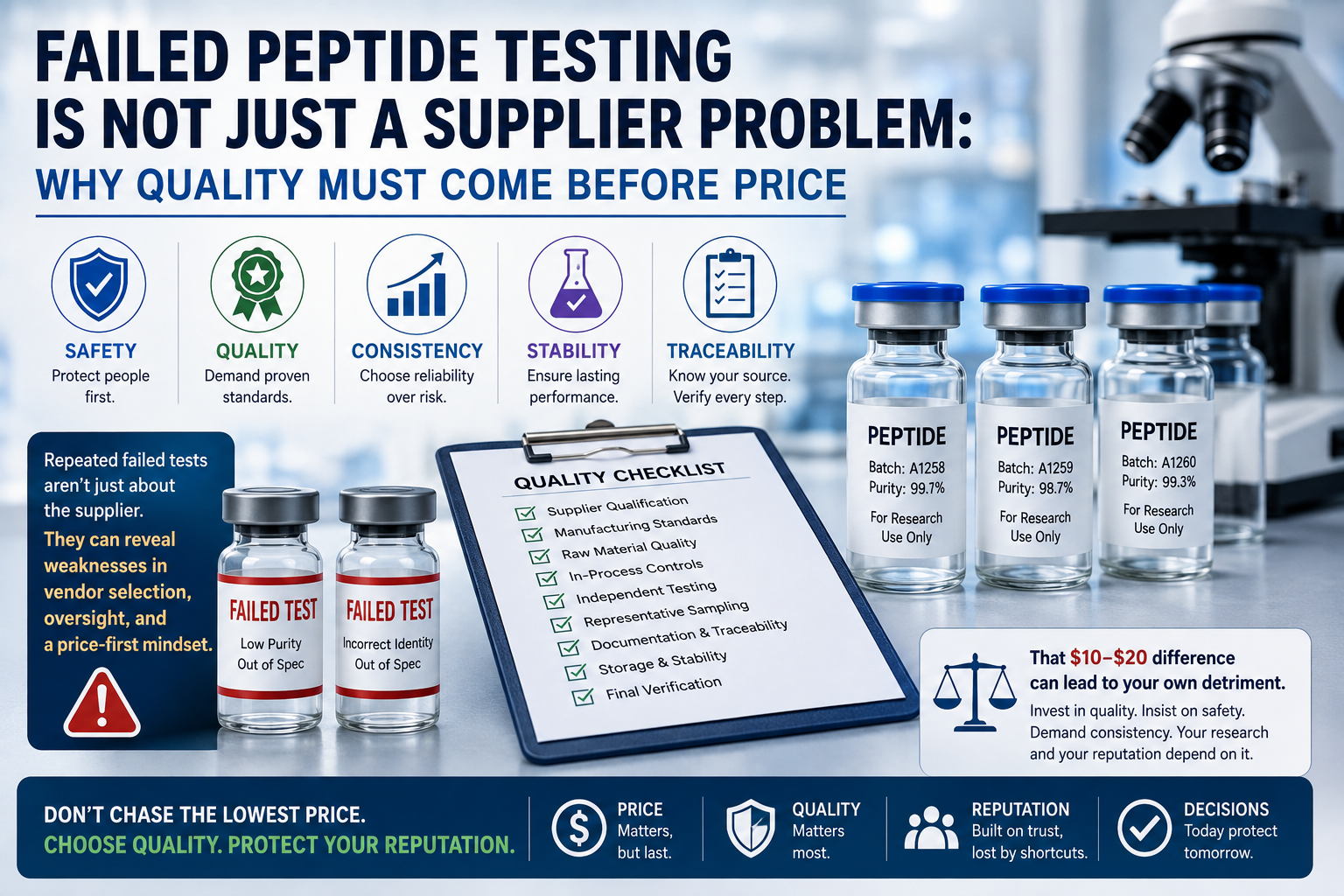
Failed Peptide Testing Is Not Just a Supplier Problem: Why Quality Must Come Before Price
Across the research-peptide market, companies increasingly publicize failed incoming tests from overseas suppliers as evidence of transparency. Rejecting material that does not meet specifications is important—but repeated failures can also reveal something uncomfortable about the company buying the material: Was the manufacturer properly qualified before the purchase was ever placed? This article explains why supplier vetting, manufacturing consistency, representative sampling, independent testing, traceability, stability, and long-term quality history matter more than saving another $10 or $20.
Article Contents
- The recent failed-testing discussion
- Transparency is good—but incomplete
- Testing cannot replace qualification
- Why “China” is not the real issue
- The race to the lowest price
- Why $10–$20 can be false savings
- Customers also drive the price race
- How manufacturers should be vetted
- Representative sampling matters
- COAs are only one layer
- Purity is not identity or content
- Consistency should be treated as an asset
- What a failed test should trigger
- The correct purchasing hierarchy
- What customers should examine
- What peptide companies should examine
- Frequently asked questions
- References
The Recent Conversation About Failed Peptide Testing Is Missing Half the Story
Across social-media groups, vendor pages, customer communities, and research-product discussions, it has become increasingly common to see peptide companies publicize incoming material that allegedly failed purity, identity, net-content, or other analytical testing. A typical post may say that a Chinese supplier failed, that several manufacturers were rejected, or that the company had to search through multiple sources before locating a batch that met its standards.
On the surface, those statements can sound reassuring. A company tested material. A result did not meet specification. The company rejected it instead of selling it. That is certainly preferable to knowingly releasing questionable inventory.
But repeated failures deserve a more sophisticated interpretation. Quality control is not merely the ability to identify bad material after purchasing it. A mature system is designed to reduce the probability of purchasing unreliable material in the first place.
Transparency Is Valuable—but Transparency Does Not Automatically Prove a Strong Quality System
Publicly acknowledging a failed test is better than hiding it. Companies should quarantine material that does not meet established specifications, investigate the discrepancy, document the outcome, and prevent failed material from entering released inventory.
However, transparency is not the same thing as prevention.
A company can be very transparent about failures and still have a weak supplier-selection program. Publishing a failed chromatogram does not answer how the supplier was selected, what qualification was performed before the order, how many previous batches were reviewed, whether the actual manufacturer was identified, what quality agreement existed, or whether purchasing decisions were driven primarily by price.
Otherwise, repeated “another supplier failed” announcements can unintentionally demonstrate that a company is excellent at finding problems after purchase while remaining poor at avoiding unreliable manufacturers before purchase.
Independent Testing Is Essential—but It Cannot Replace Supplier Qualification
Testing is an important verification layer. It helps determine whether sampled material appears to meet defined analytical specifications. But testing should sit inside a broader supplier-quality system.
ICH Q7, the internationally recognized Good Manufacturing Practice guide for active pharmaceutical ingredients, states that suppliers of critical materials should be evaluated, that materials should be purchased against agreed specifications from approved suppliers, and that supplier approval should consider evidence such as past quality history. ICH Q7 also states that samples should be representative of the batch and that sampling plans should consider material variability and the supplier's past quality history.
Those principles point to an important distinction:
| Reactive sourcing | Mature supplier qualification |
|---|---|
| Find a low quote. | Identify manufacturers capable of meeting defined specifications. |
| Buy a large quantity. | Qualify the manufacturer and build evidence before scaling purchases. |
| Test a small sample afterward. | Use representative incoming testing as verification of an already-qualified process. |
| Reject it if it fails. | Investigate every deviation and reassess supplier qualification. |
| Find another inexpensive supplier. | Prefer proven consistency over repeatedly resetting the supply chain. |
The goal is not to stop independent testing. The goal is to make testing confirm an established quality relationship rather than function as a repeated lottery ticket.
The Problem Is Not “Chinese Peptides.” The Problem Is Poorly Qualified Manufacturing
China has one of the largest pharmaceutical, chemical, biotechnology, and peptide-manufacturing ecosystems in the world. Within that enormous market are highly sophisticated manufacturers, specialized peptide facilities, contract manufacturers, exporters, brokers, trading companies, small synthesis operations, and businesses with dramatically different levels of quality control.
Therefore, “made in China” tells a purchaser very little about whether a particular lot will meet specification.
The same logic applies to domestic sourcing. A company should not automatically trust material because it was produced in the United States, South Korea, Europe, or anywhere else. Country of origin is not a substitute for documented performance.
The Race to the Lowest Price Can Create the Exact Quality Problems Companies Later Publicize
The research-peptide market has become intensely price-driven. A supplier offers a material at one price. Another offers it for $8 less. Another promises an additional discount at higher volume. Buyers send competing quotations back and forth and ask manufacturers to beat one another.
Competition is healthy. Efficient manufacturing can legitimately reduce costs. Greater production volume can lower unit pricing. Strong procurement can lower raw-material costs.
But relentless downward pressure eventually creates a basic question:
Price does not tell you which explanation is correct. That is why price should be evaluated only after a manufacturer has demonstrated that the required quality level can be produced consistently.
That $10–$20 Savings Can Become the Most Expensive Part of the Purchase
Peptide companies and customers can become fixated on small price differences. A product is $59 at one company and $45 at another, so the second option automatically appears to be the better value.
But a $10 or $20 difference is insignificant if the cheaper supply chain creates inconsistent quality.
For a business, the true cost of an unreliable batch may include:
Rejected material has already consumed purchasing capital and freight.
Investigations, confirmatory testing, and new sampling all add cost.
Rejected batches can delay restocks and disrupt inventory planning.
A failed batch must often be remanufactured or sourced elsewhere.
Delays and inconsistent product create tickets, refunds, and disputes.
Trust can be far more expensive to rebuild than inventory is to replace.
The cheapest vial can become the most expensive vial a company ever purchased.
Customers Also Help Create the Race to the Bottom
Vendors are not solely responsible for price-driven sourcing. Customers influence the market too.
Online discussions often reduce research-product comparison to one question: “Who has it cheapest?” A vendor offering the lowest price is praised, while a company charging $10 or $20 more is immediately accused of excessive markup—without examining whether the businesses have comparable testing programs, manufacturers, storage systems, batch sampling, quality staffing, packaging, or rejection rates.
That behavior sends a powerful signal to the market: price matters more than everything else.
If customers continually reward only the lowest number, companies will feel pressure to source lower, discount harder, cut margins further, and search for manufacturers willing to meet increasingly unrealistic price targets.
What Proper Manufacturer Qualification Should Examine Before Large Purchases
Supplier qualification does not mean asking a salesperson for a COA and receiving a factory photograph. It should create evidence that the organization supplying the material can repeatedly produce what the buyer has specified.
Depending on the material, purchasing volume, research context, and risk level, qualification can examine areas such as:
- ✓ Identity of the actual manufacturer rather than only the trading company
- ✓ Manufacturing history and specialization
- ✓ Peptide synthesis and purification capabilities
- ✓ Lyophilization capabilities and controls
- ✓ Analytical instrumentation and method capabilities
- ✓ Raw-material qualification procedures
- ✓ Batch and production documentation
- ✓ Deviation and out-of-specification procedures
- ✓ Change-control procedures
- ✓ Container-closure and packaging controls
- ✓ Shipping and temperature-management procedures where relevant
- ✓ Historical independent testing performance
- ✓ Responsiveness during quality investigations
- ✓ Evidence of consistent production across multiple lots
The larger and more important the purchase becomes, the less defensible it is to rely primarily on price, a salesperson’s promise, or a single supplier-generated certificate.
Testing Is Only as Informative as the Sampling Strategy Behind It
A certificate is not automatically representative of an entire production lot.
If a company purchases thousands of units and submits one convenient vial for testing, that result tells the company something important about the tested vial. It does not mathematically establish perfect uniformity throughout every unit in the batch.
ICH Q7 specifically states that samples should be representative of the batch and that sampling plans should consider factors such as material variability, supplier quality history, criticality, and the amount required for analysis.
Questions to ask about a sampling program
- How many units are sampled?
- How are the samples selected?
- Does the supplier choose the sample, or does the purchasing company?
- Are samples randomly selected from finished inventory?
- Are samples taken from different portions of production?
- Does sampling increase when a supplier is new or has a poor quality history?
- Are retain samples maintained?
- Can anomalous results be investigated with independently selected replacement samples?
A Manufacturer COA Is Useful—but It Should Not Be the Entire Quality Program
Certificates of analysis are important documents. They can provide batch identification, methods, specifications, results, manufacturing-release information, and analytical evidence.
But a supplier-issued COA is still information generated within the supplier’s own release system. A purchasing company should establish whether that documentation is reliable.
ICH Q7 states that the reliability of supplier certificates of analysis should be checked at appropriate intervals. FDA likewise urges compounders to know the quality of materials received from suppliers and to understand what testing those suppliers perform.
For research suppliers, independent third-party analysis can provide a valuable additional verification layer—especially for new suppliers, high-risk materials, major changes, or situations where historical reliability has not yet been established.
“99% Purity” Is Not the Same as Proving Identity, Net Content, or Overall Quality
One reason price discussions become distorted is that customers often compare products using one headline number: HPLC purity.
Purity is important. But a high chromatographic area percentage does not answer every quality question.
| Testing category | What it helps answer | What it does not establish alone |
|---|---|---|
| HPLC / UPLC purity | Relative chromatographic composition under the method used. | Exact identity, labeled quantity, sterility, endotoxin, or all contaminants. |
| Mass spectrometry | Whether measured mass is consistent with the stated molecule. | Exact net content or microbiological quality. |
| Net-content assay | How much target material is present. | Complete identity or purity profile by itself. |
| Elemental impurities | Presence and quantity of relevant elemental contaminants. | Peptide identity or content. |
| Endotoxin / microbiological tests | Specific microbiological quality attributes. | Chemical identity, purity, or peptide amount. |
| Stability studies | Whether quality attributes remain within specification over time under defined conditions. | The quality of unrelated batches or storage conditions. |
A company competing on quality should be able to explain why its testing program is designed the way it is—not simply point to the largest purity number on a certificate.
Consistency Should Be Treated as a Valuable Asset—not an Excuse to Switch for a Cheaper Quote
Imagine two manufacturing partners.
Manufacturer A has successfully produced dozens of consecutive batches meeting agreed specifications, responds quickly to investigations, communicates production changes, maintains consistent packaging, and has a long history of independent results matching internal documentation.
Manufacturer B offers a price that is 15% lower but has produced only one small sample order and has little verified history.
A purely price-driven purchasing system sees Manufacturer B as the obvious opportunity.
A quality-driven system recognizes that Manufacturer A has created something extremely valuable: predictability.
Consistent manufacturing reduces unexpected investigations.
Fewer rejected lots make restock planning more reliable.
Historical performance provides evidence beyond a single certificate.
Known manufacturers have established communication and corrective-action patterns.
Constantly abandoning proven manufacturing relationships to save a few dollars resets accumulated knowledge and introduces new uncertainty into the supply chain.
A Failed Test Should Trigger Root-Cause Analysis—not Just a Social-Media Post
When an incoming batch produces an unexpected result, blaming the manufacturer immediately may be premature. Out-of-specification or unexpected results can have multiple potential causes.
| Potential source | Questions to investigate |
|---|---|
| Manufacturing | Was the batch produced outside established process conditions? Was purification inadequate? Were raw materials or equipment implicated? |
| Sampling | Was the sample representative? Could a vial-selection problem explain the discrepancy? |
| Shipping / storage | Was the material exposed to heat, moisture, light, or another damaging condition? |
| Sample preparation | Was the analytical sample prepared correctly and completely? |
| Analytical method | Was the method suitable, validated or qualified for the material and measurement? |
| Laboratory execution | Could instrument, standard, calculation, integration, or execution errors have affected the result? |
A mature organization investigates before reaching a public conclusion. If the failure is confirmed as manufacturer-related, the next question is whether corrective action is credible and whether the manufacturer remains qualified.
If the same supplier repeatedly fails, continuing to purchase from it because the price is attractive becomes increasingly difficult to defend.
Price Should Be Near the Bottom of the Qualification Checklist—not at the Top
Price matters. A business cannot ignore cost, and customers cannot ignore budgets. But price should become decisive only after essential quality requirements are satisfied.
Can the organization demonstrate that the material is actually what it claims to be?
Does the material meet established chemical, physical, and other relevant specifications?
Can the manufacturer reproduce that quality from batch to batch?
Can the product be traced from manufacturer through batch testing, storage, and release?
Are storage conditions and shelf-life claims supported by appropriate evidence?
Does the manufacturer have a demonstrated performance history and credible corrective-action process?
Does the purchasing organization verify critical attributes through appropriate external or independent analysis?
Once competing suppliers meet the required quality standard, then compare cost and efficiency.
The market too often reverses this sequence. Price becomes the first qualification criterion and quality is investigated afterward. That is exactly how inexpensive purchasing can become expensive failure.
What Customers Should Ask Before Choosing a Research Peptide Company
Customers rarely have access to every internal supplier-quality document, but they can still look for signs that a company is built around more than low prices and social-media marketing.
- Are current lot-specific test reports available? Historical showcase certificates are not the same as documentation for current inventory.
- Does the vial batch match the report? A legitimate certificate is only useful if it is traceable to the material being sold.
- Does the company test more than purity? Identity, net content, and other quality attributes answer different questions.
- How many samples are tested? Ask whether sampling is representative rather than conveniently selected.
- Does the company maintain stable manufacturing relationships? Constant supplier switching can indicate price-driven procurement.
- Does the company discuss failed batches responsibly? Look for investigation and corrective action—not merely blame.
- Can reports be verified with the laboratory? Independent verification reduces the value of altered or mismatched documents.
- Does the company explain storage and stability? Quality does not end when manufacturing ends.
- Is the business transparent about its testing methodology? “Third-party tested” is a starting point, not a complete quality description.
- Does the company compete almost entirely on being cheapest? Price leadership is not automatically bad, but it deserves additional scrutiny when extensive quality controls are simultaneously claimed.
What Peptide Companies Should Learn From Repeated Failed Batches
Every failed batch should produce organizational learning. Otherwise, the company merely repeats the same purchasing cycle with a different manufacturer.
- Why was this manufacturer approved?
- What evidence supported the approval?
- Did we identify the actual manufacturing facility?
- Were specifications communicated clearly before production?
- Was the purchase disproportionately influenced by price?
- How many prior batches had been independently verified?
- Was our incoming sample representative?
- Did the supplier's original COA match independent results?
- Did the supplier provide a credible investigation?
- Was a corrective and preventive action established?
- Should the supplier remain approved?
- Does our purchasing policy need to change?
If the answer to every failed batch is simply “find another cheaper manufacturer and test again,” the system has not improved.
The FDA's Broader Message Is Simple: Know Your Supplier
Although research-peptide sellers operate in different regulatory contexts from pharmacies and registered drug manufacturers, established pharmaceutical quality principles still provide useful lessons about supply-chain risk.
FDA has specifically urged compounders to know their bulk-drug-substance and excipient suppliers, know the quality of the materials received, understand what testing suppliers perform, maintain supply-chain transparency, and clearly identify the original API manufacturer.
That principle is bigger than compounding:
Safety, Quality and Stability Should Be the Competition—not Who Can Go Cheapest
There will always be a market for competitive pricing. There is nothing wrong with companies negotiating better manufacturing costs, improving operational efficiency, or passing legitimate savings to customers.
The problem begins when the industry treats price as the definition of quality.
A better market would compete aggressively on:
Then, after those requirements are met, companies can compete on price.
That $10 or $20 difference should not be the deciding factor if the cheaper alternative introduces uncertainty into quality, consistency, safety, or stability.
Frequently Asked Questions
Is a company doing something wrong whenever a batch fails testing?
No. Even qualified manufacturers can experience deviations, and testing is specifically intended to detect unexpected problems. The concern increases when failures are frequent, corrective actions are ineffective, or the purchasing company repeatedly selects new unproven suppliers primarily because they offer lower prices.
Is publicly posting failed testing a bad thing?
No. Transparency can be valuable. But meaningful transparency should include what was investigated, whether the failure was confirmed, how the batch was controlled, what happened to the supplier's approval status, and what changed to reduce recurrence.
Does this mean Chinese peptide manufacturers should be avoided?
No. Manufacturing quality varies by company and facility, not simply by country. China contains both highly sophisticated manufacturers and lower-capability operations. The appropriate response is rigorous qualification of the specific manufacturer and continuous verification of performance.
Does a high price guarantee better peptide quality?
No. Expensive products can still be poorly sourced or inadequately tested. The point is not that expensive automatically means good. The point is that price alone—high or low—cannot establish quality. Verify the underlying controls.
Why might one reputable manufacturer cost more than another?
Possible reasons include raw-material quality, purification requirements, analytical testing, staffing, documentation, process controls, equipment, yield, rejection policies, packaging, quality oversight, or simply different commercial margins. Price alone cannot reveal which factors explain the difference.
Is one passing COA enough to qualify a manufacturer?
A single passing report is useful evidence but weak evidence of long-term consistency. ICH Q7 emphasizes supplier evaluation based on evidence such as past quality history and discusses full analysis of multiple batches before reducing in-house testing.
Why does representative sampling matter?
Because analytical testing characterizes the sample submitted. A sound sampling plan increases confidence that the tested material represents the larger batch rather than one unusually good or bad unit.
Should customers always choose the more expensive research supplier?
No. Customers should choose the supplier that can best demonstrate quality, testing, traceability, consistency, storage controls, and responsible operations at a reasonable price. A premium without evidence is just a premium.
Failed Peptide Testing: Final Guidance
Rejecting a failed batch is responsible. Publicizing the failure can also be responsible. But neither should distract from the deeper issue: quality begins before the purchase order.
A company that repeatedly buys material from manufacturers that cannot consistently meet specification should examine its own supplier-qualification system just as closely as it examines the supplier's laboratory results.
The lesson is not “do not buy from China.” The lesson is “do not buy from poorly qualified manufacturers merely because they are inexpensive.” The exact same standard should apply to manufacturers anywhere in the world.
Peptide companies need to stop treating manufacturers as interchangeable commodity sources. Customers need to stop treating research products as though the only meaningful difference is a $10 or $20 price gap.
Quality has a cost. Testing has a cost. Representative sampling has a cost. Proper storage has a cost. Rejected inventory has a cost. Maintaining experienced quality personnel has a cost. Working with consistent manufacturers can cost more than chasing whichever factory sends the lowest quotation this week.
That does not mean customers should blindly pay more. It means customers should demand evidence explaining what they are paying for.
Safety, quality, stability, consistency, testing, and traceability should come before price. The lowest number on a website should never be the industry's primary definition of value.
Authoritative References & Further Reading
- International Council for Harmonisation (ICH). Q7: Good Manufacturing Practice Guide for Active Pharmaceutical Ingredients. See particularly material management, supplier evaluation, certificate reliability, representative sampling, storage, rejected-material controls, and re-evaluation principles.
- International Council for Harmonisation. Quality Guidelines. Includes Q7 GMP, Q9 Quality Risk Management, Q10 Pharmaceutical Quality System, Q2 Analytical Validation, and related quality frameworks.
- U.S. Food and Drug Administration. FDA to Compounders: Know Your Bulks and Excipients Suppliers. FDA emphasizes knowing suppliers, understanding material quality and supplier testing, supply-chain transparency, and correct identification of original API manufacturers.
- U.S. Food and Drug Administration. Bulk Drug Substances Used in Compounding. Provides FDA background on bulk-substance quality requirements and supplier considerations.
- U.S. Food and Drug Administration. Understanding the Risks of Compounded Drugs. Summarizes current FDA quality and supply-chain risk resources.