Adamax Versions Comparison: 850, 984, and 1032 Da Explained
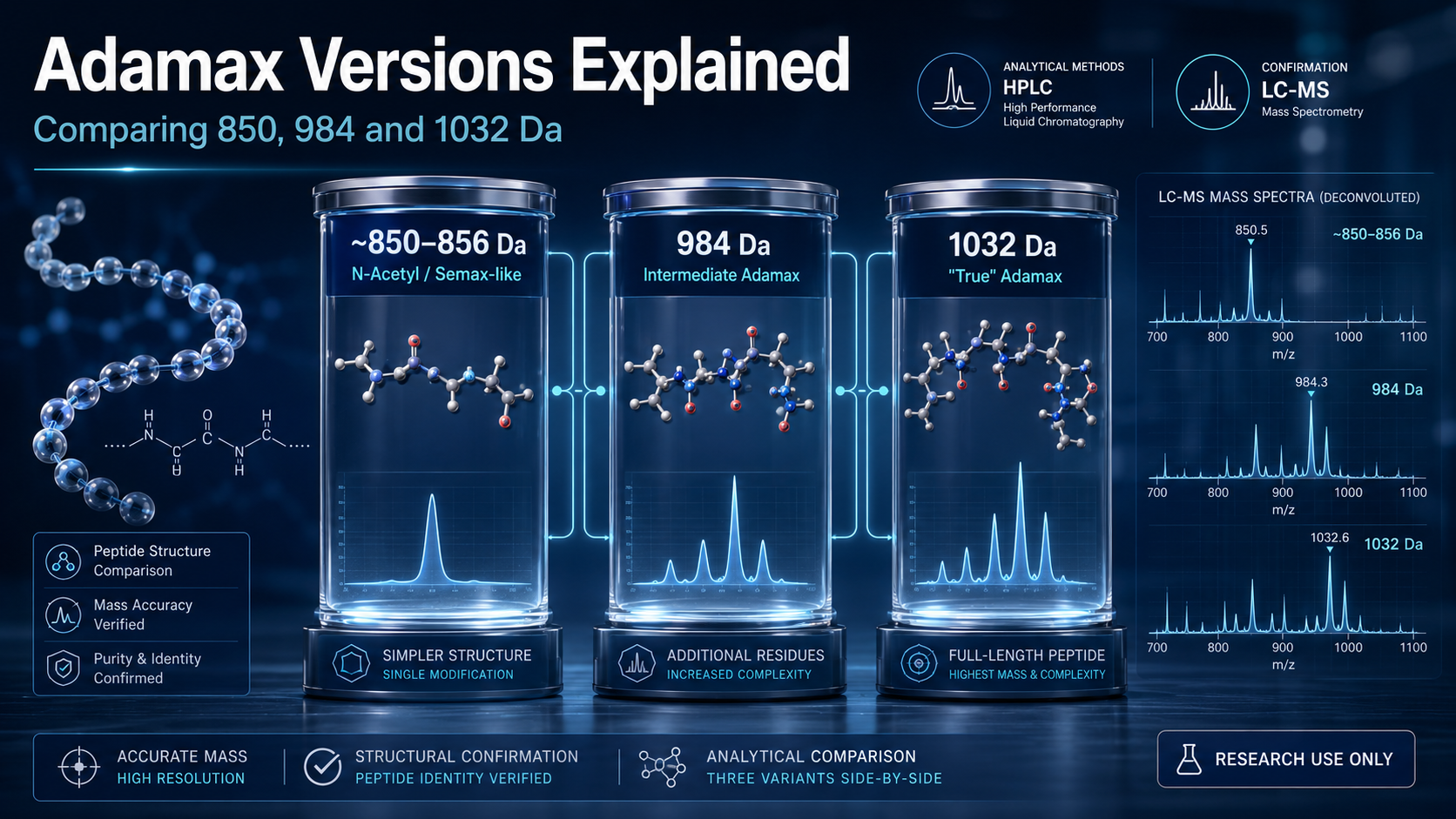
First, This Adamax versions comparison examines the three molecular-weight categories commonly discussed under the Adamax name: approximately 850–856 Da, 984 Da, and 1032 Da. It explains what each number may represent, why supplier terminology is inconsistent, how Adamax relates to Semax, and why mass spectrometry—not a product name alone—is required to establish identity.
Article Contents
Adamax Versions Comparison: Quick Reference
N-Acetyl or “850” Material
In addition, Most plausibly associated with an N-acetylated Semax-type peptide rather than an adamantane-bearing Adamax target. Unmodified Semax has a monoisotopic/average mass near the low 800s, while N-terminal acetylation adds approximately 42 Da.
984 Da Adamax
However, A supplier-reported Adamax category generally described as less extensively modified than the 1032 Da target. Its exact covalent structure cannot be inferred from the number alone and must be documented by the manufacturer and verified per lot.
1032 Da “True” Adamax
The designation many vendors use for the fully modified Adamax target. “True Adamax” is a commercial distinction rather than a recognized compendial name; therefore, an intact-mass match and preferably fragment-level confirmation remain essential.
What Is Adamax?
Likewise, Adamax is a nonstandardized research name used for a modified peptide concept related to Semax and, in many supplier descriptions, an adamantane-containing or adamantyl-modified derivative.
Semax itself is the heptapeptide Met-Glu-His-Phe-Pro-Gly-Pro, often written MEHFPGP. The published Semax literature includes studies of neurotrophin expression, BDNF/TrkB signaling, oxidative stress, metal binding and experimental neuroprotection. However, those findings belong to Semax. They should not automatically be transferred to Adamax, because changing an N-terminus, a C-terminus or adding a bulky lipophilic group can alter charge, conformation, solubility, receptor interactions, metabolism and analytical behavior.
Furthermore, the word Adamax is not controlled by the United States Pharmacopeia, European Pharmacopoeia or another widely recognized compendium. Different manufacturers may use the same name for materials with different terminal groups, linkers, counterions or molecular weights. Consequently, the name on a vial is only a starting claim. The definitive description should include a written structure, expected formula, theoretical mass, observed mass, chromatographic method and lot-specific raw data.
Version 1: Approximately 850–856 Da, Often Called N-Acetyl
The first category is often shortened to “850 Adamax.” Chemically, however, a mass in this region is much more consistent with an N-acetylated Semax-like peptide than with the higher-mass Adamax categories.
Why the number is often rounded to 850
Published databases place Semax around 813.9 Da by average molecular mass. Adding an acetyl group to the free N-terminal amino group produces a net mass increase of approximately 42.01 Da. A simple average-mass estimate therefore falls close to 855.9 Da. Depending on whether a supplier reports average neutral mass, monoisotopic mass, a rounded nominal value, an ion, a salt or an incorrectly transcribed specification, the material may be informally described as “850,” “855” or “856.”
What N-terminal acetylation changes
N-terminal acetylation caps the peptide’s free alpha-amino group. This removes a site that would otherwise carry charge under many conditions and can change metal coordination, enzymatic susceptibility, chromatographic retention and biological interactions. A Semax-specific study showed that N-terminal acetylation changed copper and zinc coordination as well as measured biological properties. Nevertheless, acetylation does not universally guarantee greater stability or a particular biological effect; the result is sequence- and assay-dependent.
Why “850 Adamax” can be misleading
However, If an 850–856 Da product contains only an acetylated Semax backbone and no adamantane-derived modification, calling it Adamax may blur a meaningful structural distinction. A responsible listing should state the actual sequence and terminal groups rather than relying on a brand-like name. At minimum, researchers should request the expected molecular formula and an intact-mass spectrum.
Version 2: 984 Da Adamax
Therefore, The second category is Adamax 984 Da. This is the corrected middle value and is commonly discussed as an intermediate, regular or less extensively modified Adamax form.
Unlike Semax, the 984 Da Adamax structure is not established in a major public compound database with one authoritative formula and sequence. Therefore, 984 Da should be treated as an analytical target associated with a supplier-defined structure—not as a complete structural description by itself.
What 984 Da may indicate
Importantly, In commercial discussions, 984 Da is often represented as a modified Semax-derived scaffold containing part of the chemistry associated with Adamax but lacking one or more features attributed to the 1032 Da version. Which feature is absent cannot be determined reliably from the mass difference alone. The difference could involve terminal capping, a linker, a particular adamantane-related substituent, counterion handling, an alternate synthetic building block or simply inconsistent reporting.
Why 984 Da is not automatically “fake”
First, A 984 Da target may be a legitimate, intentionally synthesized compound when the supplier clearly defines it and the analytical results match that definition. The problem arises when a 984 Da material is sold as chemically identical to a 1032 Da target without disclosure. Two materials separated by roughly 48 Da are not the same neutral molecular species merely because both are marketed under the same name.
What documentation should accompany 984 Da material
- ✓Next, Complete written structure or unambiguous sequence/modification notation
- ✓Moreover, Theoretical average and monoisotopic neutral masses
- ✓In addition, Expected principal ions and charge states
- ✓Observed deconvoluted intact mass
- ✓Therefore, LC-MS chromatogram linked to the same sample
- ✓Likewise, Lot number matching the vial and COA
- ✓However, Purity calculation with integration details
- ✓First, Explanation of salt, counterion and water content
Version 3: 1032 Da “True” Adamax
Next, The third category is the approximately 1032 Da Adamax target. Some suppliers call this “true Adamax,” “fully modified Adamax,” “N-acetyl Adamax amidate” or a similar phrase. These labels are not fully interchangeable unless the underlying structure is disclosed.
Why 1032 Da receives the “true” label
The “true” distinction is generally intended to communicate that the material contains the complete set of modifications expected by that supplier’s Adamax specification. In other words, the label distinguishes the 1032 Da target from lower-mass Semax-like or intermediate products. Nevertheless, the phrase remains a marketplace convention. It is not an official chemical name, and it does not replace structural evidence.
The 48 Da difference matters
In addition, A nominal 1032 Da compound is approximately 48 Da heavier than a nominal 984 Da compound. That gap is too large to dismiss as ordinary instrument error. Modern, properly calibrated high-resolution mass spectrometry should distinguish these targets easily. At the same time, a 48 Da difference does not uniquely identify a specific modification; multiple combinations of elemental changes can produce similar nominal shifts.
What “fully modified” should mean analytically
However, A strong identity package should do more than show one peak near an expected number. It should connect the proposed structure to the observed intact mass and, when practical, to diagnostic fragment ions. Orthogonal methods—such as amino-acid analysis, nuclear magnetic resonance for a small-molecule modifier, or targeted chemical assays—may provide additional confidence when a novel noncanonical group is involved.
Why Molecular Weight Alone Does Not Reveal the Full Structure
Therefore, A molecular mass is a powerful constraint, but it is not a complete molecular identity. Isomers, positional isomers and different modification sites may share the same elemental composition and exact mass. Conversely, the same core compound can appear under different reported values because of salts, adducts, isotopes, charge states or inconsistent calculation conventions.
| Reported result | What it may mean | Common mistake |
|---|---|---|
| Neutral mass | Importantly, Mass of the uncharged molecule after deconvolution | First, Comparing it directly with an m/z peak |
| [M+H]+ | Protonated singly charged ion | In addition, Calling the m/z value the neutral molecular weight |
| [M+2H]2+ | Therefore, Doubly protonated ion at roughly half the neutral m/z | Likewise, Assuming the compound has half the expected mass |
| Sodium adduct | First, [M+Na]+, roughly 22 Da above [M+H]+ | Therefore, Misidentifying an adduct as another product |
| Average mass | Abundance-weighted isotope average | However, Comparing it to a monoisotopic calculation without adjustment |
| Monoisotopic mass | Likewise, Mass using the lightest common isotope of each element | Importantly, Expecting an exact match to a rounded catalog value |
First, For Adamax versions, the COA should state exactly which convention is being used. A bare number such as “1032.24” without formula, ion notation, charge assignment or spectrum is incomplete.
HPLC vs Mass Spectrometry for Adamax Identity
What HPLC can establish
Reversed-phase HPLC separates components according to their interactions with the stationary phase and mobile phase. A dominant peak can support a high relative purity claim under the stated detection conditions. HPLC can also reveal multiple peaks, degradation products or major synthesis impurities.
What HPLC cannot establish by itself
Retention time is not a unique molecular fingerprint. Different compounds may co-elute or have similar retention. A clean chromatogram can therefore represent a highly pure wrong compound. This limitation is especially important when distinguishing 984 from 1032 Da material.
What MS contributes
Mass spectrometry measures mass-to-charge ratios. After charge-state assignment and deconvolution, intact-mass analysis can determine whether the major component is consistent with an 850–856, 984 or 1032 Da target. Tandem MS can then fragment the molecule and provide evidence for the peptide sequence and the location of modifications.
| Question | HPLC | Intact MS | MS/MS |
|---|---|---|---|
| However, Is the sample mostly one chromatographic component? | Strong | Limited for this question. | Limited for this question. |
| First, Is the principal component near 984 or 1032 Da? | Cannot establish identity alone. | Strong | Strong |
| However, Is the peptide backbone consistent with the proposed sequence? | Cannot establish identity alone. | Partial | Strong |
| Likewise, Where is a terminal modification located? | Cannot establish identity alone. | Usually cannot localize | Potentially strong |
| For example, What percentage does the main UV peak represent? | Strong under method conditions | Moreover, Not equivalent to UV area purity | Not a purity assay |
How to Evaluate an Adamax Certificate of Analysis
First, A credible COA should permit the receiving laboratory to connect the vial, sample, method and results. Decorative formatting is less important than traceability and raw analytical evidence.
- ✓In addition, Product name plus explicit structural notation
- ✓However, Unique batch or lot number
- ✓Manufacture or test date
- ✓Therefore, Expected formula and theoretical mass
- ✓Likewise, Observed intact mass with tolerance
- ✓Ion and charge-state assignments
- ✓For example, Raw or high-resolution mass spectrum
- ✓Moreover, HPLC chromatogram and integration table
- ✓Next, Column, mobile phases, gradient and detector wavelength
- ✓In addition, Reference standard or identity strategy
- ✓However, Testing laboratory and authorized reviewer
- ✓Clear pass/fail specifications
Red flags
- Therefore, The same generic spectrum appears on multiple unrelated lots.
- Likewise, The HPLC report lists purity but no identity test.
- Importantly, The COA says 1032 Da while the dominant deconvoluted mass is near 984 Da.
- First, The report supplies only a cropped peak image with no axis labels.
- Next, The lot number on the COA does not match the vial.
- Moreover, the product may be called “N-acetyl” without identifying which nitrogen carries the acetyl group.
- In addition, a report may present a sodium or potassium adduct as the neutral mass.
Common Adamax Labeling and Interpretation Errors
1. Treating 850, 984 and 1032 as potency grades
However, The numbers describe nominal molecular-mass categories, not strength, purity or potency. A higher molecular weight does not automatically mean a stronger or better product.
2. Calling every acetylated Semax derivative Adamax
Therefore, N-acetylation is one defined chemical change. Adamax descriptions commonly imply additional noncanonical chemistry. The terms should not be collapsed without structural documentation.
3. Calling 984 Da counterfeit solely because it is not 1032 Da
Likewise, A disclosed 984 Da compound may be a valid research target. The concern is substitution or ambiguous labeling, not the mere existence of a lower-mass version.
4. Assuming 1032 Da proves the modification site
Importantly, An intact mass near 1032 supports elemental consistency but may not locate the modification. Fragmentation or another orthogonal method is needed for stronger site-specific evidence.
5. Using HPLC purity as proof of molecular identity
First, A 99% area-purity result means the primary UV-detected component dominated that chromatographic method. It does not establish that the component was Adamax, nor whether it was the 984 or 1032 Da version.
Research Interpretation: What Can and Cannot Be Claimed
| Claim | Evidence status | Responsible wording |
|---|---|---|
| Therefore, Semax has published experimental literature. | Supported | In addition, Cite the specific Semax study and model. |
| However, Adamax has the same effects as Semax. | Not established | Likewise, Describe it only as structurally related or supplier-defined. |
| Importantly, Adamantane groups can alter lipophilicity and medicinal-chemistry behavior. | Likewise, Supported as a general principle | Next, Do not claim Adamax-specific pharmacokinetics without data. |
| Moreover, 1032 Da is universally recognized as the only authentic Adamax. | Not established | However, Call it a supplier or marketplace convention. |
| Therefore, MS can distinguish 984 from 1032 Da. | Supported | Importantly, Specify calibration, ion assignment and mass tolerance. |
Frequently Asked Questions About Adamax Versions
Identity, Mass, and Analytical Questions
Is the “850” version actually Adamax?
First, A material near 850–856 Da is more readily explained as an N-acetylated Semax-like peptide. It should not be assumed to contain the additional chemistry implied by Adamax unless the structure and mass spectrum demonstrate it.
Is Adamax 984 legitimate?
Next, It can be a legitimate supplier-defined research compound when the structure is disclosed and the observed mass matches the specification. It should not be represented as chemically identical to a 1032 Da target.
Why is 1032 Da called “true Adamax”?
Moreover, Some suppliers use that phrase for their fully modified target. The terminology is commercial, not pharmacopoeial. Analytical documentation is still required.
Can a 984 Da result be instrument error for a 1032 Da product?
In addition, Not ordinarily. A difference of about 48 Da is far beyond normal mass error for a properly calibrated instrument. Adducts, charge-state mistakes and deconvolution should be reviewed, but the discrepancy requires investigation.
Modification and Verification Questions
Does N-terminal acetylation add exactly 42 Da?
However, The net elemental change commonly corresponds to approximately 42.0106 Da in monoisotopic mass. Reported catalog values may differ because of average mass, rounding, salt forms or ion notation.
Does C-terminal amidation explain the entire 984-to-1032 difference?
Therefore, No. Converting a free C-terminal carboxyl group to an amide changes mass by roughly one dalton, not 48 Da. The complete structural difference must be specified rather than inferred from the names.
Is HPLC enough to identify true Adamax?
Likewise, No. HPLC is highly useful for purity and separation, but LC-MS or another suitable MS method is needed to verify the expected mass. MS/MS can provide stronger sequence and modification-site evidence.
What is the best single document to request from a supplier?
Importantly, Request the lot-specific LC-MS package containing the chromatogram, raw mass spectrum, deconvoluted neutral mass, theoretical structure/formula, expected ions and integration report.
Adamax Versions Comparison: Final Laboratory Guidance
In conclusion, the three commonly discussed Adamax versions should not be treated as interchangeable. First, the approximately 850–856 Da category is most consistent with N-acetylated Semax-like chemistry. Next, the 984 Da category represents a supplier-defined intermediate or less extensively modified Adamax target. Finally, the 1032 Da category is frequently marketed as fully modified or “true” Adamax, but that label is not an official chemical standard.
Therefore, researchers should evaluate each lot by its disclosed structure and analytical evidence. HPLC addresses chromatographic purity, whereas intact mass spectrometry distinguishes the major molecular-weight categories. When the location of a modification matters, tandem MS or another orthogonal identity method should be added.
Most importantly, claims derived from published Semax studies or general adamantane medicinal chemistry should not be presented as direct evidence for Adamax. Until compound-specific, peer-reviewed data and a standardized identity become available, transparent nomenclature and rigorous per-lot characterization are essential.
References and Further Reading
In addition, The literature directly specific to Adamax is extremely limited. Accordingly, these references cover Semax, N-terminal acetylation, peptide terminal modification, adamantane medicinal chemistry, peptide stability, HPLC and mass-spectrometric identity. They provide scientific context but do not validate unstudied Adamax-specific effects.
- For example, PubChem. Semax compound summary (CID 9811102).
- Therefore, Dolotov OV, et al. Semax regulates BDNF and TrkB expression in rat hippocampus. Brain Research. 2006.
- Likewise, Shadrina MI, et al. Neurotrophin gene expression in rat brain under Semax. Neuroscience Letters. 2007.
- Importantly, Shadrina M, et al. Temporal dynamics of NGF and BDNF gene expression under Semax. Journal of Molecular Neuroscience. 2010.
- First, Shadrina MI, et al. Rapid induction of neurotrophin mRNAs in rat glial cultures by Semax. Neuroscience Letters. 2001.
- Next, Levitskaya NG, et al. Neuroprotective effects of Semax in MPTP-induced lesions. Neuroscience and Behavioral Physiology. 2004.
- Moreover, Bashkatova VG, et al. Semax and nitric oxide generation in cerebral ischemia. Brain Research. 2001.
- In addition, Tabbì G, et al. Semax copper(II) binding and protection against metal-induced toxicity. Journal of Inorganic Biochemistry. 2015.
- However, Magrì A, et al. Influence of N-terminal acetylation of Semax on metal coordination and biological properties. Journal of Inorganic Biochemistry. 2016.
- Therefore, Myasoedov NF, et al. Semax: experience in design and study. Eksperimental'naia i Klinicheskaia Farmakologiia. 1997.
- Likewise, Semax and intracellular calcium dynamics in rat brain neurons. Bulletin of Experimental Biology and Medicine. 2025.
- Importantly, Semax and functional recovery after spinal cord injury in mice. British Journal of Pharmacology. 2025.
- First, ACTH4-10Pro8-Gly9-Pro10 and anti-inflammatory cytokine expression in spinal cord injury models. 2025.
- Next, Wanka L, Iqbal K, Schreiner PR. The lipophilic bullet hits the targets: medicinal chemistry of adamantane derivatives. Chemical Reviews. 2013.
- Moreover, Liu J, Obando D, Liao V, Lifa T, Codd R. The many faces of the adamantyl group in drug design. European Journal of Medicinal Chemistry. 2011.
- In addition, Lamoureux G, Artavia G. Use of the adamantane structure in medicinal chemistry. Current Medicinal Chemistry. 2010.
- However, Driessen HP, et al. The mechanism of N-terminal acetylation of proteins. CRC Critical Reviews in Biochemistry. 1985.
- Therefore, Hollebeke J, Van Damme P, Gevaert K. N-terminal acetylation and other functions of Nα-acetyltransferases. Biological Chemistry. 2012.
- Aksnes H, Drazic A, Marie M, Arnesen T. First things first: vital protein marks by N-terminal acetyltransferases. Trends in Biochemical Sciences. 2016.
- Importantly, Ree R, Varland S, Arnesen T. Spotlight on protein N-terminal acetylation. Experimental & Molecular Medicine. 2018.
- First, N-terminal acetylation can stabilize proteins independent of ubiquitination. 2023.
- Next, Brinckerhoff LH, et al. Terminal modifications inhibit proteolytic degradation of an immunogenic MART-1 peptide. International Journal of Cancer. 1999.
- Moreover, Nguyen LT, et al. Serum stabilities of short peptide analogs modified by end capping and cyclization. PLoS ONE. 2010.
- In addition, Werle M, Bernkop-Schnürch A. Strategies to improve plasma half life of peptide and protein drugs. Amino Acids. 2006.
- However, Fosgerau K, Hoffmann T. Peptide therapeutics: current status and future directions. Drug Discovery Today. 2015.
- Therefore, Lau JL, Dunn MK. Therapeutic peptides: historical perspectives, current development trends, and future directions. Bioorganic & Medicinal Chemistry. 2018.
- Likewise, Craik DJ, Fairlie DP, Liras S, Price D. The future of peptide-based drugs. Chemical Biology & Drug Design. 2013.
- Importantly, Vlieghe P, Lisowski V, Martinez J, Khrestchatisky M. Synthetic therapeutic peptides: science and market. Drug Discovery Today. 2010.
- First, Di L. Strategic approaches to optimizing peptide ADME properties. AAPS Journal. 2015.
- Next, Manning MC, et al. Stability of protein pharmaceuticals: an update. Pharmaceutical Research. 2010.
- Moreover, Wang W. Protein aggregation and its inhibition in biopharmaceutics. International Journal of Pharmaceutics. 2005.
- In addition, Wang W. Lyophilization and development of solid protein pharmaceuticals. International Journal of Pharmaceutics. 2000.
- However, Chang LL, Pikal MJ. Mechanisms of protein stabilization in the solid state. Journal of Pharmaceutical Sciences. 2009.
- Therefore, Chi EY, et al. Physical stability of proteins in aqueous solution. Pharmaceutical Research. 2003.
- Likewise, Mahler HC, Friess W, Grauschopf U, Kiese S. Protein aggregation: pathways, induction factors and analysis. Journal of Pharmaceutical Sciences. 2009.
- Importantly, Hermanson GT. Bioconjugate Techniques, 3rd ed. Academic Press. 2013.
- First, IUPAC. Compendium of Chemical Terminology: molecular mass and mass-to-charge ratio.
- Next, Gross JH. Mass Spectrometry: A Textbook, 3rd ed. Springer. 2017.
- Moreover, Domon B, Aebersold R. Mass spectrometry and protein analysis. Science. 2006.
- In addition, Steen H, Mann M. The ABC's of peptide sequencing. Nature Reviews Molecular Cell Biology. 2004.
- However, Aebersold R, Mann M. Mass-spectrometric exploration of proteome structure and function. Nature. 2016.
- Therefore, Niessen WMA. Liquid Chromatography–Mass Spectrometry, 3rd ed. CRC Press. 2006.
- Likewise, Snyder LR, Kirkland JJ, Dolan JW. Introduction to Modern Liquid Chromatography, 3rd ed. Wiley. 2010.
- Importantly, ICH Q2(R2). Validation of Analytical Procedures. International Council for Harmonisation.
- First, ICH Q6B. Specifications: Test Procedures and Acceptance Criteria for Biotechnological/Biological Products.
- Moreover, USP General Chapter <621>, Chromatography.
- In addition, USP General Chapter <736>, Mass Spectrometry.
- In addition, FDA. Analytical Procedures and Methods Validation for Drugs and Biologics: Guidance for Industry.
- However, FDA. Data Integrity and Compliance With Drug CGMP: Questions and Answers.
- However, NIST Chemistry WebBook. Adamantane reference data.
- Likewise, UniProt. Post-translational modification: N-terminal acetylation and C-terminal amidation resources.
- Importantly, ExPASy PeptideMass. Theoretical peptide mass calculation resource.
- First, Parker KC. Scoring methods in MALDI peptide mass fingerprinting. Journal of the American Society for Mass Spectrometry. 2002.
- Next, Keller BO, Sui J, Young AB, Whittal RM. Interferences and contaminants encountered in modern mass spectrometry. Analytica Chimica Acta. 2008.
- Moreover, European Medicines Agency. Guideline on bioanalytical method validation.