Social Media Health Claims: Research Before You Trust the Hype
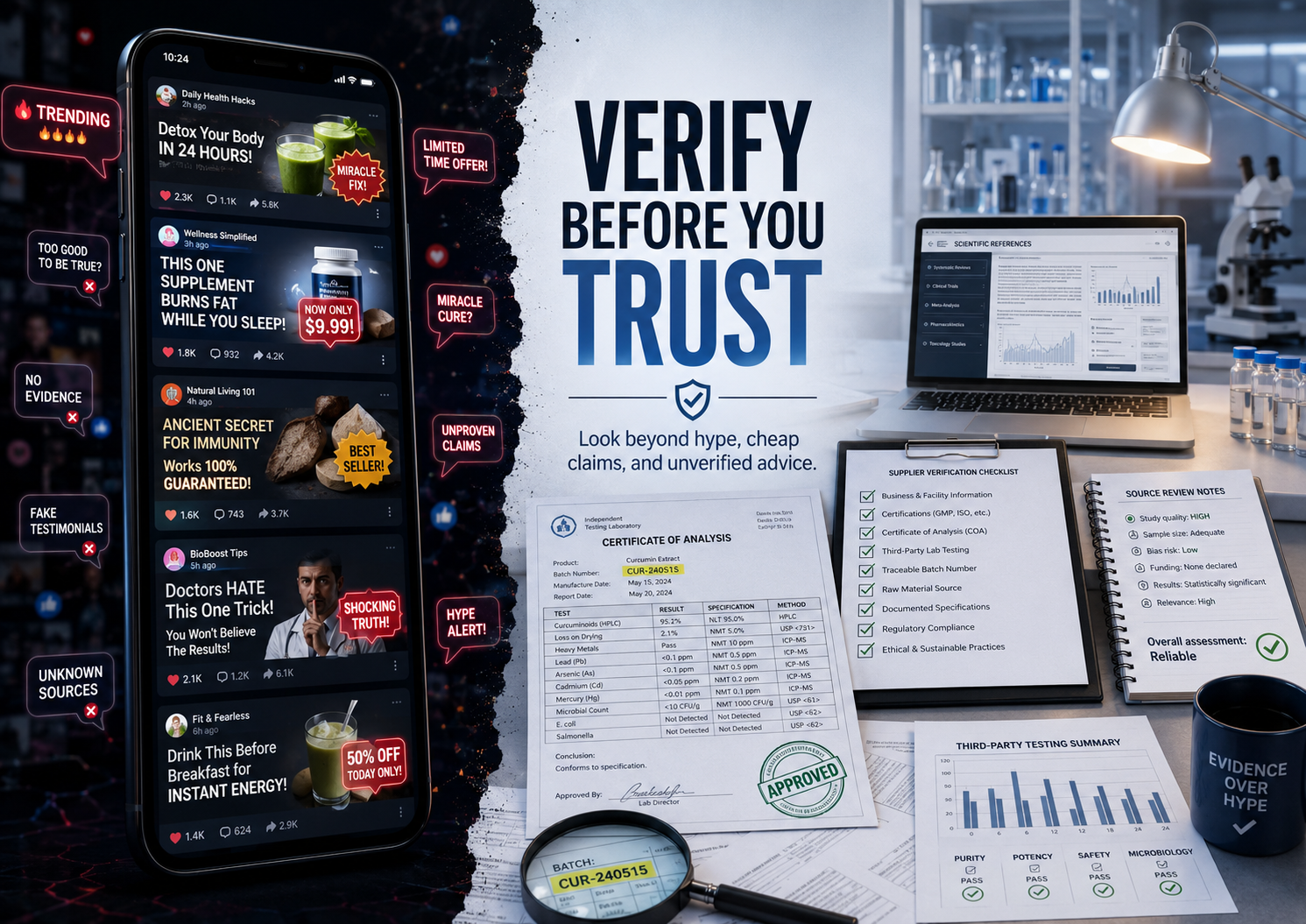
This detailed guide explains why social media health claims should never be accepted as automatic truth merely because a creator sounds confident, has a large following, reports a personal result, or repeats what many others are saying. It also explains how to evaluate research suppliers, testing claims, certificates of analysis, pricing, storage, cleanliness, and traceability before deciding that a company deserves trust.
Article Contents
- Social media is a starting point
- Good intentions are not proof
- Why experiments and testimonials mislead
- Repetition and algorithmic consensus
- Understanding evidence strength
- Choosing a reputable research supplier
- Cheap-price and gray-market warnings
- Facilities, cleanliness, and climate control
- How to evaluate COAs
- Testing breadth and proof
- Practical verification workflow
- Frequently asked questions
Social Media Should Introduce a Question—not Settle It
Social media can expose people to useful ideas, emerging research, patient experiences, and questions they had never considered. However, the platform does not validate the content. A post can be sincere, polished, widely shared, and still be incomplete or wrong.
MedlinePlus recommends asking where health information comes from, why it exists, whether anyone funds it, whether sources are provided, whether it is current, and whether other reliable sources agree. It also advises discussing consequential information with a healthcare provider before relying on it. MedlinePlus: Evaluating Health Information
People Can Mean Well and Still Be Incorrect
Many creators genuinely believe they are helping. They may have experienced a difficult illness, tried something, noticed an improvement, and shared the experience. Their account may be honest. Nevertheless, an honest account does not establish the cause of the outcome.
The person may not recognize natural symptom fluctuation, spontaneous improvement, placebo effects, regression toward the average, concurrent medication, sleep changes, dietary changes, laboratory variability, or a product that differed from what its label claimed.
Other creators simply repeat information from private groups, podcasts, vendor pages, or other influencers. Repetition can make a claim feel established even when everyone is citing another person rather than primary evidence.
Personal Experimentation Is Not a Controlled Study
Self-experimentation may generate observations, but it cannot reliably determine efficacy, causation, frequency, appropriate use, long-term risk, or whether another person will experience the same result. The experiment usually lacks blinding, controls, standardized products, objective endpoints, and systematic adverse-event collection.
| Online statement | What it establishes | What remains unknown |
|---|---|---|
| “I took it and felt better.” | The person reports improvement after an exposure. | Causation, product identity, dose accuracy, placebo effects, and generalizability. |
| “Everyone in my group uses it.” | The practice is popular in that group. | Safety, effectiveness, selection bias, and unreported failures. |
| “My bloodwork improved.” | A result changed over time. | Whether the intervention caused it, whether the test was repeated, and whether the change is clinically meaningful. |
| “This company has never had a complaint.” | A marketing or personal claim was made. | Complaint records, batch testing, fulfillment history, and independent verification. |
Repetition, Popularity, and Algorithms Can Create False Consensus
Algorithms reward attention. Dramatic transformations, certainty, controversy, urgency, fear, and extremely simple explanations often spread faster than cautious, qualified analysis. Therefore, visibility measures engagement rather than truth.
After a person watches or interacts with related content, a platform may show many similar posts. This can create an illusion that independent experts agree, even when the accounts are repeating the same unsupported claim or promoting the same commercial source.
The National Center for Complementary and Integrative Health recommends checking the sponsor, the original source, the poster’s expertise, the scientific support, the date, and whether the account is selling something. NCCIH: Evaluating Social Media Health Information
Not All Evidence Has Equal Strength
A cell study, animal experiment, testimonial, observational study, randomized trial, and systematic review answer different questions. A finding in one category cannot automatically support a much broader conclusion.
| Evidence type | Useful for | Cannot prove alone |
|---|---|---|
| Testimonial | Generating questions and understanding one person’s experience. | Causation, safety rate, or effectiveness in others. |
| Cell study | Mechanistic effects under laboratory conditions. | Safe or effective human use. |
| Animal study | Mechanism, toxicity signals, and model-specific outcomes. | Reliable human benefit at comparable exposure. |
| Observational study | Associations in real populations. | That the exposure caused the outcome. |
| Randomized trial | Comparative effects under defined conditions. | Universal effectiveness beyond the studied population. |
| Systematic review or guideline | Structured evaluation of multiple studies. | Certainty when the underlying research is weak or inconsistent. |
Do Not Trust a Research Company Because It Is Loud, Popular, or Cheap
A company that spends most of its public messaging attacking the “gray market,” boasting that it has the lowest prices, or presenting itself as the only honest seller has not automatically demonstrated quality. Marketing language is not laboratory evidence.
Similarly, a seller should not earn trust merely because its owner appears frequently on social media, answers questions confidently, or claims personal experience with the products. The relevant questions concern identity, traceability, testing, handling, facilities, records, and whether the company can prove its statements batch by batch.
Extremely Low Prices Should Trigger Questions About Where Costs Were Removed
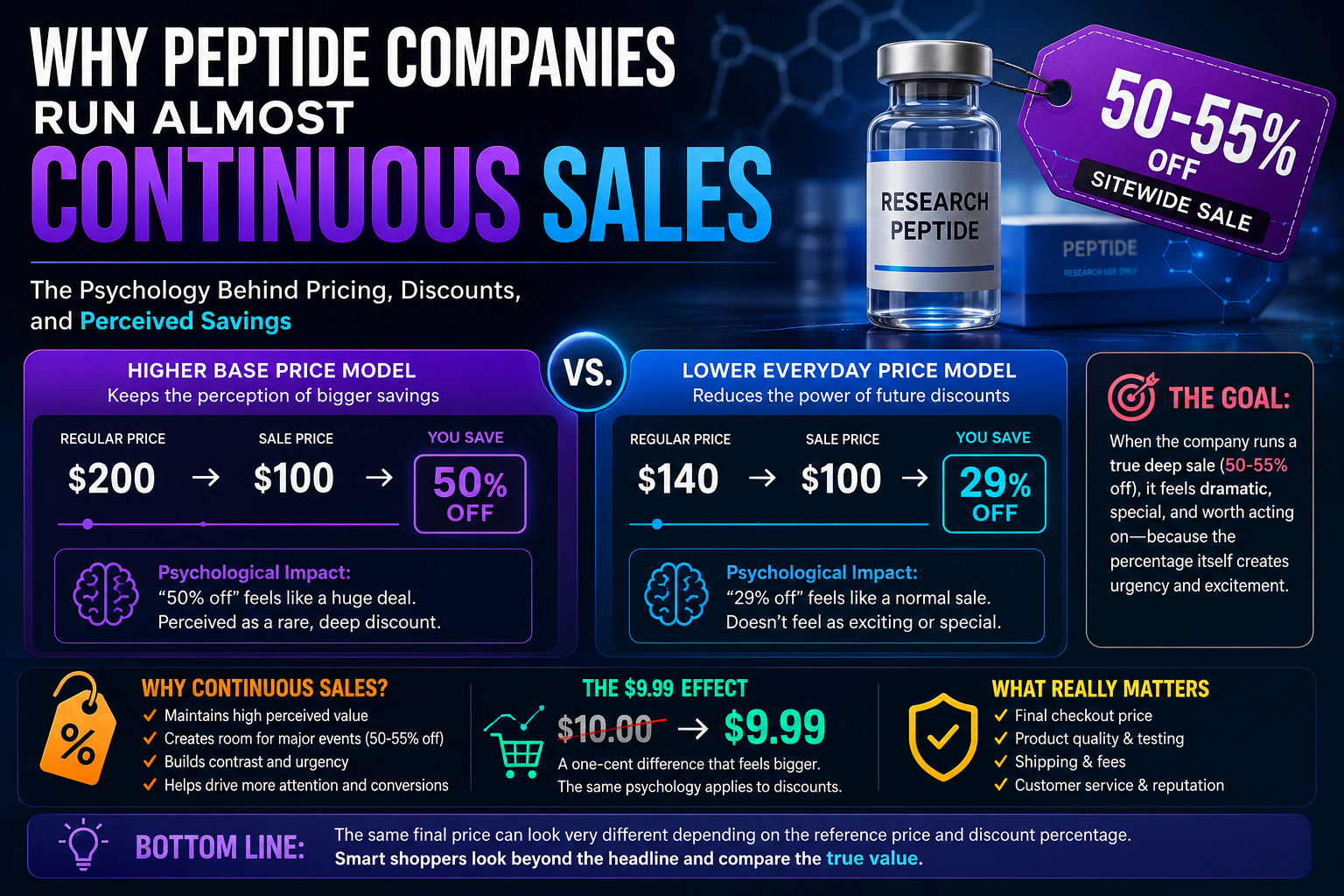
Low price alone does not prove that a product is poor, and a high price does not prove that it is good. Nevertheless, unusually low pricing is a legitimate risk signal when the product should require controlled manufacturing, specialized testing, cold or climate-managed storage, secure packaging, trained labor, quality records, and repeated batch verification.
Every seller has costs. When a price is far below the rest of the market, determine whether the company reduced testing, used only supplier paperwork, skipped net-content verification, accepted low-cost fulfillment conditions, minimized customer support, omitted contamination screening, or relied on inconsistent raw material.
Questions a low-price claim should answer
- How many independent tests does the company perform per batch?
- Does the company test one sample or multiple vials from different positions in the batch?
- Are identity, purity, and net content tested separately?
- Are microbial, endotoxin, elemental impurity, residual solvent, or route-relevant tests performed?
- Who paid for the COA, and is the laboratory independent of the manufacturer?
- Does the batch number on the vial match the report?
- Can the company show historical reports across many products and batches—not just a few showcase certificates?
- What storage, temperature, humidity, access-control, and inventory procedures protect the material?
Seller Age Is Not the Issue—Uncontrolled Facilities and Poor Handling Are
A responsible evaluation should not assume that a seller is unqualified because the owner is young. Age does not establish cleanliness, competence, or dishonesty. The real issue is whether products are stored, labeled, packed, and handled in a controlled professional environment.
A polished website can conceal an operation run from a bedroom, garage, spare room, or other environment without documented sanitation, pest control, climate monitoring, restricted access, inventory segregation, or reliable temperature and humidity control. Conversely, a small operation can maintain strong controls if it documents and follows them.
Facility and handling evidence worth requesting
Temperature and humidity monitoring with alerts and retained logs.
Written cleaning schedules, controlled work surfaces, and contamination prevention.
Clear separation of batches, quarantined material, returns, samples, and released stock.
Restricted handling rather than open household access.
Records connecting supplier lot, receiving date, internal batch, testing, storage, and shipment.
Staff procedures for labeling, packing, deviations, damage, and temperature excursions.
A COA Is Evidence Only When It Is Authentic, Relevant, and Traceable
The words “third-party tested” and “COA available” are not enough. A certificate can be outdated, copied, altered, matched to the wrong lot, supplied by the manufacturer, based on a single sample, or limited to one narrow measurement.
Claims that a company uses “Chinese COAs” should also be evaluated carefully. A laboratory’s country does not by itself determine validity. Overseas laboratories can produce legitimate analytical work, and domestic laboratories can produce weak or incomplete reports. The decisive factors are independence, competence, method suitability, raw-data traceability, accreditation where relevant, sample custody, and batch matching.
COA authenticity and quality checklist
- ✓Laboratory name, address, contact details, and authorized reviewer
- ✓Unique report number and test date
- ✓Exact product and batch or lot identifier
- ✓Sample receipt, testing, and reporting dates
- ✓Method names, instruments, acceptance criteria, and results
- ✓Chromatograms, spectra, integration tables, or supporting raw-data summaries
- ✓Clear distinction among identity, purity, and net content
- ✓Verification method for confirming the report with the laboratory
Trust Companies That Can Demonstrate a Consistent Testing Program—not Just Display a Few Certificates
A reputable supplier should be able to show a testing history across many products, batches, and dates. A few selected certificates do not prove that every product is tested or that the testing program is consistent.
The strongest programs use multiple complementary methods because one test cannot answer every question. HPLC area purity does not establish sequence identity or labeled content. Mass spectrometry does not by itself establish sterility, endotoxin, or exact net amount. A complete quality program matches methods to the material and intended research context.
| Testing category | Question answered | Common limitation |
|---|---|---|
| HPLC or UPLC | How many chromatographic components appear, and what proportion is the main peak? | A pure wrong compound can still produce a dominant peak. |
| LC-MS or HRMS | Is the principal mass consistent with the stated compound? | Mass alone may not distinguish sequence or positional isomers. |
| MS/MS or sequence analysis | Does fragmentation support the proposed sequence and modification sites? | Requires validated interpretation and suitable coverage. |
| Net-content assay | How much target material is actually present? | Cannot be inferred from HPLC area purity. |
| Microbial, sterility, or endotoxin testing | Does the sample meet relevant microbiological specifications? | Requirements differ by material and intended laboratory use. |
| Elemental impurities and residual solvents | Are manufacturing contaminants within defined limits? | Does not establish biological identity or potency. |
| Stability testing | How does the material change under actual packaging and storage conditions? | A one-time release test does not establish shelf life. |
A Practical Research and Supplier Verification Workflow
- Write down the exact claim. Separate evidence from marketing language.
- Find the original source. Do not rely on screenshots, reaction videos, or repeated hearsay.
- Check relevant credentials. Confirm whether the person has expertise in the topic being discussed.
- Inspect the evidence type. Determine whether the claim comes from a testimonial, cell study, animal model, clinical study, or review.
- Verify the exact product. Similar names, formulations, salts, analogs, and routes may not be equivalent.
- Review the company’s full testing history. Look for many lot-specific reports rather than a few selected examples.
- Confirm COAs independently. Contact the laboratory or use its report-verification system.
- Examine facility and handling controls. Ask how temperature, humidity, sanitation, access, inventory, and shipping are managed.
- Check pricing against the promised controls. Ask how the company funds extensive testing and controlled operations at its advertised price.
- Look for independent agreement. Compare government, academic, professional, and peer-reviewed sources.
- Do not let urgency replace verification. Flash sales, fear, scarcity, and “everyone is switching” claims are not evidence.
Frequently Asked Questions
Does a low price prove that a company is cutting corners?
No. Price alone does not prove quality or misconduct. However, an unusually low price should prompt questions about testing, sourcing, storage, staffing, fulfillment, and which quality controls were reduced or omitted.
Is an overseas COA automatically invalid?
No. Country of origin does not determine validity. Evaluate laboratory competence, independence, traceability, methods, raw data, sample custody, report verification, and lot matching.
Does a 99% HPLC result prove the product is correct?
No. It may show that one chromatographic component dominates under that method. It does not independently prove sequence identity, net content, sterility, endotoxin status, or correct labeling.
Should I trust a company that posts many social-media videos?
Video activity may show accessibility or marketing effort, but it does not establish quality. Evaluate testing, traceability, facilities, handling, documentation, and whether claims withstand independent verification.
How many COAs should a trustworthy company have?
There is no universal number. A company claiming broad and repeated testing should be able to demonstrate a consistent archive across products, lots, and dates. The documentation should match current inventory rather than showcase only a few historical reports.
Social Media Health Claims: Final Guidance
In conclusion, social media health claims should not receive automatic credibility because they are repeated, popular, confidently delivered, or tied to an appealing personal story. People can mean well and still misunderstand evidence. Companies can speak constantly about industry problems while failing to demonstrate their own controls.
Therefore, do your research. Look beyond social-media hype, unusually low prices, accusations about competitors, and vague claims of testing. Find a reputable company that can prove its practices through extensive lot-specific testing, legitimate and verifiable COAs, controlled handling, traceable inventory, appropriate storage, and a consistent record—not merely a few selected reports.
Most importantly, judge evidence by its quality and relevance. Judge suppliers by what they can document. Trust should be earned through transparency, verification, repeatable systems, and honest acknowledgment of limitations.
Authoritative References and Further Reading
- MedlinePlus. Evaluating Health Information.
- NCCIH. How to Know Whether Health Information on Social Media Is Accurate.
- NCCIH. Five Questions to Ask About Social Media Health Information.
- FDA. Health Fraud Scams.
- FDA. Six Warning Signs of Health Fraud.
- PubMed biomedical literature database.
- ClinicalTrials.gov study registry.
- International Council for Harmonisation. ICH Q2(R2): Validation of Analytical Procedures.
- United States Pharmacopeia. General Chapter <621>, Chromatography.