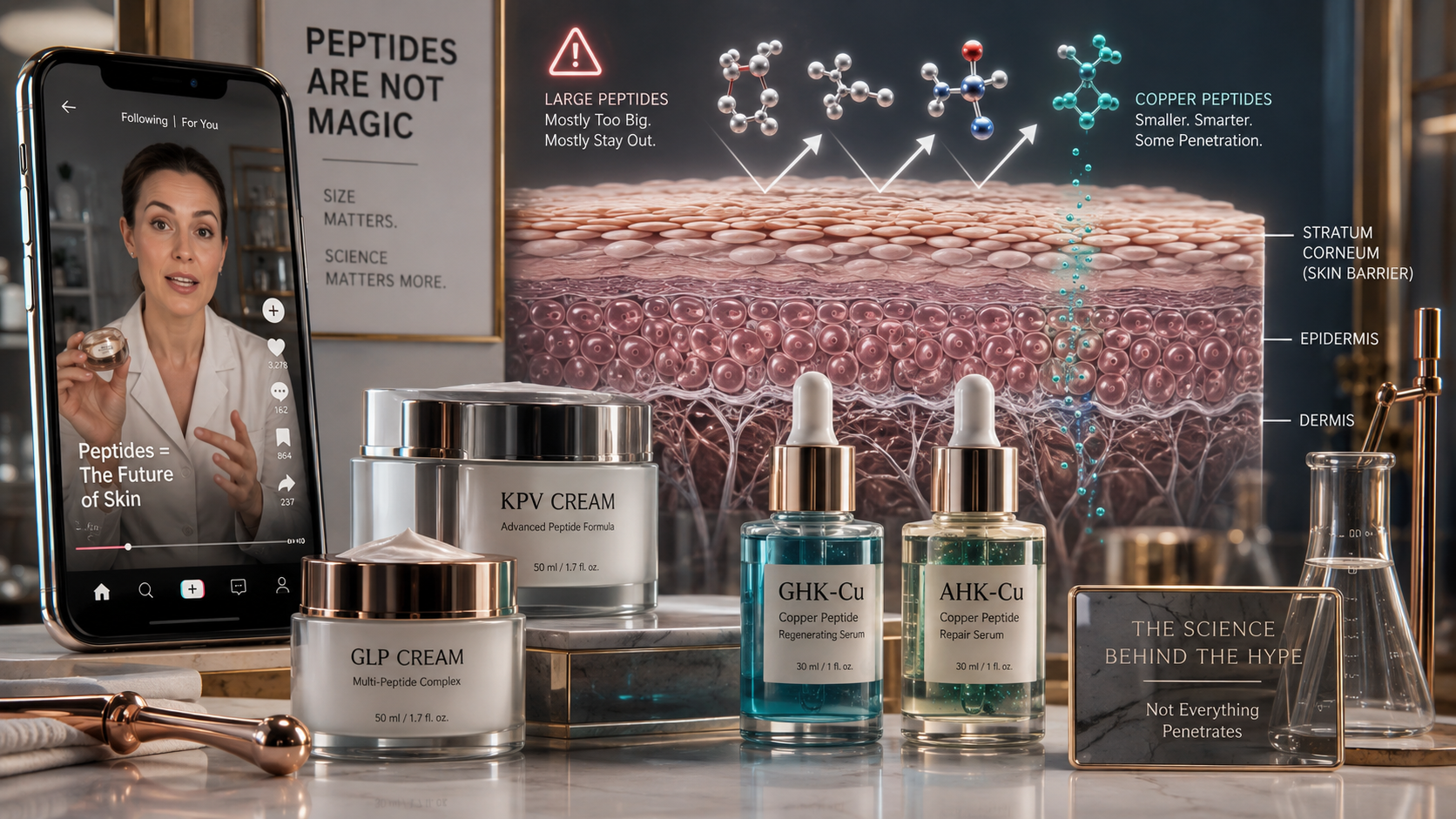
The Peptide Skin-Care Game Is Already Getting Out of Control
A white coat, a viral video, and a biologically interesting molecule do not turn an ordinary jar of cream into a validated drug-delivery system. GLP-1 body creams, KPV creams, and even legitimate copper peptides must all answer the same question: does the finished formula deliver intact peptide to the right layer of skin at a meaningful concentration?
Size is only the first gate. Charge, polarity, stability, vehicle release, skin condition, exposure time, target depth, and intact-peptide measurement determine whether a topical claim survives scientific scrutiny.
Article contents
KEYA peptide can be biologically impressive and still be a poor cream ingredient.
The central mistake in viral peptide skin-care marketing is the assumption that known activity of the isolated molecule proves meaningful activity of a finished topical product. It does not. Between those two ideas sit the stratum corneum, ionization, lipophilicity, enzymatic stability, vehicle partitioning, dose, exposure time, target depth, and finished-product clinical evidence.
01The peptide skin-care gold rush is built on a mechanism-to-product fallacy
Peptides are ideal social-media ingredients. Their names sound technical. Their signaling pathways can be illustrated with dramatic molecular graphics. A paper may show reduced inflammatory markers in cells, increased fibroblast activity, or improved hair-follicle growth in an isolated tissue model. A presenter can then leap directly from that result to a jar of cream and say, in effect, “this peptide does this, therefore this cream does this.”
That leap is the problem. A mechanistic paper usually answers a question such as: What happens when a defined concentration of peptide is placed directly onto cells, injected into tissue, added to culture medium, or delivered through an experimental device? A consumer cream must answer several additional questions:
- ◇Is the claimed peptide actually present, correctly identified, and intact in the finished product?
- ◇Does it remain stable through manufacturing, shipping, storage, oxygen exposure, light, pH changes, preservatives, and repeated opening?
- ◇Can it leave the vehicle and partition into the stratum corneum?
- ◇Can it cross or enter the necessary skin layer without being degraded or trapped?
- ◇Does enough intact peptide reach the relevant receptor or cell population?
- ◇Does the exact commercial formula improve a meaningful human endpoint compared with its vehicle?
Why the “doctor on TikTok” format is so persuasive
Credentials can help viewers identify knowledgeable professionals, but credentials are not a substitute for product-specific evidence. A person can accurately describe a peptide’s molecular pathway and still overstate what an ordinary topical formula can deliver. The most common persuasion pattern contains five moves:
- 1Authority transfer. A title, white coat, clinic setting, or confident delivery causes the viewer to transfer trust from the speaker’s profession to an unverified product claim.
- 2Ingredient halo. Evidence about the isolated peptide is presented as though it automatically applies to any product that prints the peptide’s name on a label.
- 3Delivery omission. The skin barrier, molecular charge, vehicle, stability, dose, and target depth are barely mentioned—or not mentioned at all.
- 4Endpoint substitution. Hydration, temporary plumping, or smoother surface texture is described using words that imply restored fat, rebuilt connective tissue, reduced inflammation, or systemic pharmacology.
- 5Visual proof. Before-and-after images use uncontrolled lighting, pose, distance, hydration, time of day, or compression instead of blinded measurement and a vehicle control.
A cosmetic claim that a moisturizer temporarily improves the appearance of dry, crepey skin is very different from a drug-like claim that KPV treats inflammatory disease, a GLP-1 cream drives fat loss, or a topical peptide repairs deep structural laxity. The more biological and therapeutic the promise, the more rigorous the required delivery, safety, and clinical evidence.
02A cream is not automatically a delivery system
Skin is not a sponge. Its outermost layer—the stratum corneum—is a highly organized barrier designed to keep water in and foreign material out. It is often described as a “brick-and-mortar” structure: flattened corneocytes act as bricks, while a lipid-rich matrix of ceramides, cholesterol, and fatty acids acts as mortar.
Most molecules applied to intact skin encounter this lipid-dominant layer before reaching living epidermal cells, the dermis, hair-follicle structures, subcutaneous tissue, or blood vessels. Peptides create a particular challenge because many are hydrophilic, highly hydrogen-bonding, charged at skin-relevant pH, and vulnerable to chemical or enzymatic degradation.
The three passive routes are all restrictive
A molecule can theoretically move between corneocytes through the lipid matrix, through corneocytes themselves, or through appendageal pathways such as hair follicles and sweat ducts. The follicular route can matter for scalp products, but follicles occupy only a small portion of total skin surface and do not guarantee delivery to the intended follicular structure. A product must demonstrate where the active goes—not merely assume the follicle is an open tunnel.
Physical methods such as microneedles, laser microporation, electroporation, ultrasound, or iontophoresis can bypass or alter the barrier. Those methods are not equivalent to rubbing on a lotion. When a study needs electrical current or controlled microchannels to create meaningful delivery, that fact is evidence of the barrier problem—not proof that a passive cream will do the same thing.
03“Penetration,” “permeation,” “retention,” and “absorption” are not interchangeable
Peptide marketing often uses the word penetrates without saying how far, how much, in what form, or toward what target. That ambiguity can make a weak result sound far stronger than it is.
Penetration
The molecule enters one or more skin layers. It may remain only in the stratum corneum and never reach living tissue.
Deposition / retention
The molecule or a measured marker remains within a skin layer. Retention can be useful for local action, but location and intact identity matter.
Permeation
The molecule crosses through a membrane or skin preparation and appears on the receiver side of a diffusion system.
Transdermal absorption
The molecule passes through skin into systemic circulation in a pharmacologically meaningful amount.
A product intended to hydrate the upper epidermis does not need systemic absorption. A peptide intended to signal dermal fibroblasts needs credible dermal delivery. A product claiming whole-body GLP-1 pharmacology needs controlled systemic exposure. Each claim creates a different target depth and a different evidence burden.
PRODUCT EFFICACY = IDENTITY × STABILITY × RELEASE × DELIVERY × TARGET ENGAGEMENT × DOSE × HUMAN OUTCOME
If any factor approaches zero, the overall claim can collapse—even when the isolated peptide is genuinely active.
04The 500-Dalton rule is a useful filter—not a magic permission slip
The classic “500-Dalton rule” arose from observations that molecules known to cross intact skin passively are generally below about 500 daltons, while larger molecules rarely do so without specialized assistance.1 Modern delivery research still treats low molecular weight as one favorable property, but not the only one.2
This is exactly where peptide claims become misleading:
- ◇Being above 500 Da is a major warning sign for passive intact-skin delivery.
- ◇Being below 500 Da does not guarantee delivery. KPV is the perfect example: approximately 342 Da, yet simple passive delivery across human skin was below detection in a direct experiment.4
- ◇Charge and polarity matter. A water-loving, ionized peptide may prefer the aqueous cream phase and resist partitioning into the lipid-rich stratum corneum.
- ◇Stability matters. A peptide may hydrolyze, oxidize, aggregate, bind another ingredient, dissociate from a metal, or be cleaved before reaching its target.
- ◇Target depth matters. Reaching the upper stratum corneum is not the same as reaching fibroblasts in the dermis or adipose tissue beneath it.
A rational topical candidate typically needs a favorable combination of size, charge state, polarity, lipophilicity, conformational flexibility, vehicle compatibility, and stability. That is why two similarly sized tripeptides can behave very differently.
05The GLP-1 body-cream problem: one phrase, two very different products
“GLP-1 skin care” is now used in at least two ways, and confusing them creates unnecessary hype.
Category A: ordinary skin care marketed to people losing weight on GLP-1 therapy
Some products do not contain semaglutide, tirzepatide, or another GLP-1 receptor agonist. They are moisturizers or firming products marketed to people experiencing dryness, crepiness, or visible laxity after significant weight loss. These products may contain familiar cosmetic ingredients such as humectants, emollients, retinoid alternatives, antioxidants, or cosmetic peptides.
Such a product may improve surface hydration, smoothness, light reflection, and the temporary appearance of fine creping. That does not mean the product restores lost facial fat, reattaches lax tissue, replaces surgically removed excess skin, or recreates deep structural volume. Even mainstream coverage favorable to the GLP-1 skin-care category acknowledges that topical products do not correct structural volume loss.15
“This moisturizer was tested in people using GLP-1 medications and improved measured hydration or the appearance of crepey skin over a defined period.” That is a product-specific cosmetic claim—assuming the study design and data support it.
Category B: a cream represented as delivering an active GLP-1 drug or equivalent pharmacology
This is the scientifically serious problem. Semaglutide has a molecular weight of roughly 4,114 Da.12 It is a large, highly polar peptide drug—not a small conventional transdermal molecule. FDA-labeled semaglutide products use controlled subcutaneous injection or specially engineered oral tablets; the approved labeling does not establish an ordinary body cream as an equivalent route.13
Experimental researchers are developing semaglutide microneedle systems precisely because passive transdermal peptide delivery is extraordinarily difficult. One microneedle paper begins from the premise that transdermal peptide-drug delivery is nearly impossible without overcoming the stratum corneum and then evaluates solid microneedles that physically enter the skin.14 Other preclinical systems use dissolving microneedles, nanocomplexes, or engineered patches—not a conventional cosmetic cream.
When a large peptide can be delivered only after researchers create thousands of controlled microprojections, optimize drug loading, test release, and measure pharmacokinetics, that result cannot be repackaged as evidence that the same molecule will diffuse through intact skin from a lotion.
Questions every “GLP body cream” should answer
- ◇Does “GLP-1” refer to the intended consumer, or is an actual GLP-1 receptor agonist claimed as an ingredient?
- ◇What is the exact INCI or chemical identity—not a trademarked marketing name?
- ◇What concentration is present in the finished formula?
- ◇Is the claim hydration and appearance, or systemic weight loss, fat reduction, drug-like receptor activation, or deep tissue remodeling?
- ◇Was the exact final formula tested against its vehicle, or are ingredient studies being borrowed?
- ◇Was intact active measured in human skin layers or plasma with a validated analytical method?
Bottom line on GLP-1 creams: A moisturizer designed for skin concerns during weight loss may be a legitimate cosmetic. A passive cream claiming to deliver semaglutide-like systemic pharmacology is a completely different proposition and would require extraordinary product-specific evidence.
06KPV is the clearest example of why “small peptide” does not mean “effective cream”
KPV—lysine-proline-valine—is a tripeptide derived from the C-terminal region of alpha-melanocyte-stimulating hormone. It has a molecular weight of approximately 342.43 Da, comfortably below the 500-Da rule-of-thumb threshold.6 Preclinical literature makes KPV biologically interesting because of anti-inflammatory signaling observed in cellular, intestinal, wound, and animal research.
That biology is not the same as passive skin delivery.
The direct human-skin experiment matters more than the marketing theory
In a 2017 ex-vivo study using dermatomed human skin, researchers compared simple passive diffusion with microneedles, iontophoresis, and the combination of both. KPV was positively charged under the studied acidic conditions. Under simple passive diffusion, KPV permeation was below the assay’s detection limit of 0.01 micrograms per milliliter. Microneedle treatment increased permeation to 4.4 micrograms per square centimeter per hour; iontophoresis and combined microneedle-iontophoresis increased it further.4
That is a remarkably important result for today’s KPV-cream trend. KPV is not too large by the 500-Da screen, yet an intact human-skin barrier still blocked efficient passive transdermal movement. The peptide’s hydrophilicity, positive charge, hydrogen bonding, and poor partitioning into the lipid barrier can outweigh its small size.
What that study proves—and what it does not prove
The study provides strong evidence against claims of efficient passive transdermal delivery from a simple KPV formulation. It does not prove that no KPV molecule can ever enter any superficial skin layer, that no future optimized carrier can improve local deposition, or that KPV has no biological activity. A local epidermal effect could theoretically require less depth than full transdermal passage.
But a company or influencer making a therapeutic topical claim still needs to show that the actual finished product deposits enough intact KPV in the relevant viable layer and then improves a controlled human outcome. Without that, the claim remains a mechanism plus an assumption.
The human evidence and safety gap is still large
FDA’s current compounding safety-risk page states that the agency has not identified human exposure data for drug products containing KPV by any route and lacks important safety information about whether KPV could harm humans.5 That does not declare KPV ineffective; it describes an evidence gap that social-media marketing often ignores.
When a KPV cream is promoted for eczema, psoriasis, rosacea, wound healing, infection, or another disease, it is no longer merely borrowing the language of cosmetic hydration. It is making a drug-like therapeutic claim without the product-specific human evidence expected for such a claim.
Adding research-use-only peptide powder or reconstituted solution to lotion does not create a validated topical. It creates unknown concentration uniformity, pH, preservative compatibility, microbial risk, degradation, container interaction, dose, stability, and skin exposure. Research materials are not consumer cosmetic raw ingredients and should not be applied to humans.
07GHK-Cu is a legitimate topical candidate—but “copper peptide” is not a magic password
GHK-Cu is the copper complex of the tripeptide glycyl-L-histidyl-L-lysine. The common 1:1 complex listed by PubChem has a molecular weight of approximately 403.92 Da.7 GHK and GHK-Cu have been investigated in fibroblast signaling, extracellular-matrix biology, wound models, oxidative-stress pathways, and cosmetic skin research.
Compared with semaglutide or long therapeutic peptides, GHK-Cu is structurally far more plausible for topical delivery. Compared with KPV, it also has direct skin-retention and penetration literature. But the word plausible is important: the experimental record is conditional rather than universal.
Study one: measurable delivery under a high-exposure, 48-hour design
Hostynek, Dreher, and Maibach evaluated a 0.68% aqueous copper-tripeptide preparation using flow-through diffusion cells under infinite-dose conditions for 48 hours. The study reported a permeability coefficient through dermatomed skin of 2.43 ± 0.51 × 10⁻⁴ cm/h, with measured copper both permeating and remaining in skin as a depot.8
This supports the idea that a copper tripeptide can be delivered through human skin under specific laboratory conditions. It does not prove that every low-dose commercial serum delivers the same quantity. The experiment used a defined aqueous concentration, an effectively unlimited donor amount, excised skin, and a 48-hour exposure. In addition, copper was quantified by ICP-MS; measuring copper originating from the complex is informative, but it is not identical to directly demonstrating intact GHK-Cu at every target depth.
Study two: almost no passage through intact skin over nine hours
A separate study described GHK-Cu absorption as challenging because of hydrophilicity. Over nine hours, microneedle-pretreated human skin allowed substantial peptide and copper permeation, while almost no peptide or copper passed through intact human skin.9
Those findings do not necessarily “cancel each other out.” They used different designs, concentrations, exposure times, skin models, endpoints, and delivery conditions. Together they teach the correct lesson: GHK-Cu delivery is possible under some conditions, poor under others, and deeply dependent on the finished formulation and test method.
GHK-Cu belongs in the category of credible but formulation-dependent topical candidates. Its small size, direct ex-vivo skin research, and skin-biology literature make it more defensible than KPV or a large GLP-1 agonist in an ordinary cream. It still requires finished-product identity, stability, layer-specific delivery, dose, and human outcome data.
Why the copper complex itself complicates formulation
A metal-peptide complex is not simply a permanently locked molecule floating unchanged in any base. pH, competing ligands, chelators, ionic strength, oxidation conditions, water activity, packaging, and other ingredients can affect copper binding, color, solubility, and stability. A formula should therefore verify not just total copper or total peptide at manufacturing, but the identity and integrity of the intended complex over shelf life.
This is why ingredient-level evidence is not enough. A well-designed GHK-Cu serum may be rational. A random cream with an undisclosed amount of “copper peptide” may contain too little active, may not preserve the desired complex, or may deliver only to superficial layers.
08AHK-Cu is structurally plausible, but its reputation often borrows evidence from GHK-Cu
AHK-Cu is the copper complex of alanine-histidine-lysine. Depending on the exact salt and counterion, listed formula weights can vary; the 1:1 base complex is in the same general low-hundreds range as GHK-Cu, while PubChem’s hydrochloride entry includes the added counterion.10 Its small tripeptide structure makes it a more plausible topical candidate than large therapeutic peptides.
The most frequently cited AHK-Cu paper evaluated isolated human hair follicles ex vivo and cultured dermal papilla cells. AHK-Cu stimulated follicle elongation in the ex-vivo model and dermal-papilla-cell proliferation in vitro at very low experimental concentrations.11
Why that is not a skin-penetration study
Isolated hair follicles and cultured cells are exposed directly to the compound. The stratum corneum—the major obstacle faced by a scalp serum—has effectively been bypassed. The study supports biologic plausibility at the target, not passive delivery from a finished product through intact scalp skin to that target.
It is scientifically inappropriate to say:
AHK-Cu may benefit from follicular deposition on the scalp, but that route must be demonstrated with the exact vehicle. Researchers should measure intact AHK-Cu in follicular casts or dissected follicular compartments, establish dose and residence time, and then test a controlled human endpoint. A patent, supplier brochure, or GHK-Cu paper does not fill that gap.
09Which peptides can and cannot penetrate skin efficiently?
The scientifically correct answer is that no peptide can be declared “efficiently penetrating” by name alone. Efficiency belongs to a specific molecule, chemical form, concentration, vehicle, application amount, contact time, skin condition, and target depth. Still, the available evidence allows a useful ranking.
| Peptide / class | Approx. size | Main barrier issue | What the evidence actually supports | Topical verdict |
|---|---|---|---|---|
| GHK-Cu Gly-His-Lys copper complex |
~403.9 Da for common 1:1 entry | Hydrophilic metal-peptide complex; stability and vehicle partitioning matter. | Measurable delivery under one 48-hour, high-exposure human-skin model; almost no intact-skin passage over nine hours in another experiment; microneedles improved delivery. | Conditionally plausible Best-supported named candidate here, but not universally “efficient.” |
| AHK-Cu Ala-His-Lys copper complex |
Similar low-hundreds range; salt form varies | Same broad hydrophilic/complex-stability challenges; target may be deep follicular tissue. | Interesting isolated-follicle and cell data; limited direct AHK-Cu-specific intact-skin permeability and controlled human outcome evidence. | Plausible, under-proven Do not borrow GHK-Cu penetration claims. |
| KPV Lys-Pro-Val |
~342.4 Da | Hydrophilic and positively charged under relevant study conditions; poor partitioning into lipid barrier. | Passive movement across dermatomed human skin was below detection; microneedles and iontophoresis produced delivery. | Poor passive candidate Small size did not translate into passive transdermal delivery. |
| Semaglutide GLP-1 receptor agonist |
~4,114 Da | Very large peptide drug, highly polar, stability-sensitive, far above passive-delivery norms. | Approved controlled routes include injection and engineered oral tablets; transdermal research relies on microneedles or advanced systems. | Not an ordinary-cream candidate A cosmetic cream is not an equivalent drug-delivery system. |
| Short, lipid-modified cosmetic peptides Example class: palmitoylated signal peptides |
Often above 500 Da after modification | Added lipid may improve stratum-corneum partitioning but can reduce solubility and does not ensure dermal delivery. | Chemical modification is a rational delivery strategy. Proof must still come from the exact peptide and final formulation. | Potentially improved Lipidation helps a hypothesis; it does not guarantee a clinical dose. |
| Long hydrophilic peptides, growth factors, proteins | Often 1,000–100,000+ Da | Size, charge, polarity, degradation, and structural fragility. | Meaningful delivery generally requires barrier disruption, a device, injection, or a sophisticated pharmaceutical platform. | Very poor passive candidates Surface conditioning is more plausible than deep intact-protein delivery. |
Approximate molecular weights describe a specified chemical form; counterions, hydration state, stoichiometry, and metal-complex representation can change listed formula weight. Penetration classification is based on passive intact-skin plausibility and available direct evidence—not a claim that all formulations behave identically.
10The vehicle can matter as much as the peptide
A formulation is not an inert container. It controls whether the peptide dissolves, remains intact, leaves the product film, enters the stratum corneum, and remains available at the target. A peptide that looks promising on paper can fail because the vehicle holds it too tightly or because it partitions into the wrong phase.
Variables that can reverse the result
- ◇pH and ionization: A change in pH can change net charge, solubility, metal binding, degradation rate, and skin partitioning.
- ◇Concentration: Flux often changes with donor concentration, but more peptide can also increase aggregation, instability, irritation, or cost without proportional delivery.
- ◇Vehicle type: Water-rich gels, emulsions, anhydrous bases, solvents, surfactants, and polymer systems interact differently with a peptide and the skin barrier.
- ◇Penetration enhancers: Alcohols, glycols, fatty acids, surfactants, terpenes, and other enhancers may increase delivery, but they can also irritate skin or destabilize the active.
- ◇Occlusion and hydration: Hydrating the stratum corneum can increase permeability; a result under occlusion may not match casual consumer use.
- ◇Contact time and dose per area: A 48-hour infinite-dose experiment cannot be equated automatically with a thin cosmetic application removed during normal washing.
- ◇Skin source and integrity: Human versus animal skin, anatomical site, donor age, thickness, freezing, dermatoming, inflammation, abrasion, and disease can alter permeability.
- ◇Packaging and shelf life: Airless pumps, light protection, headspace, trace metals, temperature cycling, and repeated contamination can affect stability.
- ◇Analytical identity: Detecting copper, nitrogen, fluorescence, or a label is not always the same as detecting the intact active peptide.
Why damaged skin is not a marketing shortcut
Inflamed, abraded, recently shaved, chemically exfoliated, laser-treated, or microneedled skin can absorb substances differently. That does not justify telling consumers to apply an unvalidated peptide to compromised skin. Barrier disruption increases variability and can increase irritation, contamination, immunologic exposure, or systemic absorption. A product used after a procedure requires specific sterility, compatibility, safety, and clinical testing.
Microneedling changes the route of administration. It can move a product from ordinary topical exposure toward direct intradermal access. Data from a device-assisted experiment cannot be used to imply that passive use is equivalent, and nonsterile or research-grade material should never be placed into freshly created microchannels.
11“Liposomal,” “nano,” “encapsulated,” and “transdermal” are not self-validating words
Advanced carriers can improve peptide stability, deposition, or release. Liposomes, transfersomes, ethosomes, niosomes, solid lipid nanoparticles, polymeric nanoparticles, hydrogels, nanoemulsions, and cell-penetrating-peptide systems are legitimate research areas. The mistake is treating the carrier’s name as proof of human delivery.
Carrier studies can even produce counterintuitive results: a vesicle may increase retention in upper skin while reducing passage to deeper tissue, which could be desirable for one target and undesirable for another. “More penetration” is not always better; correct localization is the goal.
12What credible proof for a peptide cream would actually look like
A serious peptide topical should move up an evidence ladder. Supplier slides and cell-culture mechanisms are the beginning—not the end.
The finished-product dossier should include
- 1Identity and assay. LC-MS or another appropriate method confirms the peptide’s identity and concentration in the final product—not merely in the raw-material certificate.
- 2Stability-indicating testing. The assay distinguishes intact peptide from degradation products over real-time and accelerated storage, including after opening.
- 3Vehicle control. The same base without peptide is tested so hydration, emolliency, occlusion, and other ingredients are not mistaken for peptide activity.
- 4Human-skin diffusion design. Intact human skin is mounted in a validated Franz or flow-through system, with barrier integrity confirmed and realistic dose per area, contact time, and application frequency.
- 5Complete mass balance. Researchers measure what remains in the donor, on the surface, in washings, in the stratum corneum, in viable epidermis, in dermis, and in receptor fluid.
- 6Layer-specific intact-peptide analysis. LC-MS/MS or another selective technique confirms the intact molecule rather than relying solely on total copper, fluorescence, or nonspecific signal.
- 7Dose response. More than one concentration is tested to determine whether delivery and biological effect track with dose.
- 8Human endpoint. A randomized, blinded, adequately powered study tests the exact marketed formula using objective measurements and appropriate duration.
- 9Safety characterization. Irritation, sensitization, phototoxicity where relevant, microbiological quality, preservative efficacy, and adverse events are assessed for the intended use site.
A phrase such as “clinically tested” is incomplete unless the company discloses what was tested, against what control, in how many people, for how long, using which objective endpoints, and whether the results were statistically and clinically meaningful.
13Red flags that the peptide story is running ahead of the evidence
- !The presenter spends ten minutes on molecular signaling and zero time on skin delivery.
- !The product never discloses the exact peptide form or finished-product concentration.
- !A cell-culture, injected-animal, oral, rectal, or isolated-tissue study is used as proof of passive topical efficacy.
- !GHK-Cu evidence is cited for AHK-Cu—or one salt/form of a peptide is treated as interchangeable with another.
- !The company says “under 500 Da” as though that alone proves penetration.
- !“Liposomal,” “nano,” “medical grade,” “pharmaceutical grade,” “doctor formulated,” or “patented” is offered instead of layer-specific delivery data.
- !Copper or a fluorescent tag is measured, but intact peptide identity is never confirmed.
- !The only human evidence is an open-label satisfaction survey without a vehicle comparator.
- !Before-and-after photographs are not standardized for lighting, distance, angle, expression, hydration, and time.
- !The claim changes from “improves the appearance of” to “heals,” “treats,” “regenerates,” “reverses,” or “activates GLP-1” without a corresponding increase in evidence.
- !Consumers are encouraged to mix research peptide into a cosmetic base or apply it after microneedling.
Five questions that cut through almost every viral claim
- 1What exact molecule and chemical form are in the finished product?
- 2At what verified concentration, and is it stable through shelf life?
- 3What intact-human-skin data show where the peptide goes?
- 4Was the exact final formula compared with its peptide-free vehicle?
- 5Does the evidence support the actual claim—surface appearance, dermal signaling, disease treatment, or systemic drug action?
Current regulatory and safety reality
Compounded drugs are not FDA-approved, and FDA does not verify their safety, effectiveness, or quality before marketing.16 FDA has also warned about fraudulent and problematic unapproved GLP-1 products, including products with false labeling and dosing concerns.17 A viral topical claim should therefore be evaluated not only for skin penetration, but also for identity, quality, legality, sterility where applicable, and truthful promotion.
14The bottom line: peptide skin care needs a reset before hype outruns reality
Peptides are not automatically useless in skin care. That broad dismissal would be as unscientific as believing every peptide cream works. Small signal peptides and copper tripeptides can be rational topical candidates, and formulation science can improve delivery. The problem is the accelerating habit of taking any peptide with an exciting biological paper and immediately assigning it to a cream.
The evidence-based conclusion
GLP-1 body skin care: A product can legitimately moisturize or improve the appearance of skin during weight loss. That does not mean an ordinary cream delivers semaglutide, reproduces GLP-1 drug action, restores lost fat, or corrects structural laxity.
KPV cream: KPV is biologically interesting and small, but direct ex-vivo human-skin research found passive transdermal delivery below detection. Claims of efficient passive delivery or disease treatment require product-specific evidence that is currently missing.
GHK-Cu: GHK-Cu is the most scientifically defensible topical candidate among these examples. Human-skin experiments show that delivery can occur under some conditions and be minimal under others. It should be described as formulation-dependent—not magically self-penetrating.
AHK-Cu: AHK-Cu has plausible structure and interesting hair-follicle biology, but isolated-follicle exposure does not prove that a scalp serum crosses intact skin. Direct delivery and human clinical evidence need to catch up with the marketing.
The rule that should govern the entire category: Never let the fame of the molecule substitute for evidence about the finished product.
This article is educational and is not medical advice, a diagnosis, a treatment recommendation, or an instruction to formulate or apply peptides. Research-use-only peptides are not cosmetic ingredients and are not intended for human or animal administration. Do not apply research materials to skin, wounds, or freshly microneedled tissue.
REFPrimary sources and official regulatory material
- Bos JD, Meinardi MMHM. The 500 Dalton rule for the skin penetration of chemical compounds and drugs. Experimental Dermatology. 2000;9(3):165–169. PubMed record.
- Prausnitz MR, Langer R. Transdermal drug delivery. Nature Biotechnology. 2008;26:1261–1268. DOI: 10.1038/nbt.1504.
- Pai VV, Bhandari P, Shukla P. Topical peptides as cosmeceuticals. Indian Journal of Dermatology, Venereology and Leprology. 2017;83:9–18. DOI: 10.4103/0378-6323.186500.
- Pawar K, Kolli CS, Rangari VK, Babu RJ. Transdermal iontophoretic delivery of lysine-proline-valine (KPV) peptide across microporated human skin. Journal of Pharmaceutical Sciences. 2017;106(7):1814–1820. DOI: 10.1016/j.xphs.2017.03.017.
- U.S. Food and Drug Administration. Certain Bulk Drug Substances for Use in Compounding That May Present Significant Safety Risks—KPV entry. FDA page.
- National Center for Biotechnology Information. PubChem Compound Summary for CID 125672, MSH (11–13) / Lys-Pro-Val. PubChem record.
- National Center for Biotechnology Information. PubChem Compound Summary for CID 378611, Cu-GHK. PubChem record.
- Hostynek JJ, Dreher F, Maibach HI. Human skin retention and penetration of a copper tripeptide in vitro as a function of skin layer. Inflammation Research. 2011;60:79–86. DOI: 10.1007/s00011-010-0238-9.
- Li H, Low YSJ, Chong HP, et al. Microneedle-mediated delivery of copper peptide through skin. Pharmaceutical Research. 2015;32:2678–2689. DOI: 10.1007/s11095-015-1652-z.
- National Center for Biotechnology Information. PubChem Compound Summary for CID 168431292, AHK-Cu hydrochloride entry. PubChem record.
- Pyo HK, Yoo HG, Won CH, et al. The effect of tripeptide-copper complex on human hair growth in vitro. Archives of Pharmacal Research. 2007;30(7):834–839. DOI: 10.1007/BF02978833.
- National Center for Biotechnology Information. PubChem Compound Summary for CID 56843331, Semaglutide. PubChem record.
- U.S. National Library of Medicine. DailyMed labeling for semaglutide products, including injection and oral tablet presentations. Ozempic injection label; Wegovy label.
- Lin H, et al. Microneedle patch with pure drug tips for delivery of semaglutide. Drug Delivery and Translational Research. Published online 2024 / issue 2025. DOI: 10.1007/s13346-024-01582-1.
- Holender S. Does GLP-1 skincare really work? Expert discussion distinguishing cosmetic skin-quality improvement from structural volume correction. Marie Claire. December 10, 2025. Article.
- U.S. Food and Drug Administration. Compounding and the FDA: Questions and Answers. FDA page.
- U.S. Food and Drug Administration. FDA’s Concerns with Unapproved GLP-1 Drugs Used for Weight Loss. FDA page.
- He B, et al. Role of peptide–cell surface interactions in cosmetic peptide application. Frontiers in Pharmacology. 2023;14:1267765. DOI: 10.3389/fphar.2023.1267765.