HEP-1 Scientific Overview: Identity, Structure, Mechanism, Evidence, and Testing
For example, HEP-1 scientific overview content should distinguish Human Ezrin Peptide 1 from unsupported liver-bioregulator claims. This 14-amino-acid ezrin-derived peptide investigated mainly for antiviral and immunomodulatory effects, not direct liver regeneration.
Important Scientific Correction
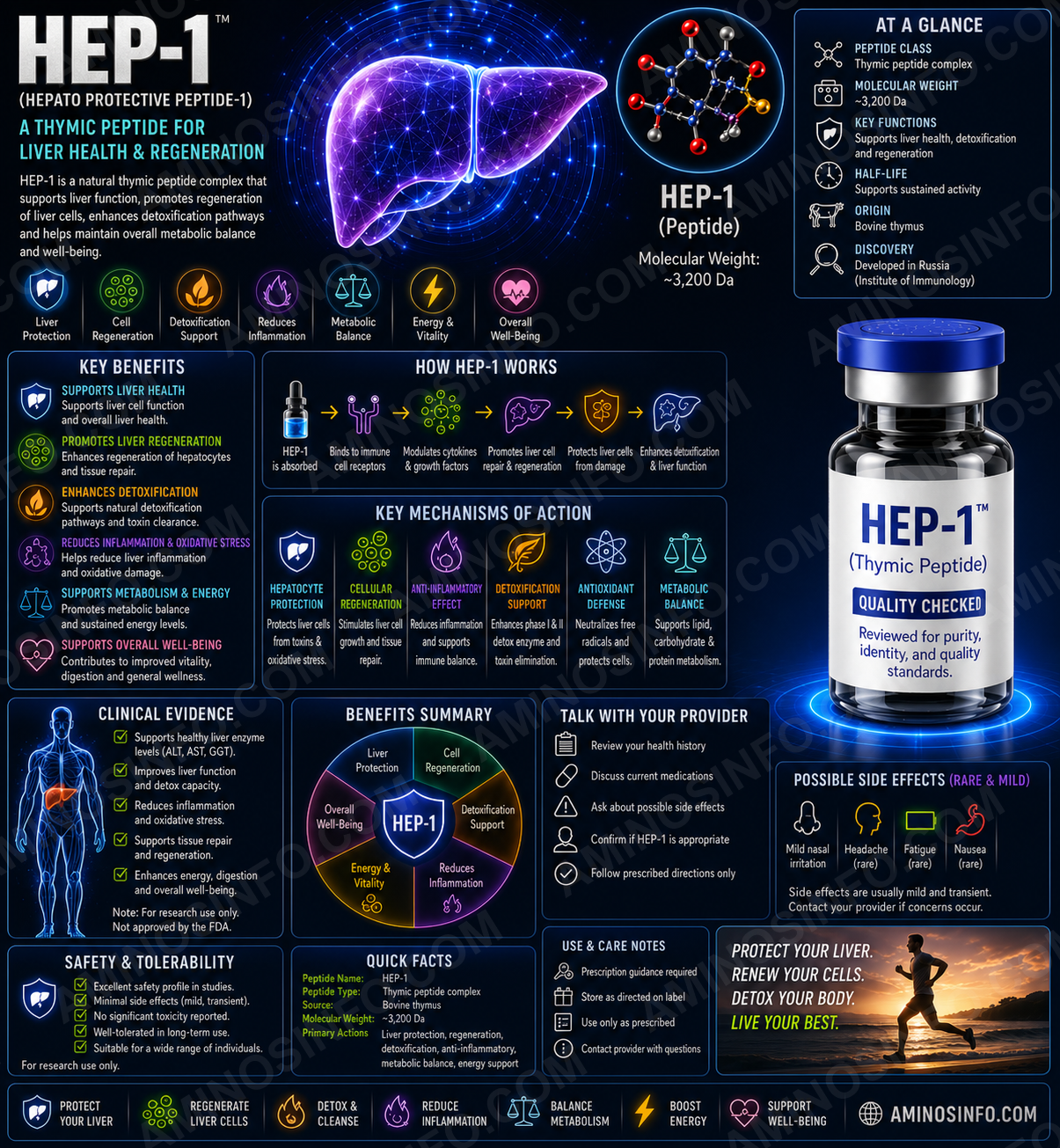
First, the original draft described HEP-1 as an organ-specific liver bioregulator with hepatocyte-repair, detoxification, oxidative-stress, and healthy-aging effects. For example, those claims are not supported by the established HEP-1 literature.
However, the documented compound is:
Meanwhile, Human Ezrin Peptide 1, a synthetic peptide corresponding to amino acids 324–337 of the human ezrin protein.
Thr-Glu-Lys-Lys-Arg-Arg-Glu-Thr-Val-Glu-Arg-Glu-Lys-Glu
TEKKRRETVEREKE
Moreover, researchers have investigated it mainly as an antiviral and immunomodulatory peptide, including work involving HIV-related immune suppression, hepatitis C virus, gastrointestinal ulcer models, and COVID-19.
What Is HEP-1?
First, HEP-1 is a synthetic, highly charged 14-amino-acid peptide modeled on a segment of the human cytoskeletal protein ezrin. It is also described in some literature as human ezrin peptide 1 or as an active component associated with the product name Gepon in Eastern European and Russian-language sources.
Next, ezrin belongs to the ERM protein family—ezrin, radixin, and moesin—which links the plasma membrane to the actin cytoskeleton and participates in immune-cell activation, receptor organization, cell adhesion, membrane trafficking, and viral entry or assembly.
Linear synthetic peptide
14 amino acids
Human ezrin
Residues 324–337
Antiviral and immunomodulatory biology
No
🧬 Molecular Structure
First, HEP-1 is a linear, non-amidated tetradecapeptide containing many lysine, arginine, and glutamate residues. It is therefore strongly charged and highly hydrophilic.
🧪 Amino-Acid Sequence
H-Thr-Glu-Lys-Lys-Arg-Arg-Glu-Thr-Val-Glu-Arg-Glu-Lys-Glu-OH
One-letter notation:
TEKKRRETVEREKE
| Feature | Description | Relevance |
|---|---|---|
| Basic residues | Likewise, Four lysines and three arginines | In addition, Contribute strong positive charge and protein interactions. |
| Acidic residues | Five glutamates | Moreover, Create alternating charge patterns within the peptide. |
| Hydrophobic content | One valine | By contrast, The peptide is otherwise predominantly polar and charged. |
| Terminal form | Also, Free N-terminus and free C-terminal carboxyl group | Consequently, the COA should confirm the terminal form because acetylation or amidation changes identity. |
⚛️ Molecular Weight and 🧫 Formula
| Calculated neutral formula | However, C74H132N26O27 |
|---|---|
| Calculated average molecular weight | Approximately 1,818.0 g/mol |
| Peptide length | 14 amino acids |
| Approximate charge character | Therefore, Highly ionic and strongly pH dependent |
Therefore, the apparent molecular weight of supplied material may differ because of acetate, trifluoroacetate, chloride, water, or other counterions. Meanwhile, a certificate should state whether assay is calculated on an anhydrous, salt-free, or “as is” basis.
📅 Discovery Timeline
1990s: Ezrin-fragment immunology research begins
First, patents and experimental work described a peptide from the central α-helical region of human ezrin as a possible modulator of immune responses in HIV-associated immune suppression and opportunistic infection.
1995: Early international patent filings
Next, patent literature disclosed the 14-residue human ezrin peptide sequence and proposed anti-infective and immune-modulating uses.
2000s: Broader infectious-disease and gastrointestinal research
Moreover, additional patents and regional reports explored HEP-1 in bacterial, fungal, viral, respiratory, and ulcer-related conditions.
2004–2014: Hepatitis C research
In addition, ezrin-, radixin-, and moesin-derived peptides were studied for interference with hepatitis C virus infection, entry, or replication. Likewise, a peptide identified as Hep-1/HEP-1 showed antiviral activity in cell models.
2020–2022: COVID-19 trials and patents
Meanwhile, researchers repurposed HEP-1 for studies in SARS-CoV-2-positive patients. In addition, a randomized trial was registered, and patents described use in acute and post-COVID settings.
Current status
Finally, HEP-1 remains outside established U.S. Moreover, clinical practice. Published evidence is limited, heterogeneous, and insufficient to establish broad efficacy or standard treatment protocols.
📖 Research History
Importantly, HEP-1 research developed from the idea that short ezrin-derived sequences could modify immune-cell signaling or interfere with virus–host interactions involving ERM proteins.
However, much of the clinical literature is regional, uncontrolled, difficult to independently verify, or linked to patent and product-development programs. By contrast, this evidence base should not be treated as equivalent to large, multicenter, peer-reviewed Phase 3 drug trials.
Ezrin Biology and Peptide Origin
What is ezrin?
First, ezrin is a membrane–cytoskeleton linker protein that helps organize microvilli, immune synapses, receptor complexes, cell shape, adhesion, migration, and signaling.
ERM proteins
Next, ezrin, radixin, and moesin share a conserved FERM domain at the N-terminus, a central α-helical region, and a C-terminal actin-binding region. Also, inactive ERM proteins can fold into a closed conformation. Phosphorylation and membrane interactions open the structure and expose binding surfaces.
Why residues 324–337?
Moreover, HEP-1 corresponds to a charged α-helical segment in the central region of ezrin. Consequently, patent descriptions refer to this area as part of a “Hep receptor” or zip-like charged helical structure. This terminology is not a standard receptor classification in modern pharmacology.
Virus–host relevance
Finally, multiple viruses use ERM proteins by multiple viruses during attachment, entry, trafficking, budding, or cell-to-cell spread. However, an ezrin-derived peptide could theoretically compete with viral or host protein interactions, but the exact target may differ across viruses.
🧠 Proposed Mechanism of Action
Importantly, no single receptor or universally accepted molecular mechanism has been established for HEP-1. Therefore, proposed actions include antiviral interference, immune modulation, inflammatory regulation, and effects on ERM-dependent membrane organization.
1. Virus-entry or membrane-complex interference
First, hepatitis C studies suggest that ERM-derived peptides can interfere with virus infection at the cell-surface or post-entry level.
2. Adaptive immune amplification
Moreover, regional clinical literature describes increased adaptive immune responses and altered antibody or lymphocyte activity. For example, independent mechanistic confirmation remains limited.
3. Inflammatory modulation
In addition, researchers have described HEP-1 as reducing excessive inflammatory responses while supporting antiviral immunity. Meanwhile, the balance between immunostimulation and immunosuppression is not fully characterized.
4. Cytoskeletal signaling
Likewise, because the parent protein organizes actin–membrane connections, HEP-1 may alter protein-protein interactions involving ERM-related signaling complexes.
5. Antiviral effects independent of liver repair
Finally, activity against hepatitis viruses would represent antiviral pharmacology, not evidence that the peptide directly regenerates hepatocytes or improves detoxification.
🎯 Target and Pathway Profile
| Target or pathway | Evidence status |
|---|---|
| Ezrin/ERM-related protein interactions | For example, Structural basis for peptide design; exact pharmacological target remains uncertain. |
| Meanwhile, Hepatitis C virus infection | Likewise, Supported by in vitro peptide studies. |
| Adaptive immune responses | In addition, Reported in regional and review literature; limited independent validation. |
| Inflammatory signaling | Moreover, Proposed and reported in selected studies. |
| Hepatocyte regeneration | By contrast, Not an established direct HEP-1 mechanism. |
| Liver detoxification enzymes | Also, No validated HEP-1-specific pathway identified. |
Research Areas
Hepatitis C virus
First, a peer-reviewed study reported that a human radixin-derived peptide and related ERM peptides, including a Hep-1 sequence, inhibited hepatitis C virus infection in cell models. Likewise, these findings support antiviral research but do not establish clinical treatment of chronic hepatitis C.
HIV and opportunistic infections
Next, patents and regional reports originally described HEP-1 in patents and regional clinical reports as an immunomodulator for HIV-associated immune dysfunction and secondary infections. In addition, modern antiretroviral therapy remains the evidence-based standard of care.
Respiratory infections
Moreover, regional reports describe intranasal or topical use for respiratory infections. Moreover, study quality, product characterization, and independent replication vary.
COVID-19
In addition, a randomized clinical study was registered to evaluate HEP-1 in hospitalized SARS-CoV-2-positive patients. By contrast, registration alone does not establish efficacy. Public evidence remains insufficient for routine use.
Gastrointestinal ulcer research
Likewise, patent literature proposed oral HEP-1 for ulcer healing through immune modulation, wound repair, and possible acid-suppression effects. Also, these claims remain outside established ulcer-treatment guidelines.
Post-COVID research
Finally, patent applications proposed HEP-1 for post-COVID symptoms. Consequently, patent claims are not equivalent to validated clinical evidence.
What HEP-1 Does and Does Not Mean for Liver Research
Why the name causes confusion
First, the prefix “HEP” may be mistaken for hepatic or hepatocyte. In HEP-1, it refers to the historical naming of a human ezrin peptide—not an organ-specific liver peptide.
Hepatitis is not the same as hepatocyte regeneration
Moreover, a compound studied against hepatitis C virus can be relevant to liver disease because the virus infects hepatocytes. That does not prove direct liver regeneration, antioxidant defense, detoxification enhancement, or anti-aging activity.
No established detoxification pathway
In addition, no validated evidence shows that HEP-1 directly increases cytochrome P450 function, glutathione conjugation, bile production, ammonia clearance, or other major hepatic detoxification pathways.
No established fibrosis therapy
Finally, HEP-1 is not an approved treatment for fatty liver disease, alcohol-associated liver disease, cirrhosis, fibrosis, hepatitis B, autoimmune hepatitis, or liver failure.
Safety and Regulatory Considerations
Limited standardized human safety data
First, there is no current FDA-approved prescribing information defining dose, route, pharmacokinetics, contraindications, drug interactions, pregnancy safety, or long-term risk.
Immune modulation can be unpredictable
Moreover, a peptide intended to amplify adaptive immunity could theoretically worsen autoimmunity, inflammatory disease, transplant rejection, or cytokine-mediated injury in susceptible individuals.
Highly charged peptide behavior
In addition, HEP-1 may bind nonspecifically to proteins, membranes, nucleic acids, excipients, filters, and container surfaces.
Oral and nasal formulation uncertainty
Likewise, peptide stability, proteolysis, mucosal absorption, local irritation, microbiological quality, and dose uniformity depend on the formulation.
Product-identity risk
However, commercial products called HEP-1 may not match the documented TEKKRRETVEREKE sequence. Exact sequence and terminal forms must be verified.
Regulatory status
Finally, HEP-1 is not FDA approved in the United States. Reports of regional registration or use do not establish U.S. approval, international harmonization, or equivalent manufacturing standards.
🧪 Laboratory Testing Methods
| Method | Purpose | Important limitation |
|---|---|---|
| RP-HPLC or UPLC | Consequently, Measures chromatographic purity and deletion or truncation impurities. | However, Highly charged peptides may require specialized gradients or columns. |
| LC-MS / HRMS | Therefore, Confirms intact molecular mass. | For example, Does not prove antiviral or immunological activity. |
| MS/MS peptide mapping | Meanwhile, Confirms the TEKKRRETVEREKE sequence. | Likewise, Arginine- and lysine-rich sequences may fragment unevenly. |
| Amino-acid analysis | In addition, Supports composition and net-content measurement. | Moreover, Does not independently establish residue order. |
| Counterion analysis | By contrast, Measures acetate, trifluoroacetate, chloride, or other salts. | Also, Counterions materially affect gross powder mass. |
| Consequently, Assay / net peptide content | However, Measures actual HEP-1 quantity. | Therefore, analysts must not infer net peptide content from HPLC area purity. |
| Charge-variant analysis | For example, Assesses ionic variants and degradation products. | Meanwhile, Method development may be difficult for short polyionic peptides. |
| Cell-based antiviral assay | Likewise, Measures inhibition of viral infection or replication. | In addition, Results are virus-, cell-line-, and protocol-specific. |
| Immune-cell assay | Moreover, Measures cytokines, lymphocyte activation, or antibody responses. | By contrast, Immune stimulation can be beneficial or harmful depending on context. |
| Also, Microbial limits or sterility | Consequently, Evaluates microbiological quality according to intended route. | However, Oral, nasal, topical, and injectable products require different standards. |
| Endotoxin testing | Therefore, Important for parenteral or high-risk mucosal preparations. | For example, A passing endotoxin test does not prove sterility. |
| Stability testing | Meanwhile, Tracks hydrolysis, oxidation, aggregation, adsorption, and assay. | Likewise, Must reflect the actual formulation, packaging, and storage conditions. |
📄 How to Interpret a HEP-1 COA
1. Verify the sequence
First, the documented HEP-1 sequence is TEKKRRETVEREKE.
2. Confirm terminal forms
Next, the standard sequence is generally represented with a free N-terminus and free C-terminal carboxyl group. Acetylated or amidated versions are different compounds.
3. Separate identity, purity, and content
- Identity First, confirms the sequence and molecular mass.
- Purity Next, estimates relative chromatographic composition.
- Net peptide content Also, measures actual HEP-1 after accounting for salts and water.
4. Check counterion burden
Moreover, a highly basic peptide can retain significant trifluoroacetate or other counterions from synthesis and purification.
5. Review route-specific microbiology
In addition, a nasal, oral, topical, or injectable product must be evaluated using standards appropriate to that route. Raw powder purity is not enough.
6. Require functional equivalence before making efficacy claims
Likewise, laboratories should evaluate a chemically correct peptide in a relevant antiviral or immune assay before representing it as equivalent to material used in published studies.
7. Do not infer liver repair from the name
However, a COA confirming HEP-1 does not support claims of hepatocyte regeneration, detoxification, fibrosis reversal, or liver anti-aging.
📊 HEP-1 vs Livagen vs Hepcidin vs Glutathione
Identity and Biological-Role Differences
| Feature | HEP-1 | Livagen | Hepcidin | Glutathione |
|---|---|---|---|---|
| Compound type | 14-residue ezrin-derived peptide | In addition, Vendor-associated short peptide bioregulator name | Moreover, 25-residue endogenous peptide hormone | Endogenous tripeptide |
| Main established biology | By contrast, Antiviral and immunomodulatory research | Also, Limited and heterogeneous bioregulator literature | Consequently, Iron homeostasis through ferroportin | However, Redox buffering and conjugation |
| Direct liver-regeneration evidence | Not established | Therefore, Not established in large rigorous trials | No | For example, No direct regenerative drug effect |
| FDA approved? | No | No | Meanwhile, No native-hepcidin drug; analog development exists | Likewise, No general liver-repair approval |
HEP-1 vs the Original Draft’s Claimed Liver Bioregulator
Evidence-Based Identity Corrections
| Original claim | Evidence-based correction |
|---|---|
| Organ-specific liver peptide | In addition, HEP-1 is a human ezrin-derived peptide. |
| Moreover, Hepatocyte repair and regeneration | By contrast, Not an established direct mechanism. |
| Detoxification-pathway enhancement | Also, No validated CYP, glutathione, bile, or ammonia-clearance mechanism. |
| Healthy hepatic aging | Consequently, No credible clinical evidence identified. |
| However, Comparable to Livagen or Pancragen | Therefore, Scientifically inappropriate; these are different naming systems and evidence bases. |
HEP-1 vs Other ERM-Derived Peptides
| Peptide family | Parent protein | Research context |
|---|---|---|
| HEP-1 | Ezrin | For example, Antiviral and immunomodulatory studies. |
| Radixin-derived peptide | Radixin | Meanwhile, Hepatitis C virus inhibition in cell models. |
| Moesin-derived peptide | Moesin | Likewise, Related ERM protein-interaction research. |
🔗 Related Proteins and Pathways
- Ezrin: First, Membrane–actin linker and parent protein of HEP-1.
- Radixin and moesin: Next, Related ERM-family proteins.
- Hepatitis C virus: Also, Major antiviral research context for ERM-derived peptides.
- Actin cytoskeleton: Moreover, Central to ERM protein function.
- Immune synapse: In addition, ERM proteins help organize receptors and cytoskeletal signaling.
- Viral entry and budding pathways: Likewise, Processes in which ERM proteins can participate.
🖼️ Original Diagram Specifications
Diagram 1: HEP-1 sequence and charge map
In addition, Show TEKKRRETVEREKE with acidic residues in one class, basic residues in another, and the free N- and C-termini labeled.
Diagram 2: Ezrin domain structure
Moreover, Show the N-terminal FERM domain, central α-helical region containing residues 324–337, and C-terminal actin-binding region.
Diagram 3: ERM membrane–cytoskeleton linkage
By contrast, Illustrate ezrin connecting membrane proteins to cortical actin and organizing receptor complexes.
Diagram 4: Proposed antiviral mechanism
Also, Show HEP-1 competing with ERM-related virus–host protein interactions at a membrane or intracellular complex. Label the exact target as unresolved.
Diagram 5: Identity correction
Consequently, Use a split graphic contrasting “HEP-1 = human ezrin peptide” with “hepatic bioregulator claim = unsupported.”
Diagram 6: COA workflow
However, Show sequence confirmation, LC-MS identity, HPLC purity, counterion, net content, microbial testing, stability, and functional antiviral assay.
❓ Frequently Asked Questions
Is HEP-1 a peptide?
Therefore, Yes. The documented HEP-1 is a 14-amino-acid synthetic peptide derived from human ezrin.
What is its sequence?
TEKKRRETVEREKE.
Is HEP-1 a liver peptide?
For example, No. The name does not mean hepatic peptide. It refers to Human Ezrin Peptide 1.
What is HEP-1 studied for?
Meanwhile, researchers have studied it for antiviral, anti-inflammatory, and immunomodulatory effects, including hepatitis C and COVID-19 research.
Does HEP-1 regenerate the liver?
Likewise, No validated evidence establishes direct hepatocyte regeneration or liver repair in humans.
Is HEP-1 FDA approved?
No.
Is HEP-1 the same as Gepon?
In addition, Gepon is described in some regional and patent literature as a product containing HEP-1. Product composition and regulatory standards should be verified independently.
Does hepatitis C research prove liver-health benefits?
Moreover, No. Antiviral activity against a liver-tropic virus is not the same as improving detoxification, fibrosis, metabolic liver disease, or liver aging.
Can HEP-1 be taken orally or intranasally?
By contrast, Those routes have appeared in patents and regional reports, but no FDA-approved formulation or standardized U.S. dosing regimen exists.
Does 99% HPLC purity prove effectiveness?
Also, No. It does not establish sequence identity by itself, net content, counterion burden, route-specific safety, antiviral activity, or clinical benefit.
HEP-1 Scientific Overview: Final Thoughts
In conclusion, the original HEP-1 draft was based on an incorrect identity. HEP-1 is not an organ-specific hepatic-repair peptide. It is a 14-amino-acid human ezrin-derived peptide with the sequence TEKKRRETVEREKE.
Moreover, its legitimate research history centers on antiviral and immune-modulating biology, including hepatitis C cell studies, HIV-related development, gastrointestinal patents, and COVID-19 clinical investigation. The evidence base remains limited and does not support broad claims of liver regeneration, detoxification enhancement, fibrosis reversal, or healthy hepatic aging.
Therefore, any HEP-1 product should be evaluated against the documented sequence, terminal chemistry, molecular mass, counterion burden, net peptide content, microbiological quality, stability, and a relevant functional assay. The name alone is not enough to establish identity or benefit.
📚 References
- For example, Bukong TN, et al. A novel human radixin peptide inhibits hepatitis C virus infection. 2014.
- Moreover, Holms RD. Ezrin peptide therapy from HIV to COVID. 2021.
- In addition, ClinicalTrials.gov. Ezrin Peptide HEP-1 for treatment of coronavirus disease.
- However, European Union Clinical Trials Register. Human Ezrin Peptide 1 as a therapeutic agent for SARS-CoV-2-positive patients. EudraCT 2020-005527-36.
- Therefore, World Intellectual Property Organization. Ezrin peptide HEP-1 for use in coronavirus disease.
- Likewise, World Intellectual Property Organization. Ezrin peptide 1 for treating COVID-19.
- For example, World Intellectual Property Organization. Ezrin peptide 1 for treating post-COVID-19.
- Moreover, United States Patent. Ezrin-derived peptides and pharmaceutical compositions thereof.
- In addition, World Intellectual Property Organization. The use of peptides in anti-ulcer therapy.
- However, World Intellectual Property Organization. WO95/33768. Human ezrin peptide and immune-modulating use.
- Therefore, World Intellectual Property Organization. WO2004/067024. Ezrin peptides and hepatitis C research.
- Likewise, MedChemExpress. HEP-1, human ezrin peptide 324–337.
- For example, Fehon RG, McClatchey AI, Bretscher A. Organizing the cell cortex: the role of ERM proteins. Nature Reviews Molecular Cell Biology. 2010.
- Moreover, Bretscher A, Edwards K, Fehon RG. ERM proteins and merlin: integrators at the cell cortex. Nature Reviews Molecular Cell Biology. 2002.
- In addition, McClatchey AI. ERM proteins at a glance. Journal of Cell Science.
- However, Arpin M, Chirivino D, Naba A, Zwaenepoel I. Emerging role for ERM proteins in cell adhesion and migration. Cell Adhesion & Migration.
- Therefore, Neisch AL, Fehon RG. Ezrin, radixin and moesin: key regulators of membrane–cortex interactions and signaling. Current Opinion in Cell Biology.
- Likewise, Tsukita S, Yonemura S. ERM proteins: head-to-tail regulation of actin–plasma membrane interaction. Trends in Biochemical Sciences.
- For example, Gary R, Bretscher A. Ezrin self-association involves binding of an N-terminal domain to a normally masked C-terminal domain. Molecular Biology of the Cell.
- Moreover, Fievet B, et al. Phosphoinositide binding and phosphorylation regulate ezrin activation. Journal of Cell Biology.
- In addition, Viswanatha R, Ohouo PY, Smolka MB, Bretscher A. Local phosphocycling mediated by LOK/SLK restricts ezrin function. Journal of Cell Biology.
- However, Roumier A, et al. Ezrin controls immune synapse morphology and T-cell activation. Immunity-related literature.
- Therefore, Ilani T, Khanna C, Zhou M, Veenstra TD, Bretscher A. Immune-cell and tumor roles of ezrin. Cancer Research.
- Likewise, Clucas J, Valderrama F. ERM proteins in cancer progression. Journal of Cell Science.
- For example, Sato N, et al. ERM proteins and viral infection mechanisms. Virology reviews.
- Roy NH, Burkhardt JK. The actin cytoskeleton in T-cell activation. Annual Review of Immunology.
- Delon J, Kaibuchi K, Germain RN. Exclusion of CD43 from the immunological synapse is mediated by ERM proteins. Immunity.
- International Council for Harmonisation. ICH Q2(R2): Validation of Analytical Procedures.
- United States Pharmacopeia. General Chapter <621>, Chromatography.
- United States Pharmacopeia. General Chapters <61> and <62>, Microbiological Examination of Nonsterile Products.
- United States Pharmacopeia. General Chapter <71>, Sterility Tests.
- United States Pharmacopeia. General Chapter <85>, Bacterial Endotoxins Test.
- International Council for Harmonisation. ICH Q3C: Impurities—Guideline for Residual Solvents.
- International Council for Harmonisation. ICH Q6B: Specifications for Biotechnological/Biological Products.
- International Council for Harmonisation. ICH Q1A(R2): Stability Testing of New Drug Substances and Products.
HEP-1, Antiviral, and Clinical-Development Sources
Ezrin Biology, Immunology, and Analytical Sources
Consequently, Identity, sequence, mechanism, antiviral research, and regulatory status were reviewed in July 2026. HEP-1 remains unapproved in the United States and should not be represented as a validated liver-regeneration peptide.