Melanocortin biology · desire · human evidence
PT-141 (Bremelanotide): The Brain-Based Peptide Behind Desire Research
How a tanning-research analog became a prescription melanocortin drug, what scientists know about MC4R signaling, why it differs from PDE5 inhibitors and hormone therapy, what the female HSDD trials actually found, why evidence in men remains investigational, and which safety and quality issues are too important to overlook.
Educational use only. This article does not diagnose sexual dysfunction, recommend an individual treatment, or provide a peptide-mixing, dosing or injection protocol. The FDA-approved bremelanotide product is prescription-only and has meaningful cardiovascular, gastrointestinal, pigmentation, pregnancy and drug-interaction warnings. A research-labeled vial is not equivalent to an FDA-approved autoinjector.
Article contents
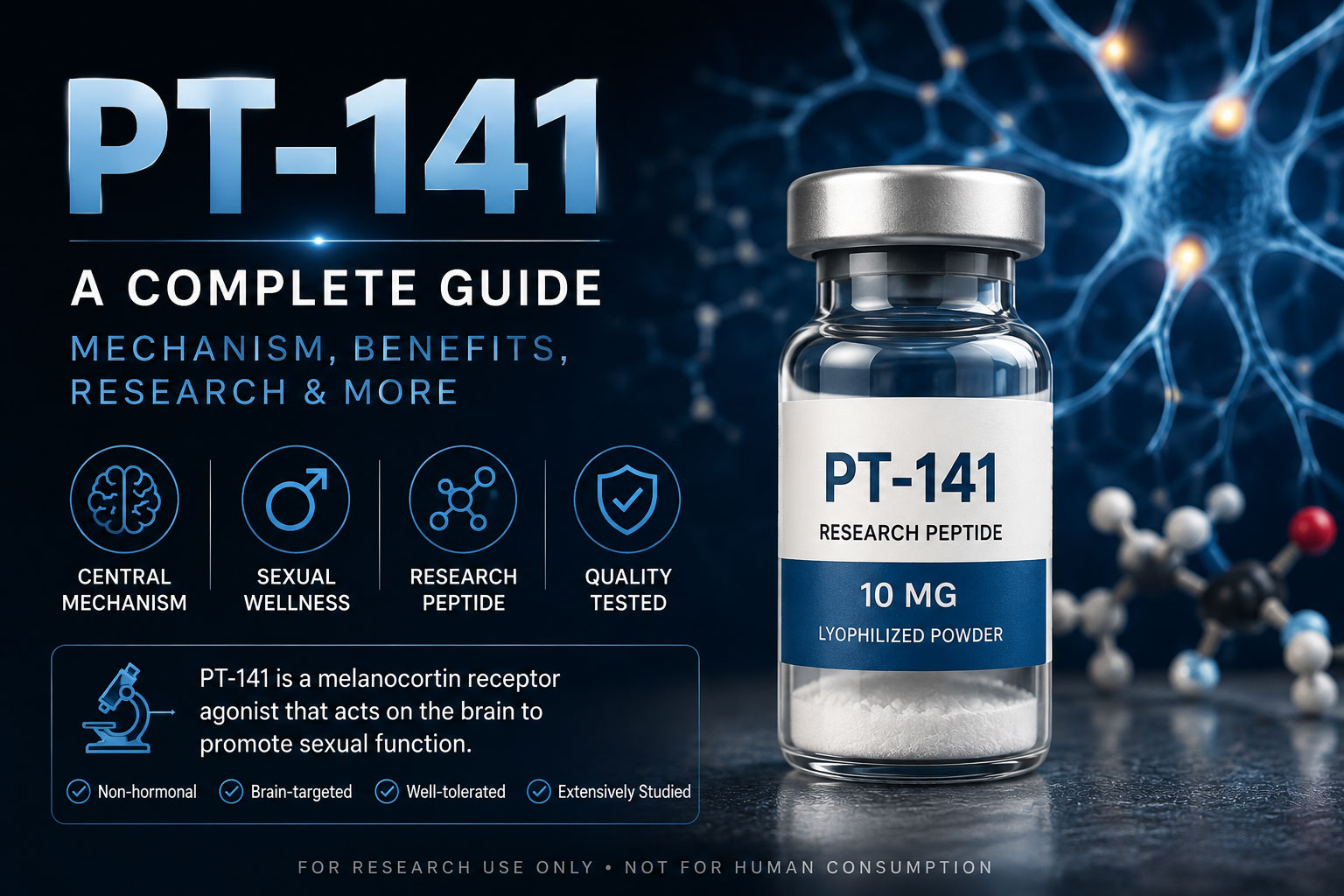
PT-141 is often described as a “libido peptide,” but that label is too vague to be useful. The molecule is better understood as a central melanocortin receptor agonist: it acts on signaling systems in the brain and nervous system rather than functioning mainly as a vasodilator or as replacement testosterone or estrogen. That distinction explains both its scientific appeal and the limits of what it can reasonably be expected to do.
The same active peptide is known generically as bremelanotide and is marketed in an FDA-approved prescription product for a narrow indication: acquired, generalized hypoactive sexual desire disorder (HSDD) in premenopausal women. It is not approved for postmenopausal women, men, general sexual enhancement, athletic performance, weight loss, depression or relationship repair. The evidence outside the approved population ranges from biologically interesting to preliminary—not interchangeable with proof.
1Executive summary: what is established, plausible and unproven
Bremelanotide activates multiple melanocortin receptor subtypes. MC4R signaling in the CNS is considered especially relevant, although the exact mechanism that improves HSDD remains unknown.
The U.S. indication is acquired, generalized HSDD causing distress and not better explained by a medical, psychiatric, relationship or medication-related cause.
Older, small investigational trials reported objective erectile responses in men. They do not establish an approved male indication, modern long-term safety or superiority to standard ED care.
Confidence, antidepressant effects, appetite control, fitness benefits and relationship improvement are not validated indications and should not be marketed as predictable drug effects.
The eight conclusions that matter most
- PT-141 and bremelanotide name the same active peptide, but not every product sold under those names is equivalent. FDA approval applies to the specific prescription formulation, manufacturing controls, device and labeled use.
- Its scientific novelty is central signaling. It is neither a PDE5 inhibitor nor sex-hormone replacement.
- The FDA label does not claim the exact mechanism is known. MC4R-centered hypotheses are supported by receptor distribution and animal research, but the human therapeutic pathway remains incompletely mapped.
- Phase 3 trials found statistically significant but modest average improvements in desire and distress. They did not show a significant increase in satisfying sexual events.
- Evidence in men is investigational. Early studies are interesting but small, old and not an approved basis for general male use.
- Sexual function is multidimensional. A central arousal signal cannot automatically correct relationship conflict, depression, medication effects, pain, endocrine disease, sleep deprivation or cardiovascular causes of dysfunction.
- Adverse effects are not trivial. Nausea occurred in 40% of treated participants in pooled phase 3 trials, and the drug can transiently raise blood pressure, lower heart rate and cause potentially persistent focal hyperpigmentation.
- “Research use only” does not create clinical equivalence. Sterility, identity, potency, endotoxin control, device performance and validated stability matter when a peptide is intended for injection.
2What PT-141 is—and what the name does not tell you
PT-141 was the development code for bremelanotide, a synthetic cyclic heptapeptide derived from the melanocortin family. “Cyclic” refers to the ring-like structure created within the peptide chain, a design that can influence receptor binding and stability. The FDA-approved label describes bremelanotide as a nonselective melanocortin receptor agonist with activity across MC1R, MC4R, MC3R, MC5R and MC2R, with MC1R and MC4R considered most relevant at therapeutic exposure.
The historical development and research code. It is still widely used in scientific discussions and in online peptide marketing.
The generic drug name. It identifies the active peptide, not a guarantee that every formulation has the same quality, concentration, sterility or clinical evidence.
The FDA-approved prescription drug-device product supplied as a specific sterile, single-dose autoinjector for a defined indication and with approved labeling.
The critical product distinction
Saying that a vial “contains PT-141” does not demonstrate pharmaceutical equivalence to the approved product. An injectable drug is defined by more than the molecular name: identity, assay, impurities, aggregation, bacterial endotoxins, sterility, pH, container compatibility, particulate control, storage validation and dose delivery all influence risk.
3From tanning research to a central sexual-response drug
The PT-141 story began with alpha-melanocyte-stimulating hormone (α-MSH), an endogenous melanocortin peptide best known for stimulating melanin production. Researchers explored α-MSH analogs as ways to increase pigmentation without relying entirely on ultraviolet exposure. During development of the related analog melanotan II, investigators observed an unexpected physiological effect: melanocortin stimulation could produce sexual responses, including erections.
That observation shifted the research question. Instead of asking only how melanocortins affect melanocytes, scientists began studying how the same receptor family influences hypothalamic and autonomic circuits involved in motivation, arousal and genital response. Bremelanotide was developed to pursue that central pathway while separating the sexual-response program from the original tanning objective.
The origin story is scientifically important, but it can also be misleading when simplified. PT-141 was not discovered as a universal “passion switch,” and pigmentation biology never disappeared. Activation of MC1R remains relevant to the focal hyperpigmentation warning in the approved label.
4How PT-141 works: melanocortin receptors, the hypothalamus and desire signaling
Melanocortin receptors are G-protein-coupled receptors distributed across the skin, adrenal system, immune cells, peripheral tissues and brain. Their functions differ by subtype and location. For PT-141, the most discussed central target is MC4R, which is expressed in multiple areas of the central nervous system, including hypothalamic networks involved in motivation, autonomic control and sexual behavior.
| Receptor | Relevant biology | How it relates to PT-141 | What should not be assumed |
|---|---|---|---|
| MC1R | Melanocytes and pigmentation | Clinically relevant binding helps explain pigment changes | Pigmentation is not evidence that sexual benefit will occur |
| MC4R | CNS circuits for behavior, energy balance and autonomic function | Most prominent mechanistic hypothesis for desire effects | The exact human HSDD mechanism is not proven |
| MC3R | Central metabolic and behavioral signaling | May contribute within the broader melanocortin network | It is not established as the sole or primary clinical target |
| MC5R / MC2R | Exocrine, immune and adrenal-related biology | Lower-order activity in the label’s potency ranking | Broad receptor activity does not imply broad clinical benefits |
The proposed dopamine connection
A commonly cited model proposes that activating MC4R-containing neurons in the medial preoptic area of the hypothalamus can increase dopamine signaling in pathways that facilitate sexual motivation. This model is grounded largely in animal and neurobiological research. It is plausible and useful, but the FDA label appropriately states that the mechanism by which bremelanotide improves HSDD in women is unknown.
Desire, arousal, genital response and performance are not identical
Marketing often collapses four different concepts into the word “libido.” Desire is motivational; subjective arousal is the felt state of becoming sexually engaged; genital response includes vascular and autonomic changes; and performance refers to functional outcomes in a particular encounter. A central melanocortin signal may influence more than one layer, but it does not guarantee all four will improve together.
Why context still matters
Desire emerges from an interaction among brain signaling, hormones, medication effects, physical comfort, relationship context, stress, sleep, mood, past experiences and expectations. PT-141 can modify one signaling system; it cannot erase every competing influence.
5How it differs from PDE5 inhibitors and hormone therapy
| Approach | Primary target | What it may support | What it does not automatically solve |
|---|---|---|---|
| PT-141 / bremelanotide | Central melanocortin signaling | Desire-related and arousal pathways in selected patients | Vascular disease, pain, relationship distress, endocrine deficiency |
| PDE5 inhibitors | Nitric-oxide/cGMP vascular pathway | Penile blood-flow response in appropriate men with stimulation | Low desire, relationship context, untreated hormonal or neurological causes |
| Hormone therapy | Endocrine signaling and documented deficiency or menopausal context | Symptoms linked to a specific hormonal state | All psychological, relational, vascular or medication-related causes |
| Psychotherapy / sex therapy | Cognition, anxiety, relationship patterns, communication and behavior | Contextual and psychological contributors | Every biological cause or medication effect |
The central-versus-vascular distinction helps explain why researchers considered bremelanotide for people whose problems were not fully addressed by blood-flow drugs. It does not mean that PT-141 is “better” in general. Different mechanisms address different bottlenecks, and combining therapies without a prescriber can create unpredictable cardiovascular, gastrointestinal and medication-interaction risks.
PT-141 also does not raise testosterone or estrogen in the way hormone replacement does. A person with an endocrine disorder, medication-induced dysfunction, pelvic pain or uncontrolled vascular disease requires assessment of that underlying problem rather than assuming a central arousal signal is the missing piece.
6The strongest evidence: acquired, generalized HSDD in premenopausal women
The approved indication is narrower than “low libido.” Acquired means the low desire developed after a period without the problem. Generalized means it occurs across partners, situations and types of sexual activity rather than only in one context. The low desire must cause marked distress or interpersonal difficulty and must not be better explained by another medical or psychiatric condition, a relationship problem, or a medication or drug.
Two similarly designed, 24-week randomized, double-blind phase 3 trials—often called the RECONNECT studies—formed the main efficacy basis. Across the studies, bremelanotide produced statistically greater average improvement than placebo on the Female Sexual Function Index desire domain and on a question measuring distress about low desire. The average treatment-placebo difference was modest: desire scores improved by roughly 0.3 to 0.4 points more than placebo on a 1.2-to-6 scale, while distress improved by about 0.3 points more on a 0-to-4 scale.
Desire score
Both phase 3 studies met the desire co-primary endpoint.
Distress score
Both studies also found greater reduction in distress related to low desire.
Satisfying sexual events
The secondary endpoint did not differ significantly from placebo.
Statistical significance does not answer how meaningful the benefit will feel to a particular person. Some participants improved; others did not; and adverse effects caused substantially more discontinuations in the active group. A later methodological critique argued that several outcome measures had limited validation and that the observed benefits were small. A balanced reading therefore recognizes a genuine signal without turning it into a promise of dramatic transformation.
What FDA approval does—and does not—mean
Approval means the agency concluded that the specific product’s benefits outweighed its risks for the labeled population when used as directed. It does not mean the drug works for every woman, that the average effect is large, or that men, postmenopausal women and healthy users seeking enhancement have an approved indication.
7Evidence in men: intriguing early trials, no approved male indication
Early clinical development included healthy men and men with erectile dysfunction. Small randomized studies using investigational intranasal PT-141 reported objective erectile responses measured with RigiScan, including responses in some men with ED. Another small crossover study found a greater erectile response when low-dose intranasal PT-141 was combined with sildenafil than with sildenafil alone.
These studies help establish that the melanocortin system can influence male genital response through a central pathway. They do not establish that current unapproved PT-141 products are safe or effective for men. The trials were small, used investigational formulations and endpoints, and did not create an FDA-approved male indication. The approved label specifically states that Vyleesi is not indicated in men.
A person who experiences erectile difficulty should not assume that adding a desire-oriented peptide addresses the cause. Vascular assessment, medication review and evaluation of endocrine, neurological and psychological contributors can be more important than choosing another compound.
8Real-world expectations: what people may notice—and what remains anecdotal
Individual reports often describe increased sexual thoughts, greater responsiveness to cues, more subjective arousal or a renewed sense of spontaneity. Those descriptions are consistent with the drug’s central mechanism and with the approved trial outcomes in selected women. They should still be treated as experiences rather than guaranteed effects.
Desire and attention to sexual cues
This is the most biologically coherent and clinically studied domain, especially in acquired generalized HSDD.
Confidence and relationship effects
Improved confidence or closeness may occur indirectly when distress improves, but these are not direct, reliable pharmacologic endpoints.
Mood and mental energy
PT-141 is not an antidepressant or stimulant. Reports of feeling energized, outgoing or present may reflect context, expectancy or improved sexual well-being.
Appetite and weight
The broader melanocortin system participates in energy balance, but bremelanotide is not approved or clinically established as an appetite or weight-loss drug.
Why responses vary
- Cause of the problem: a central desire deficit is different from pain, low hormones, medication effects, vascular disease or relationship distress.
- Baseline expectation: anticipation can magnify both perceived benefit and adverse effects.
- Stress and sleep: exhaustion, anxiety and poor sleep can suppress responsiveness even when a drug engages its receptor.
- Adverse effects: nausea, headache or flushing can overwhelm any desired subjective effect.
- Product quality: an unverified research vial adds uncertainty about identity, potency and sterility that does not exist in the same way for an approved product.
9What representative human studies actually found
| Study / population | Design | Main signal | Important limitation | Evidence interpretation |
|---|---|---|---|---|
| RECONNECT phase 3 trials Premenopausal women with acquired generalized HSDD |
Two 24-week randomized placebo-controlled studies | Statistically greater improvement in desire and distress | Modest average effect; no significant SSE difference; high discontinuation | Supports the narrow approved indication |
| Open-label extension Women continuing after phase 3 |
Up to 52 additional weeks without placebo control | Reported symptom improvement persisted in continuing participants | No concurrent control; selection and attrition bias | Useful for tolerability and persistence, not definitive comparative efficacy |
| Early intranasal male studies Healthy men and men with ED |
Small placebo-controlled pharmacodynamic trials | Objective erectile responses exceeded placebo in selected conditions | Small samples, investigational intranasal formulation, limited long-term outcomes | Proof of biological activity, not an approved male-use standard |
| PT-141 + sildenafil crossover study 19 men with ED |
Small randomized crossover comparison | Greater measured erectile response than low-dose sildenafil alone | Very small, short study; does not establish routine combination safety | Hypothesis-generating only |
| 2024 outcome-measure critique Reanalysis of RECONNECT evidence |
Methodological review and additional outcome analysis | Effect sizes ranged from nil to small across outcomes | Interpretive paper rather than a new randomized trial | Important counterweight to overly enthusiastic claims |
How to read these trials without being misled
- A statistically significant questionnaire difference may still be modest in daily life.
- A drug can improve desire-related distress without increasing the number of satisfying encounters.
- Open-label continuation cannot separate treatment effect from expectancy, selection and natural change.
- A small erectile-response experiment in men does not validate broad “libido optimization” claims.
- Study results from the approved autoinjector cannot automatically be transferred to a different, unapproved formulation.
10Safety, contraindications and drug interactions
The label also recommends cardiovascular-risk assessment and well-controlled blood pressure before and during treatment. This is not a minor precaution for a drug that transiently changes blood pressure and heart rate.
Blood pressure and heart rate
In clinical studies, the approved product caused transient blood-pressure increases after each dose and a corresponding decrease in heart rate. Maximal average increases reported in the label were about 6 mmHg systolic and 3 mmHg diastolic, with heart rate reductions up to 5 beats per minute; values usually returned to baseline within 12 hours. Averages can hide larger individual responses, which is why cardiovascular history matters.
Common adverse reactions in the pooled phase 3 trials
| Adverse reaction | Bremelanotide | Placebo | Why it matters |
|---|---|---|---|
| Nausea | 40.0% | 1.3% | 13% needed antiemetic therapy; 8% discontinued because of nausea |
| Flushing | 20.3% | 0.3% | Can be uncomfortable and is not evidence of efficacy |
| Injection-site reactions | 13.2% | 8.4% | Pain, redness, bruising, itching or altered sensation were included |
| Headache | 11.3% | 1.9% | Occasionally severe; one serious headache event was reported |
| Vomiting | 4.8% | 0.2% | Can compound dehydration and medication-absorption concerns |
| Other ≥2% | Cough, fatigue, hot flush, tingling, dizziness, nasal congestion | Not all reactions feel compatible with the intended experience | |
Focal hyperpigmentation
MC1R activation can increase melanin expression. In phase 3 trials using intermittent treatment, focal hyperpigmentation involving areas such as the face, gums and breasts was reported in about 1% of treated patients. More frequent exposure produced much higher rates in a separate study, and complete resolution after stopping was not confirmed in every patient. People with darker skin were more likely to develop pigmentary changes.
Drug interactions through slower gastric emptying
Bremelanotide can slow gastric emptying and therefore delay or reduce absorption of oral medications. The label specifically warns about oral drugs that depend on reaching a threshold concentration quickly, including some antibiotics and rapid-onset pain medications. It can substantially reduce exposure to oral naltrexone, creating a serious risk of treatment failure when naltrexone is being used for alcohol or opioid use disorder.
Pregnancy, lactation and special populations
- Pregnancy: use is not recommended; the label cites potential fetal harm from animal data and advises contraception for people who can become pregnant.
- Breastfeeding: human milk data are unavailable.
- Children and geriatric patients: safety and effectiveness have not been established.
- Severe kidney or liver impairment: exposure may be higher and adverse reactions more pronounced; the label calls for caution.
- Liver events: one acute hepatitis case occurred in an uncontrolled extension; causality could not be excluded, although the broader program did not show a clear hepatotoxicity signal.
Adverse effects are not a “sign it is working”
Nausea, flushing, headache, blood-pressure changes and pigmentation reflect pharmacology and exposure—not proof of a beneficial sexual response. Treating side effects as a badge of potency can encourage unsafe escalation.
11Approved drug, compounded preparation and “research peptide” are not the same category
| Category | Premarket FDA review | What can be assumed | What cannot be assumed |
|---|---|---|---|
| FDA-approved Vyleesi | Yes, for the approved product and indication | Reviewed formulation, device, manufacturing and labeling | Benefit for unapproved populations or purposes |
| Lawfully compounded drug | No | May serve a patient-specific medical need when legal conditions are met | FDA verification of safety, effectiveness, quality or therapeutic equivalence |
| Research-labeled peptide | No clinical-drug approval | Only what valid analytical documentation actually demonstrates | Sterility, endotoxin control, dose accuracy, clinical safety or suitability for human injection |
FDA states that compounded drugs are not FDA-approved and are not reviewed before marketing for safety, effectiveness or quality. The agency has also cited compounding operations for preparing bremelanotide/PT-141 products that did not qualify for statutory exemptions. That regulatory history matters because injectable peptide quality failures can cause harm even when the intended molecule itself is pharmacologically understood.
A certificate of analysis answers only the tests it contains
- Identity: Is the main compound bremelanotide?
- Purity: What fraction of detected peptide material is the target compound?
- Assay or net content: How much active material is actually present?
- Sterility: Are viable microorganisms absent under a validated method?
- Bacterial endotoxins: Is pyrogenic contamination controlled?
- Particulates, pH and stability: Will the formulation remain suitable throughout its stated life?
A high HPLC purity percentage does not prove sterile manufacture, accurate fill, low endotoxin or safe use. Nor does a research label convert a non-approved product into the clinically studied autoinjector.
12Common PT-141 myths—and the more accurate version
Reality: The comparison highlights central versus vascular action, but oversimplifies two different drug classes, indications, evidence bases and safety profiles.
Reality: Bremelanotide is a melanocortin receptor agonist, not sex-hormone replacement.
Reality: The label is limited to selected premenopausal women. Male evidence remains investigational.
Reality: Higher or more frequent exposure can increase blood-pressure, nausea and pigmentation risks without guaranteeing additional benefit.
Reality: Those are adverse effects, not validated markers of sexual efficacy.
Reality: A pharmacologic signal cannot substitute for communication, safety, consent, trust or therapy when those are the central issues.
Reality: Improved confidence may be secondary to reduced sexual distress, but antidepressant and anxiolytic effects are not established indications.
Reality: The melanocortin system regulates energy balance, but bremelanotide is not a validated weight-loss therapy.
Reality: A matching molecular name does not establish identical formulation, sterility, delivery accuracy, stability or regulatory review.
Reality: That claim lacks controlled clinical evidence and can multiply interaction, cardiovascular and product-quality uncertainty.
13A practical evidence-based framework
Low desire, arousal difficulty, ED, pain, medication effects and relationship distress are not interchangeable complaints.
Sleep, depression, anxiety, medications, alcohol, endocrine disease, pain and cardiovascular health can change the treatment path.
The strongest evidence is not “any adult with low libido”; it is the specific labeled HSDD population.
Blood pressure, heart disease, oral naltrexone and time-sensitive oral medications require special attention.
A useful outcome is reduced distress or meaningful improvement—not simply feeling an adverse effect or seeing a lab result.
Combining peptides, PDE5 drugs, hormones or psychoactive supplements without clinical oversight makes cause and risk harder to interpret.
Persistent nausea, problematic blood-pressure effects, pigmentation changes or lack of meaningful improvement warrant clinician review rather than escalation.
Consent, communication, emotional safety and realistic expectations remain essential regardless of pharmacology.
14Frequently asked questions
Is PT-141 the same as bremelanotide?
Is PT-141 a hormone?
What is the FDA-approved use?
Does it work for men?
Is it the same as sildenafil?
How quickly does bremelanotide enter the bloodstream?
How long does it last?
Can it cause skin darkening?
Is nausea common?
Is it safe with high blood pressure or heart disease?
Can it interact with oral medications?
Is PT-141 a weight-loss peptide?
Can it improve mood or confidence?
Does a high-purity COA prove an injectable vial is safe?
The bottom line
PT-141 is scientifically distinctive because it reaches sexual-response biology through the central melanocortin system rather than acting primarily as a vascular drug or a sex hormone. That mechanism is real. The approved evidence is also real—but narrower and more modest than online enthusiasm often suggests.
For selected premenopausal women with acquired, generalized HSDD, prescription bremelanotide can improve average desire and distress scores. It does not reliably increase satisfying sexual events, it is not approved for men or general enhancement, and its nausea, cardiovascular, interaction and pigmentation risks deserve serious attention. The most responsible view is neither dismissal nor hype: PT-141 is a meaningful central-neurobiology drug whose value depends on the right diagnosis, the right product, realistic goals and qualified medical oversight.
15Selected official and peer-reviewed references
- DailyMed. Vyleesi (bremelanotide injection), current U.S. prescribing information and patient labeling, revised March 2024. Official label.
- U.S. Food and Drug Administration. Vyleesi approval package, NDA 210557, approved June 21, 2019. FDA approval package.
- Kingsberg SA et al. (2019). Bremelanotide for the treatment of hypoactive sexual desire disorder: two randomized phase 3 trials. PubMed 31599840.
- Simon JA et al. (2019). Long-term safety and efficacy of bremelanotide in premenopausal women with HSDD. PubMed 31599847.
- Spielmans GI, Ellefson EM. (2024). Small effects, questionable outcomes: methodological analysis of bremelanotide HSDD evidence. PubMed 36809187.
- Pfaus JG et al. (2022). The neurobiology of bremelanotide for HSDD in premenopausal women. PubMed 33455598.
- Shadiack AM et al. (2007). Melanocortins in the treatment of male and female sexual dysfunction. PubMed 17584134.
- Diamond LE et al. (2004). Double-blind placebo-controlled evaluation of intranasal PT-141 in healthy men and men with ED. PubMed 14963471.
- Diamond LE et al. (2005). Co-administration of investigational intranasal PT-141 and sildenafil in men with ED. PubMed 15833522.
- Safarinejad MR. (2008). Bremelanotide in men who had not responded adequately to sildenafil. PubMed 18206919.
- U.S. Food and Drug Administration. Compounding and FDA: questions and answers. Compounded drugs are not FDA-approved and are not premarket reviewed for safety, effectiveness or quality. FDA compounding guidance.
- U.S. Food and Drug Administration. Tailor Made Compounding warning letter discussing bremelanotide/PT-141 among ineligible compounded bulk-drug products. FDA warning letter.
Mechanistic hypotheses are labeled as hypotheses; approved use is separated from off-label investigation; statistical findings are separated from practical effect size; and research-grade products are not treated as equivalent to the FDA-approved drug.