Wolverine Peptide Blend: What It Is, How It Works, Benefits, and Research Overview
A comprehensive, evidence-graded review of the Wolverine blend, a nonstandardized commercial combination of BPC-157 and TB-500 marketed for experimental research involving tendon, ligament, muscle, wound, vascular, epithelial, and cellular-migration pathways.
What Is the Wolverine Peptide Blend?
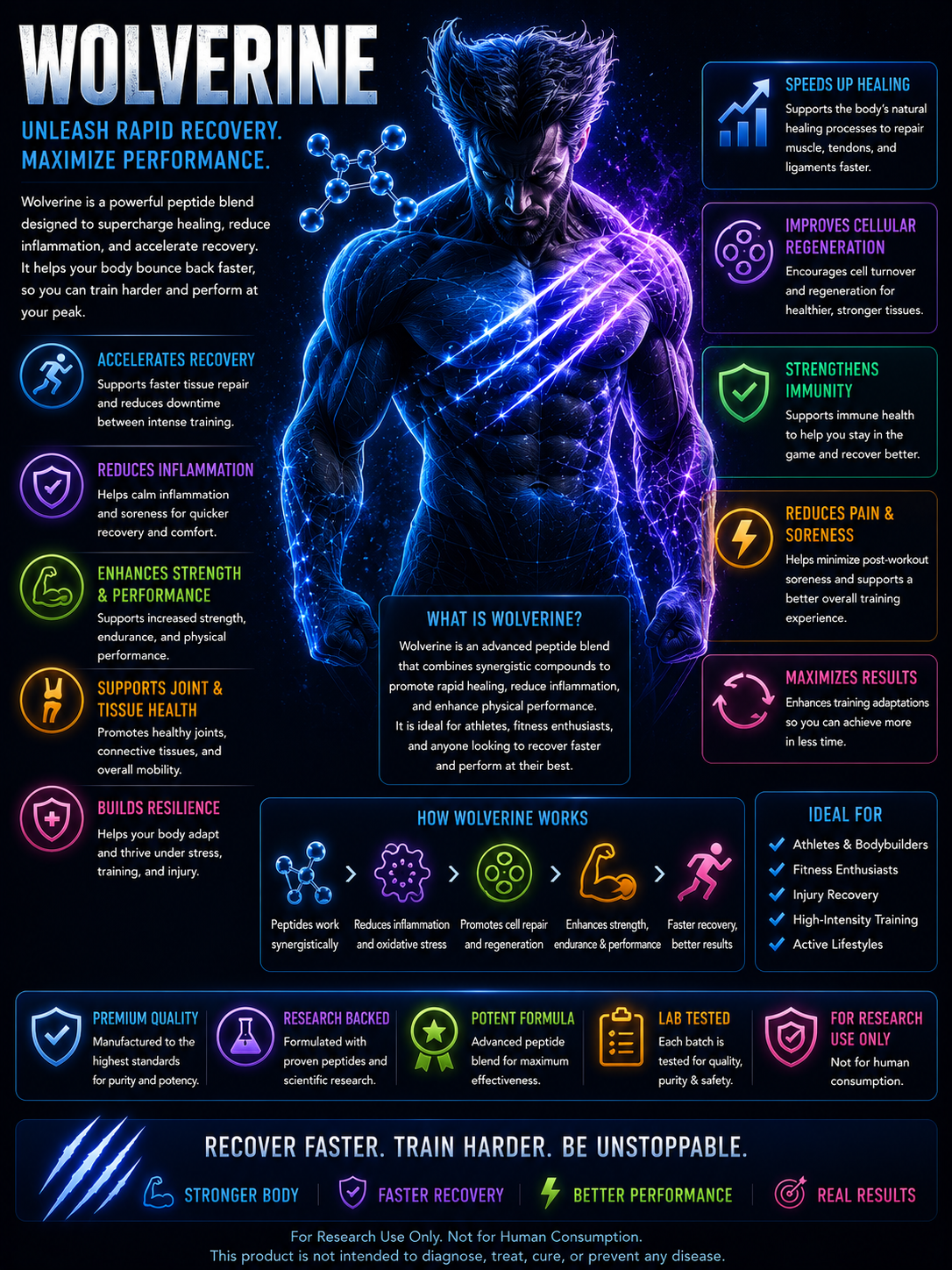
The Wolverine blend is a commercial name for a two-component mixture containing BPC-157 and TB-500. The name references a fictional character known for rapid healing, but it has no scientific or regulatory definition.
BPC-157 + TB-500
1:1 by labeled mass
10 mg or 20 mg
No
None established
No
Typical Wolverine Composition
| Version | BPC-157 | TB-500 | Total |
|---|---|---|---|
| Common lower-total blend | 5 mg | 5 mg | 10 mg |
| Common higher-total blend | 10 mg | 10 mg | 20 mg |
| Other commercial versions | Variable | Variable | Variable |
🧬 Component Chemistry
BPC-157
GEPPPGKPADDAGLV
| Length | 15 amino acids |
|---|---|
| Formula | C62H98N16O22 |
| Molecular weight | Approximately 1419.5 Da |
| Structure | Linear peptide, no disulfide bonds |
Best-characterized TB-500 fragment
Ac-LKKTETQ-OH
| Length | 7 amino acids |
|---|---|
| Formula | C38H68N10O14 |
| Molecular weight | Approximately 889.0 Da |
| Origin | Thymosin beta-4 residues 17–23 |
Full-length thymosin beta-4
Ac-SDKPDMAEIEKFDKSKLKKTETQEKNPLPSKETIEQEKQAGES-OH
| Length | 43 amino acids |
|---|---|
| Molecular weight | Approximately 4963.5 Da |
| Key distinction | Contains multiple regions absent from Ac-LKKTETQ |
📅 Research Background
- 1980s–1990s: Thymosin beta-4 research established actin binding, cell migration, angiogenesis, and tissue repair.
- 1990s–2000s: BPC-157 research expanded across gastric, tendon, muscle, nerve, and vascular animal models.
- 1999: Full-length thymosin beta-4 accelerated wound healing in animal studies.
- 2003–2011: BPC-157 studies reported Achilles-tendon healing and fibroblast migration through FAK-paxillin signaling.
- 2012: Anti-doping laboratories identified TB-500 material as Ac-LKKTETQ.
- 2020s: Commercial sellers increasingly combined BPC-157 and TB-500 under the Wolverine name.
🧠 Proposed Multi-Pathway Mechanism
Fibroblast migration
BPC-157 has increased tendon-fibroblast migration and FAK-paxillin signaling in experimental systems.
Cytoskeletal remodeling
Thymosin-related peptides regulate actin dynamics required for cell movement and wound closure.
Angiogenesis
Both components are associated with endothelial migration and vascular signaling in preclinical models.
Nitric-oxide biology
BPC-157 appears to interact with nitric-oxide synthase pathways and vascular adaptation.
Matrix organization
BPC-157 research includes collagen organization, while thymosin beta-4 research includes fibroblasts, collagen deposition, and remodeling.
Potential Research Areas
Tendon and ligament research
Animal work involving BPC-157 includes Achilles tendon, ligament injury, tendon-to-bone integration, and fibroblast behavior.
Muscle research
BPC-157 and full-length thymosin beta-4 have each been studied in muscle-injury and regeneration models.
Wound healing
Full-length thymosin beta-4 has direct wound-healing literature, while BPC-157 has broad animal cytoprotection and wound data.
Gastrointestinal research
BPC-157 has been investigated in ulcers, intestinal injury, fistulas, and mucosal protection models.
Nerve research
BPC-157 and thymosin-related peptides have been studied in peripheral nerve and neurorestorative models.
Vascular research
The combination is conceptually linked to endothelial integrity, collateral circulation, angiogenesis, and tissue perfusion.
Potential Synergy and Research Rationale
The theoretical rationale combines BPC-157-related cytoprotection, vascular signaling, fibroblast migration, and collagen organization with TB-500-related actin regulation and cellular migration.
However, overlapping pathways do not prove synergy. The components may be additive, redundant, antagonistic, unstable together, or active at mismatched molar concentrations. No validated study establishes a 1:1 mass ratio as optimal.
Formulation Compatibility and Stability
- BPC-157 and TB-500 may differ greatly in size, charge, hydrophobicity, and molar concentration.
- Ac-LKKTETQ and full-length Tβ4 require different analytical and formulation strategies.
- Peptides may adsorb to glass, rubber, plastic, filters, or vial surfaces.
- A pH favorable to one component may increase degradation or aggregation of the other.
- A clear solution does not exclude truncation, deacetylation, epimerization, oxidation, aggregation, or incorrect content.
Human Evidence
Human evidence for BPC-157 is limited to very small and uncontrolled reports, including a small knee-pain series and a two-person intravenous safety pilot. Controlled human studies of Ac-LKKTETQ are essentially absent.
Defined full-length thymosin beta-4 formulations have reached wound and ophthalmic human trials, but those results do not validate a Wolverine blend or an undisclosed TB-500 ingredient.
No controlled human pharmacokinetic, safety, or efficacy trial has evaluated the combined BPC-157/TB-500 formulation.
FDA and WADA Status
Neither the Wolverine blend nor BPC-157 is FDA approved. FDA states that compounded BPC-157 may present immunogenicity, peptide-impurity, and active-ingredient-characterization risks and that available human safety information is insufficient.
The 2026 World Anti-Doping Agency Prohibited List includes BPC-157 and thymosin beta-4 derivatives such as TB-500.
Potential Side Effects and Safety Considerations
- Injection-site pain, redness, swelling, or infection
- Hypersensitivity and anti-peptide antibodies
- Endotoxin, microbial contamination, or particulates
- Incorrect sequence, component amount, or ratio
- Unknown liver and kidney handling
- Unknown coagulation and blood-pressure effects
- Unknown reproductive and developmental safety
- Potentially undesirable angiogenesis or cell migration in cancer or proliferative disease
🧪 Laboratory Testing Methods
| Method | Purpose | Key limitation |
|---|---|---|
| Component-specific RP-HPLC/UPLC | Separates BPC-157 and TB-500 species | One method may not resolve both optimally |
| LC-HRMS | Confirms intact masses | Does not alone prove sequence |
| MS/MS peptide mapping | Confirms residue order | Requires separate optimized methods |
| TB-500 identity assay | Determines fragment versus full-length Tβ4 | The trade name is insufficient |
| N-terminal acetylation assay | Confirms required modification | Must distinguish other +42 Da changes |
| Chiral amino-acid analysis | Detects epimers | Hydrolysis can introduce artifacts |
| Separate net-content assays | Quantifies each component | Total vial mass cannot establish ratio |
| Counterion and water analysis | Corrects TFA, acetate, salts, and moisture | Gross mass may overstate peptide |
| SEC-HPLC / DLS | Measures aggregates and particles | Components differ greatly in size |
| BPC-157 conformer profiling | Characterizes proline-related forms | Conformers may interconvert |
| G-actin binding assay | Measures TB-500-related potency | Fragment and full-length potency differ |
| Fibroblast migration assay | Measures BPC-157-related activity | Does not prove clinical healing |
| Endothelial migration assay | Measures vascular activity | Angiogenesis is context dependent |
| Blend-compatibility assay | Tracks components after mixing | Separate stability cannot predict blend behavior |
| Sterility, endotoxin, and particles | Finished injectable evaluation | Raw purity does not establish safety |
| Stability-indicating assay | Tracks degradation and potency loss | Requires validated stress studies |
📄 How to Interpret a Wolverine COA
- Confirm BPC-157 sequence: GEPPPGKPADDAGLV.
- Require the exact TB-500 sequence.
- Determine whether TB-500 is Ac-LKKTETQ, full-length Tβ4, or another analogue.
- Require separate identity and net-content testing for both components.
- Do not accept one total purity percentage for the blend.
- Confirm terminal modifications and stereochemistry.
- Measure truncations, epimers, oxidation, and deacetylation.
- Correct each component for water and counterions.
- Use fibroblast-migration testing for BPC-157-related potency.
- Use actin-binding or actin-polymerization testing for TB-500-related potency.
- Perform blend-specific compatibility and stability studies.
- For injectables, require sterility, endotoxin, particles, fill accuracy, container closure, and post-reconstitution stability.
- A COA does not establish human safety, efficacy, or FDA approval.
📊 Comparison Tables
Wolverine vs GLOW vs KLOW
| Feature | Wolverine | GLOW | KLOW |
|---|---|---|---|
| Typical components | BPC-157 + TB-500 | GHK-Cu + BPC-157 + TB-500 | GHK-Cu + BPC-157 + TB-500 + KPV |
| Main theme | Soft-tissue recovery | Repair plus skin/matrix | Repair plus inflammatory signaling |
| Standardized? | No | No | No |
| Direct blend trials? | No | No | No |
BPC-157 vs TB-500
| Feature | BPC-157 | TB-500 |
|---|---|---|
| Main pathway | Cytoprotection, endothelial and fibroblast signaling | Actin and cellular migration |
| Typical size | 15 aa | 7 aa fragment or 43 aa parent |
| Human evidence | Extremely limited | Fragment: essentially absent; full-length: selected local trials |
| FDA approved | No | No |
Basic Blend vs Research-Qualified Blend
| Attribute | Basic claim | Research-qualified material |
|---|---|---|
| Identity | “BPC/TB blend” | Two exact sequences and modifications |
| Content | Total vial mass | Two separate net-content values |
| Purity | One percentage | Component-specific purity and degradants |
| Potency | Often untested | Fibroblast and actin functional assays |
🖼️ Original Diagram Specifications
- Composition wheel showing equal labeled masses of BPC-157 and TB-500.
- Sequence comparison of BPC-157, Ac-LKKTETQ, and full-length Tβ4.
- Mechanism map showing fibroblast migration, actin remodeling, vascular signaling, collagen, and wound closure.
- Soft-tissue repair cascade from injury through remodeling.
- TB-500 identity problem: fragment versus full-length parent versus undisclosed analogue.
- Evidence pyramid showing component animal data, limited component human data, and absent blend trials.
- COA workflow showing two identities, two contents, potency, sterility, and blend stability.
❓ Frequently Asked Questions
Is Wolverine one peptide?
No. It is a commercial BPC-157 and TB-500 blend.
What is usually in it?
Often 5/5 mg or 10/10 mg of BPC-157 and TB-500.
Is the formula standardized?
No.
Is it FDA approved?
No.
Has the blend been studied in humans?
No controlled human trial has been established.
Is TB-500 the same as thymosin beta-4?
Not necessarily. Exact sequence testing is required.
Does Wolverine heal injuries?
Animal and cell research provides a rationale for the components, but human combination efficacy is unproven.
Is it the same as GLOW?
No. GLOW generally adds GHK-Cu.
Is it the same as KLOW?
No. KLOW generally adds GHK-Cu and KPV.
Is it prohibited in sports?
Its BPC-157 and TB-500 components are prohibited by WADA.
Does 99% HPLC purity prove the blend is correct?
No. Both components need separate identity, content, impurity, potency, and stability testing.
Is there an established human dose?
No FDA-approved or clinically validated dose exists.
Final Thoughts
The Wolverine blend combines BPC-157’s experimental cytoprotective, endothelial, nitric-oxide, fibroblast, and collagen-related pathways with TB-500-related actin and cellular-migration biology.
The concept has a plausible soft-tissue repair rationale, but no evidence establishes synergy, an optimal ratio, one-vial compatibility, or human clinical benefit. Most supporting evidence comes from separate animal studies.
The TB-500 name creates substantial uncertainty because Ac-LKKTETQ and full-length thymosin beta-4 are different molecules. A credible product evaluation must confirm both exact sequences, terminal modifications, stereochemistry, separate net contents, impurities, potency, microbiological quality, and blend-specific stability.
📚 References
- McGuire FP, et al. Regeneration or Risk? A Narrative Review of BPC-157 for Musculoskeletal Healing. 2025.
- Vasireddi N, et al. Emerging Use of BPC-157 in Orthopaedic Sports Medicine. 2025.
- Chang CH, et al. The Promoting Effect of Pentadecapeptide BPC 157 on Tendon Healing. Journal of Applied Physiology. 2011.
- Staresinic M, et al. Gastric Pentadecapeptide BPC 157 Accelerates Healing of Transected Rat Achilles Tendon. 2003.
- Cushman CJ, et al. Local and Systemic Peptide Therapies for Soft Tissue Regeneration. 2024.
- Lee E, et al. Intra-Articular Injection of BPC 157 for Multiple Types of Knee Pain. 2021.
- Lee E, et al. Safety of Intravenous Infusion of BPC-157 in Humans. 2025.
- Philp D, et al. Animal Studies with Thymosin Beta-4. Annals of the New York Academy of Sciences. 2010.
- Malinda KM, et al. Thymosin Beta-4 Accelerates Wound Healing. Journal of Investigative Dermatology. 1999.
- Goldstein AL, Kleinman HK. Advances in the Basic and Clinical Applications of Thymosin Beta-4. 2015.
- Esposito S, et al. Characterization of the N-Terminally Acetylated Thymosin Beta-4 Fragment Identified in TB-500. 2012.
- Ho ENM, et al. Doping Control Analysis of TB-500. 2012.
- U.S. Food and Drug Administration. Certain Bulk Drug Substances for Use in Compounding That May Present Significant Safety Risks: BPC-157.
- World Anti-Doping Agency. 2026 Prohibited List.
- International Council for Harmonisation. ICH Q1A(R2), Q2(R2), Q3A, Q3B, Q3C, and Q6B.
- United States Pharmacopeia General Chapters <621>, <71>, <85>, and <788>.
Composition, chemistry, evidence, FDA and WADA status, safety, and analytical recommendations reviewed in July 2026.