Cerebrolysin: What It Is, How It Works, Benefits, and Research Overview
A comprehensive, evidence-graded review of Cerebrolysin, a standardized injectable porcine-brain protein hydrolysate containing a complex mixture of low-molecular-weight peptides and free amino acids studied for neuroprotection, neuroplasticity, stroke recovery, traumatic brain injury, dementia, and cognitive impairment.
What Is Cerebrolysin?
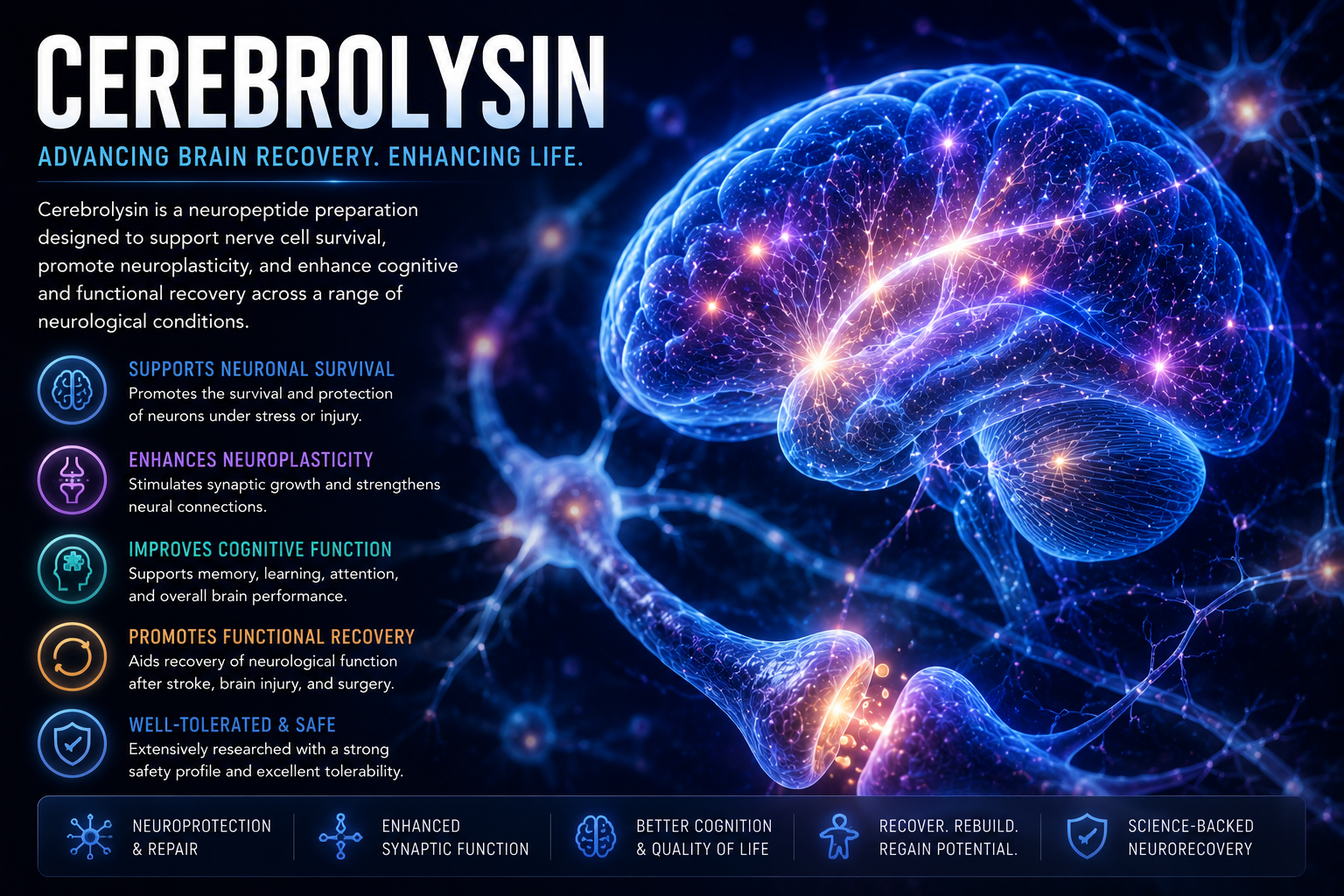
Cerebrolysin is an injectable neuropeptide preparation manufactured from enzymatically hydrolyzed, purified porcine brain proteins. It is marketed in a number of countries as a prescription medicine for neurological conditions, while remaining unapproved in the United States.
Porcine-brain protein hydrolysate
Sterile aqueous injection
215.2 mg concentrate per mL
Small peptides and amino acids
No
No
Primary research areas
- Acute ischemic stroke and rehabilitation
- Traumatic brain injury
- Alzheimer’s disease and vascular dementia
- Post-stroke cognitive impairment
- Neuroplasticity and neurogenesis
- Excitotoxicity, oxidative stress, and apoptosis
- Blood–brain barrier integrity
- Axonal sprouting and synaptic remodeling
🧬 Composition and Manufacturing
Porcine starting material
Cerebrolysin is produced from pig brain proteins. The starting tissue undergoes controlled processing, enzymatic hydrolysis, purification, filtration, standardization, and sterile filling.
Low-molecular-weight peptide mixture
The product is commonly described as containing biologically active low-molecular-weight peptides capable of crossing or influencing the blood–brain barrier, together with free amino acids.
Labeled concentration
Manufacturer prescribing information states that one milliliter contains 215.2 mg of Cerebrolysin concentrate in aqueous solution. Listed excipients are sodium hydroxide and water for injection.
No public complete sequence inventory
The preparation contains many peptide species rather than a single defined sequence. A complete quantitative list of every peptide is not presented as a conventional active-ingredient sequence specification.
Hydrolysate standardization
Consistency depends on controlling the source tissue and hydrolysis process so that each batch produces a reproducible peptide-size distribution, chromatographic fingerprint, amino-acid profile, and biological response.
Biologic-product complexity
A product can match total protein or nitrogen concentration while differing substantially in peptide composition or biological activity. Comparative research has reported that some claimed alternatives had different peptide profiles and lacked comparable biological activity.
Why Cerebrolysin Has No Single Sequence or Molecular Formula
| Property | Cerebrolysin | Single synthetic peptide |
|---|---|---|
| Number of molecular species | Many peptides and amino acids | One intended parent molecule |
| Single amino-acid sequence | No | Yes |
| Single molecular formula | No | Yes |
| Single molecular weight | No; requires distribution profile | Yes |
| Identity strategy | Orthogonal fingerprint and bioassay | Sequence and parent mass |
| Batch consistency | Process and multivariate comparability | Purity and exact chemical identity |
Incorrect “peptide purity” claims
A statement such as “Cerebrolysin 99% pure” is incomplete unless it defines what was measured. There is no single parent peak whose HPLC area can represent the entire active mixture.
Incorrect milligram equivalence
Total dried solids or peptide mass does not establish equivalence to branded Cerebrolysin. Two hydrolysates may contain the same total mass but different sequence populations, degradation products, contaminants, and potency.
Reference-product dependence
Meaningful authentication generally requires direct comparison with a qualified reference lot using the same analytical platform.
📅 Development and Research Timeline
- 1970s: Cerebrolysin entered neurological use and research in parts of Europe and Asia.
- 1980s–1990s: Studies expanded into dementia, stroke, neurotrophic signaling, and neuronal survival.
- 2000s: Randomized trials evaluated Alzheimer’s disease, vascular dementia, acute ischemic stroke, and traumatic brain injury.
- 2010: A large acute-stroke trial reported no significant overall primary-outcome advantage, although exploratory severe-stroke subgroups drew interest.
- 2011: A randomized vascular-dementia trial reported improvements in cognition and global outcome.
- 2012: A pooled safety analysis described mostly mild and transient adverse events across dementia and stroke trials.
- 2016: FDA granted orphan designation to a porcine-brain peptide fraction for frontotemporal dementia; the designation did not become FDA approval.
- 2016–2021: Trials combined Cerebrolysin with structured rehabilitation after stroke and traumatic brain injury.
- 2019: Cochrane analyses described dementia evidence as limited and inconsistent and acute-stroke evidence as not demonstrating a mortality benefit.
- 2023–2025: New reviews and meta-analyses continued to report possible neurological-recovery signals while emphasizing heterogeneity and the need for better trials.
- 2026: Cerebrolysin remained marketed internationally but not FDA approved in the United States.
🧠 Proposed Mechanism of Action
Multimodal rather than single-receptor pharmacology
Cerebrolysin is not understood as one ligand acting at one receptor. Its proposed activity reflects a network of peptide species acting through several cellular pathways.
Neurotrophic-factor-like activity
Experimental work suggests effects that resemble or enhance signaling associated with BDNF, NGF, CNTF, and related neurotrophic systems without proving that the preparation simply contains intact human growth factors.
PI3K–AKT and survival signaling
Activation of survival pathways may reduce apoptosis and support neuronal resilience after ischemic, excitotoxic, metabolic, or traumatic stress.
Sonic hedgehog signaling
Preclinical literature describes modulation of sonic-hedgehog-related pathways involved in progenitor-cell activity, neurogenesis, angiogenesis, and tissue remodeling.
Anti-inflammatory effects
Reported effects include reduction of selected pro-inflammatory mediators, modulation of microglial responses, and support of the neurovascular unit.
Neuroprotection Research
Excitotoxicity
Cerebrolysin has protected neuronal cultures and organotypic brain slices against glutamate-associated injury in experimental models.
Oxidative stress
Studies report reduced free-radical damage and improved endogenous cellular-defense responses.
Apoptosis
The preparation has been associated with lower activation of selected pro-apoptotic enzymes and improved cell survival after injury.
Blood–brain barrier
Animal traumatic-brain-injury research reported reduced edema, lower barrier permeability, and increased expression of tight-junction proteins.
Timing matters
Acute neuroprotection may depend heavily on how quickly treatment begins, injury severity, standard care, and rehabilitation.
Neuroplasticity and Neurorecovery
Neurogenesis
Experimental literature suggests increased progenitor-cell proliferation and differentiation in neurogenic regions.
Synaptogenesis
Cerebrolysin has been associated with preservation or restoration of synaptic proteins and dendritic structures in animal models.
Axonal sprouting
Research explores enhancement of axonal growth, network reorganization, and functional reconnection after central and peripheral nerve injury.
Angiogenesis and neurovascular remodeling
Vascular remodeling may support tissue recovery by improving perfusion and creating a permissive environment for neural repair.
Rehabilitation synergy
Several studies investigate Cerebrolysin as an adjunct to physical or occupational rehabilitation rather than as a replacement for rehabilitation.
Acute Ischemic-Stroke Research
Randomized trials
Multiple controlled studies have tested Cerebrolysin after ischemic stroke, often alongside antiplatelet, thrombolytic, or rehabilitation care.
Neurological-score signals
Some trials and meta-analyses report greater early improvement on the NIH Stroke Scale or composite neurological measures.
Functional independence
Effects on modified Rankin Scale or durable functional independence are less consistent than effects on early neurological scores.
Mortality
Cochrane analysis found no clear mortality difference between Cerebrolysin and placebo in acute ischemic stroke.
Serious adverse events
Some reviews have raised concern about the number of nonfatal serious adverse events in individual studies, while other pooled analyses report no significant overall difference.
Heterogeneity
Trials vary in dose, treatment window, stroke severity, duration, rehabilitation intensity, geographic setting, and outcome definitions.
Clinical interpretation
The evidence supports continued research and possible adjunctive use where locally approved, but does not support replacing reperfusion therapy, antithrombotic care, vascular-risk management, or rehabilitation.
Traumatic-Brain-Injury Research
Clinical studies
Cerebrolysin has been studied in mild, moderate, and severe traumatic brain injury, including minimally conscious states and rehabilitation settings.
Potential outcomes
Reported research endpoints include consciousness recovery, cognitive performance, motor function, disability, return to activity, and post-traumatic symptoms.
Animal mechanisms
Preclinical work reports reduced edema, preservation of blood–brain barrier integrity, decreased inflammation, and improved neuronal survival.
Systematic-review findings
Reviews often describe encouraging signals but emphasize small studies, variable protocols, and limited certainty.
No U.S. approval
Cerebrolysin is not FDA approved for concussion, traumatic brain injury, disorders of consciousness, or neurorehabilitation.
Alzheimer’s Disease and Dementia Research
Alzheimer’s disease
Randomized trials have evaluated cognition, activities of daily living, clinical global impression, and behavioral symptoms.
Vascular dementia
A multicenter trial reported improved cognition and global outcomes with persistence of selected benefits after treatment.
Cochrane interpretation
Systematic reviews have concluded that evidence may suggest cognitive benefit but remains limited by study quality, heterogeneity, potential bias, and uncertainty about clinical importance.
Disease modification is unproven
No evidence establishes that Cerebrolysin removes amyloid, prevents neurodegeneration, or reliably slows dementia progression over years.
Not FDA approved
Cerebrolysin is not an FDA-approved Alzheimer’s or vascular-dementia therapy.
Cognitive, Developmental, and Psychiatric Research
Post-stroke cognitive impairment
Studies explore memory, attention, executive function, and global cognition during stroke recovery.
Developmental and neuropsychiatric models
Preclinical and limited clinical literature has examined autism-related behavior, Rett-syndrome models, schizophrenia-related models, depression, and other psychiatric conditions.
Evidence quality
Most psychiatric applications remain exploratory, with small samples or animal models and no broad regulatory approval.
Healthy cognition
No robust evidence establishes Cerebrolysin as a safe cognitive enhancer or “nootropic” for healthy adults.
Evidence Quality and Conflicting Findings
| Research area | Potential signal | Main uncertainty |
|---|---|---|
| Acute ischemic stroke | Possible early neurological improvement | Inconsistent durable functional benefit |
| Stroke rehabilitation | Possible motor-recovery improvement | Small studies and heterogeneous rehabilitation |
| Traumatic brain injury | Possible cognitive and consciousness benefit | Limited trial size and protocol variation |
| Vascular dementia | Possible cognitive and global improvement | Low-to-moderate certainty and bias concerns |
| Alzheimer’s disease | Possible short-term symptom improvement | No proven long-term disease modification |
| Healthy cognitive enhancement | Insufficient evidence | No robust controlled clinical program |
Positive meta-analyses
Several pooled analyses report statistically significant improvement in neurological scores or response rates.
Conservative reviews
Cochrane reviews have emphasized uncertainty, inconsistent efficacy, and lack of proven mortality benefit.
Sponsor and publication considerations
Interpretation should examine trial sponsorship, access to individual-patient data, publication bias, comparator care, and selective subgroup analyses.
Statistical versus clinical significance
A small improvement in a neurological scale may not translate to independent living, reduced institutionalization, or improved long-term quality of life.
International and U.S. Regulatory Status
International use
Cerebrolysin is authorized or prescribed in a number of European, Asian, and other national markets for neurological indications under country-specific labeling.
No single European Union-wide approval claim
National authorization in European countries should not be confused with a centralized EMA authorization applicable throughout the European Union.
United States
Cerebrolysin is not FDA approved.
Orphan designation
FDA granted an orphan designation in 2016 for a porcine-brain peptide fraction for frontotemporal dementia. FDA’s database states that it was not approved for the orphan indication.
Compounding enforcement
FDA warning-letter materials have stated that Cerebrolysin was not a component of an FDA-approved human drug, did not have an applicable USP or NF monograph, and did not appear on the applicable 503A bulks list in the cited context.
UNII limitation
FDA’s UNII system lists Cerebrolysin, but a UNII is an identity code and does not imply regulatory review or approval.
Potential Side Effects, Contraindications, and Safety Considerations
Reported adverse reactions
- Vertigo or dizziness
- Agitation
- Feeling hot or flushing
- Headache
- Sweating
- Nausea
- Injection or infusion reactions
- Blood-pressure or heart-rate changes when administered too rapidly
- Allergic or hypersensitivity reactions
Contraindications in manufacturer information
- Hypersensitivity to product components
- Epilepsy
- Severe renal impairment
Seizure concern
Manufacturer materials list epilepsy as a contraindication. Neurologically active peptide mixtures may alter excitability, and rapid administration or patient-specific factors may increase risk.
Renal impairment
Severe renal impairment is listed as a contraindication in manufacturer prescribing information.
Infusion compatibility
As a complex biologic mixture, Cerebrolysin may be incompatible with some solutions or co-administered products. Product-specific instructions should govern handling where legally prescribed.
Animal-source risks
Quality controls must address animal health, tissue sourcing, adventitious agents, transmissible spongiform encephalopathy risk assessment, viral safety, and manufacturing traceability.
Immunogenicity
Repeated exposure to a porcine-derived peptide mixture may create antibody or hypersensitivity risks even when most peptides are small.
Counterfeit and substitute risk
Unregulated products may be diluted, contaminated, improperly stored, mislabeled, or manufactured from a different hydrolysate with a noncomparable fingerprint.
🧪 Laboratory Testing Methods
| Method | Purpose | Important limitation |
|---|---|---|
| SEC-HPLC / size-exclusion chromatography | Measures peptide molecular-weight distribution and excludes high-molecular-weight species | Limited sequence identification |
| LC-HRMS peptidomics | Profiles thousands of peptide ions and sequence features | Requires a qualified reference lot and complex data analysis |
| Data-independent LC-MS/MS | Creates reproducible peptide fingerprints across lots | Not every peptide can be fully sequenced or quantified |
| Targeted peptide-marker assay | Monitors selected identity and consistency markers | Markers cannot represent the entire mixture alone |
| Free amino-acid analysis | Measures individual amino-acid composition | Does not establish peptide composition |
| Total peptide / nitrogen assay | Measures bulk concentration | Same total mass can have different biological activity |
| Amino-nitrogen assay | Estimates hydrolysis extent | Nonspecific |
| Peptide molecular-weight cutoff assay | Confirms absence of undesired larger proteins | Does not identify low-mass impurities |
| RP-UPLC fingerprint | Measures hydrophobic peptide distribution | Complex coelution requires multivariate comparison |
| Capillary electrophoresis | Profiles charge distribution | Sensitive to buffer and pH conditions |
| UV and fluorescence fingerprinting | Measures aromatic and bulk compositional patterns | Low specificity |
| Proteomic principal-component analysis | Compares lot-to-lot similarity to reference batches | Requires validated acceptance boundaries |
| Cell-survival assay | Measures protection against glutamate, oxidative, or metabolic injury | Cell model may not predict clinical efficacy |
| Neurite-outgrowth assay | Measures neurotrophic and regenerative activity | May be sensitive to culture conditions |
| Synaptic-protein assay | Measures effects on synaptophysin, PSD-95, or related markers | Surrogate biological endpoint |
| BDNF / NGF pathway assay | Measures induction or modulation of neurotrophic signaling | Does not prove intact growth factors are present |
| PI3K–AKT signaling assay | Measures cell-survival pathway activation | Not specific to Cerebrolysin |
| Apoptosis assay | Measures caspase activity, TUNEL, or cell death | Strongly model dependent |
| Excitotoxicity assay | Measures protection against glutamate or NMDA injury | In-vitro relevance is limited |
| Inflammatory-response assay | Measures cytokine or microglial effects | May vary by donor and model |
| Adventitious-agent testing | Assesses viral, microbial, and animal-source contamination | Requires a risk-based validated panel |
| Porcine-species identity testing | Confirms animal source and detects substitution | Residual DNA may be very low after processing |
| Residual DNA assay | Measures host-tissue nucleic acids | Does not assess peptide impurities |
| Endotoxin assay | Measures bacterial endotoxin | Matrix interference must be controlled |
| Sterility testing | Confirms absence of viable microorganisms | Sampling cannot guarantee every unit |
| Particulate-matter testing | Measures visible and subvisible particles | Does not identify soluble aggregates |
| Osmolality and pH | Confirms injectable-solution consistency | Not an identity test |
| Extractables and leachables | Evaluates ampoule or vial packaging risk | Requires product-specific storage studies |
| Stability-indicating fingerprint | Tracks oxidation, hydrolysis, aggregation, precipitation, and potency change | Multiple orthogonal methods are required |
📄 How to Interpret a Cerebrolysin COA
- Do not expect one sequence, formula, or parent molecular weight.
- Confirm the manufacturer, batch number, animal source, and complete chain of custody.
- Verify the labeled concentration of Cerebrolysin concentrate per milliliter.
- Require a peptide molecular-weight distribution, not only total peptide mass.
- Use orthogonal LC-MS/MS and chromatographic fingerprints against a qualified reference lot.
- Report free amino acids separately from peptide-bound amino acids.
- Confirm batch comparability using predefined multivariate acceptance limits.
- Measure high-molecular-weight proteins, aggregates, and particulates.
- Use multiple biological potency assays, such as neuronal survival and neurite outgrowth.
- Verify porcine source and animal-tissue traceability.
- Review viral, adventitious-agent, and transmissible-agent risk controls.
- Measure residual DNA, endotoxin, bioburden, sterility, and particles.
- Confirm pH, osmolality, appearance, fill volume, and container closure.
- Require real-time and accelerated stability data in the final container.
- Do not accept “99% purity” as a complete identity or quality specification.
- Do not infer equivalence from total milligrams alone.
- A COA cannot establish clinical efficacy, FDA approval, or interchangeability with the authorized reference product.
📊 Comparison Tables
Cerebrolysin vs Cortexin vs Single Synthetic Peptides
| Feature | Cerebrolysin | Cortexin | Single synthetic peptide |
|---|---|---|---|
| Source | Porcine brain | Animal cerebral-cortex extract | Chemical or recombinant synthesis |
| Composition | Complex hydrolysate | Complex peptide fraction | One defined molecule |
| Single sequence | No | No | Yes |
| Identity test | Fingerprint plus bioassay | Fingerprint plus bioassay | Sequence and parent mass |
| FDA approved | No | No | Product dependent |
Cerebrolysin vs Citicoline vs Edaravone
| Feature | Cerebrolysin | Citicoline | Edaravone |
|---|---|---|---|
| Type | Peptide and amino-acid mixture | Defined nucleotide precursor | Defined small-molecule antioxidant |
| Main research theme | Neuroprotection and neurorecovery | Membrane and neurotransmitter metabolism | Free-radical scavenging |
| U.S. FDA status | Not approved | Not FDA approved as a stroke drug | Approved for selected ALS and MCI indications, product dependent |
| Composition control | Complex fingerprint | Single molecule | Single molecule |
Cerebrolysin vs Approved Alzheimer’s Medicines
| Feature | Cerebrolysin | Symptomatic drugs | Amyloid-directed antibodies |
|---|---|---|---|
| Main concept | Multimodal neurotrophic support | Cholinergic or NMDA modulation | Amyloid removal |
| FDA approval | No | Yes | Yes, selected products |
| Disease modification proven | No | No | Modest slowing in selected early disease populations |
| Monitoring | No FDA-approved U.S. protocol | Product specific | MRI and ARIA monitoring |
Authentic Reference Product vs Unverified Hydrolysate
| Attribute | Qualified reference product | Unverified “Cerebrolysin-like” product |
|---|---|---|
| Animal source | Documented and controlled | May be unclear |
| Peptide fingerprint | Lot-comparable | May differ substantially |
| Biological potency | Validated multi-assay profile | Often untested |
| Sterile manufacturing | Product-specific regulated controls | May be uncertain |
| Interchangeability | Cannot be assumed | |
🖼️ Original Diagram Specifications
- Manufacturing overview: Porcine brain tissue, controlled hydrolysis, purification, molecular-weight fractionation, standardization, filtration, and sterile filling.
- Mixture identity: Hundreds or thousands of peptide species and amino acids shown as a distribution rather than one sequence.
- Multimodal mechanism: Neurotrophic, anti-apoptotic, antioxidant, anti-inflammatory, blood–brain-barrier, and plasticity pathways.
- Stroke-recovery model: Acute neuroprotection followed by rehabilitation-supported neuroplasticity.
- Evidence map: Stroke, TBI, vascular dementia, Alzheimer’s disease, and exploratory psychiatry with evidence-strength grading.
- Risk map: Seizure risk, renal impairment, hypersensitivity, infusion effects, animal-source risks, contamination, and counterfeit products.
- COA workflow: Source traceability, molecular-weight distribution, LC-MS fingerprint, amino-acid profile, bioassays, sterility, and lot comparability.
❓ Frequently Asked Questions
Is Cerebrolysin a peptide?
It is a mixture containing many low-molecular-weight peptides and amino acids rather than one peptide.
What is its amino-acid sequence?
There is no single sequence.
What is its molecular formula?
There is no single molecular formula.
What is its molecular weight?
It has a molecular-weight distribution rather than one molecular weight.
What is Cerebrolysin made from?
Purified enzymatic hydrolysate of porcine brain proteins.
How much concentrate is in the commercial solution?
Manufacturer information states 215.2 mg of Cerebrolysin concentrate per milliliter.
Is Cerebrolysin FDA approved?
No.
Is it approved in other countries?
It is marketed or authorized in multiple countries under national regulatory systems, but indication and approval status vary by country.
Does it treat stroke?
Some trials report improved early neurological recovery, while systematic reviews find inconsistent evidence and no clear mortality benefit. It is not a replacement for established acute-stroke treatment.
Does it treat traumatic brain injury?
Research is encouraging but not definitive, and it is not FDA approved for TBI.
Does it treat Alzheimer’s disease?
Some studies report short-term cognitive or global improvements, but long-term disease modification is unproven.
Is it a nootropic for healthy people?
No robust evidence establishes safety or cognitive benefit in healthy adults.
Can it cause seizures?
Manufacturer prescribing information lists epilepsy as a contraindication.
Why is severe renal impairment a contraindication?
Manufacturer labeling lists it as a contraindication, and the complex peptide and amino-acid load may have uncertain handling in severe renal dysfunction.
Can a lab report 99% purity for Cerebrolysin?
A single purity percentage is not an adequate specification for a complex hydrolysate.
How should it be authenticated?
By comparison to a qualified reference lot using molecular-weight distribution, LC-MS/MS fingerprints, amino-acid profiles, biological potency, source controls, and sterile-product testing.
Final Thoughts
Cerebrolysin is fundamentally different from a defined synthetic peptide. It is a standardized porcine-brain protein hydrolysate containing a complex population of low-molecular-weight peptides and amino acids. Therefore, it has no single sequence, molecular formula, or parent mass.
Its proposed pharmacology is multimodal. Experimental studies suggest neurotrophic, anti-apoptotic, antioxidant, anti-inflammatory, blood–brain-barrier, neurogenesis, synaptogenesis, and axonal-remodeling effects. Clinical research has focused most heavily on stroke, traumatic brain injury, Alzheimer’s disease, and vascular dementia.
The clinical evidence is mixed. Some trials and meta-analyses report improvements in early neurological or cognitive scores, while conservative systematic reviews emphasize heterogeneity, potential bias, uncertain durable functional benefit, and lack of a demonstrated mortality advantage in acute ischemic stroke.
Cerebrolysin is not FDA approved. International authorization varies by country. Quality evaluation must focus on animal-source traceability, manufacturing consistency, molecular-weight distribution, high-resolution peptide fingerprints, free amino-acid composition, multiple biological potency assays, viral and adventitious-agent controls, sterility, endotoxin, particles, and batch comparability. Total milligrams or one HPLC percentage cannot establish equivalence.
📚 References
- EVER Neuro Pharma. Cerebrolysin Product Monograph. 2021.
- EVER Neuro Pharma. Cerebrolysin Treatment Handbook. 2023.
- U.S. Food and Drug Administration. Orphan Drug Designation: Peptide Fraction Derived From Porcine Brain Protein for Frontotemporal Dementia.
- U.S. Food and Drug Administration. Cerebrolysin UNII Record. UNII 37KZM6S21G.
- U.S. Food and Drug Administration. Tailor Made Compounding LLC Warning Letter. 2020.
- Thome J, et al. Safety and Tolerability of Cerebrolysin: Clinical Experience From Dementia and Stroke Trials. 2012.
- Guekht AB, et al. Cerebrolysin in Vascular Dementia: Randomized, Double-Blind, Placebo-Controlled Multicenter Trial. Journal of Stroke and Cerebrovascular Diseases. 2011.
- Cui S, et al. Cerebrolysin for Vascular Dementia. Cochrane Database of Systematic Reviews. 2019.
- Ziganshina LE, et al. Cerebrolysin for Acute Ischaemic Stroke. Cochrane Database of Systematic Reviews. 2016.
- Lang W, et al. A Prospective, Randomized, Placebo-Controlled Trial of Cerebrolysin in Acute Ischemic Stroke. 2013.
- Muresanu DF, et al. Cerebrolysin and Recovery After Stroke: A Randomized, Placebo-Controlled, Double-Blind Multicenter Trial. Stroke. 2016.
- Bornstein NM, et al. Safety and Efficacy of Cerebrolysin in Early Post-Stroke Recovery: Meta-Analysis. 2017.
- Stan A, et al. Cerebrolysin and Early Neurorehabilitation in Acute Ischemic Stroke. 2017.
- Wang Z, et al. Cerebrolysin for Functional Recovery in Acute Ischemic Stroke: Meta-Analysis. 2017.
- Patel PN, et al. Safety and Efficacy of Cerebrolysin for Neurorecovery After Ischemic Stroke: Systematic Review and Meta-Analysis. 2025.
- Jarosz K, et al. Cerebrolysin in Patients With Traumatic Brain Injury: Systematic Review and Meta-Analysis. 2023.
- Kim JY, et al. Effects of Cerebrolysin in Patients With Minimally Conscious State After Severe Brain Injury. 2019.
- Lu W, et al. Cerebrolysin Alleviates Early Brain Injury After Traumatic Brain Injury. 2022.
- Vázquez-Roque RA, et al. Chronic Cerebrolysin Administration and Synaptic Pathology in Experimental Models. 2011.
- Stepanichev M, et al. Effects of Cerebrolysin on the Nerve Growth Factor System in Aging Rat Brain. 2017.
- Seidl LF, et al. Comparing the Biological Activity and Composition of Cerebrolysin and Other Peptide Preparations. 2024.
- Riley C, et al. A Peptide Preparation Protects Organotypic Brain Slices Against Glutamate Toxicity. Journal of Neural Transmission. 2006.
- Mureșanu DF, et al. Role and Impact of Cerebrolysin for Ischemic Stroke Care. 2022.
- International Council for Harmonisation. ICH Q5A, Q5C, Q5D, Q6B, Q7, Q9, and Q10.
- European Medicines Agency. Guideline on Starting Materials and Intermediates for Non-Recombinant Biological Medicinal Products.
- United States Pharmacopeia General Chapters <71>, <85>, <788>, <621>, and applicable biologics chapters.
Composition, clinical evidence, current U.S. regulatory status, safety, and analytical recommendations reviewed in July 2026.