DSIP (Delta Sleep-Inducing Peptide): What It Is, How It Works, Benefits, and Research Overview
A comprehensive, evidence-graded review of DSIP—also called delta sleep-inducing peptide or emideltide—a nine-amino-acid peptide investigated for sleep regulation, circadian physiology, stress adaptation, neuroendocrine signaling, pain, withdrawal, and neuroprotection.
What Is DSIP?
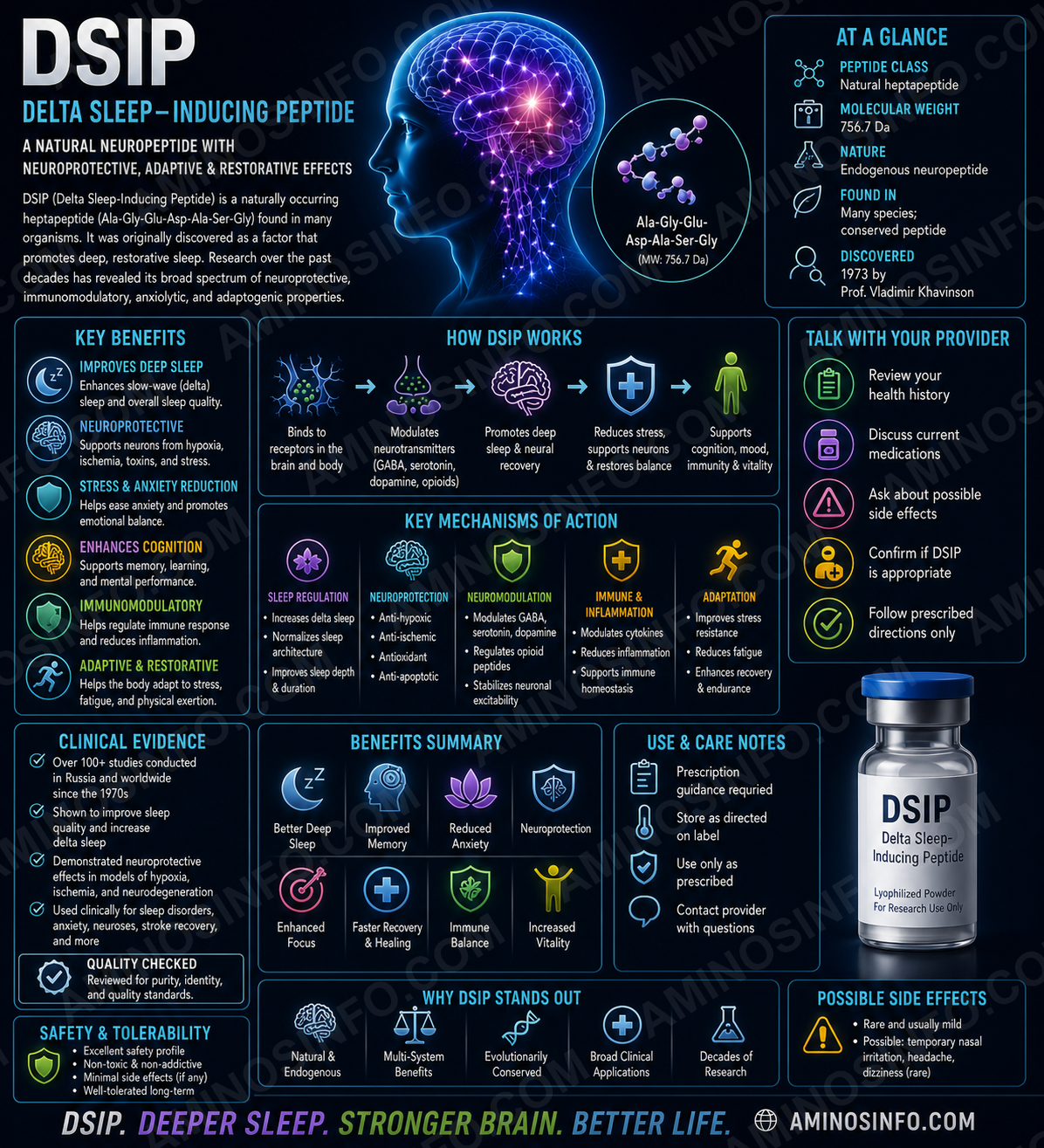
DSIP stands for delta sleep-inducing peptide. The standardized substance name used in FDA materials is emideltide. It is a linear nonapeptide originally isolated during experiments involving electrically induced sleep-like states in rabbits.
9 amino acids
WAGGDASGE
Approximately 848.8 Da
None
None confirmed
No
Main research themes
- Sleep onset and slow-wave sleep
- Sleep architecture normalization
- Circadian and locomotor rhythms
- Stress adaptation and HPA-axis signaling
- Endogenous opioid and enkephalin pathways
- Pain and antinociception
- Alcohol and opioid withdrawal
- Neuroprotection and post-stroke recovery
🧬 Structure, Sequence, and Molecular Properties
🧪 Amino-acid sequence
H-Trp-Ala-Gly-Gly-Asp-Ala-Ser-Gly-Glu-OH
WAGGDASGE
| Length | 9 amino acids |
|---|---|
| Molecular formula | C35H48N10O15 |
| Average molecular weight | Approximately 848.8 g/mol |
| PubChem CID | 68816 |
| FDA UNII | YN28Z5YZ73 |
| N terminus | Free tryptophan amino group |
| C terminus | Free glutamic-acid carboxyl group |
| Disulfide bonds | None |
| Standardized name | Emideltide |
Highly polar structure
DSIP contains multiple acidic and polar residues and has low predicted passive lipid permeability. Reported CNS activity may involve transport, peripheral-to-central signaling, metabolites, or indirect endocrine pathways rather than simple diffusion.
Acidic residues
Asp5 and Glu9 contribute negative charge near physiologic pH. The peptide’s chromatographic and formulation behavior is sensitive to pH, ionic strength, and counterion composition.
Tryptophan oxidation
The N-terminal tryptophan can oxidize to several products, including hydroxytryptophan, oxindolylalanine, kynurenine-like species, or higher oxidation products. These impurities may change potency and immunogenicity.
Isoaspartate formation
Asp5 may undergo isomerization to isoaspartate during storage. An isoAsp variant can have the same molecular formula and nearly identical intact mass but different backbone geometry.
Discovery and the Biological-Identity Controversy
Original rabbit experiments
Researchers obtained cerebral venous blood from rabbits after low-frequency electrical stimulation of thalamic regions associated with sleep-like behavior. A sleep-promoting fraction was isolated and chemically characterized as a nonapeptide.
1977 identification
The Basel research group reported DSIP’s isolation and sequence during the 1970s, and the peptide was named for increased delta-wave sleep observed in experimental mammals.
Natural occurrence remains disputed
Later investigators reported DSIP-like immunoreactivity in brain and peripheral tissues, but definitive proof that free WAGGDASGE is a broadly occurring endogenous neuropeptide has remained difficult.
No known precursor gene
DSIP has not been linked to a conventional peptide-hormone precursor gene in the way that orexin, melatonin-related enzymes, or many classical neuropeptides have.
Possible DSIP-like molecules
Some researchers proposed that antibody assays may detect related peptide fragments, conjugates, phosphorylated forms, or larger precursor-derived molecules rather than free DSIP itself.
Implication
DSIP is chemically well defined as a synthetic peptide, but its exact endogenous source, receptor, and physiologic role remain unresolved.
📅 Discovery and Research Timeline
- 1960s: Rabbit cross-circulation and hemodialysate experiments supported the concept of a circulating sleep-promoting factor.
- 1970s: A sleep-promoting nonapeptide was isolated and named delta sleep-inducing peptide.
- 1978: Sequence and early animal sleep effects were reported.
- 1981–1984: Small human studies examined acute sleep effects, insomnia, performance, pain, and repeated administration.
- 1986–1988: Research expanded into circadian effects, thermoregulation, endocrine responses, opioid pathways, and sleep-onset physiology.
- 1992: A placebo-controlled study in 16 chronic-insomnia patients found weak improvements in sleep efficiency and latency that may partly have reflected placebo-group changes.
- 1990s: Animal work examined stress adaptation, cortisol, beta-endorphin, substance P, and withdrawal.
- 2006: A major review described DSIP as a “still unresolved riddle” because its natural occurrence and biological role remained obscure.
- 2021: Animal studies explored DSIP and DSIP-like peptides in stroke, brain infarction, myocardial infarction, and motor recovery.
- 2026: FDA classified emideltide as a compounded substance raising significant safety concerns and scheduled formal advisory review of its proposed compounding uses.
🧠 Proposed Mechanism of Action
No confirmed receptor
Unlike orexin, melatonin, GABA, or opioid peptides, DSIP has no validated dedicated receptor.
State-dependent activity
Effects vary with species, time of day, baseline sleep pressure, stress, route, dose, and prior sleep deprivation.
Indirect rather than sedative action
Several studies described delayed or normalizing effects rather than immediate pharmacologic sedation. DSIP may influence physiologic preparation for sleep instead of directly suppressing neuronal activity.
Peripheral contribution
Changes in body temperature, heart rate, blood pressure, endocrine signals, and pain threshold may occur before sleep changes and may contribute to sleep onset.
Blood–CSF transport
Experimental work suggests DSIP can cross the blood–CSF barrier, although transport and clearance mechanisms remain incompletely characterized.
Sleep Architecture and Insomnia Research
Delta sleep
DSIP was named for experimental increases in delta-frequency EEG activity and slow-wave sleep.
Not universally sleep inducing
Responses have varied among species and experimental conditions. In some animals REM effects were more prominent; in others DSIP had little effect.
Delayed response
Human research reported that sleep-promoting effects sometimes emerged approximately one hour after injection or during the second hour rather than immediately.
Possible normalization
Some investigators described DSIP as normalizing disturbed sleep architecture rather than simply increasing total sleep.
Chronic-insomnia controlled study
A double-blind matched-pairs study of 16 chronic-insomnia patients found higher sleep efficiency and shorter sleep latency with DSIP, but the authors concluded that effects were weak and partly could have resulted from incidental placebo-group change.
Open-label studies
Very small uncontrolled studies reported prolonged improvement after repeated injections, but lack of blinding, small samples, regression to the mean, and concurrent medication issues limit interpretation.
No modern pivotal trial
There is no large contemporary polysomnographic trial establishing clinically meaningful benefit, comparative efficacy, durability, or safety.
Circadian, Locomotor, and Thermoregulatory Research
Time-of-day dependence
DSIP effects appear strongly influenced by circadian phase. The same dose may produce different behavioral or sleep effects depending on administration time.
Locomotor rhythms
Animal studies reported changes in circadian locomotor activity and adaptation to altered light–dark conditions.
Thermoregulation
DSIP has been associated with changes in body temperature and thermal adaptation, which may be relevant because sleep onset normally involves coordinated heat redistribution.
Autonomic preparation
Changes in heart rate and blood pressure have been interpreted as part of a broader sleep-preparatory response.
No circadian-disorder approval
DSIP is not an established treatment for jet lag, shift-work disorder, delayed sleep phase, or circadian-rhythm disorders.
Endocrine and Stress-Axis Research
HPA axis
Animal studies examined DSIP effects on corticotropin, cortisol or corticosterone, and stress adaptation.
Stress-coping effects
Some experiments reported delayed changes in cortisol, beta-endorphin, and substance P after repeated stress.
Growth hormone
DSIP has been investigated in sleep-related GH release, but results do not establish a predictable therapeutic effect on the GH–IGF-1 axis.
Other hormones
Historical research described changes in luteinizing hormone, melatonin, ACTH, corticosteroids, and other endocrine measures, often with inconsistent direction and strong context dependence.
Endocrine uncertainty
Because no receptor is established, endocrine changes may be secondary to sleep, stress, temperature, opioid signaling, or other systemic effects.
Neurotransmitter, Opioid, and Enkephalin Pathways
Met-enkephalin release
DSIP stimulated immunoreactive Met-enkephalin release from rat lower-brainstem slices in vitro.
Opioid-dependent analgesia
Central DSIP produced antinociception in rodents that was blocked by naloxone, suggesting involvement of endogenous opioid pathways.
Monoamine systems
Historical studies explored serotonin, norepinephrine, dopamine, and acetylcholine changes, but no single transmitter mechanism explains the full profile.
GABA and glutamate
DSIP is sometimes marketed as a GABAergic sleep peptide, but direct high-affinity GABA receptor agonism has not been established.
Network modulation
The available evidence better supports broad network or indirect neuromodulation than a single conventional receptor mechanism.
Pain and Antinociception Research
Animal studies
Central administration produced dose-dependent antinociceptive effects in hot-plate and tail-pinch tests.
Naloxone sensitivity
Blocking opioid receptors reduced the antinociceptive effect, supporting involvement of endogenous opioid signaling.
Small human study
A seven-patient uncontrolled study involving migraine, vasomotor headache, tinnitus, and psychogenic pain reported lower pain levels in six patients after repeated intravenous administration.
Evidence limitation
The human study was extremely small, uncontrolled, heterogeneous, and not sufficient to establish analgesic efficacy.
No pain indication
DSIP is not approved for migraine, neuropathic pain, chronic pain, tinnitus, or opioid-sparing therapy.
Alcohol and Opioid-Withdrawal Research
Historical interest
DSIP was studied for insomnia, autonomic symptoms, craving, and stress associated with alcohol or opioid withdrawal.
Opioid-system rationale
Enkephalin and endorphin interactions provided a mechanistic basis for withdrawal research.
Clinical limitations
Older reports were small, used variable protocols, and predated modern standards for randomized addiction-treatment trials.
Not a detoxification drug
DSIP is not FDA approved for opioid-use disorder, alcohol-use disorder, withdrawal management, craving, or relapse prevention.
High-stakes risk
Alcohol and sedative withdrawal can be life threatening, and opioid withdrawal treatment should use evidence-based medical care.
Stroke, Ischemia, and Neuroprotection Research
Animal stroke models
Intranasal DSIP was reported to accelerate motor recovery after experimental stroke in rats.
DSIP-like KND peptide
A related DSIP-like peptide reduced brain infarction in mice and myocardial infarction in rats when given during reperfusion.
Possible pathways
Proposed mechanisms include stress adaptation, mitochondrial protection, inflammatory modulation, microcirculation, and reduction of ischemic injury.
Not direct clinical evidence
Animal recovery and infarct-size findings do not establish benefit in human stroke.
No emergency role
DSIP is not an approved treatment for stroke, heart attack, traumatic brain injury, or post-stroke rehabilitation.
Human Clinical Evidence
Acute healthy-subject studies
Small double-blind studies reported sleep pressure, delayed sleep promotion, and changes in subsequent-night sleep without classic sedative impairment.
Insomnia studies
Several small studies reported shorter sleep latency, improved sleep efficiency, or normalization after repeated dosing. The strongest controlled study described effects as weak and potentially influenced by placebo-group variation.
Twenty-four-hour effects
Some studies reported improved daytime alertness and performance despite nighttime sleep improvement.
Open-label durability claims
Long follow-up improvements reported in very small open-label cohorts are hypothesis generating rather than confirmatory.
No modern dose-finding program
There is no contemporary clinical program establishing dose-response, route comparison, pharmacokinetics, long-term safety, rebound, tolerance, or dependence risk.
Major Evidence Limitations
- No confirmed endogenous precursor gene
- No validated dedicated receptor
- Natural occurrence of free DSIP remains disputed
- Strong species and circadian dependence
- Many studies are more than three decades old
- Small sample sizes
- Inconsistent routes and doses
- Weak or mixed placebo-controlled findings
- Limited modern polysomnography
- No established pharmacokinetic profile for common compounded routes
- No long-term safety or immunogenicity program
- No approved formulation or dose
- Possible confusion between free base, acetate, phosphate, analogues, and DSIP-like peptides
- Commercial claims frequently exceed the evidence
FDA and Current Regulatory Status
FDA approval
Emideltide/DSIP is not FDA approved for any indication.
FDA substance registration
FDA’s substance system assigns emideltide the UNII YN28Z5YZ73. A UNII identifies a substance but does not imply approval.
Compounding safety category
FDA currently lists emideltide among bulk substances that may present significant safety risks. The agency cites potential immunogenicity and complexities involving peptide impurities and active-ingredient characterization.
Insufficient safety information
FDA states that it has not identified adequate safety information for the proposed route and therefore cannot determine whether compounded emideltide would harm humans.
2026 advisory review
As of July 15, 2026, FDA had scheduled emideltide free base and emideltide acetate for Pharmacy Compounding Advisory Committee discussion on July 24, 2026. The meeting had not yet occurred.
Sports status
DSIP is not generally named as a separate category on the WADA Prohibited List, but athletes remain responsible for unapproved substances and any prohibited ingredients or effects. Historical WADA surveillance documents identified DSIP as an unapproved sleep-aid peptide.
Potential Side Effects and Safety Considerations
Historical tolerability
Small older studies often described short-term intravenous DSIP as well tolerated, but the sample sizes were too small to detect uncommon or long-term risks.
Potential direct effects
- Headache
- Dizziness or lightheadedness
- Transient arousal or sleep pressure
- Changes in daytime alertness
- Nausea
- Blood-pressure or heart-rate changes
- Altered body temperature
- Unpredictable endocrine effects
Sleep-related risks
- Excessive sleepiness
- Impaired driving or performance
- Paradoxical arousal
- Interaction with sedatives, alcohol, opioids, or sleep medicines
- Masking untreated sleep apnea or other sleep disorders
Immunogenicity
Aggregates, oxidized tryptophan, isoaspartate, deletion peptides, or contaminated injectable products may stimulate immune responses.
Product-quality risks
- Incorrect sequence
- Free base versus acetate confusion
- Phosphate or analogue substitution
- Trp oxidation
- Asp isomerization
- Aggregation
- Endotoxin, microbial contamination, or particles
- Incorrect fill or net peptide content
Pregnancy and pediatrics
Reproductive, developmental, pregnancy, lactation, and pediatric safety have not been established.
🧪 Laboratory Testing Methods
| Method | Purpose | Important limitation |
|---|---|---|
| RP-HPLC / UPLC | Separates intact DSIP from deletion peptides, oxidation products, isoAsp variants, and synthesis impurities | Area purity does not prove sequence or potency |
| Hydrophilic-interaction LC | Provides orthogonal separation for highly polar DSIP species | Retention is sensitive to water and salt composition |
| LC-HRMS | Confirms intact mass near 848.8 Da | IsoAsp and some stereoisomers have the same mass |
| MS/MS peptide sequencing | Confirms WAGGDASGE residue order | Gly-rich sequences can produce limited diagnostic ions |
| N-terminal Trp assay | Confirms free tryptophan and detects oxidation | Multiple oxidation products require standards |
| Tryptophan-oxidation panel | Measures hydroxy, oxindolyl, kynurenine-like, and higher oxidation products | Light and oxygen exposure during testing can create artifacts |
| Asp / isoAsp mapping | Distinguishes normal Asp5 from isoaspartate | Intact mass cannot distinguish them |
| Chiral amino-acid analysis | Detects D-amino-acid or epimer contamination | Hydrolysis may introduce racemization |
| Terminal-group analysis | Confirms free N and C termini | Terminal variants may require orthogonal testing |
| Amino-acid analysis | Confirms composition and supports net-content measurement | Does not prove sequence order |
| Net peptide-content assay | Measures actual emideltide free-base content | Must correct for acetate, water, and excipients |
| Acetate and counterion assay | Distinguishes free base from acetate or other salt forms | Counterion stoichiometry may vary |
| Phosphate assay | Detects phosphorylated DSIP or phosphate contamination | Does not identify phosphorylation site by itself |
| Residual-solvent testing | Measures synthesis and purification solvents | Does not establish biological activity |
| SEC-HPLC / DLS | Measures aggregates and particles | Small peptide size limits SEC sensitivity |
| Capillary electrophoresis | Measures charge variants and acidic impurities | Requires tight pH control |
| Sleep-EEG animal assay | Measures effects on delta power, sleep latency, and architecture | Strong species and circadian dependence |
| Circadian-response assay | Evaluates time-of-day dependence | Complex and difficult to standardize |
| Enkephalin-release assay | Measures opioid-pathway interaction | Does not identify a direct DSIP receptor |
| Opioid-antagonist interaction assay | Tests naloxone-sensitive biological effects | Indirect pathway evidence only |
| Cortisol / corticosterone panel | Measures stress-axis effects | Results depend heavily on experimental stress |
| Blood–brain or blood–CSF transport assay | Evaluates CNS exposure | Animal transport may not predict humans |
| Sterility, endotoxin, and particles | Required for finished injectable evaluation | Raw peptide purity cannot establish injectable safety |
| Stability-indicating assay | Tracks oxidation, isoAsp formation, clipping, aggregation, adsorption, and potency loss | Requires validated forced-degradation and real-time studies |
📄 How to Interpret a DSIP / Emideltide COA
- Confirm the exact sequence: WAGGDASGE.
- Confirm molecular formula C₃₅H₄₈N₁₀O₁₅.
- Verify molecular weight near 848.8 Da.
- Use MS/MS sequencing rather than intact mass alone.
- Confirm free N-terminal tryptophan.
- Confirm the free C-terminal glutamic-acid carboxyl group.
- Measure tryptophan oxidation products.
- Distinguish Asp5 from isoAsp5.
- Confirm all amino acids have the intended L stereochemistry.
- Measure deletion peptides and epimers.
- State emideltide free base versus acetate or another salt form.
- Report net free-base peptide content after correcting for counterions and water.
- Measure aggregates, particles, and adsorption losses.
- Do not treat HPLC purity as proof of sleep-related potency.
- Use time-controlled EEG or validated neurophysiology assays when functional activity is claimed.
- For finished injectables, require sterility, endotoxin, particles, pH, osmolality, fill accuracy, container closure, and post-reconstitution stability.
- A COA does not establish FDA approval, clinical efficacy, or suitability for human administration.
📊 Comparison Tables
DSIP vs Melatonin vs Orexin Antagonists vs Benzodiazepines
| Feature | DSIP | Melatonin | Dual orexin antagonists | Benzodiazepines |
|---|---|---|---|---|
| Established target | None confirmed | MT1 / MT2 | OX1R / OX2R | GABA-A modulation |
| Main concept | Sleep normalization / state modulation | Circadian timing | Reduce wake drive | Broad CNS sedation |
| Modern human evidence | Weak and limited | Moderate, indication dependent | Strong for approved products | Strong but risk limited |
| FDA-approved products | No | Ramelteon is related; melatonin itself is supplement status in U.S. | Yes | Yes |
DSIP vs Selank vs Semax
| Feature | DSIP | Selank | Semax |
|---|---|---|---|
| Length | 9 aa | 7 aa | 7 aa |
| Main research focus | Sleep and stress physiology | Anxiety and neuroimmune signaling | Neuroprotection and cognition |
| Confirmed receptor | No | No single established receptor | No single established receptor |
| FDA approved | No | No | No |
DSIP vs Orexin-A and Orexin-B
| Feature | DSIP | Orexin-A / B |
|---|---|---|
| Main physiologic association | Sleep-promoting or sleep-normalizing research | Wakefulness and arousal |
| Defined receptors | None | OX1R and OX2R |
| Endogenous biology | Controversial | Well established |
| Clinical development | Minimal and old | Major approved antagonist and emerging agonist programs |
Basic DSIP Claim vs Research-Qualified Emideltide
| Attribute | Basic claim | Research-qualified material |
|---|---|---|
| Identity | “DSIP 5 mg” | WAGGDASGE by MS/MS |
| Content | Gross vial mass | Net free-base content corrected for water and counterion |
| Purity | One HPLC percentage | Trp oxidation, isoAsp, deletion, epimer, and aggregate profile |
| Potency | Assumed from identity | Validated time-controlled functional assay |
| Human efficacy | Not established by a COA | |
🖼️ Original Diagram Specifications
- Peptide architecture: WAGGDASGE with N-terminal tryptophan, Asp5, and Glu9 highlighted.
- Discovery diagram: Thalamic stimulation, cerebral venous sampling, purification, and sleep-testing workflow.
- Sleep-normalization model: Circadian, autonomic, endocrine, opioid, and thermoregulatory pathways converging on sleep onset.
- Human evidence timeline: Early acute studies, open-label insomnia work, controlled 1992 study, and absence of modern pivotal trials.
- Biological-identity controversy: Synthetic DSIP versus DSIP-like immunoreactivity, unknown precursor, and unknown receptor.
- Risk map: Unpredictable sleep response, endocrine effects, immunogenicity, oxidation, isoAsp, contamination, and drug interactions.
- COA workflow: Sequence, Trp oxidation, Asp/isoAsp, salt correction, functional assay, sterility, and stability.
❓ Frequently Asked Questions
Is DSIP a peptide?
Yes. It is a linear nine-amino-acid peptide.
What is its exact sequence?
WAGGDASGE.
What is its molecular formula?
C₃₅H₄₈N₁₀O₁₅.
What is its molecular weight?
Approximately 848.8 Da.
What is emideltide?
Emideltide is the standardized substance name used for DSIP.
Does DSIP have a known receptor?
No dedicated receptor has been conclusively established.
Is DSIP naturally produced in humans?
DSIP-like immunoreactivity has been reported, but the natural occurrence, precursor, and physiologic identity of free WAGGDASGE remain disputed.
Does DSIP reliably cause deep sleep?
No. Small studies reported possible improvements, but effects were inconsistent, delayed, weak, and not confirmed in modern large trials.
Is DSIP a sedative?
Older investigators described it as a sleep-normalizing or preparatory signal rather than a conventional immediate sedative.
Is DSIP FDA approved?
No.
What does FDA currently say?
FDA says compounded emideltide may pose immunogenicity and peptide-characterization risks and that sufficient safety information is unavailable.
Is DSIP used for opioid withdrawal?
It was studied historically, but it is not an approved or established withdrawal treatment.
Does DSIP reduce pain?
Animal studies suggest naloxone-sensitive antinociception, but human evidence is extremely limited.
Does DSIP affect cortisol?
Animal stress studies report changes in corticosteroid and related peptide signaling, but human effects are not predictable.
Can DSIP be used for stroke recovery?
No clinical evidence establishes this. Current support comes from animal research.
Does 99% HPLC purity prove an effective DSIP product?
No. Sequence, tryptophan oxidation, isoAsp formation, salt form, net content, potency, sterility, and stability must also be evaluated.
Final Thoughts
DSIP is a chemically simple but biologically enigmatic nonapeptide. Its WAGGDASGE sequence is well defined, yet its endogenous precursor, receptor, normal physiologic role, and reproducible mechanism remain unresolved nearly five decades after discovery.
Older human studies provide a limited signal that DSIP may influence sleep latency, sleep efficiency, daytime performance, or disturbed sleep architecture. However, the studies were small, methods varied, and the best controlled insomnia study characterized the effects as weak and potentially influenced by placebo-group changes.
DSIP has also been investigated in stress physiology, pain, endogenous opioid signaling, withdrawal, circadian regulation, thermoregulation, stroke, and ischemia. Most of these findings are animal based or derive from very small uncontrolled human studies.
FDA does not approve emideltide for any use and currently states that compounded products may pose immunogenicity and peptide-characterization risks, with insufficient information to determine safety. Analytical authentication requires much more than HPLC purity: full sequence confirmation, tryptophan-oxidation profiling, Asp-versus-isoAsp analysis, stereochemistry, terminal-group verification, salt-corrected content, aggregation, functional neurophysiology, sterility, and stability are all important.
📚 References
- PubChem. Delta Sleep-Inducing Peptide, CID 68816.
- FDA Global Substance Registration System. Emideltide, UNII YN28Z5YZ73.
- Schoenenberger GA, Monnier M. Characterization of a Delta-Electroencephalogram-Inducing Peptide. Proceedings of the National Academy of Sciences. 1977.
- Kastin AJ, et al. Isolation and Characterization of Delta Sleep-Inducing Peptide. 1978.
- Graf MV, Kastin AJ. Delta-Sleep-Inducing Peptide: A Review. Neuroscience & Biobehavioral Reviews. 1984.
- Graf MV, Kastin AJ. Delta-Sleep-Inducing Peptide: An Update. Peptides. 1986.
- Kovalzon VM, Strekalova TV. Delta Sleep-Inducing Peptide: A Still Unresolved Riddle. Journal of Neurochemistry. 2006.
- Schneider-Helmert D, et al. Acute and Delayed Effects of DSIP in Humans. 1981.
- Schneider-Helmert D, et al. Influence of Synthetic DSIP on Human Sleep. 1981.
- Schneider-Helmert D. Effects of DSIP in Man: Multifunctional Psychophysiological Properties. 1983.
- Kaeser HE. A Clinical Trial With DSIP. 1984.
- Schneider-Helmert D. DSIP in Insomnia. 1984.
- Schneider-Helmert D, et al. Efficacy of DSIP to Normalize Sleep in Middle-Aged and Elderly Chronic Insomniacs. 1986.
- Schneider-Helmert D, et al. Effects of DSIP on 24-Hour Sleep-Wake Functions. 1987.
- Bes F, et al. Effects of Delta Sleep-Inducing Peptide on Sleep of Chronic Insomniac Patients. 1992.
- Yehuda S. DSIP: A Tool for Investigating the Sleep-Onset Mechanism. 1988.
- Zlokovic BV, et al. Passage of DSIP Across the Blood-CSF Barrier. 1988.
- Nakamura A, et al. DSIP Stimulates Met-Enkephalin Release From Rat Lower-Brainstem Slices. Brain Research. 1989.
- Nakamura A, et al. Potent Antinociceptive Effect of Centrally Administered DSIP. 1988.
- Larbig W, et al. Therapeutic Effects of DSIP in Pain Syndromes. 1984.
- Sudakov KV, et al. DSIP and Stress-Adaptation Mechanisms. 1995.
- Iyer KS, et al. Evidence for a Role of DSIP in Slow-Wave Sleep and Sleep-Related Growth Hormone Release. 1988.
- Tukhovskaya EA, et al. Delta Sleep-Inducing Peptide Recovers Motor Function in a Rat Stroke Model. Molecules. 2021.
- Tukhovskaya EA, et al. DSIP-Like KND Peptide Reduces Brain and Myocardial Infarction. Biomedicines. 2021.
- U.S. Food and Drug Administration. Certain Bulk Drug Substances for Use in Compounding That May Present Significant Safety Risks: Emideltide.
- U.S. Food and Drug Administration. Evaluation of Emideltide-Related Bulk Drug Substances for the 503A Bulks List. May 2026.
- U.S. Food and Drug Administration. July 23–24, 2026 Pharmacy Compounding Advisory Committee Meeting Materials.
- International Council for Harmonisation. ICH Q1A(R2), Q2(R2), Q3A, Q3B, Q3C, and Q6B.
- United States Pharmacopeia General Chapters <621>, <71>, <85>, and <788>.
Sequence, chemistry, discovery, human sleep evidence, current FDA status, safety, and analytical recommendations reviewed on July 15, 2026.