BPC-157: What It Is, How It Works, Benefits, and Research Overview
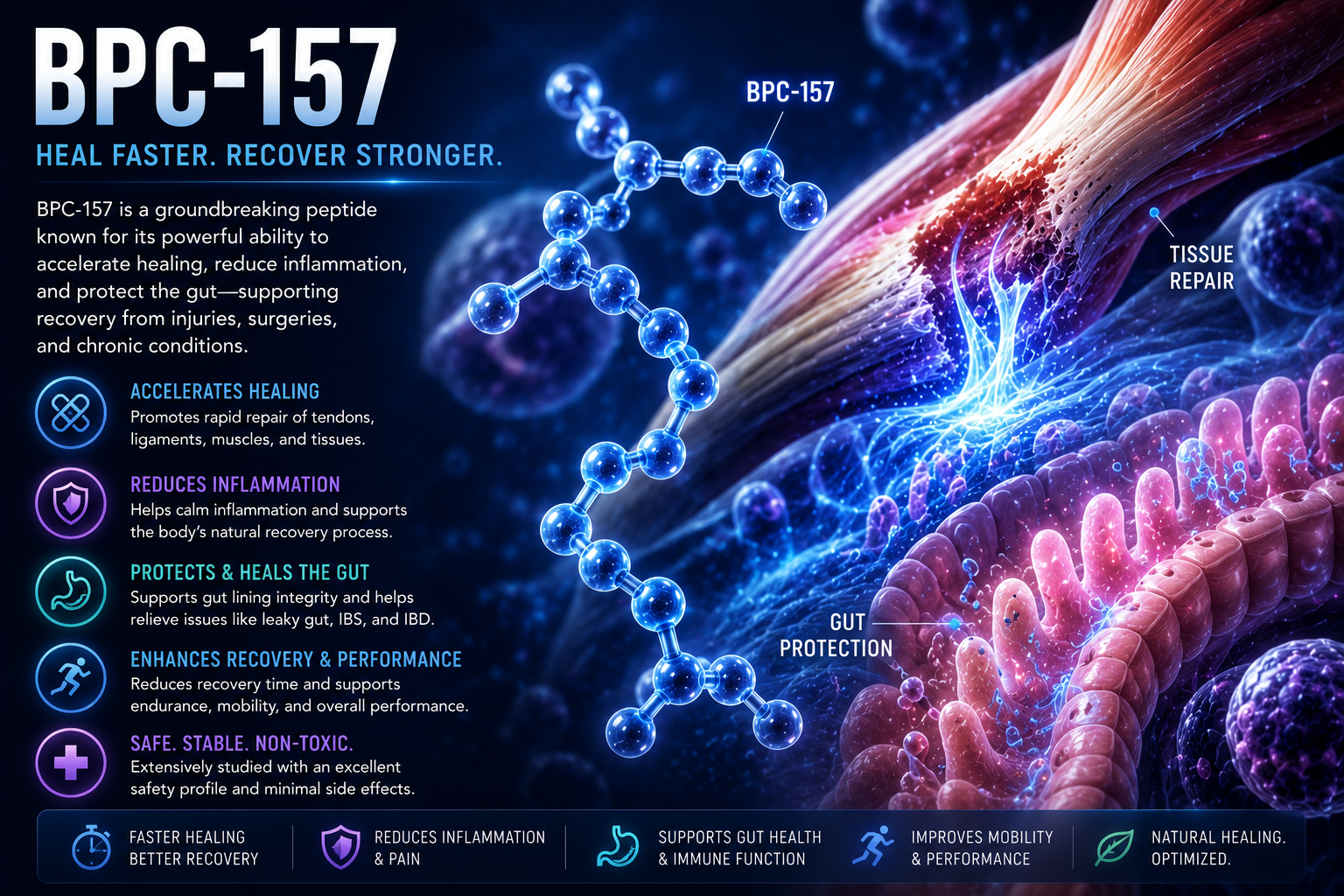
A comprehensive, evidence-graded review of BPC-157, a synthetic 15-amino-acid peptide derived from a sequence described within a gastric “body protection compound” and investigated for gastrointestinal protection, tendon and ligament repair, muscle injury, vascular signaling, nerve recovery, inflammation, and cytoprotection.
What Is BPC-157?
BPC-157, also called bepecinbody protection compound 157, is a synthetic pentadecapeptide. It was developed from a sequence described within a protective protein fraction isolated from human gastric juice.
15 amino acids
GEPPPGKPADDAGLV
Approximately 1,419.5 Da
None
None confirmed
No
Main research themes
- Tendon-to-bone healing
- Ligament and muscle repair
- Gastric and intestinal protection
- Angiogenesis and endothelial function
- Nitric-oxide signaling
- Fibroblast migration and collagen organization
- Peripheral nerve regeneration
- Inflammation, oxidative stress, and cytoprotection
🧬 Structure, Sequence, and Molecular Properties
🧪 Amino-acid sequence
H-Gly-Glu-Pro-Pro-Pro-Gly-Lys-Pro-Ala-Asp-Asp-Ala-Gly-Leu-Val-OH
GEPPPGKPADDAGLV
| Length | 15 amino acids |
|---|---|
| Molecular formula | C62H98N16O22 |
| Average molecular weight | Approximately 1,419.5 g/mol |
| CAS number | 137525-51-0 |
| PubChem CID | 9941957 |
| N terminus | Free glycine amino group |
| C terminus | Free valine carboxyl group |
| Disulfide bonds | None |
| Common salt forms | Free base, acetate, and other vendor-defined salts |
Proline-rich sequence
BPC-157 contains four proline residues. The proline-rich backbone can strongly influence conformation, cis–trans isomerization, protease resistance, chromatographic behavior, and synthesis-related impurity patterns.
Acidic residues
Glu2, Asp10, and Asp11 contribute negative charge and may influence solubility, pH sensitivity, counterion binding, and formulation behavior.
No cysteine
BPC-157 contains no cysteine and therefore has no disulfide bond. Claims involving oxidized or reduced disulfide forms are chemically incorrect.
Acetate form
PubChem lists BPC-157 acetate separately with a calculated molecular weight of approximately 1,479.6 Da. Gross salt mass is not identical to BPC-157 free-base content.
Origin and Relationship to Gastric Proteins
Gastric-juice research
BPC-157 was developed from a 15-amino-acid sequence associated with a larger “body protection compound” described in human gastric juice.
Synthetic research molecule
Commercial BPC-157 is chemically synthesized. It should not be described as a naturally circulating human hormone with an established endocrine receptor.
Natural occurrence uncertainty
The precise abundance, physiological release, precursor processing, and receptor biology of free native GEPPPGKPADDAGLV in humans are not firmly established.
Gastric stability claims
Preclinical literature describes unusual stability in gastric juice and activity after several administration routes in animals. These findings do not establish oral bioavailability or clinical efficacy in humans.
📅 Research and Regulatory Timeline
- 1990s: BPC-157 entered experimental gastric-protection, ulcer, and wound-healing research.
- 2000s: Rodent studies expanded into tendon, ligament, muscle, bone, fistula, vascular, and nerve models.
- 2010s: Research increasingly focused on nitric oxide, angiogenesis, endothelial function, fibroblasts, dopamine, serotonin, and CNS injury.
- 2015: A phase I safety and pharmacokinetic study, NCT02637284, was registered for healthy volunteers; publicly available published results remained limited.
- 2019: A systematic review concluded that promising tissue-healing findings were overwhelmingly based on small-animal studies and limited research groups.
- 2022: WADA explicitly added BPC-157 to the Prohibited List under S0 Non-Approved Substances.
- 2023–2024: FDA identified significant safety concerns for compounded BPC-157, including immunogenicity and impurity risks.
- 2025: A retrospective orthopaedic review described knee-pain improvement in seven of twelve patients after an intra-articular injection.
- 2025: A two-person healthy-volunteer pilot reported no adverse effects after intravenous doses up to 20 mg, but was far too small to establish general safety.
- May 2026: FDA published briefing materials describing unresolved immunogenicity, aggregation, impurity, safety, and effectiveness concerns.
- July 23, 2026: FDA scheduled BPC-157-related bulk substances for Pharmacy Compounding Advisory Committee discussion; as of July 15, that meeting had not yet occurred.
🧠 Proposed Mechanism of Action
No confirmed single receptor
No dedicated high-affinity BPC-157 receptor has been validated.
Network-level signaling
Most mechanistic claims involve modulation of existing pathways rather than direct replacement of one endogenous hormone.
Context dependence
Effects vary with tissue, injury model, timing, route, dose, vascular status, and species.
Repair versus uncontrolled growth
Pathways that support angiogenesis, fibroblast activity, and cell survival may aid repair in one setting while creating theoretical risks in cancer, fibrosis, or pathological vascular growth.
Nitric Oxide and Vascular Signaling
Nitric-oxide system
BPC-157 research repeatedly describes interaction with nitric-oxide synthase pathways and correction of disturbances caused by both nitric-oxide blockade and excessive nitric-oxide signaling.
Endothelial protection
Animal studies report protection of endothelial integrity, preservation of microcirculation, and reduced thrombosis or vascular injury in selected models.
Blood-vessel response
Reported effects include changes in vasodilation, collateral-vessel recruitment, and vascular adaptation after occlusion or tissue injury.
Clinical uncertainty
Human effects on blood pressure, clotting, bleeding, endothelial function, and interactions with nitrates, anticoagulants, or antihypertensive drugs are not established.
Angiogenesis and Endothelial Research
VEGF-related signaling
Preclinical studies have reported increased expression or activity of VEGF-related pathways and enhanced endothelial migration.
New-vessel formation
Angiogenesis may support delivery of oxygen, nutrients, and repair cells to damaged tissue.
Collateral circulation
Some animal models suggest rapid activation of alternative vascular pathways after major vessel occlusion.
Not universally beneficial
Angiogenesis can also contribute to tumor growth, retinopathy, inflammatory disease, and unwanted tissue remodeling.
No human angiogenesis dose-response
There is no established human exposure level that separates desired wound vascularization from unwanted angiogenic risk.
Tendon, Ligament, and Fibroblast Research
Tendon-to-bone healing
Rodent studies report improved tendon integration, collagen organization, mechanical strength, and functional recovery.
Fibroblast migration
BPC-157 has been linked to increased fibroblast migration, spreading, and survival in culture systems.
Focal-adhesion signaling
Research describes activation of FAK–paxillin-related pathways important for cell attachment, motility, and tissue remodeling.
Collagen organization
Animal studies report improved collagen arrangement rather than simply greater collagen quantity.
Intra-articular knee report
A retrospective study reported prolonged relief in seven of twelve people with chronic knee pain after one injection. There was no placebo group, imaging endpoint, blinding, standardized diagnosis, or large safety sample.
No approved orthopaedic indication
BPC-157 is not approved for rotator-cuff injury, Achilles tendinopathy, ligament tears, arthritis, meniscal injury, or postoperative healing.
Muscle, Bone, and Wound Research
Muscle injury
Animal studies report improved healing after crush, transection, denervation, or corticosteroid-related muscle injury.
Bone repair
Experimental work has examined fracture healing, bone defects, and tendon-to-bone integration.
Skin and wound closure
Research describes accelerated closure, improved granulation tissue, and enhanced vascularization in selected wound models.
Functional outcomes
Rodent gains in mechanical strength or movement do not establish equivalent human rehabilitation outcomes.
Scar and fibrosis uncertainty
Fibroblast and collagen stimulation may not always produce ideal remodeling and could theoretically contribute to fibrosis.
Gastrointestinal Research
Gastric protection
BPC-157 has been studied in ulcer, alcohol, NSAID, stress, and toxin-related gastric injury models.
Intestinal healing
Animal studies include inflammatory bowel injury, fistulas, anastomoses, short-bowel models, and intestinal obstruction.
Mucosal defense
Proposed effects include epithelial protection, blood-flow preservation, nitric-oxide modulation, and reduced inflammatory injury.
Oral activity in animals
Some animal studies report activity after oral or intragastric administration. Human absorption and clinically effective oral exposure have not been established.
No approved GI indication
BPC-157 is not approved for inflammatory bowel disease, ulcers, reflux, fistulas, leaky gut, or postoperative intestinal healing.
Peripheral Nerve and CNS Research
Peripheral nerve injury
Rodent studies report improved axonal regeneration, myelination, muscle function, and recovery after nerve transection or compression.
Spinal-cord and brain injury
Research has examined traumatic brain injury, spinal-cord injury, stroke, and encephalopathy models.
Neurotransmitter systems
Published work explores dopamine, serotonin, GABA, and nitric-oxide pathways.
Behavioral findings
Animal models report changes in anxiety, catalepsy, seizure susceptibility, and drug-related behavior, but these findings are not validated human treatments.
No neurological approval
BPC-157 is not approved for neuropathy, stroke, spinal-cord injury, traumatic brain injury, Parkinson’s disease, depression, or anxiety.
Inflammation, Oxidative Stress, and Cytoprotection
Inflammatory signaling
Animal and cell studies report reduced inflammatory mediators and altered immune-cell activity.
Oxidative stress
Research describes reduced lipid peroxidation, improved antioxidant defenses, and protection from toxin-related injury.
Cell survival
BPC-157 may influence apoptosis, mitochondrial stability, and cytoprotective signaling.
Broad claims require caution
A compound appearing beneficial in many unrelated rodent injury models may reflect genuine pleiotropy, model-specific bias, publication bias, or limited independent replication.
Human Evidence
Registered phase I study
NCT02637284 was registered as a safety and pharmacokinetic study in healthy volunteers. Publicly available peer-reviewed results have remained limited.
Two-person intravenous pilot
A 2025 report administered intravenous BPC-157 to two healthy adults at doses up to 20 mg and reported no adverse effects during the study. Two participants cannot detect uncommon toxicity, delayed immune reactions, reproductive risk, malignancy risk, or safety in patients with disease.
Chronic knee-pain report
A retrospective report described improvement in seven of twelve patients after intra-articular injection. The uncontrolled design does not establish causation or quantify placebo effect.
No definitive efficacy trial
There is no large randomized controlled human trial establishing efficacy for tendon, ligament, muscle, nerve, gastrointestinal, wound, or pain indications.
No validated dosing framework
No FDA-approved dose, route, treatment duration, monitoring plan, drug-interaction framework, or product specification exists.
Cancer, Angiogenesis, and Cellular-Growth Concerns
Why concern exists
BPC-157 research describes angiogenesis, endothelial survival, fibroblast migration, and anti-apoptotic effects—pathways that can support both repair and pathological growth.
No proof that BPC-157 causes cancer
Current evidence does not establish that BPC-157 causes human cancer.
No proof of oncologic safety
There are also no long-term human studies excluding increased tumor growth, metastatic support, pathological angiogenesis, or interaction with cancer therapies.
High-risk populations
Active malignancy, recent cancer treatment, proliferative retinopathy, or unexplained masses would create substantial theoretical concern in the absence of clinical data.
Major Evidence Limitations
- Most evidence is from rodents or cell models
- Very limited human exposure data
- No approved therapeutic indication
- No validated direct receptor
- Many studies originate from a relatively small number of related investigators
- Predominantly positive publication pattern suggests possible publication bias
- Limited independent replication
- Variable routes and doses
- No established pharmacokinetics for common commercial use
- No long-term immunogenicity, reproductive, cancer, cardiovascular, or organ-toxicity program
- No standardized product form across vendors
- Free base, acetate, arginate, and other claimed forms may not be equivalent
- No validated human efficacy for localized injection near an injury
- No FDA-reviewed finished-product specification
FDA, Compounding, and WADA Status
FDA approval
BPC-157 is not FDA approved for any indication.
FDA compounding concerns
FDA states that compounded BPC-157 may present significant immunogenicity risk, potentially amplified by aggregation and peptide-related impurities. The agency also reports inadequate safety information for proposed administration.
Current 503A review
FDA placed BPC-157-related bulk substances in a category involving identified significant safety risks pending further evaluation. FDA briefing materials were published in May 2026.
July 23, 2026 advisory meeting
As of July 15, 2026, FDA had scheduled BPC-157 free base and BPC-157 acetate for Pharmacy Compounding Advisory Committee discussion on July 23, 2026. The meeting had not yet occurred.
WADA prohibition
The 2026 WADA Prohibited List explicitly includes BPC-157 under S0 Non-Approved Substances. It is prohibited at all times, both in and out of competition.
No TUE pathway for an unapproved product
Because BPC-157 has no approved therapeutic use, athletes should not assume that a prescription or clinic recommendation makes it permitted.
Potential Side Effects and Safety Considerations
Human safety is not established
The absence of adverse effects in two healthy volunteers cannot define a safe dose or rule out uncommon, cumulative, delayed, or disease-specific harm.
Potential direct effects
- Injection-site pain, redness, swelling, or infection
- Headache
- Dizziness
- Nausea
- Blood-pressure or vascular effects
- Bleeding or clotting interactions
- Unexpected inflammatory or immune reactions
Immunogenicity
Aggregates, deletion peptides, epimers, oxidized products, counterion impurities, or contaminated injectables may trigger antibodies or hypersensitivity.
Angiogenesis risk
Uncontrolled vascular growth is a theoretical concern in malignancy, retinopathy, and other proliferative conditions.
Drug interactions
Interactions with anticoagulants, antiplatelet drugs, nitrates, antihypertensives, immunosuppressants, chemotherapy, and wound-healing therapies are unknown.
Pregnancy and pediatrics
Pregnancy, lactation, reproductive, developmental, and pediatric safety have not been established.
Product-quality risk
- Incorrect sequence or stereochemistry
- Incorrect salt form
- Inaccurate net content
- Deletion peptides and proline isomers
- Aggregation
- Endotoxin or microbial contamination
- Visible or subvisible particles
🧪 Laboratory Testing Methods
| Method | Purpose | Important limitation |
|---|---|---|
| RP-HPLC / UPLC | Separates intact BPC-157 from deletion peptides, epimers, oxidation products, and synthesis impurities | Area purity does not prove sequence or potency |
| LC-HRMS | Confirms intact mass near 1,419.5 Da | Isomers and epimers can share mass |
| LC-MS/MS sequencing | Confirms GEPPPGKPADDAGLV residue order | Proline-rich fragmentation can be complex |
| N-terminal identity assay | Confirms free Gly1 | Only assesses one terminus |
| C-terminal identity assay | Confirms free Val15 carboxyl group | Amidated variants require orthogonal resolution |
| Chiral amino-acid analysis | Detects D-amino-acid or epimer contamination | Hydrolysis may create racemization artifacts |
| Proline cis–trans profile | Measures conformational heterogeneity | Conformers can interconvert during analysis |
| Deletion-peptide panel | Measures incomplete synthesis products | Reference standards may be needed |
| Asp isomerization assay | Detects isoAsp or related backbone variants | Intact mass may be unchanged |
| Oxidation and degradation panel | Measures chemical breakdown during storage | Multiple degradation pathways require orthogonal methods |
| Net peptide-content assay | Measures actual free-base BPC-157 | Must correct for acetate, water, salts, and excipients |
| Acetate and counterion assay | Defines salt form and corrects content | Counterion stoichiometry may vary |
| Residual-solvent testing | Measures synthesis and purification solvents | Does not establish potency |
| SEC-HPLC / DLS | Measures aggregates and particles | Small peptide size limits SEC sensitivity |
| Endothelial migration assay | Measures vascular-cell response | Does not prove clinical wound healing |
| Angiogenesis tube-formation assay | Measures endothelial network formation | Can overpredict in-vivo angiogenesis |
| VEGF-pathway assay | Measures modulation of angiogenic signaling | Indirect and model dependent |
| Nitric-oxide assay | Measures NO production or NOS pathway effects | Assay chemistry can be nonspecific |
| Fibroblast migration assay | Measures wound-cell motility | Cell-culture behavior may not predict tissue repair |
| FAK–paxillin signaling assay | Measures focal-adhesion pathway activation | Not unique to BPC-157 |
| Collagen organization assay | Measures matrix deposition and alignment | More collagen is not always better repair |
| Tendon mechanical-strength model | Measures functional repair in animals | Does not establish human efficacy |
| Gastric cytoprotection assay | Measures protection in epithelial injury models | Model-specific |
| Neurite-outgrowth assay | Measures neural repair signaling | Surrogate endpoint |
| Cell-proliferation and tumor panel | Evaluates unwanted growth signaling | Cannot exclude long-term human cancer risk |
| Anti-drug-antibody risk assessment | Evaluates immunogenicity potential | Predictive assays are imperfect |
| Sterility, endotoxin, and particles | Required for finished injectable evaluation | Raw purity cannot establish injectable safety |
| Stability-indicating assay | Tracks clipping, isomerization, aggregation, adsorption, and potency loss | Requires validated forced-degradation and real-time studies |
📄 How to Interpret a BPC-157 COA
- Confirm the exact sequence: GEPPPGKPADDAGLV.
- Confirm molecular formula C₆₂H₉₈N₁₆O₂₂.
- Verify molecular weight near 1,419.5 Da for free base.
- Use MS/MS sequencing rather than intact mass alone.
- Confirm all amino acids have the intended L stereochemistry.
- Confirm free N-terminal glycine and free C-terminal valine.
- Measure deletion peptides, epimers, Asp isomers, and proline-related variants.
- State free base versus acetate or another salt form.
- Report net free-base content after correcting for counterions and water.
- Measure aggregates and particles.
- Use nitric-oxide, endothelial, fibroblast, or other validated functional assays when potency is claimed.
- Include cell-proliferation and angiogenesis-risk characterization.
- Do not infer tendon-healing efficacy from HPLC purity.
- For finished injectables, require sterility, endotoxin, particles, pH, osmolality, fill accuracy, container closure, and post-reconstitution stability.
- A COA does not establish FDA approval, clinical efficacy, or suitability for human administration.
📊 Comparison Tables
BPC-157 vs TB-500 vs Thymosin Beta-4
| Feature | BPC-157 | TB-500 | Thymosin Beta-4 |
|---|---|---|---|
| Length | 15 aa | Short synthetic fragment or vendor-defined product | 43 aa |
| Main research theme | Cytoprotection, vessels, fibroblasts, repair | Actin and migration claims | Actin binding, migration, repair |
| Established receptor | No | No | No single conventional receptor |
| FDA approved | No | No | No |
BPC-157 vs GHK-Cu vs KPV
| Feature | BPC-157 | GHK-Cu | KPV |
|---|---|---|---|
| Main focus | Tissue protection and repair | Matrix remodeling and copper signaling | Inflammatory signaling |
| Length | 15 aa | 3 aa plus copper | 3 aa |
| Human evidence | Minimal | Some topical/cosmetic research | Minimal |
| FDA approved injectable | No | No | No |
BPC-157 vs Platelet-Rich Plasma
| Feature | BPC-157 | Platelet-rich plasma |
|---|---|---|
| Type | Single synthetic peptide | Autologous blood-derived biologic |
| Human orthopaedic evidence | Very limited | Substantial but indication dependent |
| Standardization | Variable research products | Also variable by preparation system |
| FDA approval as a drug | No | Not generally approved as a drug; procedure context differs |
Basic BPC Claim vs Research-Qualified Material
| Attribute | Basic claim | Research-qualified material |
|---|---|---|
| Identity | “BPC-157 10 mg” | GEPPPGKPADDAGLV by MS/MS |
| Content | Gross vial weight | Net free-base content corrected for salt and water |
| Purity | One HPLC number | Deletion, epimer, Asp-isomer, conformer, and aggregate profile |
| Potency | Assumed | Validated pathway-specific bioassay |
| Human efficacy | Not established by a COA | |
🖼️ Original Diagram Specifications
- Sequence architecture: GEPPPGKPADDAGLV with the proline-rich region and acidic residues highlighted.
- Repair pathway: Endothelium, nitric oxide, fibroblasts, focal adhesion, collagen, and tissue remodeling.
- Angiogenesis balance: Potential wound-healing benefit versus tumor and pathological-vessel concern.
- Evidence map: Tendon, muscle, gut, nerve, vascular, and human evidence graded by strength.
- Human evidence timeline: Registered phase I study, knee-pain retrospective report, two-person IV pilot, and FDA review.
- Risk map: Immunogenicity, angiogenesis, blood pressure, bleeding interactions, contamination, and unknown long-term safety.
- COA workflow: Sequence, stereochemistry, salt correction, impurities, bioassays, sterility, and stability.
❓ Frequently Asked Questions
Is BPC-157 a peptide?
Yes. It is a synthetic 15-amino-acid peptide.
What is its exact sequence?
GEPPPGKPADDAGLV.
What is its molecular formula?
C₆₂H₉₈N₁₆O₂₂.
What is its molecular weight?
Approximately 1,419.5 Da for free-base BPC-157.
Does it contain a disulfide bond?
No. BPC-157 contains no cysteine.
Is BPC-157 naturally produced in humans?
It was developed from a gastric-protein sequence, but free circulating BPC-157 has not been established as a conventional human hormone.
Is BPC-157 FDA approved?
No.
Does it heal tendons or ligaments?
Animal studies are promising, but controlled human efficacy has not been established.
What human evidence exists?
A registered phase I program, a small uncontrolled knee-pain report, and a two-person intravenous safety pilot. This is not enough to establish efficacy or general safety.
Is oral BPC-157 proven effective?
No. Animal gastric stability does not establish reliable human oral absorption or efficacy.
Does it increase blood-vessel growth?
Preclinical studies suggest angiogenic and endothelial effects. Human magnitude and safety are unknown.
Could angiogenesis affect cancer?
It is a theoretical concern. BPC-157 has not been proven to cause cancer, but long-term oncologic safety is unestablished.
Is BPC-157 prohibited in sports?
Yes. It is prohibited at all times under WADA S0.
Can athletes obtain a TUE?
Its unapproved status and lack of established medical indication make permissibility highly unlikely; athletes should rely on their anti-doping organization.
Does 99% HPLC purity prove a safe or effective product?
No. Exact sequence, stereochemistry, salt-corrected content, impurity profile, potency, sterility, endotoxin, and stability are also required.
Final Thoughts
BPC-157 is a proline-rich 15-amino-acid synthetic peptide with the sequence GEPPPGKPADDAGLV. Its preclinical literature spans tendon, ligament, muscle, bone, gastrointestinal, nerve, vascular, inflammatory, and cytoprotective models.
Proposed mechanisms include nitric-oxide modulation, endothelial protection, angiogenesis, fibroblast migration, focal-adhesion signaling, collagen organization, anti-inflammatory activity, and cellular survival. No single dedicated receptor has been confirmed.
The human evidence remains extremely limited. A retrospective knee-pain report and a two-person intravenous pilot are insufficient to establish clinical efficacy, a safe dose, route-specific safety, or long-term risk. The overwhelmingly positive animal literature and concentration of publications among relatively few research groups also create replication and publication-bias concerns.
BPC-157 is not FDA approved. FDA identifies significant concerns involving immunogenicity, aggregation, peptide impurities, and inadequate safety information, and WADA prohibits it at all times. Analytical authentication requires the exact sequence, stereochemistry, terminal groups, salt-corrected content, degradation and aggregation profiling, pathway-relevant potency testing, sterility, endotoxin, and stability. A COA cannot establish human healing benefit or safety.
📚 References
- PubChem. BPC-157, CID 9941957.
- PubChem. BPC-157 Acetate.
- FDA Global Substance Registration System. BPC-157 Substance Record.
- Sikiric P, et al. Stable Gastric Pentadecapeptide BPC-157: Cytoprotection and Organoprotection Research.
- Seiwerth S, et al. BPC-157 and Blood Vessels. Current Pharmaceutical Design. 2014.
- Gwyer D, et al. Gastric Pentadecapeptide BPC-157 as an Effective Therapy for Muscle Crush Injury in the Rat. Journal of Orthopaedic Surgery and Research. 2019 review.
- Chang CH, et al. BPC-157 Enhances Tendon-to-Bone Healing in a Rat Model. Research literature.
- Hsieh MJ, et al. BPC-157 Enhances Fibroblast Migration Through FAK–Paxillin Signaling. Journal of Applied Physiology-related literature.
- Staresinic M, et al. BPC-157 in Tendon, Muscle, and Ligament Healing Models.
- Gjurasin M, et al. BPC-157 and Peripheral Nerve Regeneration.
- Sikiric P, et al. BPC-157, Nitric Oxide, Vascular Occlusion, and Collateral Recruitment Models.
- Vasireddi N, et al. Emerging Use of BPC-157 in Orthopaedic Sports Medicine. 2025.
- Lee E, et al. Safety of Intravenous Infusion of BPC-157 in Humans. 2025.
- McGuire FP, et al. Regeneration or Risk? A Narrative Review of BPC-157 for Musculoskeletal Healing. 2025.
- Józwiak M, et al. Multifunctionality and Possible Medical Application of BPC-157. 2025.
- Yuan C, et al. The Role of BPC-157 in Tissue Repair and Pain. 2026.
- ClinicalTrials.gov. NCT02637284: PCO-02 Safety and Pharmacokinetics Trial.
- U.S. Food and Drug Administration. Certain Bulk Drug Substances for Use in Compounding That May Present Significant Safety Risks: BPC-157.
- U.S. Food and Drug Administration. Pharmacy Compounding Advisory Committee Briefing Document: BPC-157-Related Bulk Drug Substances. May 2026.
- U.S. Food and Drug Administration. July 23–24, 2026 Pharmacy Compounding Advisory Committee Meeting Materials.
- World Anti-Doping Agency. 2026 Prohibited List.
- U.S. Anti-Doping Agency. BPC-157: Experimental Peptide Prohibited.
- International Council for Harmonisation. ICH Q1A(R2), Q2(R2), Q3A, Q3B, Q3C, and Q6B.
- United States Pharmacopeia General Chapters <621>, <71>, <85>, and <788>.
Sequence, chemistry, preclinical and human evidence, current FDA status, WADA status, safety, and analytical recommendations reviewed on July 15, 2026.