Tesamorelin / Ipamorelin Blend: What It Is, How It Works, Benefits, and Research Overview
A comprehensive, evidence-graded review of a nonstandardized commercial blend combining tesamorelin, a 44-residue growth hormone-releasing hormone analogue, with ipamorelin, a synthetic five-residue ghrelin-receptor agonist. The blend is marketed for research involving pulsatile growth-hormone release, IGF-1 signaling, visceral adipose tissue, body composition, recovery, and metabolic physiology.
What Is a Tesamorelin / Ipamorelin Blend?
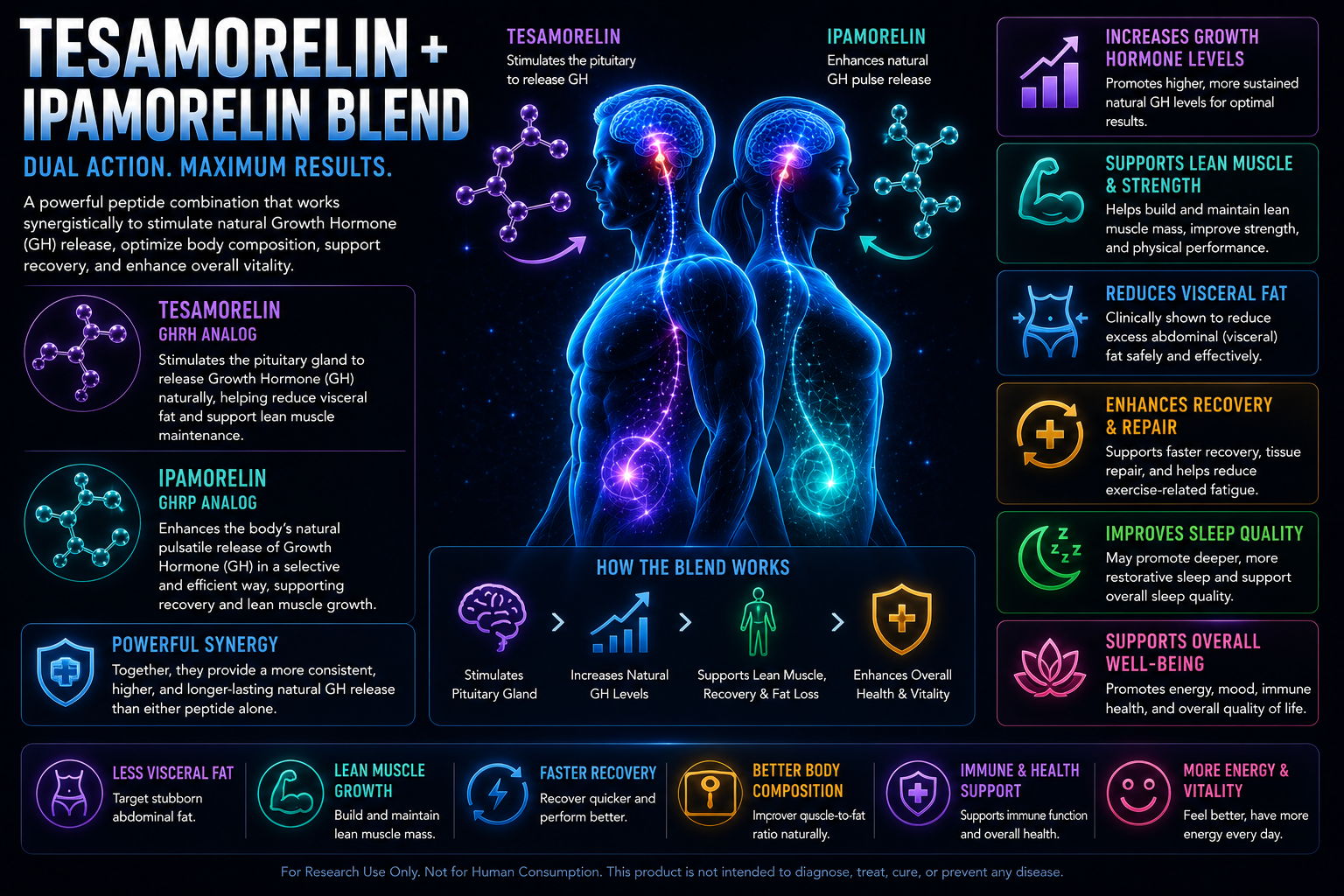
A tesamorelin/ipamorelin blend is a commercial research combination designed to stimulate endogenous growth-hormone release through two complementary receptor systems:
- Tesamorelin: Activates the pituitary growth hormone-releasing hormone receptor, also called GHRHR.
- Ipamorelin: Activates the growth hormone secretagogue receptor type 1a, also called GHSR-1a or the ghrelin receptor.
44-aa modified GHRH analogue
5-residue GHSR agonist
Endogenous GH pulses
IGF-1
No
No
Why are they combined?
GHRH receptor agonists and ghrelin-receptor agonists can produce complementary pituitary signaling. GHRH provides a direct stimulatory signal, while GHSR activation can amplify GH release and reduce somatostatin restraint. This biological rationale does not prove that a specific commercial ratio is safer or more effective.
Typical Composition and Nonstandardization
There is no official or universally accepted tesamorelin/ipamorelin blend formula. Commercial products may vary in:
- Total milligrams per vial
- Tesamorelin-to-ipamorelin mass ratio
- Free base versus acetate content
- Excipients and stabilizers
- Actual net peptide content
- Sterility, endotoxin, and aggregate controls
🧬 Tesamorelin Structure and Chemistry
🧪 Peptide sequence
trans-3-hexenoyl-YADAIFTNSYRKVLGQLSARKLLQDIMSRQQGESNQERGARARL-OH
Tesamorelin contains the 44-amino-acid sequence of human GHRH plus a trans-3-hexenoyl group attached to the N-terminal tyrosine. The lipid-like C6 modification improves resistance to enzymatic cleavage compared with native GHRH.
| Length | 44 amino acids |
|---|---|
| N-terminal modification | trans-3-hexenoyl group attached to Tyr1 |
| Free-base formula | C221H366N72O67S |
| Free-base molecular weight | 5,135.9 Da |
| Commercial drug form | Tesamorelin acetate |
| Disulfide bonds | None |
| Primary receptor | GHRH receptor |
Acetate correction
FDA labeling describes tesamorelin acetate with approximately seven acetate equivalents. A COA must distinguish gross acetate-salt mass from tesamorelin free-base equivalent.
FDA-approved formulations
EGRIFTA WR and EGRIFTA SV are approved formulations with different strengths, reconstitution instructions, dosage recommendations, and storage requirements. FDA labeling states that they are not substitutable.
🧬 Ipamorelin Structure and Chemistry
🧪 Peptide sequence
H-Aib-His-D-2-Nal-D-Phe-Lys-NH₂
| Length | 5 residues |
|---|---|
| Full chemical shorthand | Aib-His-D-2-naphthylalanine-D-Phe-Lys-NH₂ |
| Molecular formula | C38H49N9O5 |
| Free-base molecular weight | 711.9 Da |
| CAS number | 170851-70-4 |
| C terminus | Amidated |
| Unnatural residues | Aib, D-2-Nal, and D-Phe |
| Primary receptor | GHSR-1a |
Why unnatural amino acids matter
The nonstandard residues increase protease resistance and receptor selectivity but complicate synthesis, chiral analysis, impurity identification, and immunogenicity assessment.
Acetate form
Commercial ipamorelin is frequently supplied as an acetate salt. Separate measurement of acetate, water, and free-base peptide content is required.
📅 Discovery and Development Timeline
- 1980s–1990s: Native GHRH and synthetic growth-hormone secretagogues were characterized.
- 1998: Ipamorelin was described as a selective pentapeptide GH secretagogue with less ACTH and cortisol release than GHRP-2 or GHRP-6 in animal studies.
- 1999: Human pharmacokinetic and pharmacodynamic modeling showed dose-proportional exposure and a discrete GH pulse after ipamorelin administration.
- 2005–2010: Tesamorelin clinical trials showed reductions in visceral adipose tissue in adults with HIV-associated lipodystrophy.
- 2010: FDA initially approved tesamorelin for reduction of excess abdominal fat in HIV-infected adults with lipodystrophy.
- 2010s: Tesamorelin research expanded into liver fat, body composition, and metabolic markers.
- 2024: FDA evaluated ipamorelin-related bulk drug substances and proposed against inclusion on the 503A Bulks List because of insufficient effectiveness data, physicochemical concerns, and safety signals.
- 2025: FDA approved the EGRIFTA WR formulation and updated labeling.
- 2026: Tesamorelin remained approved for its specific HIV-lipodystrophy indication; ipamorelin remained unapproved and identified by FDA as a substance raising significant compounding safety concerns.
🧠 How Might the Combination Work?
1. GHRH receptor signaling
Tesamorelin activates a Gs-coupled receptor on pituitary somatotrophs, increasing adenylate cyclase, cyclic AMP, protein kinase A signaling, GH synthesis, and GH release.
2. GHSR-1a signaling
Ipamorelin activates the ghrelin receptor, which primarily uses Gq/11 pathways, phospholipase C, intracellular calcium, and pituitary GH release.
3. Somatostatin interaction
Growth-hormone secretagogues may reduce functional somatostatin restraint and amplify GHRH-stimulated GH release.
4. Pulsatile rather than direct GH replacement
Both compounds stimulate endogenous GH secretion rather than supplying recombinant GH directly. Their activity depends on an intact hypothalamic-pituitary axis.
5. Downstream IGF-1
GH stimulates hepatic and local IGF-1 production. Many anabolic, growth, and metabolic effects are mediated partly by IGF-1.
🎯 Receptor Profile
| Compound | Primary target | Main signaling | Notable selectivity issue |
|---|---|---|---|
| Tesamorelin | GHRH receptor | Gs → cAMP → PKA | Requires functioning pituitary somatotrophs |
| Ipamorelin | GHSR-1a | Gq/11 → PLC → calcium | Designed for greater GH selectivity than older GHRPs |
| Endogenous GH | Growth-hormone receptor | JAK2/STAT5 and related pathways | Acts in liver and peripheral tissues |
| IGF-1 | IGF-1 receptor | PI3K/AKT/mTOR and MAPK | Mitogenic and metabolic effects |
GH and IGF-1 Axis Biology
Physiologic pulsatility
Growth hormone is normally released in pulses influenced by sleep, fasting, exercise, age, sex, GHRH, ghrelin, and somatostatin.
Feedback regulation
GH and IGF-1 feed back to the hypothalamus and pituitary. Chronic stimulation may alter pulse amplitude, receptor sensitivity, glucose metabolism, and endocrine balance.
IGF-1 monitoring
FDA labeling for tesamorelin recommends monitoring IGF-1 and considering discontinuation when elevations remain persistent.
Not equivalent to physiologic restoration
Increasing GH secretion does not necessarily restore normal timing, tissue specificity, or feedback regulation.
Tesamorelin Clinical Evidence
HIV-associated visceral adiposity
Randomized controlled trials demonstrated reductions in visceral adipose tissue in HIV-infected adults with lipodystrophy and excess abdominal fat.
Magnitude and durability
Studies reported visceral-fat reductions of roughly 15–18% during continued treatment. Visceral fat tended to reaccumulate after treatment withdrawal.
Weight neutrality
FDA labeling states that tesamorelin is not indicated for general weight-loss management and is weight neutral.
Liver fat
A randomized study reported modest reductions in liver fat in HIV-infected adults with abdominal fat accumulation, but tesamorelin is not approved as a general fatty-liver treatment.
Lean mass and lipids
Trials and meta-analyses report increases in lean body mass and improvements in selected lipid measures, while effects on glucose vary by baseline risk and treatment response.
Approved population matters
Evidence from HIV-associated lipodystrophy cannot automatically be generalized to healthy adults, obesity, bodybuilding, or age-related body-composition changes.
Ipamorelin Research Evidence
Selective GH release
Early animal research found that ipamorelin stimulated GH with less ACTH and cortisol release than GHRP-2 or GHRP-6.
Human pharmacology
A human study reported dose-proportional pharmacokinetics, a terminal half-life of approximately two hours, and a GH peak roughly 0.67 hours after dosing.
Postoperative ileus program
Ipamorelin was investigated intravenously for postoperative ileus. FDA’s review identified adverse events including hypokalemia, insomnia, hyperglycemia, nausea, vomiting, abdominal distention, and two deaths in ipamorelin-treated subjects, although causality for the deaths was unclear.
No approved indication
Clinical development did not establish an FDA-approved use for GH deficiency, postoperative ileus, muscle growth, weight loss, recovery, or anti-aging.
Limited subcutaneous safety data
FDA states that it lacks sufficient safety information for several proposed injectable routes and cannot determine whether compounded ipamorelin would cause harm.
Body Composition and Metabolic Research
Visceral fat
The strongest body-composition evidence belongs to tesamorelin in HIV-associated lipodystrophy.
General obesity
The approved tesamorelin label specifically states it is not indicated for weight-loss management.
Glucose intolerance
GH can reduce insulin sensitivity. Tesamorelin labeling warns that glucose intolerance or diabetes may develop and recommends glucose monitoring.
Ipamorelin uncertainty
Ipamorelin’s GH-releasing activity creates similar theoretical concerns, and FDA has cited hyperglycemia in clinical development.
Blend inference
Combining two GH secretagogues may increase GH and IGF-1 exposure but has not been shown to improve the benefit-risk balance.
Muscle, Recovery, and Healthy-Aging Research
Anabolic signaling
GH and IGF-1 influence protein turnover, connective tissue, bone, and muscle physiology.
Lean mass versus function
An increase in lean body mass does not necessarily produce meaningful improvements in strength, mobility, injury recovery, or health.
Recovery claims
No controlled human study establishes the tesamorelin/ipamorelin blend as a treatment for tendon, ligament, muscle, or post-surgical recovery.
Age-related decline
GH secretion declines with age, but pharmacologically increasing GH in otherwise healthy older adults can produce edema, arthralgia, glucose intolerance, and other adverse effects.
Not a replacement for GH deficiency care
Suspected growth-hormone deficiency requires endocrine evaluation. The blend is not an approved substitute for diagnostic testing or FDA-approved GH therapy.
Potential Synergy and Its Limitations
Complementary receptor signaling
GHRHR and GHSR-1a activation can produce greater GH release together than either signal alone in experimental physiology.
Possible pulse amplification
Ipamorelin may amplify a tesamorelin-driven pituitary pulse, particularly when endogenous somatostatin tone is favorable.
No validated ratio
No peer-reviewed evidence establishes an optimal tesamorelin-to-ipamorelin mass or molar ratio.
No blend pharmacokinetics
The components differ markedly in size, clearance, receptor signaling, and effective concentration.
Greater effect may mean greater risk
Amplifying GH release may also increase IGF-1 elevation, edema, glucose intolerance, carpal-tunnel symptoms, and growth-related concerns.
One-Vial Compatibility and Stability
Large size difference
Tesamorelin is a 44-residue modified peptide of approximately 5.14 kDa; ipamorelin is a compact pentapeptide of approximately 0.71 kDa.
Different degradation risks
Tesamorelin is vulnerable to oxidation, deamidation, hydrolysis, clipping, and adsorption. Ipamorelin requires control of epimers, unnatural-residue impurities, amidation, and aggregation.
pH and excipient effects
A formulation optimized for pharmaceutical tesamorelin may not be optimized for ipamorelin, and vice versa.
Approved formulation is not reproducible by mixing powders
EGRIFTA WR uses a specific formulation including hydroxypropyl betadex and mannitol. A research blend is not equivalent to that approved product.
Blend-specific stability required
Separate component stability does not establish one-vial compatibility after lyophilization or reconstitution.
Human Evidence for the Combination
No randomized controlled trial has established the safety, pharmacokinetics, optimal ratio, efficacy, or long-term outcomes of a combined tesamorelin/ipamorelin product.
What is known separately
- Tesamorelin has substantial human evidence for its approved HIV-lipodystrophy indication.
- Ipamorelin has early human pharmacology and an unsuccessful postoperative-ileus development history.
- Neither evidence base establishes the combination.
What remains unknown
- Peak and total GH exposure from the blend
- Long-term IGF-1 elevation
- Glucose and insulin effects
- Antibody formation
- Malignancy risk
- Optimal formulation and storage
- Whether the blend is superior to approved tesamorelin alone
FDA, Compounding, and Anti-Doping Status
Tesamorelin
FDA approved tesamorelin for reducing excess abdominal fat in HIV-infected adults with lipodystrophy. The approval does not cover general obesity, bodybuilding, anti-aging, or recovery.
Ipamorelin
Ipamorelin is not FDA approved. FDA identifies compounded ipamorelin acetate as raising significant safety concerns related to aggregation, peptide impurities, unnatural amino acids, immunogenicity, insufficient effectiveness, and limited safety information.
Combination product
No tesamorelin/ipamorelin combination has FDA approval.
WADA status
The 2026 WADA Prohibited List bans GHRH and its analogues, including tesamorelin, as well as growth-hormone secretagogues and ghrelin mimetics, including ipamorelin.
Potential Side Effects, Contraindications, and Safety Considerations
Tesamorelin contraindications
- Disruption of the hypothalamic-pituitary axis
- Active malignancy
- Known hypersensitivity
- Pregnancy
Common tesamorelin adverse reactions
- Arthralgia
- Injection-site erythema or itching
- Pain in extremity
- Peripheral edema
- Myalgia
Growth-axis risks
- Elevated IGF-1
- Glucose intolerance or diabetes
- Fluid retention
- Carpal-tunnel symptoms
- Joint pain
- Potential excessive tissue growth
Malignancy concern
Growth hormone and IGF-1 support cell proliferation and survival. FDA-approved tesamorelin is contraindicated in active malignancy and requires careful risk assessment in patients with a history of cancer.
Ipamorelin-specific uncertainty
FDA cites aggregation, immunogenicity, peptide-related impurities, unnatural amino-acid characterization, hyperglycemia, hypokalemia, and serious adverse events in prior intravenous clinical development.
Critical illness
Tesamorelin labeling warns about increased mortality observed with pharmacologic GH in acute critical illness and advises considering discontinuation in critically ill patients.
🧪 Laboratory Testing Methods
| Method | Purpose | Important limitation |
|---|---|---|
| Component-specific RP-HPLC / UPLC | Separates tesamorelin and ipamorelin from their impurities | A single method may not optimally resolve both |
| LC-HRMS | Confirms intact masses near 5,135.9 and 711.9 Da | Does not alone prove sequence or stereochemistry |
| MS/MS peptide mapping | Confirms complete tesamorelin and ipamorelin sequences | Tesamorelin requires high sequence coverage |
| N-terminal lipid-modification assay | Confirms trans-3-hexenoylation of tesamorelin Tyr1 | Must distinguish positional and geometric isomers |
| Chiral amino-acid analysis | Confirms D-2-Nal and D-Phe in ipamorelin | Hydrolysis may introduce artifacts |
| Aib and 2-Nal identity testing | Confirms unnatural residues | Requires authentic standards |
| C-terminal amidation assay | Confirms Lys-NH₂ in ipamorelin | Free-acid impurity may retain similar mass behavior |
| Separate net-content assays | Quantifies each component independently | Total vial mass cannot establish ratio |
| Acetate and counterion analysis | Corrects gross mass to free-base equivalent | Acetate stoichiometry may vary |
| SEC-HPLC / DLS | Measures aggregates and particles | Very different component sizes complicate one method |
| Oxidation and deamidation panel | Measures tesamorelin degradation | Multiple sites may require peptide mapping |
| Epimer and deletion-peptide panel | Measures synthesis-related impurities | Reference standards are needed |
| GHRHR binding assay | Measures tesamorelin receptor affinity | Binding does not prove cellular signaling |
| GHRHR cAMP assay | Measures tesamorelin functional potency | Cell background influences response |
| GHSR-1a binding assay | Measures ipamorelin receptor affinity | Constitutive receptor activity complicates interpretation |
| Calcium or inositol-phosphate assay | Measures ipamorelin GHSR signaling | Not unique to GH release |
| Pituitary GH-release assay | Measures individual and combined functional potency | Animal or cell systems may not predict human pulses |
| Combination-response assay | Tests additivity, synergy, or antagonism | Requires full concentration-response matrices |
| Anti-drug antibody assessment | Evaluates immunogenicity risk | Predictive models are imperfect |
| Sterility, endotoxin, and particles | Required for finished injectable evaluation | Raw purity cannot establish injectable safety |
| Stability-indicating assay | Tracks clipping, oxidation, deamidation, epimerization, aggregation, adsorption, and potency loss | Requires validated forced-degradation and real-time studies |
📄 How to Interpret a Tesamorelin / Ipamorelin COA
- Confirm both exact sequences independently.
- Verify tesamorelin contains the full 44-residue GHRH sequence.
- Confirm the trans-3-hexenoyl group on tesamorelin Tyr1.
- Verify tesamorelin free-base mass near 5,135.9 Da.
- Confirm ipamorelin as Aib-His-D-2-Nal-D-Phe-Lys-NH₂.
- Verify ipamorelin free-base mass near 711.9 Da.
- Confirm D stereochemistry and unnatural-residue identity.
- Confirm ipamorelin C-terminal amidation.
- Report separate net-content values for both components.
- Correct for acetate, water, counterions, and excipients.
- Do not accept one combined HPLC purity percentage.
- Measure tesamorelin oxidation, deamidation, and clipping.
- Measure ipamorelin epimers, deletions, aggregates, and nonamidated material.
- Use separate GHRHR and GHSR-1a potency assays.
- Use a combination GH-release assay to assess interaction.
- Perform blend-specific lyophilized and reconstituted stability studies.
- For finished injectables, require sterility, endotoxin, particles, pH, osmolality, fill accuracy, and container closure.
- A research COA does not establish equivalence to EGRIFTA or suitability for human administration.
📊 Comparison Tables
Tesamorelin vs Ipamorelin
| Feature | Tesamorelin | Ipamorelin |
|---|---|---|
| Type | Modified GHRH analogue | Ghrelin-receptor agonist |
| Length | 44 aa | 5 residues |
| Primary receptor | GHRHR | GHSR-1a |
| FDA status | Approved for HIV-associated lipodystrophy | Not approved |
| Strongest evidence | Visceral-fat reduction in HIV lipodystrophy | Early GH-release pharmacology |
Tesamorelin / Ipamorelin vs CJC-1295 / Ipamorelin
| Feature | Tesamorelin / Ipamorelin | CJC-1295 / Ipamorelin |
|---|---|---|
| GHRH component | FDA-approved tesamorelin molecule | Unapproved CJC analogue |
| Duration | Tesamorelin is short acting | Depends on DAC or no-DAC form |
| Approved combination | No | No |
| Human evidence | Strong for tesamorelin alone in one indication | Limited for the combination |
Blend vs Recombinant Growth Hormone
| Feature | Tesamorelin / Ipamorelin | Recombinant GH |
|---|---|---|
| Action | Stimulates endogenous pituitary GH release | Supplies GH directly |
| Pituitary required | Yes | No |
| Pulse behavior | Potentially pulsatile | Pharmacologic injection profile |
| Approved uses | Tesamorelin component has one specific indication | Multiple specific GH-deficiency and growth indications |
Research Blend vs EGRIFTA
| Attribute | Research blend | EGRIFTA WR / SV |
|---|---|---|
| Components | Tesamorelin plus ipamorelin | Tesamorelin only |
| Manufacturing | Variable and unapproved | FDA-reviewed pharmaceutical manufacturing |
| Formulation | Variable | Validated product-specific formulation |
| Clinical indication | None approved | HIV-associated excess abdominal fat |
| Interchangeable? | No | |
🖼️ Original Diagram Specifications
- Dual-receptor pathway: Tesamorelin at GHRHR and ipamorelin at GHSR-1a converging on pituitary GH release.
- Sequence architecture: Tesamorelin 44-aa chain with N-terminal hexenoyl group beside the five-residue ipamorelin structure.
- GH–IGF-1 axis: Hypothalamus, pituitary, liver, IGF-1, muscle, adipose tissue, and feedback loops.
- Visceral-fat evidence: Approved tesamorelin indication versus unsupported general weight-loss claims.
- Risk map: Elevated IGF-1, glucose intolerance, edema, carpal tunnel, malignancy, and immunogenicity.
- Evidence pyramid: Strong tesamorelin-alone trials, limited ipamorelin trials, absent blend trials.
- COA workflow: Two sequences, two receptor assays, separate content, modifications, sterility, and blend stability.
❓ Frequently Asked Questions
Is tesamorelin/ipamorelin one peptide?
No. It is a two-component commercial blend.
Is the combination FDA approved?
No. Tesamorelin alone is approved for a specific HIV-lipodystrophy indication; ipamorelin and the combination are not approved.
What is tesamorelin?
A 44-amino-acid GHRH analogue with an N-terminal trans-3-hexenoyl modification.
What is ipamorelin?
A synthetic pentapeptide GHSR-1a agonist with the sequence Aib-His-D-2-Nal-D-Phe-Lys-NH₂.
Why combine them?
They stimulate GH release through complementary GHRH and ghrelin-receptor pathways.
Does the blend reduce visceral fat?
Tesamorelin alone reduces visceral fat in adults with HIV-associated lipodystrophy. No trial establishes the blend for general visceral-fat reduction.
Is tesamorelin a weight-loss drug?
No. FDA labeling states that it is not indicated for weight-loss management and is weight neutral.
Does ipamorelin increase cortisol?
Early animal data suggested greater GH selectivity and less ACTH/cortisol release than older GHRPs, but human safety and endocrine selectivity are not fully established.
Can the blend raise blood sugar?
Yes. GH stimulation may reduce insulin sensitivity, and both tesamorelin labeling and FDA’s ipamorelin review identify glucose concerns.
Can it raise IGF-1?
Yes. Tesamorelin is known to increase IGF-1 and IGFBP-3.
Is it safe with cancer?
Tesamorelin is contraindicated in active malignancy. Growth-axis stimulation creates concern for existing neoplastic cells.
Is the blend prohibited in sports?
Yes. Tesamorelin and ipamorelin fall within WADA-prohibited GH-releasing factors and secretagogues.
Does 99% HPLC purity prove the blend is correct?
No. Both exact sequences, modifications, stereochemistry, separate contents, receptor potency, sterility, and compatibility must be confirmed.
Is a research blend equivalent to EGRIFTA?
No.
What is the most important COA requirement?
Independent identification and quantification of both compounds, including tesamorelin hexenoylation and ipamorelin unnatural-residue stereochemistry.
Final Thoughts
A tesamorelin/ipamorelin blend combines two distinct mechanisms for stimulating endogenous growth-hormone release. Tesamorelin activates the GHRH receptor, while ipamorelin activates the ghrelin receptor. This creates a plausible complementary pituitary signal and may increase GH and IGF-1 exposure.
The evidence bases are highly unequal. Tesamorelin has randomized human trials and FDA approval for reducing excess abdominal fat in adults with HIV-associated lipodystrophy. Ipamorelin has early GH-release pharmacology but no approved indication, and FDA currently identifies substantial safety, characterization, and compounding concerns.
No controlled human study establishes the combination’s optimal ratio, pharmacokinetics, long-term safety, or superiority over tesamorelin alone. Increasing GH output may also increase glucose intolerance, edema, joint symptoms, carpal-tunnel effects, elevated IGF-1, and growth-related risks.
Analytical authentication requires the complete 44-residue tesamorelin sequence, N-terminal trans-3-hexenoylation, correct free-base content, the exact ipamorelin pentapeptide with Aib and D-amino-acid stereochemistry, C-terminal amidation, separate component potency, blend-specific stability, and route-appropriate sterile-product controls. A research blend is not interchangeable with FDA-approved EGRIFTA.
📚 References
- U.S. Food and Drug Administration. EGRIFTA WR Prescribing Information. Revised March 2025.
- U.S. Food and Drug Administration. Purple Book: Egrifta and Egrifta SV.
- Falutz J, et al. Metabolic Effects of a Growth Hormone-Releasing Factor in Patients With HIV. New England Journal of Medicine. 2007.
- Falutz J, et al. Long-Term Safety and Effects of Tesamorelin in HIV Patients With Abdominal Fat Accumulation. AIDS. 2008.
- Falutz J, et al. Effects of Tesamorelin, a Growth Hormone-Releasing Factor, in HIV-Infected Patients With Abdominal Fat Accumulation. 2010.
- Falutz J, et al. Effects of Tesamorelin on Visceral Adipose Tissue and Body Image. 2010.
- Stanley TL, et al. Effect of Tesamorelin on Visceral Fat and Liver Fat in HIV-Infected Patients. JAMA. 2014.
- Stanley TL, et al. Reduction in Visceral Adiposity and Metabolic Outcomes With Tesamorelin. Clinical Infectious Diseases. 2012.
- Russo SC, et al. Efficacy and Safety of Tesamorelin in People With HIV on Contemporary Antiretroviral Therapy. 2024.
- Badran AS, et al. Tesamorelin in HIV-Associated Lipodystrophy: Meta-Analysis of Randomized Controlled Trials. 2026.
- Raun K, et al. Ipamorelin, the First Selective Growth Hormone Secretagogue. European Journal of Endocrinology. 1998.
- Gobburu JV, et al. Pharmacokinetic-Pharmacodynamic Modeling of Ipamorelin in Healthy Volunteers. 1999.
- Johansen PB, et al. Ipamorelin, a New Growth-Hormone-Releasing Peptide, in Experimental Growth Models. 1999.
- Fuh VL, et al. Growth Hormone Secretagogues: Mechanism of Action and Clinical Development. 1998.
- Sigalos JT, Pastuszak AW. The Safety and Efficacy of Growth Hormone Secretagogues. Sexual Medicine Reviews. 2018.
- PubChem. Ipamorelin, CID 9831659.
- U.S. Food and Drug Administration. Evaluation of Ipamorelin-Related Bulk Drug Substances for the 503A Bulks List. 2024.
- U.S. Food and Drug Administration. Certain Bulk Drug Substances for Use in Compounding That May Present Significant Safety Risks: Ipamorelin Acetate. Updated 2026.
- World Anti-Doping Agency. 2026 Prohibited List.
- World Anti-Doping Agency. Tesamorelin Administration Study and Detection Research.
- International Council for Harmonisation. ICH Q1A(R2), Q2(R2), Q3A, Q3B, Q3C, Q5C, and Q6B.
- United States Pharmacopeia General Chapters <621>, <71>, <85>, and <788>.
Sequence, chemistry, clinical evidence, FDA and anti-doping status, safety, and analytical recommendations reviewed in July 2026.