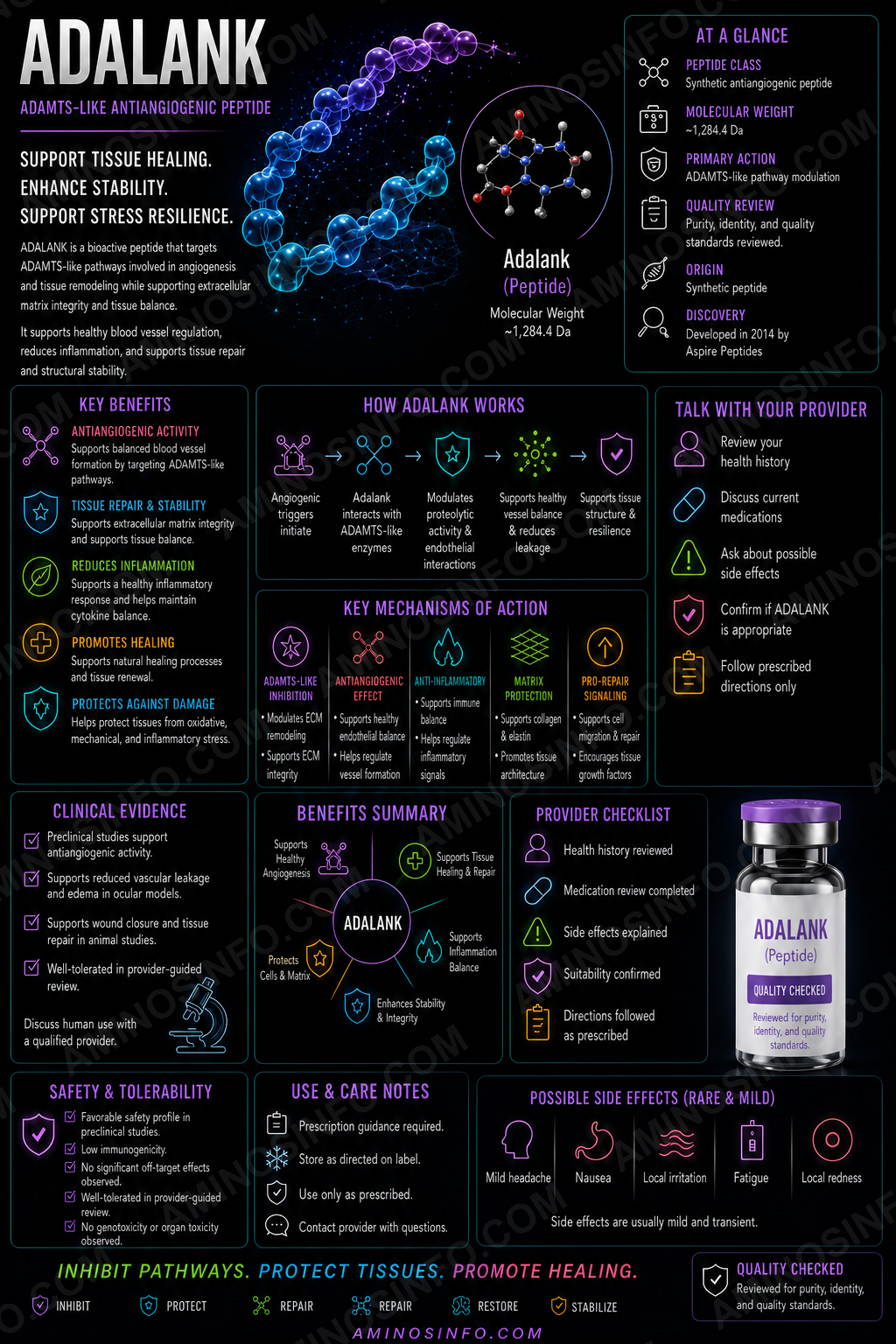
Adalank: What It Is, Proposed Structure, Mechanism, and Research Overview
An evidence-graded review of Adalank, a recently marketed modified Selank analogue whose nomenclature, exact structure, pharmacology, and research record are not yet standardized in peer-reviewed scientific literature.
What Is Adalank?
Adalank is a recent commercial name used for one or more modified analogues of Selank, a synthetic heptapeptide developed from the endogenous immunomodulatory tetrapeptide tuftsin.
Unlike Selank, Adalank does not currently have a clearly documented discovery paper, recognized nonproprietary name, CAS identity, pharmacopoeial monograph, clinical-development record, or standardized sequence across suppliers.
Adalank
Vendor-defined analogue
Selank
No
None identified
No
Nomenclature and Identity Problem
Definition 1: Terminally protected Selank
Some commercial databases describe Adalank as Selank with an acetylated N-terminus and amidated C-terminus:
Ac-Thr-Lys-Pro-Arg-Pro-Gly-Pro-NH₂
This structure is more commonly described elsewhere as N-acetyl Selank amidate.
Definition 2: Adamantane-modified Selank analogue
Other suppliers list:
Ac-Thr-Lys-Pro-Arg-Pro-Gly-Pro-{Adam}-NH₂
Here, {Adam} is said to represent an adamantane-related acid or residue. This notation is chemically incomplete because it does not identify the exact adamantane derivative, attachment point, linker, stereochemistry, or bond type.
Definition 3: Marketing blend or trade name
Some commercial pages use “Adalank” loosely for products combining Selank-like calming claims with “Adamax”-style cognitive claims. Such usage may describe a blend rather than one molecule.
Why the distinction matters
These proposed identities would have different molecular masses, formulas, chromatographic retention, solubility, metabolism, brain exposure, and toxicology. They cannot be treated as interchangeable.
🧬 Proposed Structure
Selank parent sequence
H-Thr-Lys-Pro-Arg-Pro-Gly-Pro-OH
One-letter notation: TKPRPGP
Proposed Adalank structure A
Ac-Thr-Lys-Pro-Arg-Pro-Gly-Pro-NH₂
This is terminally protected Selank without an adamantane group.
Proposed Adalank structure B
Ac-Thr-Lys-Pro-Arg-Pro-Gly-Pro-{Adam}-NH₂
This is not a complete chemically unambiguous sequence.
⚛️ Molecular Weight and 🧫 Formula
| Identity | Formula | Molecular weight | Confidence |
|---|---|---|---|
| Parent Selank | C₃₃H₅₇N₁₁O₉ | Approximately 751.9 g/mol | Well documented |
| N-acetyl Selank amidate | Must be calculated from a fully specified structure and verified analytically | Expected to differ from parent Selank | Moderate if this identity is explicitly supplied |
| Adamantane-modified “Adalank” | One supplier lists C₄₆H₇₅N₁₃O₁₀ | One supplier lists approximately 970.19 g/mol | Provisional vendor claim only |
📅 Discovery Timeline and Research History
1980s–1990s: Selank developed
Russian researchers developed Selank from tuftsin-related glyproline research for anxiolytic, cognitive, and immunological investigation.
2000s: Selank animal and mechanistic literature expands
Studies examined anxiety behavior, learning, memory, monoamines, enkephalin metabolism, and gene expression.
2010s: Selank transcriptomic and GABAergic research
Peer-reviewed studies reported changes in neurotransmission-related gene expression and relationships to GABAergic signaling.
2017–2020: Human Selank neuroimaging and online-market research
Research examined functional connectivity in healthy participants and documented the expanding online market for nootropic research peptides.
2025–2026: “Adalank” appears in commercial catalogs
The term appears primarily on supplier, database, social-media, and marketing pages rather than in primary scientific publications.
Current status
No direct Adalank research program, clinical-trial registration, toxicology package, or standardized chemical identity was located.
Relationship to Selank and Tuftsin
Tuftsin
Tuftsin is the endogenous tetrapeptide Thr-Lys-Pro-Arg, associated with phagocyte and immune signaling.
Selank
Selank extends the tuftsin sequence with Pro-Gly-Pro:
Thr-Lys-Pro-Arg-Pro-Gly-Pro
Glyproline motif
The C-terminal Pro-Gly-Pro motif is associated with resistance to some peptidases and is a common feature of Russian regulatory-peptide research.
Adalank modification
Adalank is claimed to add terminal protection, an adamantane-related group, or both. The exact form must be established for each product.
Modification can change activity
Acetylation, amidation, lipidation, or adamantane conjugation can alter charge, hydrophobicity, receptor interaction, protease resistance, membrane binding, distribution, and toxicity.
🧠 Proposed Mechanism of Action
There is no direct experimentally established Adalank mechanism. The following pathways are hypotheses extrapolated from Selank or general medicinal chemistry.
1. GABAergic modulation
Selank studies suggest complex interaction with GABA-related gene expression and benzodiazepine responses. Adalank has not been directly tested.
2. Monoamine signaling
Selank research includes serotonin, norepinephrine, and dopamine-related observations. No direct Adalank neurotransmitter study was found.
3. Gene-expression effects
Selank alters expression of genes involved in neurotransmission and immune signaling in animal and cell models. Chemical modification may preserve, weaken, or change these effects.
4. Peptidase resistance
Terminal acetylation and amidation can reduce degradation by aminopeptidases and carboxypeptidases. An adamantane group may further alter stability, but this must be measured.
5. Tissue and membrane distribution
Adamantane can increase hydrophobicity in some drug molecules, but increased lipophilicity does not automatically mean improved blood–brain barrier penetration.
🎯 Receptor and Pathway Profile
| Target or pathway | Adalank evidence status |
|---|---|
| GABA-A receptor modulation | Hypothesis extrapolated from Selank-related findings; no direct Adalank study. |
| BDNF signaling | Frequently claimed commercially; no direct Adalank evidence identified. |
| Monoamine systems | Selank-derived hypothesis only. |
| Enkephalin metabolism | Selank and tuftsin-related literature; not established for Adalank. |
| Immune gene expression | Selank-derived hypothesis only. |
| Specific molecular receptor | None established. |
Anxiety and GABAergic Claims
Selank evidence
Selank has demonstrated anxiolytic-like effects in animal models and has regional clinical literature in anxiety disorders.
Gene-expression findings
Selank administration changed expression of neurotransmission-related genes, with overlap or correlation with GABA exposure in rat brain tissue.
Diazepam interaction
Animal research evaluated Selank alone and with diazepam under chronic stress conditions.
Adalank evidence
No controlled Adalank anxiety study was identified.
No established clinical claim
It is scientifically inappropriate to state that Adalank reduces anxiety, is non-sedating, or outperforms Selank without direct comparative trials.
Cognition, Memory, and Neuroplasticity Claims
Selank learning research
Selank improved learning performance in selected rat models, particularly animals with poorer baseline learning.
Human functional-connectivity research
A study in 52 healthy participants evaluated whole-brain resting-state functional connectivity after Selank and Semax.
Synaptic-plasticity claims
Claims that Adalank directly promotes neurite outgrowth, long-term potentiation, or synaptogenesis were not supported by identifiable Adalank publications.
BDNF claims
Commercial descriptions frequently invoke BDNF-like pathways, but direct Adalank BDNF measurements were not found.
No proven cognitive enhancer
No human trial establishes improved memory, attention, executive function, academic performance, dementia outcomes, or age-related cognition after Adalank.
Neuroprotection and Oxidative-Stress Claims
No direct Adalank injury model
No peer-reviewed ischemia, excitotoxicity, traumatic brain injury, oxidative stress, apoptosis, or neurodegeneration study of Adalank was identified.
Selank is not Semax
Some neuroprotective claims appear to blend Selank literature with Semax research. Semax has a separate sequence and stronger ischemic-brain literature.
Analogue uncertainty
Adding terminal protections or an adamantane group can change both efficacy and toxicity.
Neurodegenerative disease claims
No evidence establishes Adalank treatment of Alzheimer’s disease, Parkinson’s disease, stroke, traumatic brain injury, or cognitive aging.
Adamantane-Modification Hypothesis
What adamantane is
Adamantane is a rigid hydrophobic cage structure used in some approved drugs and medicinal-chemistry scaffolds.
Potential purposes of conjugation
- Increase hydrophobicity
- Alter membrane interaction
- Modify metabolic stability
- Change protein binding
- Extend tissue retention
Potential risks
- Reduced aqueous solubility
- Aggregation or adsorption
- Unexpected off-target binding
- Longer tissue exposure
- New metabolites
- Changed renal or hepatic clearance
Blood–brain barrier claims
An adamantane group does not guarantee central nervous system penetration. Brain exposure requires measured pharmacokinetic data.
Incomplete notation
“{Adam}” is not adequate chemical nomenclature. The exact atom connectivity and linker must be shown.
Direct Evidence and Major Limitations
No primary Adalank publication identified
Searches of PubMed and PubMed Central did not identify a direct Adalank paper.
No standardized identity
Commercial sources disagree about whether Adalank is terminally protected Selank, an adamantane conjugate, or a blend.
No pharmacokinetics
Half-life, bioavailability, nasal absorption, plasma exposure, brain exposure, metabolism, and excretion are unknown.
No validated potency assay
There is no accepted biological test that links Adalank batch quality to a specific mechanism.
No human safety data
No controlled human dose-ranging or adverse-event study was found.
Selank extrapolation risk
Even small peptide modifications can create a new chemical entity with materially different effects.
Safety and Regulatory Considerations
Unknown toxicology
Acute, repeated-dose, genotoxic, reproductive, developmental, immunotoxic, cardiac, and neurobehavioral toxicology data were not identified.
Unknown interaction profile
Potential interactions with benzodiazepines, antidepressants, stimulants, antipsychotics, anticonvulsants, alcohol, sedatives, or immunomodulators are unknown.
Nasal-formulation risks
Intranasal products require evaluation of pH, osmolality, preservatives, particles, microbial quality, mucosal toxicity, spray uniformity, and delivered dose.
Adamantane-related uncertainty
If an adamantane moiety is present, lipophilicity, tissue accumulation, metabolism, and off-target pharmacology require independent study.
Product misidentification
A generic “99% HPLC” claim cannot establish which proposed Adalank structure is present.
Regulatory status
Adalank is not FDA approved and has no recognized approved indication.
🧪 Laboratory Testing Methods
| Method | Purpose | Important limitation |
|---|---|---|
| Complete structural disclosure | Defines exact residue, adamantane derivative, linker, termini, and stereochemistry. | Must occur before meaningful testing can be designed. |
| RP-HPLC / UPLC | Measures chromatographic purity and separates related impurities. | Cannot establish sequence or adamantane connectivity by itself. |
| LC-HRMS | Confirms exact intact mass and elemental composition. | Multiple isomers may share the same mass. |
| MS/MS sequencing | Confirms Selank core sequence and terminal modifications. | Nonstandard adamantane residues may require custom fragmentation interpretation. |
| NMR spectroscopy | Confirms atom connectivity, adamantane attachment, and terminal chemistry. | Requires sufficient high-purity material and reference data. |
| Amino-acid analysis | Confirms peptide composition. | Does not identify an adamantane modifier or sequence order. |
| Chiral analysis | Confirms L-amino-acid stereochemistry. | Hydrolysis may introduce artifacts. |
| Net peptide-content assay | Measures actual Adalank amount. | Cannot be inferred from HPLC area purity. |
| Free Selank and deprotected analogue assay | Detects incomplete modification or hydrolysis. | Requires authentic standards. |
| Adamantane-linker impurity assay | Detects free modifier and related synthesis impurities. | Impossible without exact chemical identity. |
| Solubility and aggregation testing | Evaluates hydrophobicity-related formulation risks. | Must reflect actual formulation concentration. |
| In vitro permeability assays | Generates preliminary epithelial or BBB hypotheses. | Does not prove human brain exposure. |
| Plasma and tissue pharmacokinetics | Measures stability, exposure, metabolism, and brain distribution. | No public Adalank data identified. |
| Microbial limits, sterility, and endotoxin | Evaluates route-specific microbiological quality. | Requirements depend on final dosage form. |
| Nasal spray performance testing | Measures delivered dose, plume, droplet size, priming, and uniformity. | Raw-peptide COA does not cover finished spray performance. |
| Stability-indicating assay | Tracks oxidation, deamidation, hydrolysis, aggregation, and modifier loss. | Requires a fully defined reference compound. |
📄 How to Interpret an Adalank COA
- Demand a complete chemical name and drawing: “Adalank” alone is inadequate.
- Determine which identity is claimed: N-acetyl Selank amidate, adamantane-modified analogue, or a blend.
- Verify the exact Selank core: Thr-Lys-Pro-Arg-Pro-Gly-Pro.
- Confirm N- and C-terminal chemistry: Acetylation and amidation must be separately demonstrated.
- Identify the adamantane modifier: Exact derivative, linker, attachment atom, and stereochemistry are required.
- Confirm exact mass and formula by HRMS: Do not rely on a catalog value.
- Use MS/MS and NMR: HPLC purity alone cannot prove identity.
- Measure net content: Area purity is not the labeled milligram amount.
- Review free Selank, incomplete modifications, modifier-related impurities, water, counterions, and residual solvents.
- For nasal products, review finished-product testing: Microbial quality, preservative effectiveness, dose uniformity, spray performance, pH, and osmolality.
- Do not infer efficacy: A COA cannot prove anxiety reduction, cognitive enhancement, neuroprotection, BDNF activation, or brain penetration.
📊 Adalank vs Selank vs N-Acetyl Selank Amidate
| Feature | Adalank | Selank | N-Acetyl Selank Amidate |
|---|---|---|---|
| Identity | Conflicting vendor definitions | Defined TKPRPGP heptapeptide | Defined terminally protected Selank analogue if properly specified |
| Peer-reviewed evidence | None directly identified | Animal, mechanistic, regional clinical, and limited human imaging research | Very limited direct evidence |
| Adamantane group | Present in some definitions | No | No |
| FDA approved? | No | No | No |
Adalank vs Selank vs Semax
| Feature | Adalank | Selank | Semax |
|---|---|---|---|
| Parent sequence | Selank-derived claim | TKPRPGP | MEHFPGP |
| Main marketed theme | Longer-lasting calm/cognition | Anxiolytic and cognitive research | Neuroprotection and cognition research |
| Direct literature | None identified | Moderate regional/preclinical literature | Moderate regional/preclinical literature |
| Same mechanism? | Unknown | No single receptor established | No single receptor established |
Adalank vs Dihexa vs P21 vs FGL
| Compound | Main proposed pathway | Direct Adalank-equivalent evidence? |
|---|---|---|
| Adalank | Selank-like signaling plus modification-dependent distribution | No |
| Dihexa | HGF/c-Met-related synaptogenic research | No; chemically unrelated |
| P21 | CNTF-derived neurogenesis research | No; chemically unrelated |
| FGL | NCAM/FGFR-related plasticity research | No; chemically unrelated |
Adalank vs Evidence-Based Anxiety and Cognitive Care
| Approach | Established role | Difference from Adalank |
|---|---|---|
| Cognitive behavioral therapy | Evidence-based anxiety treatment | No peptide exposure or identity uncertainty |
| Approved antidepressants | Selected anxiety and mood disorders | Defined pharmacology and regulated manufacturing |
| Benzodiazepines | Short-term selected anxiety indications | Defined receptor pharmacology and known dependence risks |
| Sleep, exercise, and medical evaluation | Supports cognition and addresses reversible causes | Established safety framework |
| Adalank | Unvalidated research analogue | No standardized identity or clinical evidence |
🔗 Related Peptides and Pathways
- Selank: Defined TKPRPGP parent peptide.
- Tuftsin: Endogenous Thr-Lys-Pro-Arg tetrapeptide.
- Pro-Gly-Pro: Glyproline motif appended to tuftsin in Selank.
- Semax: Distinct ACTH-derived glyproline peptide.
- GABAergic signaling: Selank-associated mechanistic research.
- Monoamine systems: Selank-related hypothesis.
- Adamantane: Hydrophobic scaffold claimed in some Adalank structures.
- N-acetyl Selank amidate: Terminally protected Selank analogue sometimes conflated with Adalank.
🖼️ Original Diagram Specifications
Diagram 1: Identity tree
Show Selank as the parent structure branching into unmodified Selank, N-acetyl Selank amidate, proposed adamantane-modified Adalank, and undefined commercial blends.
Diagram 2: Complete versus incomplete chemical notation
Contrast a full structural drawing with the ambiguous token “{Adam},” highlighting linker and attachment uncertainty.
Diagram 3: Evidence-transfer warning
Show Selank evidence on one side and Adalank claims on the other, with a barrier labeled “new chemical entity requires direct testing.”
Diagram 4: Hypothetical pharmacokinetic changes
Show how acetylation, amidation, and adamantane conjugation might alter peptidase resistance, charge, solubility, membrane binding, clearance, and tissue distribution.
Diagram 5: Selank-related signaling hypothesis
Show GABAergic, monoamine, immune, and gene-expression pathways, with every arrow to Adalank marked “unverified extrapolation.”
Diagram 6: Evidence ladder
Show supplier specification, analytical identity, in vitro pharmacology, animal PK/toxicology, human phase trials, and regulatory approval.
Diagram 7: COA workflow
Show structural disclosure, HRMS, MS/MS, NMR, chiral analysis, modifier impurities, net content, nasal-product testing, and stability.
❓ Frequently Asked Questions
Is Adalank a peptide?
It is marketed as a modified Selank peptide analogue, but its exact standardized chemical identity is unresolved.
What is Adalank’s sequence?
Suppliers disagree. Some imply Ac-TKPRPGP-NH₂, while others list Ac-TKPRPGP-{Adam}-NH₂.
What does “Adam” mean?
It appears to denote an adamantane-related modifier, but the exact chemical residue and attachment are often not disclosed.
What is its molecular formula?
No universally verified formula exists. One supplier lists C₄₆H₇₅N₁₃O₁₀ for an adamantane-modified form.
What is its molecular weight?
One supplier lists approximately 970.19 g/mol, but this requires independent structural and analytical confirmation.
Is Adalank the same as Selank?
No. It is claimed to be a modified Selank analogue.
Is it the same as N-acetyl Selank amidate?
Some sources use the terms as though they are equivalent, while others add an adamantane modification. The names are not reliably standardized.
Is Adalank FDA approved?
No.
Has Adalank been studied in humans?
No direct peer-reviewed human study was identified.
Does Adalank reduce anxiety?
This is a commercial extrapolation from Selank, not a directly established Adalank effect.
Does it increase BDNF?
No direct Adalank BDNF study was identified.
Does it cross the blood–brain barrier?
Unknown. No direct brain-exposure pharmacokinetic study was identified.
Is an adamantane group automatically beneficial?
No. It may alter stability or distribution but can also reduce solubility or create new off-target effects.
Does 99% HPLC prove Adalank identity?
No. A complete structure, HRMS, MS/MS, NMR, and appropriate reference standards are needed.
Final Thoughts
Adalank should currently be described as an unstandardized commercial Selank analogue rather than a well-characterized neuroactive research peptide. The original draft incorrectly presented speculative cognition, neuroprotection, oxidative-stress, apoptosis, long-term potentiation, and BDNF claims as though they came from direct Adalank studies.
The available public evidence instead supports a narrower conclusion: Selank has a peer-reviewed research record, while Adalank’s exact identity and claimed advantages remain uncertain. The first scientific requirement is not another efficacy claim—it is unambiguous chemical characterization.
A legitimate Adalank research program would require a complete structure, reference standard, validated analytical methods, in vitro pharmacology, pharmacokinetics, brain-distribution measurements, toxicology, and controlled human studies before health or cognitive claims could be supported.
📚 References
- Volkova A, et al. Selank Administration Affects the Expression of Genes Involved in Neurotransmission. 2016.
- Kasian A, et al. Peptide Selank Enhances the Effect of Diazepam in Reducing Anxiety in Unpredictable Chronic Mild Stress. 2017.
- Kozlovskii II, et al. The optimizing action of the synthetic peptide Selank on a conditioned active avoidance reflex in rats. 2003.
- Medvedeva EV, et al. Selank-related transcriptomic and neurotransmission research. Molecular Genetics, Microbiology and Virology.
- Volkova AV, et al. Selank and GABA-related gene-expression responses in rat brain. Molecular Genetics and Genomics.
- Lebedev AA, et al. Selank anxiolytic effects in animal behavioral models. Bulletin of Experimental Biology and Medicine.
- Seredenin SB, et al. Selank: anxiolytic peptide drug research. Experimental and Clinical Pharmacology.
- Semax and Selank functional-connectivity study. Functional Connectomic Approach to Studying Selank and Semax Effects. 2020.
- Ashmarin IP, et al. Natural and hybrid stable regulatory glyproline peptides. 2005.
- Ashmarin IP, et al. Glyproline regulatory peptides in neuroscience and immunology. Pathophysiology literature.
- Kolik LG, et al. Selank effects on anxiety and memory in animal models. Neuroscience and Behavioral Physiology.
- Kozlovskii II, et al. Selank and learning in rats with different baseline abilities. Bulletin of Experimental Biology and Medicine.
- Medvedeva EV, et al. Selank and immune-system gene expression in mouse spleen. Molecular Biology literature.
- Medvedeva EV, et al. Selank effects on neurotransmission-related genes. Molecular Genetics literature.
- V'yunova TV, et al. Selank structural and biological properties. Russian Journal of Bioorganic Chemistry.
- V'yunova TV, et al. Selank metabolism and peptide-fragment research. Peptides.
- Kost NV, et al. Selank and enkephalin-degrading enzymes. Bulletin of Experimental Biology and Medicine.
- Myasoedov NF, et al. Selank as a synthetic tuftsin analogue. Russian peptide research literature.
- Vanhee C, et al. The occurrence of putative cognitive enhancing research peptides in products available on the internet. 2020.
- PubChem. Selank compound record.
- ChEBI. Selank chemical entity record.
- UniProt. Tuftsin-related precursor and immune-peptide biology resources.
- Nishi K, et al. Tuftsin: structure and immunological function. International Journal of Peptide and Protein Research.
- Najjar VA, Nishioka K. Tuftsin: a natural phagocytosis-stimulating peptide. Nature.
- Fridkin M, Najjar VA. Tuftsin and phagocyte activation. Critical Reviews in Biochemistry.
- Begley DJ. Delivery of therapeutic peptides to the central nervous system. Pharmaceutical Research.
- Pardridge WM. Blood–brain barrier drug targeting. NeuroRx.
- Di L, Kerns EH. Blood–brain barrier in drug discovery. Drug Discovery Today.
- Wang CK, Craik DJ. Designing macrocyclic and modified peptides for membrane permeability. Nature Chemical Biology.
- Lau JL, Dunn MK. Therapeutic peptides: historical perspectives and current development trends. Bioorganic & Medicinal Chemistry.
- Fosgerau K, Hoffmann T. Peptide therapeutics: current status and future directions. Drug Discovery Today.
- Craik DJ, Fairlie DP, Liras S, Price D. The future of peptide-based drugs. Chemical Biology & Drug Design.
- Vlieghe P, Lisowski V, Martinez J, Khrestchatisky M. Synthetic therapeutic peptides: science and market. Drug Discovery Today.
- Zasloff M. Antimicrobial and regulatory peptides: modification can alter activity and toxicity. Nature.
- Wanka L, Iqbal K, Schreiner PR. The lipophilic bullet hits the targets: medicinal chemistry of adamantane derivatives. Chemical Reviews.
- Liu J, Obando D, Liao V, Lifa T, Codd R. The many faces of the adamantyl group in drug design. European Journal of Medicinal Chemistry.
- Lamoureux G, Artavia G. Use of the adamantane structure in medicinal chemistry. Current Medicinal Chemistry.
- ICH Q2(R2). Validation of Analytical Procedures.
- ICH Q3A and Q3B. Impurities in New Drug Substances and Products.
- ICH Q3C. Residual Solvents.
- ICH Q1A(R2). Stability Testing of New Drug Substances and Products.
- ICH M10. Bioanalytical Method Validation.
- United States Pharmacopeia General Chapter <621>. Chromatography.
- United States Pharmacopeia General Chapter <71>. Sterility Tests.
- United States Pharmacopeia General Chapter <85>. Bacterial Endotoxins Test.
- United States Pharmacopeia General Chapter <51>. Antimicrobial Effectiveness Testing.
- United States Pharmacopeia General Chapter <698>. Deliverable Volume.
- United States Pharmacopeia chapters and FDA guidance concerning nasal spray drug-product chemistry, manufacturing, and controls.
- European Pharmacopoeia. Nasal preparations and peptide analytical quality chapters.
- Tocris Bioscience. Peptide nomenclature and terminal-modification guidance.
Adalank identity, commercial specifications, Selank parent evidence, medicinal-chemistry considerations, safety uncertainty, and analytical requirements were reviewed in July 2026. No direct peer-reviewed Adalank study was identified.