Thyroidget Scientific Overview: Identity, Chemistry, Evidence, and Testing
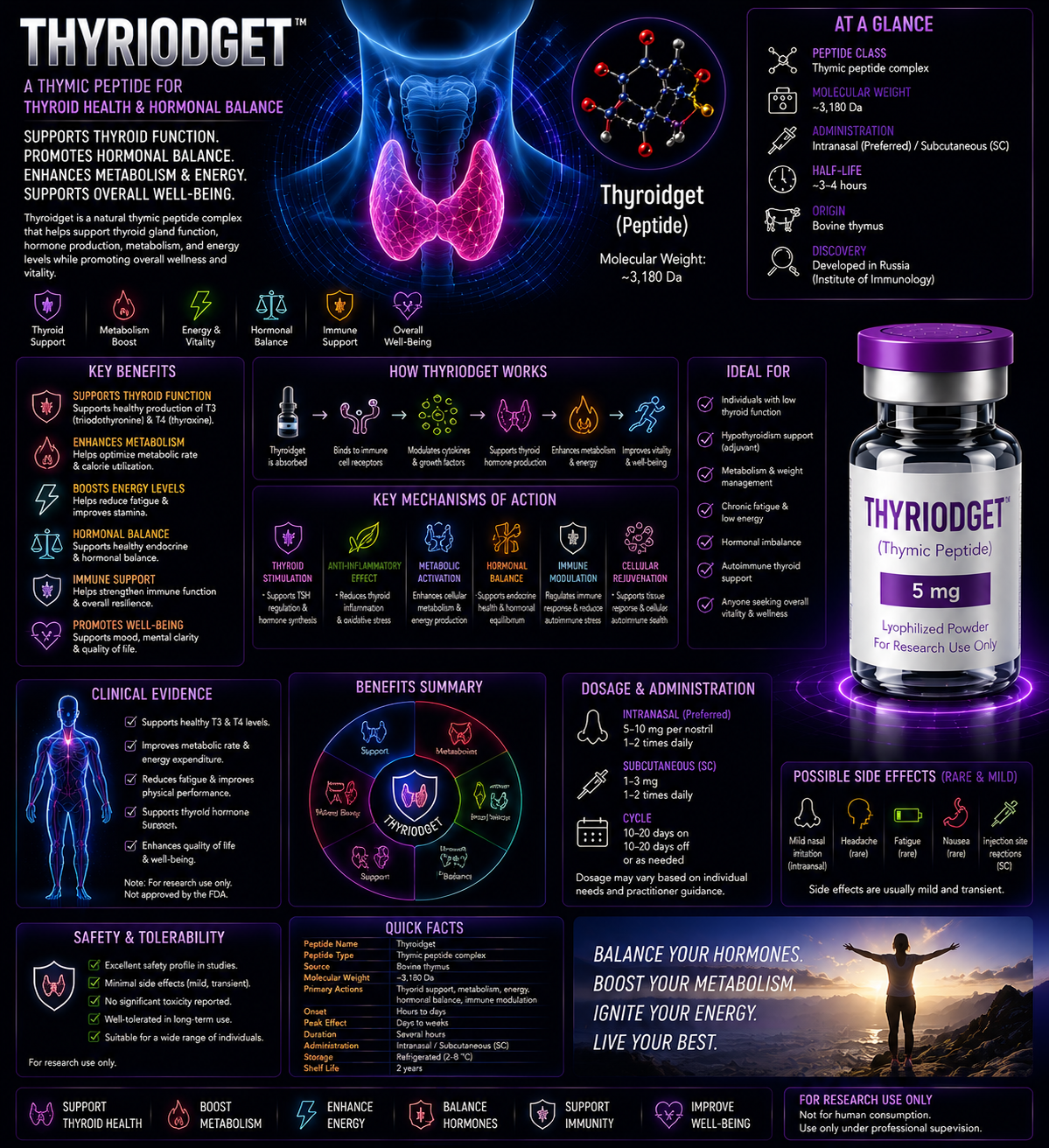
For example, Thyroidget scientific overview content should distinguish the defined Asp–Trp dipeptide from AEDL, Thyreogen, Thyramin, and thyroid-derived peptide mixtures. This dipeptide is listed as DW in ultrashort-peptide research, but direct thyroid pharmacology and controlled human evidence remain limited.
Important Scientific Correction
First, the original article assigned Thyriodget the sequence Ala-Glu-Asp-Leu (AEDL). However, that assignment is incorrect.
| Name | Identity | Research association |
|---|---|---|
| Thyroidget | Asp–Trp (DW) | Meanwhile, Listed as a thyroid regulator in ultrashort-peptide research |
| Bronchogen | Ala–Glu–Asp–Leu (AEDL) | Likewise, Bronchial and respiratory epithelial research |
| Thyreogen | In addition, Low-molecular-weight peptide complex obtained from animal thyroid tissue | Moreover, Thyroid-derived Cytomax product; not one standardized AEDL tetrapeptide |
| Thyramin | Thyroid-derived peptide complex/product | By contrast, Older tissue-specific bioregulator literature |
Importantly, evidence from thyroid-derived peptide mixtures cannot automatically be attributed to purified DW. For example, the biological composition, exposure, and mechanism of a complex extract differ from those of a chemically defined dipeptide.
What Is Thyroidget?
First, Thyroidget is a name used for the ultrashort dipeptide Asp–Trp, abbreviated DW. It appears in published tables of short regulatory peptides as a proposed thyroid regulator and in research examining how very small peptides may interact with peptide or amino-acid transport systems.
Next, it is part of a broader Khavinson-associated hypothesis that two- to four-residue peptides may influence tissue signaling, chromatin, transcription, differentiation, or age-related cellular regulation. Meanwhile, for DW specifically, direct thyroid pharmacology remains poorly characterized.
Asp–Trp
DW
2 amino acids
Ultrashort dipeptide
Thyroid regulation
No
🧬 Structure, 🧪 Sequence, ⚛️ Molecular Weight, and 🧫 Formula
First, Thyroidget is a linear dipeptide consisting of L-aspartic acid followed by L-tryptophan, normally represented with a free amino terminus and free carboxyl terminus.
H-Asp-Trp-OH
DW
| Component | Chemical feature | Analytical relevance |
|---|---|---|
| Aspartic acid | Also, Acidic amino acid with a side-chain carboxyl group | Consequently, Contributes negative charge and possible Asp/isoAsp-related impurities. |
| Tryptophan | However, Aromatic indole amino acid | Therefore, Strong UV absorbance near 280 nm and susceptibility to oxidation. |
| Peptide bond | For example, Asp linked to Trp | Meanwhile, analysts must distinguish DW from free amino acids and the reversed peptide WD. |
| Molecular formula | Likewise, C15H17N3O5 |
|---|---|
| Average molecular weight | Approximately 319.32 g/mol |
| Monoisotopic mass | Approximately 319.1168 Da |
| Peptide length | 2 amino acids |
| Expected stereochemistry | In addition, L-Asp–L-Trp unless otherwise specified |
📅 Discovery Timeline and 📖 Research History
1970s–1990s: Tissue-derived peptide bioregulators
First, Russian and Eastern European research programs developed low-molecular-weight peptide preparations from organs including the thymus, pineal gland, thyroid gland, vessels, cartilage, liver, and brain.
2000s: Thyroid peptide complexes
Next, reports evaluated preparations such as Thyramin or thyroid peptide complexes. Likewise, these were mixtures, not purified Asp–Trp.
2010s: Defined ultrashort peptides
Moreover, research increasingly emphasized specific dipeptides, tripeptides, and tetrapeptides as candidate regulatory motifs.
2022: DW identified in transport research
In addition, a peer-reviewed article examining potential transport of biologically active ultrashort peptides listed Thyroidget (DW) as a thyroid regulator. The work centered on computational transporter interactions, not a controlled human thyroid-treatment trial.
Current status
Finally, research vendors market material under the Thyroidget name, but no standardized pharmaceutical specification, successful late-stage clinical program, or FDA approval exists.
Thyroid Physiology Relevant to Thyroidget Claims
Hypothalamic–pituitary–thyroid axis
First, TRH from the hypothalamus stimulates pituitary TSH. In addition, tSH activates the TSH receptor on thyroid follicular cells and promotes iodine uptake, thyroglobulin production, hormone synthesis, and gland growth.
Hormone synthesis
Next, iodide enters through the sodium–iodide symporter. Moreover, thyroid peroxidase oxidizes iodide and incorporates it into thyroglobulin. Coupling reactions produce T4 and T3.
Peripheral activation
Moreover, deiodinase enzymes convert T4 to active T3 or inactive metabolites in liver, kidney, muscle, brain, and other tissues.
Metabolic signaling
In addition, T3 binds nuclear thyroid hormone receptors and regulates energy expenditure, temperature, lipid and carbohydrate metabolism, cardiac activity, growth, and neural development.
Autoimmune thyroid disease
Finally, Hashimoto thyroiditis and Graves disease are immune disorders. By contrast, a short peptide cannot be assumed to correct autoimmune thyroid disease without direct clinical evidence.
🧠 Proposed Mechanism of Action and 🎯 Target Profile
Importantly, researchers have not established a validated receptor-level mechanism for Thyroidget DW.
Thyroid targeting and clinical benefit remain unproven
Peptide-transporter hypothesis
First, computational studies suggest that selected ultrashort peptides may interact with proton-coupled oligopeptide transporters or amino-acid carriers. Also, predicted docking does not prove oral absorption, intact systemic exposure, or selective thyroid uptake.
Rapid hydrolysis
Next, DW may be split by peptidases into aspartate and tryptophan. Consequently, research must determine whether any effect belongs to the intact peptide, its metabolites, or neither.
Chromatin and gene-expression hypothesis
Moreover, Khavinson-related literature proposes that ultrashort peptides may interact with DNA, histones, or transcriptional machinery. However, direct evidence linking DW to specific thyroid genes is sparse.
Metabolic effects would be indirect
However, a meaningful effect on basal metabolic rate would require altered thyroid hormone production, release, conversion, receptor activity, or downstream transcription. Therefore, those outcomes have not been proven in rigorous human trials of purified DW.
| Potential target | Evidence status |
|---|---|
| Peptide/amino-acid transporters | Moreover, Computational or general transport plausibility |
| TSH receptor | By contrast, No validated direct agonist or antagonist effect |
| Thyroid peroxidase | Also, No established direct effect |
| Sodium–iodide symporter | Consequently, No established direct effect |
| Thyroid hormone receptors | However, No evidence DW acts as T3 or T4 |
| Therefore, Thyroid chromatin or gene expression | For example, Hypothesis; DW-specific evidence limited |
Potential Research Areas, Benefits, and Evidence Limits
Thyroid follicular-cell models
First, appropriate studies could test iodide uptake, thyroglobulin expression, TPO activity, TSH responsiveness, oxidative stress, cell survival, and differentiation in validated human thyroid-cell models.
Pharmacokinetics and tissue distribution
Next, oral stability, intestinal absorption, plasma half-life, metabolism, thyroid exposure, and excretion have not been adequately established.
Gene-expression research
Moreover, RNA sequencing, proteomics, chromatin-accessibility analysis, and promoter assays could test whether DW reproducibly changes thyroid-associated pathways.
Aging and metabolism
In addition, age-related thyroid changes are influenced by illness, medication, autoimmunity, iodine status, pituitary function, and changes in hormone conversion. For example, no convincing evidence shows that DW reverses “thyroid aging.”
Human evidence
However, publicly accessible peer-reviewed literature specifically evaluating purified Thyroidget DW in randomized human thyroid trials is extremely limited or absent. Meanwhile, there is no established evidence that it predictably changes TSH, free T4, free T3, thyroid antibodies, ultrasound findings, symptoms, or levothyroxine requirements.
Potential Side Effects and Safety Considerations
First, no approved label defines dose, contraindications, pharmacokinetics, interactions, reproductive safety, or long-term adverse effects.
Endocrine risk
Moreover, if a compound genuinely altered thyroid function, excessive activity could theoretically produce palpitations, tremor, insomnia, heat intolerance, weight loss, bone loss, or arrhythmia. Likewise, reduced activity could worsen hypothyroidism.
Autoimmune disease
Effects in Finally, Hashimoto thyroiditis or Graves disease are unknown.
Pregnancy
Likewise, maternal thyroid hormone balance is critical for fetal development. In addition, an unapproved peptide should not replace monitored thyroid treatment.
Tryptophan degradation
Meanwhile, the tryptophan residue can oxidize under light, oxygen, heat, or reactive conditions, creating impurities with unknown activity.
Product-name confusion
However, online products labeled Thyriodget, Thyroidget, Thyreogen, thyroid peptide, or AEDL may contain different materials. Moreover, the exact sequence must be verified.
🧪 Testing Methods
| Method | Purpose | Limitation |
|---|---|---|
| RP-HPLC or UPLC | Meanwhile, Separates DW from free amino acids and degradants. | Likewise, Does not prove sequence or biological activity. |
| LC-MS / HRMS | Confirms intact mass. | In addition, DW and WD have the same elemental composition and mass. |
| MS/MS | Moreover, Confirms residue order as Asp followed by Trp. | By contrast, Requires appropriate standards and interpretation. |
| Chiral amino-acid analysis | Also, Confirms L-Asp and L-Trp. | Consequently, Hydrolysis can create artifacts. |
| Quantitative assay | However, Measures net DW content. | Therefore, analysts must not infer net content from HPLC area purity. |
| Free amino-acid analysis | For example, Detects hydrolysis or incomplete synthesis. | Meanwhile, Requires sufficient chromatographic resolution. |
| Tryptophan-oxidation analysis | Likewise, Detects oxidized indole products. | In addition, Impurity profile depends on storage and formulation. |
| Moreover, Residual solvents and water | Measures nonpeptide material. | By contrast, Does not establish endocrine activity. |
| Also, Microbial or sterility testing | Consequently, Assesses route-specific microbiological quality. | However, Standards differ by oral, topical, or injectable route. |
| Thyroid-cell assays | Therefore, Could measure iodide uptake, TPO, thyroglobulin, or TSH response. | For example, No single cell assay proves clinical benefit. |
📄 COA Interpretation
Confirm identity
First, the COA should state Asp–Trp or DW. AEDL is not Thyroidget.
Verify sequence order
Next, Asp–Trp and Trp–Asp have the same molecular formula and mass but are different compounds. By contrast, mS/MS or another sequence-sensitive method is necessary.
Confirm stereochemistry
Moreover, the expected material is generally L-Asp–L-Trp unless the specification says otherwise.
Separate identity, purity, and content
- Identity First, confirms DW.
- Purity Next, estimates relative chromatographic composition.
- Also, net content measures actual DW after analysts account for water, salts, and residuals.
Review degradation
In addition, analysts should evaluate free Asp, free Trp, reversed-sequence impurities, isoAsp species, and oxidized tryptophan.
Do not infer thyroid efficacy
However, a chemically correct COA cannot demonstrate thyroid targeting, TSH normalization, hormone production, metabolism changes, or human safety.
📊 Comparison Tables
Thyroidget, Bronchogen, and Thyroid-Complex Differences
| Feature | Thyroidget | Bronchogen | Thyreogen | Thyramin |
|---|---|---|---|---|
| Composition | Asp–Trp (DW) | AEDL | Thyroid-derived peptide complex | Thyroid-derived peptide complex |
| Single defined sequence? | Yes | Yes | For example, No FDA approval applies. | Generally no |
| Research focus | Thyroid regulation | Bronchial epithelium | Thyroid tissue | Thyroid tissue |
| Human evidence | Meanwhile, Extremely limited for purified DW | Primarily preclinical | Limited regional literature | Limited regional literature |
| FDA approved? | Moreover, Regulators have not approved this compound. | In addition, No approved indication exists. | This remains unapproved. | However, No FDA approval applies. |
Experimental Dipeptide Versus Approved Thyroid Hormones
| Feature | Thyroidget DW | Levothyroxine | Liothyronine |
|---|---|---|---|
| Type | Experimental dipeptide | Synthetic T4 | Synthetic T3 |
| Established mechanism | None defined | Likewise, Hormone replacement; converted partly to T3 | Direct T3 replacement |
| Approved use | None | In addition, Hypothyroidism and selected TSH-suppression settings | Selected hormone-replacement settings |
| Clinical monitoring | No validated protocol | Moreover, TSH and free T4 | Specialist-directed monitoring |
Related Ultrashort Peptides
| Peptide | Sequence | Common classification |
|---|---|---|
| Thyroidget | DW | Thyroid regulator |
| Bronchogen | AEDL | Bronchoprotector |
| Vesugen | KED | Vascular bioregulator |
| Vilon | KE | Immune/thymic bioregulator |
| Retiget | DA | Retinal research peptide |
🖼️ Original Diagram Specifications
Diagram 1: DW molecular map
By contrast, Show Asp–Trp, the peptide bond, aspartate side-chain carboxyl group, tryptophan indole ring, and free termini.
Diagram 2: Identity correction
Also, Compare Thyroidget DW, Bronchogen AEDL, Thyreogen complex, and Thyramin complex.
Diagram 3: Thyroid hormone synthesis
Consequently, Show TSH receptor, NIS, TPO, thyroglobulin, T4/T3 release, and deiodinases. Label the Thyroidget target as unknown.
Diagram 4: Proposed transport
However, Show intestinal peptide transport, hydrolysis, systemic circulation, and the unresolved question of thyroid delivery.
Diagram 5: Evidence ladder
Therefore, Show chemistry, computational transport, cell assays, animal studies, controlled human trials, and approval. Place DW at the early research stages.
Diagram 6: COA workflow
For example, Show sequence order, exact mass, stereochemistry, free amino acids, Trp oxidation, net content, microbiology, stability, and batch review.
❓ Frequently Asked Questions
Is it Thyriodget or Thyroidget?
Meanwhile, The published spelling is generally Thyroidget.
Is Thyroidget a peptide?
Likewise, Yes. It is listed as the dipeptide Asp–Trp (DW).
Is Thyroidget AEDL?
In addition, No. AEDL is Bronchogen.
What is its molecular weight?
Moreover, Approximately 319.32 g/mol for neutral Asp–Trp.
Does it treat hypothyroidism?
By contrast, No reliable clinical evidence establishes it as a hypothyroidism treatment.
Does it raise T3 or T4?
Also, rigorous controlled human trials have not demonstrated this effect.
Can it replace levothyroxine?
No.
Does it treat Hashimoto disease?
Consequently, No validated evidence shows that DW reduces thyroid antibodies or controls autoimmune thyroiditis.
Is it the same as Thyreogen?
However, No. Thyroidget is a defined dipeptide; Thyreogen is a thyroid-derived peptide complex.
Does a COA prove thyroid activity?
Therefore, No. A COA establishes analytical characteristics, not organ targeting or clinical effectiveness.
Thyroidget Scientific Overview: Final Thoughts
In conclusion, the original draft used the wrong sequence. Published ultrashort-peptide literature identifies Thyroidget as Asp–Trp (DW), while AEDL is Bronchogen. Thyreogen and Thyramin are separate thyroid-derived peptide complexes.
However, DW is scientifically interesting as a defined ultrashort peptide, but evidence for thyroid-specific pharmacology remains sparse. Transport modeling and broad bioregulator hypotheses do not establish treatment of hypothyroidism, Hashimoto disease, Graves disease, metabolic dysfunction, or age-related thyroid decline.
Therefore, research material should be verified for exact sequence order, stereochemistry, molecular mass, free amino acids, tryptophan oxidation, net peptide content, and route-appropriate microbiological quality. Clinical thyroid claims require controlled studies with TSH, free T4, free T3, antibodies, imaging, symptoms, and safety outcomes.
📚 References
- Therefore, Khavinson V, et al. Transport of biologically active ultrashort peptides using POT and LAT carriers. International Journal of Molecular Sciences. 2022.
- Likewise, Gorbachev AL, et al. Peptide bioregulator efficacy in correction of reduced thyroid function. 2005.
- For example, Khavinson V, Kuznik B. Peptide Bioregulators: The New Class of Geroprotectors. 2014.
- Moreover, Khavinson VK, Morozov VG. Peptides of pineal gland and thymus prolong human life. Neuro Endocrinology Letters. 2003.
- In addition, Avolio F, et al. Peptides regulating proliferative activity and inflammatory processes. International Journal of Molecular Sciences. 2022.
- However, Lazareva EM, et al. Peptide AEDL activates metabolism and autophagy in root research. 2025.
- Therefore, Kononenko NV, et al. Peptide AEDL and glutathione stimulate root development. International Journal of Molecular Sciences. 2025.
- Likewise, Khavinson peptide-product documentation. Thyreogen thyroid peptide complex A-2.
- For example, Mullur R, Liu YY, Brent GA. Thyroid hormone regulation of metabolism. Physiological Reviews. 2014.
- Moreover, Brent GA. Mechanisms of thyroid hormone action. Journal of Clinical Investigation.
- In addition, Yen PM. Physiological and molecular basis of thyroid hormone action. Physiological Reviews.
- However, Ortiga-Carvalho TM, et al. Hypothalamus-pituitary-thyroid axis. Comprehensive Physiology.
- Therefore, Chaker L, et al. Hypothyroidism. Lancet. 2017.
- Likewise, De Leo S, et al. Hyperthyroidism. Lancet. 2016.
- For example, Jonklaas J, et al. Guidelines for treatment of hypothyroidism. Thyroid. 2014.
- Moreover, Ross DS, et al. ATA guidelines for hyperthyroidism and thyrotoxicosis. Thyroid.
- In addition, Alexander EK, et al. Thyroid disease during pregnancy and postpartum. Thyroid.
- Caturegli P, et al. Finally, Hashimoto thyroiditis. Autoimmunity Reviews.
- However, Dai G, Levy O, Carrasco N. Cloning and characterization of the thyroid iodide transporter. Nature. 1996.
- Therefore, Bizhanova A, Kopp P. The sodium–iodide symporter. Molecular and Cellular Endocrinology.
- Likewise, Carvalho DP, Dupuy C. Thyroid hormone biosynthesis and release. Molecular and Cellular Endocrinology.
- For example, Gereben B, et al. Deiodinase-regulated thyroid hormone signaling. Endocrine Reviews.
- Moreover, Bianco AC, Kim BW. Local control of thyroid hormone action. Journal of Clinical Investigation.
- In addition, Daniel H. Molecular and integrative physiology of intestinal peptide transport. Annual Review of Physiology.
- However, Brandsch M. Drug transport via intestinal peptide transporter PepT1. Current Opinion in Pharmacology.
- Therefore, Smith DE, et al. Proton-coupled oligopeptide transporter family SLC15. Molecular Aspects of Medicine.
- Likewise, International Council for Harmonisation. ICH Q2(R2): Validation of Analytical Procedures.
- For example, United States Pharmacopeia. General Chapter <621>, Chromatography.
- Moreover, United States Pharmacopeia. General Chapters <61> and <62>, Microbiological Examination of Nonsterile Products.
- In addition, United States Pharmacopeia. General Chapter <71>, Sterility Tests.
- However, United States Pharmacopeia. General Chapter <85>, Bacterial Endotoxins Test.
- Therefore, International Council for Harmonisation. ICH Q3C: Residual Solvents.
- International Council for Harmonisation. ICH Q1A(R2): Stability Testing.
Thyroidget, Ultrashort-Peptide, and Thyroid-Biology Sources
Transport, Analytical, and Quality-Control Sources
For example, this article review checked identity, sequence assignment, chemistry, thyroid physiology, evidence limitations, and regulatory status in July 2026.