
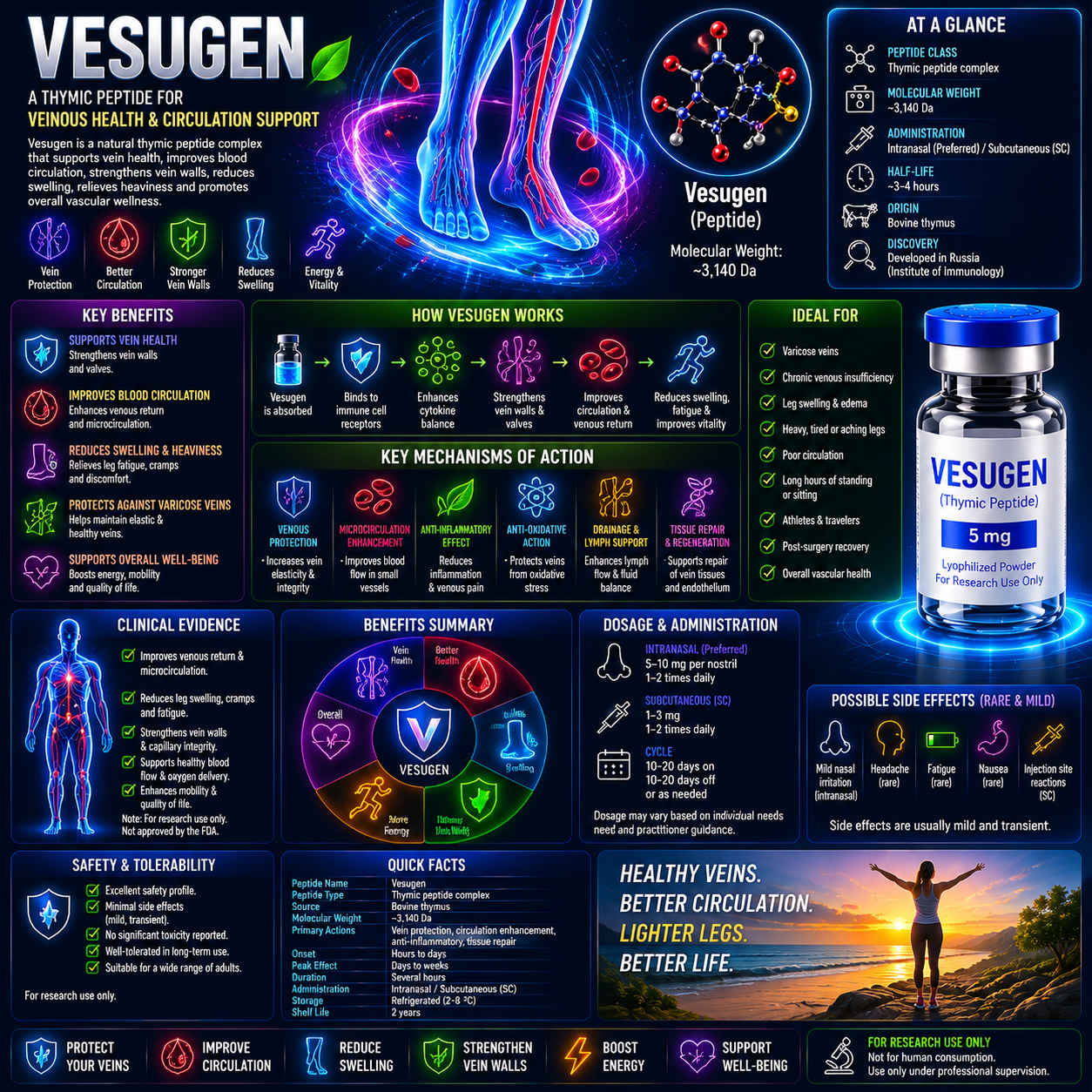
Vesugen: What It Is, How It Works, Benefits, and Research Overview What Is Vesugen? Vesugen is an investigational vascular bioregulator peptide stud
Vesugen: What It Is, How It Works, Benefits, and Research Overview
What Is Vesugen?
Vesugen is an investigational vascular bioregulator peptide studied for its potential role in blood vessel signaling, endothelial function, cardiovascular resilience, and healthy vascular aging research. It belongs to the family of Khavinson peptide bioregulators, a group of short tissue-specific peptides developed primarily through Russian gerontology and peptide-regulation research. Vesugen is also commonly referred to as:
KED (Lys-Glu-Asp) or T-38, a synthetic tripeptide associated with vascular wall and endothelial signaling pathways. Researchers classify Vesugen as a vascular/endothelial peptide bioregulator because of its proposed activity in blood vessel tissue and microcirculation research.
Researchers investigate Vesugen in relation to:
- Endothelial (blood vessel lining) function
- Microcirculation and vascular signaling
- Cardiovascular aging and vascular resilience
- Blood-flow regulation and vascular remodeling
- Neurovascular and cognitive aging pathways
Important: Vesugen is not FDA approved and remains investigational, with most evidence coming from preclinical studies, mechanistic research, Khavinson peptide literature, and limited regional clinical observations, rather than large modern Western clinical trials.
What Is Vesugen Made Of?
Vesugen is a synthetic tripeptide (3 amino acids) composed of:
Lysine – Glutamic Acid – Aspartic Acid
Lys-Glu-Asp (KED). Researchers describe it as a vascular bioregulator peptide associated with endothelial tissue signaling and blood vessel wall proteins.
Because of its small size, Vesugen is considered:
- Structurally simple
- Tissue-focused in vascular biology research
- Experimentally stable for mechanistic studies involving endothelial signaling and aging biology
How Does Vesugen Work?
The precise mechanism remains under investigation, but researchers theorize Vesugen may influence vascular endothelial signaling, gene expression, cellular resilience, and microcirculatory adaptation pathways.
1. Endothelial Cell and Blood Vessel Signaling
One of the largest areas of interest involves:
Endothelial cells
These cells line the inside of blood vessels and help regulate:
- Blood flow
- Vascular tone
- Inflammation
- Nutrient and oxygen delivery
Researchers investigate whether Vesugen may help support:
- Endothelial cell signaling
- Vascular wall resilience
- Blood vessel repair pathways during aging or stress
- Cellular communication involved in circulation and tissue perfusion
In simple terms:
Vesugen says:
“Help support healthy blood vessel signaling and vascular resilience.”
2. Vascular Aging and Endothelial Senescence Research
Researchers investigate Vesugen in relation to:
Vascular aging
Experimental work explores whether Vesugen may help model:
- Endothelial aging and dysfunction
- Oxidative stress adaptation in vascular tissue
- Cellular signaling involved in blood vessel maintenance
- Age-related decline in vascular resilience
Researchers are particularly interested in how short peptides may affect endothelial senescence pathways and tissue-specific cellular signaling during aging.
3. Blood Flow and Microcirculation Research
Some regional clinical literature investigated Vesugen in vascular insufficiency and circulation-related conditions.
A small study involving men with vasculogenic erectile dysfunction associated with atherosclerosis reported improved objective blood-flow measurements after treatment, suggesting possible vascular signaling effects. However, this evidence is limited, regional, and not definitive proof of efficacy.
Researchers continue studying whether Vesugen influences:
- Microcirculatory signaling
- Blood-flow dynamics
- Vascular tissue adaptation under stress conditions
4. Neurovascular and Cognitive Aging Research
Researchers have also explored Vesugen in:
Neurovascular and aging models
Some experimental literature suggests Vesugen may influence:
- Neurovascular communication pathways
- Neuronal differentiation signaling
- Cognitive aging biology and tissue resilience
A 2021 review described KED (Vesugen) as a vasoprotective peptide investigated for neuroplasticity-related signaling and neuronal differentiation in experimental systems.
5. Gene Expression and Epigenetic Signaling
Like several Khavinson peptides, Vesugen is studied for potential effects on:
- Gene transcription pathways
- Chromatin accessibility
- Endothelial protein synthesis
- Tissue-specific cellular adaptation during aging
Researchers hypothesize that Vesugen may interact with promoter regions or chromatin-associated systems involved in vascular tissue signaling, though this remains mechanistic and early-stage science.
Why Is Vesugen Getting Attention?
Vesugen attracts attention because it combines several important research themes:
- Vascular endothelial signaling
- Blood-flow and microcirculation biology
- Cardiovascular aging and vascular resilience
- Neurovascular and cognitive aging research
- Short-peptide gene regulation biology
Researchers are especially interested in how a peptide consisting of only three amino acids may influence tissue-specific vascular signaling systems.
Potential Research Areas of Interest
1. Cardiovascular and Vascular Research
Researchers investigate whether Vesugen may support:
- Endothelial signaling pathways
- Blood vessel resilience
- Microcirculatory adaptation
- Vascular tissue maintenance during aging
2. Blood Flow and Circulation Research
Experimental work explores Vesugen in relation to:
- Blood-flow signaling
- Vascular remodeling pathways
- Atherosclerosis-associated vascular dysfunction
- Tissue oxygenation and circulation biology
3. Healthy Aging Research
Researchers study Vesugen for:
- Vascular aging models
- Endothelial resilience during aging
- Neurovascular signaling and biological aging markers
4. Neurovascular and Brain Research
Researchers investigate whether Vesugen influences:
- Neuronal differentiation signaling
- Neurovascular communication
- Neuroplasticity-associated pathways in experimental systems
Vesugen vs Cardiogen vs Livagen vs Epitalon
| Feature | Vesugen | Cardiogen | Livagen | Epitalon |
|---|---|---|---|---|
| Structure | Tripeptide (KED) | Tetrapeptide (AEDR) | Tetrapeptide (KEDA) | Tetrapeptide (AEDG) |
| Main Focus | Vascular signaling & endothelial resilience | Cardiac signaling | Liver signaling | Healthy aging & circadian biology |
| Tissue Focus | Blood vessels/endothelium | Heart tissue | Liver | Pineal/aging biology |
| Major Research Area | Blood flow & vascular aging | Cardiac remodeling | Hepatic signaling | Telomere/circadian research |
| FDA Approved? | No | No | No | No |
Researchers generally view:
- Vesugen → vascular/endothelial bioregulator peptide
- Cardiogen → cardiac tissue signaling peptide
- Livagen → liver and chromatin signaling peptide
- Epitalon → aging and circadian signaling peptide
Potential Side Effects and Safety Considerations
Because Vesugen remains investigational:
- Human therapeutic evidence is limited
- Long-term pharmacology remains uncertain
- Most evidence comes from preclinical, mechanistic, and regional peptide bioregulator literature, not large modern clinical trials
Researchers emphasize that findings should be interpreted as experimental and hypothesis-generating, rather than established clinical evidence.
Frequently Asked Questions
Is Vesugen a peptide?
Yes. Vesugen is a synthetic tripeptide composed of Lys-Glu-Asp (KED) studied for vascular and endothelial signaling research.
Is Vesugen FDA approved?
No. Vesugen is not FDA approved and remains investigational.
What is Vesugen studied for?
Researchers study Vesugen for vascular signaling, endothelial resilience, blood-flow biology, cardiovascular aging, and neurovascular research.
Does Vesugen improve circulation?
Some limited regional studies suggest possible improvements in vascular blood-flow markers, but robust clinical evidence remains lacking.
What makes Vesugen different from Cardiogen?
Vesugen is primarily studied for blood vessels and endothelial signaling, whereas Cardiogen focuses more on heart tissue and myocardial signaling.
Final Thoughts
Vesugen is an investigational vascular bioregulator peptide that has generated interest for its potential role in endothelial signaling, blood-flow biology, vascular resilience, cardiovascular aging, and neurovascular research. As a short KED tripeptide, Vesugen is studied for how ultrashort peptides may influence tissue-specific vascular signaling and cellular adaptation. While mechanistic findings are intriguing, Vesugen remains experimental, human evidence is limited, and broader clinical relevance continues to be explored.
