Vilon (Lys–Glu / KE): What It Is, How It Works, Benefits, and Research Overview
A detailed, evidence-graded review of Vilon, including its L-lysyl-L-glutamic-acid structure, molecular properties, relationship to thymic peptide research, chromatin and ribosomal-gene findings, IL-2 transcription, inflammatory and proliferative studies, telomere and SIRT1/PARP research, animal longevity findings, safety, analytical testing, and COA interpretation.
What Is Vilon?
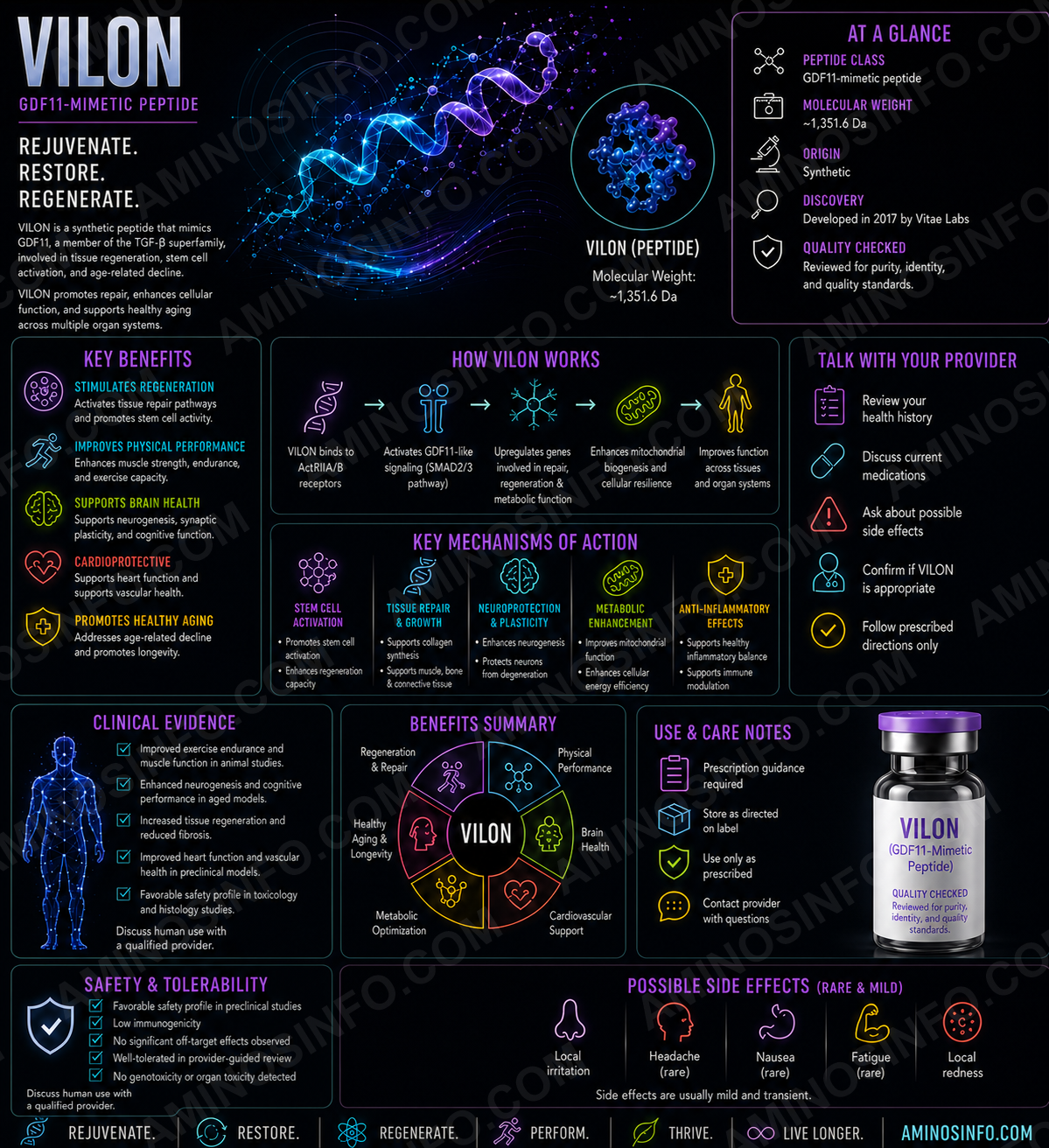
Vilon is a synthetic dipeptide composed of L-lysine followed by L-glutamic acid. Its sequence is Lys–Glu, abbreviated KE.
It was developed within the Khavinson peptide-bioregulator research program and is commonly described as a thymic or immune-associated regulatory peptide. The sequence has also been discussed as one of the short biologically active peptides associated with the broader thymus-derived preparation Thymalin.
Vilon
L-lysyl-L-glutamic acid
Lys–Glu
KE
2 amino acids
No
🧬 Molecular Structure
Vilon is the conventional α-dipeptide formed by linking the α-carboxyl group of L-lysine to the α-amino group of L-glutamic acid. The expected research form has free N- and C-termini.
🧪 Amino-Acid Sequence
H-L-Lys-L-Glu-OH
One-letter notation: KE
| Residue | Chemical feature | Analytical relevance |
|---|---|---|
| L-lysine | Basic ε-amino side chain | Can form side-chain-linked impurities or alter salt content. |
| L-glutamic acid | Acidic γ-carboxyl side chain | Requires confirmation of conventional α-linkage and sequence order. |
⚛️ Molecular Weight and 🧫 Formula
| Neutral molecular formula | C11H21N3O5 |
|---|---|
| Average molecular weight | Approximately 275.30 g/mol |
| Peptide length | 2 amino acids |
| Stereochemistry | L-Lys and L-Glu |
| Expected linkage | Conventional α-peptide bond |
| Common PubChem identity | Lysylglutamic acid |
KE and EK have the same elemental formula and molecular mass. Intact-mass testing alone cannot distinguish them.
📅 Discovery Timeline and Research History
1970s–1980s: Thymic peptide bioregulator programs expand
Researchers investigated low-molecular-weight thymus-derived peptides for immune regulation, tissue signaling, and aging.
1980s–1990s: KE peptide synthesized and characterized
Lys–Glu was developed as a defined synthetic analogue associated with thymic peptide activity.
2000: IL-2 and animal-longevity studies
Research reported concentration- and time-dependent stimulation of interleukin-2 gene expression in mouse splenocytes and longer lifespan in female CBA mice.
2002: Intestinal enzyme and transport studies
Aged-rat studies examined membrane enzymes, glucose transport, and glycine transport after oral Vilon treatment.
2004–2006: Chromatin studies in older human lymphocytes
Vilon was reported to promote deheterochromatinization and reactivation of selected ribosomal genes in cultured lymphocytes from older donors.
2019–2021: DNA-binding and gene-regulation models
Systematic modeling and review literature proposed selective interactions of KE with double-stranded DNA and transcriptional regulation.
2022: THP-1 inflammatory and proliferative study
Vilon was tested with other peptide bioregulators in a human leukemia-derived monocyte/macrophage model.
2023: SIRT1 and PARP studies
Research examined KE effects on SIRT1, PARP1, and PARP2 gene expression and protein synthesis in human mesenchymal stem cells of different replicative ages.
Current status
Vilon remains investigational and has not entered a broadly recognized modern clinical-development program.
Relationship to Thymic Peptide Research
Association with Thymalin
KE is frequently described as one of the short peptide constituents or active motifs associated with Thymalin, a bovine thymus-derived peptide complex.
Defined peptide versus extract
Vilon is one chemically defined molecule. Thymalin is a mixture. Findings from one cannot automatically be attributed to the other.
Thymic function is broader than one peptide
The thymus regulates T-cell development through epithelial cells, chemokines, cytokines, antigen presentation, hormones, and many cell–cell interactions.
No proven thymus restoration
There is no robust evidence that KE physically rebuilds an aged thymus or restores a youthful T-cell repertoire.
🧠 Proposed Mechanisms of Action
No validated high-affinity receptor has been established as the exclusive target of Vilon.
1. Chromatin decondensation
Studies in cultured lymphocytes from older donors reported increased deheterochromatinization and reactivation of selected previously condensed chromatin regions.
2. Ribosomal-gene activation
Vilon was associated with increased activity of nucleolar organizer regions, which are involved in ribosomal RNA synthesis.
3. IL-2 transcription
Mouse-splenocyte studies reported increased IL-2 gene expression in vitro without conventional antigenic induction.
4. DNA interaction
Computational and biophysical work proposes that KE can interact with selected DNA motifs. Binding or docking does not prove selective gene regulation in living humans.
5. SIRT1 and PARP pathways
Recent studies reported effects on SIRT1, PARP1, and PARP2 expression in cultured human mesenchymal stem cells.
🎯 Target and Pathway Profile
| Target or pathway | Evidence status |
|---|---|
| Chromatin condensation | Altered in cultured lymphocytes from older donors. |
| Nucleolar organizer regions | Reactivation reported in cytogenetic studies. |
| IL-2 gene expression | Increased in mouse splenocytes in vitro. |
| SIRT1 | Gene and protein changes reported in human MSC cultures. |
| PARP1 and PARP2 | Expression changes reported in human MSC cultures. |
| Double-stranded DNA motifs | Proposed through modeling and binding studies. |
| Single exclusive receptor | None established. |
Chromatin and Ribosomal-Gene Research
Age-related heterochromatinization
Chromatin can become more condensed with age, potentially reducing access to selected genes. This is one of many age-associated epigenetic changes.
2004 Vilon study
Cultured lymphocytes from older donors were treated with Vilon and evaluated using cytogenetic markers of facultative and structural heterochromatin.
Reported deheterochromatinization
The study reported progressive reactivation of facultative heterochromatin and increased synthetic activity.
2006 comparative study
Epitalon, Livagen, and Vilon were reported to activate ribosomal genes and decondense selected chromatin regions in lymphocytes from older people.
Important distinction
Vilon did not produce every chromatin change observed with Epitalon or Livagen, including selected pericentromeric effects.
Clinical meaning remains uncertain
More open chromatin is not automatically beneficial. Chromatin compaction can silence damaged, repetitive, oncogenic, or inappropriate genes.
Immune and IL-2 Research
Interleukin-2 biology
IL-2 supports T-cell proliferation, regulatory T-cell survival, immune activation, and immune tolerance.
Mouse-splenocyte study
KE increased IL-2 gene expression in cultured mouse spleen lymphocytes in a concentration- and time-dependent manner.
Comparative peptide study
Vilon, Epitalon, and Cortagen all stimulated IL-2 mRNA, with Vilon and Epitalon producing stronger responses under the tested conditions.
Immune activation is not universally beneficial
Increasing IL-2 can support antiviral or antitumor immunity but can also contribute to inflammation or immune dysregulation.
No proven infection prevention
No large modern trial establishes that Vilon prevents infections, improves vaccine responses, or restores immune function in healthy older adults.
Inflammation and Proliferation Research
THP-1 model
A 2022 study tested Vilon and several other peptides in THP-1 cells, a leukemia-derived monocytic cell line that can be differentiated toward macrophage-like states.
Proliferative effects
The study evaluated cell proliferation under resting and stimulated conditions. Results differed by peptide, concentration, and cell state.
Inflammatory signaling
TNF and IL-6 responses were measured after lipopolysaccharide stimulation.
Cell-line limitation
THP-1 cells are not normal primary human monocytes, thymocytes, or intact immune systems.
No established anti-inflammatory indication
These findings do not establish treatment of autoimmune disease, sepsis, inflammatory bowel disease, arthritis, or chronic inflammatory conditions.
Telomere, SIRT1, and DNA-Repair Research
Telomere normalization claims
Review literature reports that KE normalized telomere length in phytohemagglutinin-stimulated blood lymphocytes from people of different ages.
Interpretation requires caution
“Normalization” is not the same as durable telomere elongation, improved healthspan, or lower mortality.
SIRT1
SIRT1 is an NAD-dependent deacetylase involved in metabolic regulation, stress responses, chromatin, and DNA repair.
PARP1 and PARP2
PARP enzymes participate in DNA-damage signaling and consume NAD during repair.
2023 mesenchymal-stem-cell study
KE altered SIRT1, PARP1, and PARP2 gene expression and protein synthesis in young and replicatively aged human MSC cultures.
No proven DNA-repair therapy
Gene-expression changes do not prove reduced mutation burden, slower aging, cancer prevention, or improved tissue repair in humans.
Animal Aging and Longevity Research
Female CBA mouse study
Subcutaneous Vilon beginning at six months of age was reported to increase activity and endurance, lower body temperature, lengthen lifespan, and reduce spontaneous tumors.
Separate tumor-growth report
A related publication reported suppression of spontaneous tumor growth and increased lifespan in mice.
What was not changed
The study reported no effect on age-related estrous changes or free-radical processes.
Model limitations
- Single strain and sex
- Small or incompletely reported sample sizes
- Limited independent replication
- Potential laboratory and husbandry effects
- No direct translation to human longevity
No proven human lifespan extension
Vilon has not been shown in a modern randomized trial to extend human life or prevent age-related disease.
Intestinal and Metabolic Research
Aged-rat enzyme studies
Oral Vilon increased selected membrane and cytosolic enzyme activities in the small intestine of aged rats.
Nutrient transport studies
Research reported improved glucose and glycine transport characteristics in aged-rat intestinal tissue.
Meaning remains uncertain
Changes in ex vivo transport or enzyme activity do not establish improved nutrition, metabolism, or gastrointestinal health in humans.
No established metabolic indication
Vilon is not proven to treat malabsorption, diabetes, sarcopenia, intestinal aging, or metabolic disease.
Evidence Limitations and Clinical Interpretation
Research-group concentration
A large portion of Vilon literature comes from the same peptide-bioregulator research network.
Small and older studies
Many publications have limited methodological detail by current standards.
Mechanistic endpoints dominate
Chromatin markers, gene expression, cell proliferation, and enzyme activity are not equivalent to clinical benefit.
Human therapeutic trials are sparse
There is little modern evidence showing improved infection rates, vaccine response, disability, cardiovascular outcomes, dementia risk, or survival.
Sequence simplicity does not guarantee biological specificity
KE can arise from protein digestion and may interact with multiple transporters or cellular pathways.
Safety and Regulatory Considerations
No standardized human safety profile
No FDA-approved label defines dose, route, pharmacokinetics, contraindications, pregnancy safety, drug interactions, or long-term adverse effects.
Immune effects
IL-2 and immune-signaling changes could theoretically matter in autoimmunity, transplantation, infection, cancer, or immunosuppressive therapy.
Chromatin and proliferation effects
Any intervention that alters chromatin access or proliferation requires evaluation for off-target gene activation and tumor risk.
Product-quality risk
Unapproved material may contain EK instead of KE, D-amino acids, side-chain-linked isomers, salts, free amino acids, residual solvents, microbial contamination, endotoxin, or inaccurate content.
Regulatory status
Vilon is not FDA approved in the United States.
🧪 Laboratory Testing Methods
| Method | Purpose | Important limitation |
|---|---|---|
| RP-HPLC, HILIC, ion-pair HPLC, or UPLC | Separates KE from free amino acids, EK, and degradants. | Very small polar peptides can be poorly retained without method optimization. |
| LC-MS / HRMS | Confirms intact mass and major impurities. | Cannot distinguish KE from EK or linkage isomers by mass alone. |
| MS/MS sequencing | Confirms Lys–Glu order. | Short peptides may produce limited fragment ions. |
| NMR spectroscopy | Confirms sequence connectivity and α-peptide linkage. | Requires adequate purity and concentration. |
| Chiral amino-acid analysis | Confirms L-Lys and L-Glu stereochemistry. | Hydrolysis and derivatization may introduce artifacts. |
| Net peptide-content assay | Measures actual KE concentration. | Must not be inferred from HPLC area purity. |
| Sequence-isomer assay | Detects EK and side-chain-linked isomers. | Authentic standards are highly valuable. |
| Free amino-acid analysis | Detects hydrolysis or incomplete synthesis. | Requires sufficient separation from intact KE. |
| IL-2 transcription assay | Measures one proposed immune effect. | Not a validated clinical potency assay. |
| Chromatin-accessibility assay | Measures heterochromatin, NOR activity, ATAC-seq, or related endpoints. | Results are cell-type and condition dependent. |
| SIRT1/PARP expression assay | Measures proposed aging and DNA-repair pathways. | Expression changes do not prove functional repair. |
| Microbial limits, sterility, and endotoxin | Evaluate route-specific microbiological quality. | Requirements depend on final formulation. |
| Stability-indicating assay | Tracks hydrolysis, racemization, assay, pH, water, and appearance. | Must reflect real formulation and storage conditions. |
📄 How to Interpret a Vilon COA
- Verify exact sequence: H-L-Lys-L-Glu-OH, abbreviated KE.
- Confirm sequence order: KE is not EK.
- Confirm α-peptide linkage: Side-chain-linked lysyl or glutamyl isomers are different compounds.
- Verify stereochemistry: Both residues should be L-amino acids.
- Confirm molecular formula and mass: C₁₁H₂₁N₃O₅ and approximately 275.30 g/mol.
- Separate purity, identity, and net content: These are distinct analytical measurements.
- Review free lysine, free glutamate, sequence isomers, water, counterions, and residual solvents.
- Match testing to route: Injectable, oral, or nasal formulations require different controls.
- Do not infer biological efficacy: A COA cannot prove chromatin rejuvenation, telomere normalization, immune restoration, cancer prevention, or lifespan extension.
📊 Vilon vs Thymogen vs Thymalin vs Epitalon
| Feature | Vilon | Thymogen | Thymalin | Epitalon |
|---|---|---|---|---|
| Sequence or composition | KE | EW | Complex thymic peptide mixture | AEDG |
| Length | 2 amino acids | 2 amino acids | Mixture | 4 amino acids |
| Main research focus | Chromatin, IL-2, immune aging | Immune and hematopoietic signaling | Broad thymic immune effects | Pineal, circadian, and telomere research |
| FDA approved? | No | No | No | No |
Vilon vs KE Sequence Isomers
| Compound | Sequence or linkage | Same formula and mass? | Same identity? |
|---|---|---|---|
| Vilon | α-L-Lys-L-Glu | Reference | Yes |
| Glu-Lys | α-L-Glu-L-Lys | Yes | No |
| Lys side-chain isopeptide | Alternative ε-linkage | Often yes | No |
| γ-Glu-linked analogue | Glutamate side-chain linkage | Often yes | No |
Vilon vs Established Epigenetic Interventions
| Approach | Mechanism | Difference from Vilon |
|---|---|---|
| DNA methyltransferase inhibitors | Direct enzyme inhibition | Approved only for selected cancers with substantial toxicity |
| Histone deacetylase inhibitors | Alter histone acetylation | Defined molecular targets and clinical indications |
| CRISPR epigenome editing | Locus-specific experimental regulation | Research-stage targeted technology |
| Vilon | Proposed broad chromatin and gene effects | No validated receptor or approved indication |
Vilon vs Evidence-Based Immune Support
| Approach | Established role | Difference from Vilon |
|---|---|---|
| Vaccination | Antigen-specific immune memory | Defined preventive intervention |
| Correction of nutrient deficiency | Restores deficient immune function | Evidence-based when deficiency is documented |
| Antimicrobials | Direct pathogen treatment | Pathogen-specific therapy |
| Vilon | Experimental immune and chromatin peptide | No FDA approval or established clinical role |
🔗 Related Peptides and Pathways
- Thymalin: Thymus-derived peptide complex associated with KE.
- Thymogen: EW dipeptide studied for immune and hematopoietic effects.
- Epitalon: AEDG tetrapeptide studied in circadian and telomere research.
- Livagen: KEDA tetrapeptide studied in liver and chromatin research.
- IL-2: T-cell growth and regulatory cytokine influenced in mouse splenocyte studies.
- SIRT1: NAD-dependent deacetylase examined in KE-treated MSCs.
- PARP1 and PARP2: DNA-damage-response enzymes examined in the same research.
- Nucleolar organizer regions: Ribosomal-gene regions assessed in chromatin studies.
🖼️ Original Diagram Specifications
Diagram 1: Vilon molecular structure
Show H-Lys-Glu-OH with lysine’s ε-amino side chain, glutamate’s γ-carboxyl side chain, the α-peptide bond, and free termini.
Diagram 2: KE versus EK and linkage isomers
Show KE, EK, ε-linked, and γ-linked alternatives, noting that some share identical formula and mass.
Diagram 3: Chromatin research
Show condensed heterochromatin, decondensation, nucleolar organizer activation, ribosomal RNA transcription, and the warning that more open chromatin is not universally beneficial.
Diagram 4: IL-2 pathway
Show experimental KE exposure, IL-2 transcription in mouse splenocytes, T-cell proliferation, Treg maintenance, and context-dependent effects.
Diagram 5: SIRT1/PARP pathway
Show NAD, SIRT1, PARP1, PARP2, DNA damage, chromatin, and stress responses, with Vilon effects labeled cell-culture findings.
Diagram 6: Evidence ladder
Show molecular identity, computational DNA models, cell culture, mouse studies, human biomarker studies, randomized clinical trials, and FDA approval.
Diagram 7: COA workflow
Show intact mass, MS/MS sequence, NMR linkage, chiral analysis, sequence-isomer controls, net content, microbiology, and stability.
❓ Frequently Asked Questions
Is Vilon a peptide?
Yes. It is a synthetic dipeptide.
What is its exact sequence?
H-L-Lys-L-Glu-OH, abbreviated KE.
What is its molecular formula?
C₁₁H₂₁N₃O₅.
What is its molecular weight?
Approximately 275.30 g/mol.
Is KE the same as EK?
No. The two sequences have the same formula and mass but different residue order.
Is Vilon FDA approved?
No.
Does Vilon alter chromatin?
Older human-lymphocyte culture studies reported deheterochromatinization and ribosomal-gene activation.
Does Vilon increase IL-2?
Mouse-splenocyte studies reported increased IL-2 gene expression in vitro.
Does Vilon lengthen telomeres?
Review literature describes normalization of telomere length in stimulated lymphocytes, but clinical relevance and independent replication remain limited.
Does Vilon extend lifespan?
One mouse study reported lifespan extension. Human lifespan extension has not been established.
Does it prevent cancer?
No. Animal tumor findings do not establish human cancer prevention.
Does Vilon rejuvenate the immune system?
No robust clinical evidence establishes immune rejuvenation or thymic restoration.
Does 99% HPLC purity prove Vilon identity?
No. HPLC alone may not distinguish KE from EK or linkage isomers.
Final Thoughts
Vilon is a chemically simple but biologically ambitious research dipeptide composed of L-lysine and L-glutamic acid. Its strongest published themes involve chromatin decondensation in cultured lymphocytes from older donors, IL-2 transcription in mouse splenocytes, THP-1 inflammatory and proliferative models, SIRT1/PARP expression in cultured mesenchymal stem cells, and longevity observations in mice.
These studies support continued mechanistic research but do not establish treatment of immune aging, infection, inflammation, cancer, telomere shortening, or age-related disease in humans.
Legitimate material should be verified for exact KE sequence order, conventional α-linkage, L/L stereochemistry, intact mass, sequence and linkage isomers, net peptide content, free amino acids, route-specific microbiological quality, and stability.
📚 References
- PubChem. Lysylglutamic acid compound record.
- Lezhava T, et al. Bioregulator Vilon-induced reactivation of chromatin in cultured lymphocytes from old people. 2004.
- Lezhava T, et al. Anti-aging peptide bioregulators induce reactivation of chromatin in cultured lymphocytes from old people. 2006.
- Khavinson VK, et al. Epigenetic modification under the influence of peptide bioregulators. 2023.
- Khavinson VK, et al. Peptide Regulation of Gene Expression: A Systematic Review. 2021.
- Khavinson VK, et al. The Use of Thymalin for Immunocorrection and Molecular Aspects of Thymic Peptides. 2021.
- Kazakova TB, et al. Effect of peptide Lys-Glu on interleukin-2 gene expression in mouse spleen lymphocytes. 2000.
- Kazakova TB, et al. In vitro effect of short peptides on interleukin-2 mRNA synthesis. 2002.
- Avolio F, et al. Peptides Regulating Proliferative Activity and Inflammatory Pathways in THP-1 Cells. 2022.
- Khavinson VK, Anisimov VN. A synthetic dipeptide Vilon inhibits growth of spontaneous tumors and increases life span of mice. 2000.
- Khavinson VK, et al. Effect of Vilon on biological age and lifespan in mice. 2000.
- Khavinson VK, et al. Effect of Vilon and Epithalon on activity of enzymes in the small intestine of old rats. 2002.
- Khavinson VK, et al. Effect of Vilon and Epithalon on glucose and glycine transport in the small intestine. 2002.
- Khavinson VK, et al. KE peptide regulates SIRT1, PARP1, and PARP2 gene expression and protein synthesis during aging of human mesenchymal stem cells. 2023.
- Kolchina N, et al. Systematic search for structural motifs of peptide binding to double-stranded DNA. 2019.
- Linkova N, et al. The Influence of KE and EW Dipeptides on Gene Expression and Protein Synthesis. 2023.
- Khavinson VK. Peptides and ageing. 2002.
- Anisimov VN, Khavinson VK. Peptide bioregulation of aging: results and prospects. Biogerontology. 2010.
- Khavinson VK, et al. Peptide bioregulators: the new class of geroprotectors. 2013.
- Khavinson VK, Kuznik BI. Peptide Bioregulators: The New Class of Geroprotectors. 2014.
- Blackburn EH, Epel ES, Lin J. Human telomere biology: a contributory and interactive factor in aging and disease. Science.
- de Lange T. How shelterin solves the telomere end-protection problem. Cell.
- Shay JW, Wright WE. Telomeres and telomerase in normal and cancer stem cells. FEBS Letters.
- Haigis MC, Sinclair DA. Mammalian sirtuins: biological insights and disease relevance. Annual Review of Pathology.
- Imai S, Guarente L. NAD and sirtuins in aging and disease. Trends in Cell Biology.
- Gupte R, Liu Z, Kraus WL. PARPs and ADP-ribosylation. Genes & Development.
- Ray Chaudhuri A, Nussenzweig A. The multifaceted roles of PARP1 in DNA repair and chromatin remodeling. Nature Reviews Molecular Cell Biology.
- Bannister AJ, Kouzarides T. Regulation of chromatin by histone modifications. Cell Research.
- Allis CD, Jenuwein T. The molecular hallmarks of epigenetic control. Nature Reviews Genetics.
- Bonev B, Cavalli G. Organization and function of the 3D genome. Nature Reviews Genetics.
- Malek TR, Castro I. Interleukin-2 receptor signaling: at the interface between tolerance and immunity. Immunity.
- Boyman O, Sprent J. The role of interleukin-2 during homeostasis and activation of the immune system. Nature Reviews Immunology.
- Ross SH, Cantrell DA. Signaling and function of interleukin-2 in T lymphocytes. Annual Review of Immunology.
- Palmer DB. The effect of age on thymic function. Frontiers in Immunology.
- Thomas R, Wang W, Su DM. Age-related thymic involution and immunosenescence. Immunity & Ageing.
- Nikolich-Žugich J. The twilight of immunity. Nature Immunology.
- Goronzy JJ, Weyand CM. Immune aging and vaccine responses. Nature Immunology.
- International Council for Harmonisation. ICH Q2(R2): Validation of Analytical Procedures.
- United States Pharmacopeia. General Chapter <621>, Chromatography.
- United States Pharmacopeia. General Chapters <61> and <62>, Microbiological Examination of Nonsterile Products.
- United States Pharmacopeia. General Chapter <71>, Sterility Tests.
- United States Pharmacopeia. General Chapter <85>, Bacterial Endotoxins Test.
- United States Pharmacopeia. General Chapters <232> and <233>, Elemental Impurities.
- International Council for Harmonisation. ICH Q3C: Residual Solvents.
- International Council for Harmonisation. ICH Q1A(R2): Stability Testing of New Drug Substances and Products.
Identity, molecular properties, chromatin, immune, inflammatory, telomere, SIRT1/PARP, aging, safety, and analytical findings were reviewed in July 2026. Vilon remains an unapproved investigational peptide.