
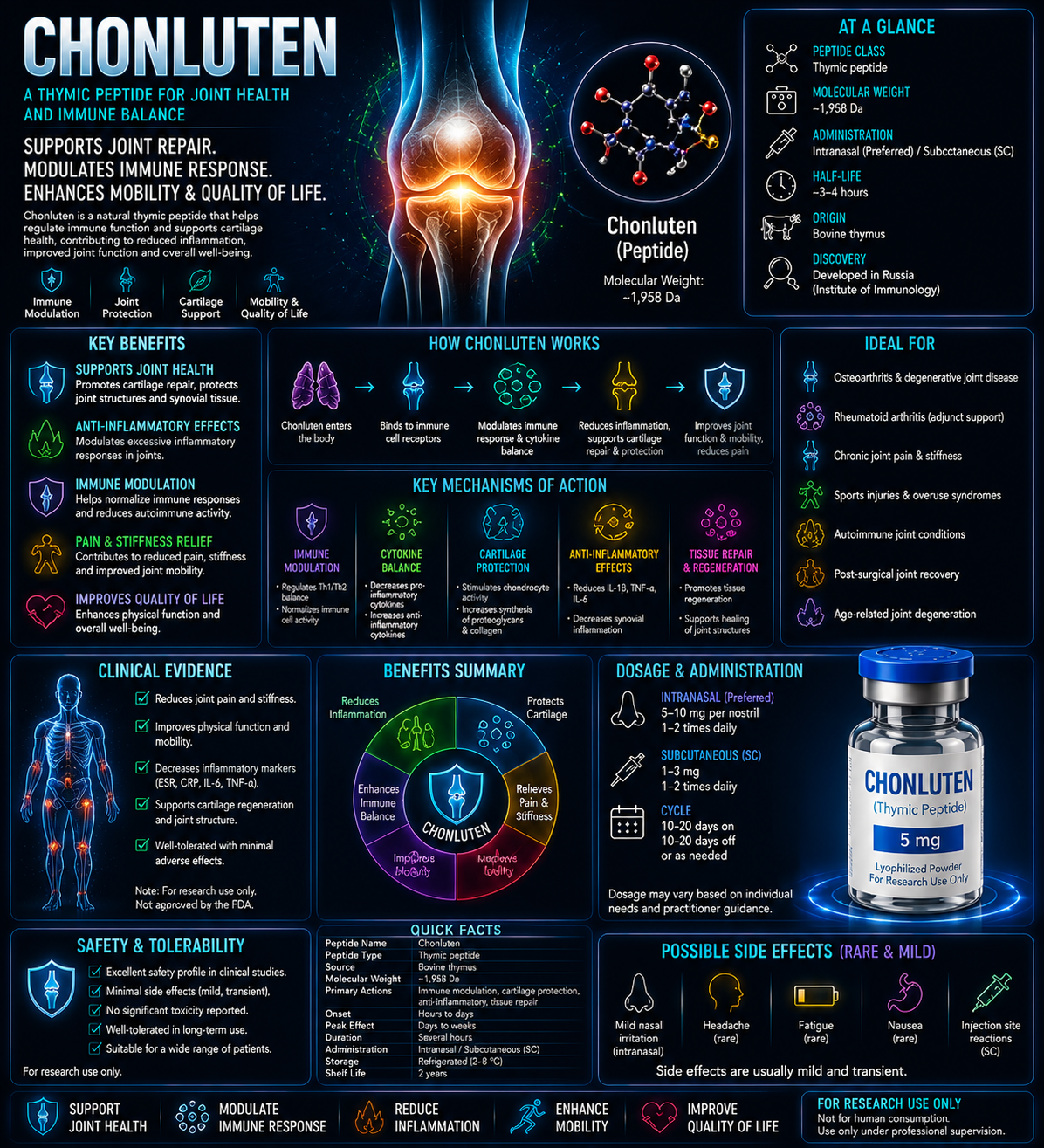
Chonluten: What It Is, How It Works, Benefits, and Research Overview What Is Chonluten? Chonluten is an investigational peptide bioregulator studied
Chonluten: What It Is, How It Works, Benefits, and Research Overview
What Is Chonluten?
Chonluten is an investigational peptide bioregulator studied for its potential role in respiratory tissue signaling, bronchial epithelial resilience, inflammation regulation, and healthy lung aging research. It belongs to the family of Khavinson bioregulator peptides, a group of short peptides investigated for tissue-specific signaling and possible gene-regulatory activity. Chonluten is also commonly referred to as:
EDG (Glu-Asp-Gly) or Tripeptide T-34. It is studied primarily in relation to bronchopulmonary tissue and respiratory epithelial biology.
Researchers investigate Chonluten in relation to:
- Bronchial epithelial integrity and repair
- Respiratory inflammation signaling
- Oxidative stress and antioxidant pathways
- Healthy lung aging and tissue resilience
- Bronchopulmonary regeneration models
Important: Chonluten is not FDA approved and remains investigational, with most evidence coming from cell studies, animal research, and Russian peptide bioregulator literature.
What Is Chonluten Made Of?
Chonluten is a synthetic tripeptide (3 amino acids) composed of:
Glutamic Acid – Aspartic Acid – Glycine
Glu-Asp-Gly (EDG). It is categorized as a bronchopulmonary bioregulator peptide, meaning researchers study it for selective signaling activity in respiratory tissue.
Because of its very small size, Chonluten is considered:
- Structurally simple
- Experimentally stable
- Tissue-focused in respiratory biology research
How Does Chonluten Work?
The precise mechanism remains under investigation, but researchers believe Chonluten may influence gene expression, inflammatory signaling, oxidative stress pathways, and epithelial tissue regulation.
1. Bronchial Epithelial and Respiratory Tissue Signaling
One of the largest areas of interest is Chonluten’s interaction with:
Bronchial epithelial and alveolar cell systems
Researchers investigate whether Chonluten may:
- Support airway epithelial maintenance pathways
- Influence tissue repair signaling after inflammatory stress
- Help maintain respiratory mucosal integrity
- Modulate cellular signaling involved in bronchial resilience
In simple terms:
Chonluten says:
“Help maintain healthy respiratory tissue signaling and resilience.”
2. Inflammation and Cytokine Regulation
A 2022 cellular study investigating several Khavinson peptides found that Chonluten influenced inflammatory signaling in THP-1 monocyte/macrophage models, including suppression of inflammatory mediators such as:
- TNF-α (Tumor Necrosis Factor alpha)
- IL-6 (Interleukin-6)
when immune cells were stimulated with inflammatory signals. Researchers proposed this may reflect an anti-inflammatory regulatory effect rather than broad immune suppression.
Researchers continue exploring whether Chonluten may influence:
- Bronchial inflammatory signaling
- Immune-cell recruitment in airway tissue
- Respiratory stress adaptation pathways
3. Oxidative Stress and Antioxidant Signaling
Researchers also study Chonluten for potential effects on:
- Oxidative stress adaptation
- Antioxidant defense pathways
- Cellular stress proteins and repair signaling
Experimental literature has discussed possible interactions with pathways involving:
- HSP70 (heat shock proteins)
- SOD (superoxide dismutase)
- Stress-response signaling genes in bronchial tissue models
This has led researchers to investigate Chonluten in models involving:
- Hypoxia
- Respiratory oxidative stress
- Chronic inflammatory airway environments
4. Healthy Lung Aging and Respiratory Resilience
Researchers investigate Chonluten in:
Respiratory aging models
to better understand:
- Age-related decline in airway resilience
- Bronchial epithelial deterioration
- Recovery signaling in lung tissue under stress
The broader hypothesis in Khavinson peptide research is that short peptides may help regulate tissue-specific cellular communication during aging.
Why Is Chonluten Getting Attention?
Chonluten attracts attention because it combines several important research themes:
- Respiratory tissue resilience
- Bronchial epithelial signaling
- Inflammatory regulation
- Oxidative stress adaptation
- Healthy lung aging biology
Researchers are especially interested in how a peptide consisting of only three amino acids may influence broader cellular signaling pathways in respiratory tissue.
Potential Research Areas of Interest
1. Respiratory Tissue and Airway Research
Researchers investigate whether Chonluten may support:
- Bronchial epithelial signaling pathways
- Respiratory mucosal resilience
- Airway stress adaptation
- Tissue repair signaling in bronchial systems
2. Bronchopulmonary Disease Models
Experimental work explores Chonluten in relation to:
- Chronic airway inflammation models
- COPD and bronchial remodeling pathways
- Respiratory tissue degeneration research
3. Oxidative Stress and Inflammation Research
Researchers study whether Chonluten influences:
- TNF-α and IL-6 signaling
- Oxidative stress proteins
- Inflammatory cell recruitment
- Cellular stress resilience in respiratory systems
4. Healthy Lung Aging Research
Researchers investigate Chonluten for:
- Age-related respiratory decline
- Bronchial cellular maintenance
- Respiratory resilience and tissue repair biology
Chonluten vs Bronchogen vs Thymalin vs Epitalon
| Feature | Chonluten | Bronchogen | Thymalin | Epitalon |
|---|---|---|---|---|
| Main Focus | Respiratory signaling & inflammation | Bronchial epithelial repair | Immune regulation | Healthy aging & circadian biology |
| Structure | Tripeptide (EDG) | Tetrapeptide (AEDL) | Peptide complex | Tetrapeptide (AEDG) |
| Tissue Focus | Bronchopulmonary tissue | Bronchi/lung tissue | Thymus/immune system | Pineal/aging biology |
| Major Research Area | Oxidative stress & airway signaling | Airway repair | Immune aging | Telomere & circadian research |
| FDA Approved? | No | No | No | No |
Researchers generally view:
- Chonluten → respiratory inflammatory and stress signaling peptide
- Bronchogen → bronchial tissue bioregulator peptide
- Thymalin → immune/thymic peptide complex
- Epitalon → aging and circadian signaling peptide
Potential Side Effects and Safety Considerations
Because Chonluten remains investigational:
- Human therapeutic evidence is limited
- Long-term pharmacology remains uncertain
- Most evidence comes from cell studies, animal work, and peptide bioregulator research
Researchers emphasize that broader clinical significance remains uncertain and findings should be interpreted as preclinical and experimental.
Frequently Asked Questions
Is Chonluten a peptide?
Yes. Chonluten is a synthetic tripeptide (Glu-Asp-Gly / EDG) studied for respiratory tissue and inflammatory signaling research.
Is Chonluten FDA approved?
No. Chonluten is not FDA approved and remains investigational.
What is Chonluten studied for?
Researchers study Chonluten for respiratory tissue signaling, airway inflammation, oxidative stress, bronchial resilience, and healthy lung aging research.
Does Chonluten affect inflammation?
Preclinical studies suggest Chonluten may influence TNF-α, IL-6, and inflammatory signaling pathways, though human evidence remains limited.
What makes Chonluten different from Bronchogen?
Chonluten is primarily studied for respiratory stress signaling and inflammatory modulation, while Bronchogen focuses more on bronchial epithelial repair and tissue-specific airway signaling.
Final Thoughts
Chonluten is an investigational respiratory bioregulator peptide that has generated interest for its potential role in bronchial epithelial resilience, inflammatory signaling, oxidative stress adaptation, and healthy lung aging research. As a short EDG tripeptide, Chonluten is being studied for how small tissue-specific peptides may influence respiratory biology and cellular signaling. While findings are intriguing, Chonluten remains experimental, human evidence is limited, and broader clinical relevance continues to be explored.
