
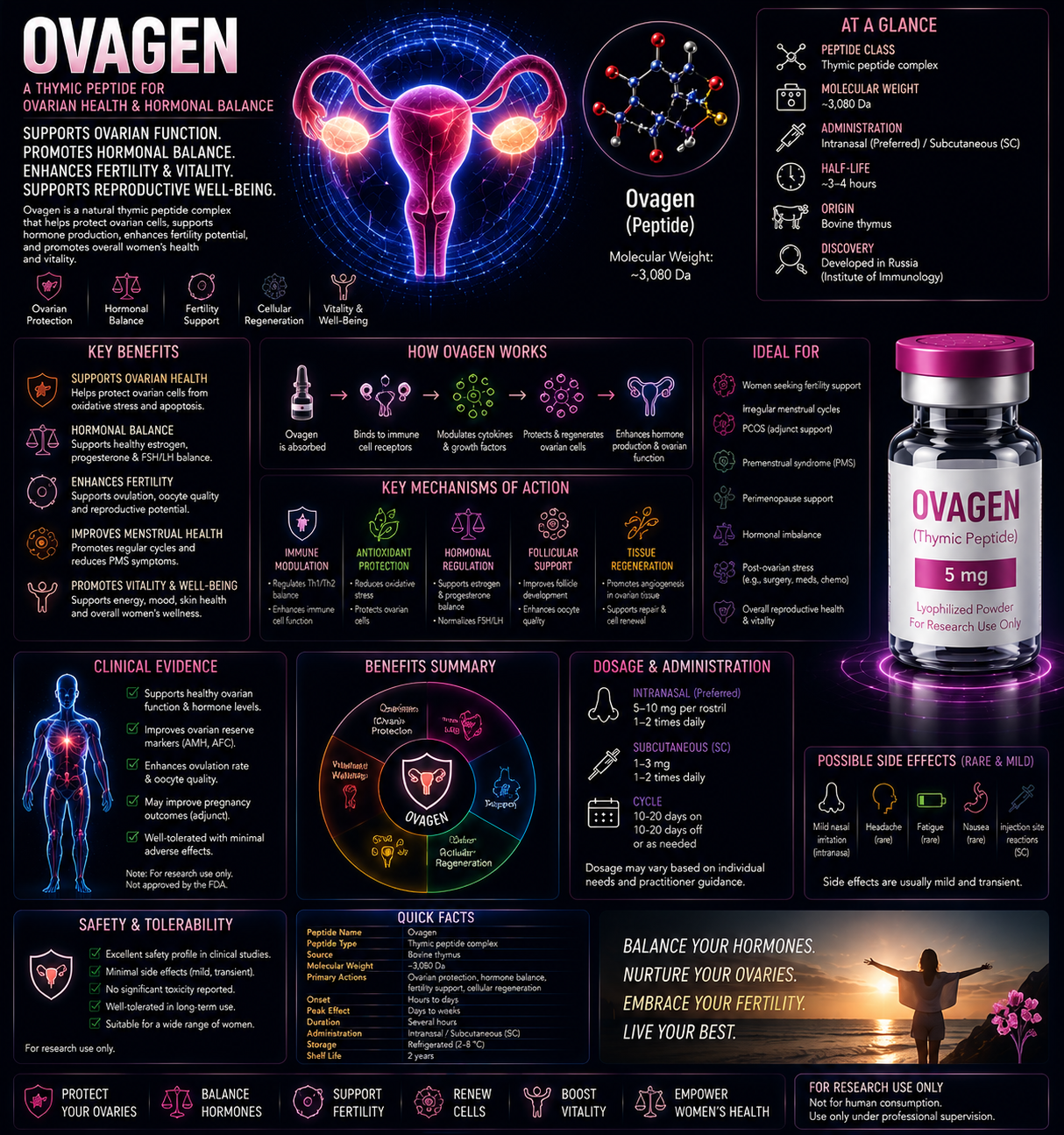
Ovagen: What It Is, How It Works, Benefits, and Research Overview What Is Ovagen? Ovagen is an investigational peptide bioregulator studied for its
Ovagen: What It Is, How It Works, Benefits, and Research Overview
What Is Ovagen?
Ovagen is an investigational peptide bioregulator studied for its potential role in female reproductive system support, ovarian tissue signaling, and healthy aging of reproductive function. It belongs to the family of Khavinson peptide bioregulators, a group of short tissue‑specific peptides developed primarily in Russian and Eastern European peptide research for their proposed effects on gene regulation, tissue signaling, and cellular resilience.
Ovagen is typically described as a synthetic tetrapeptide, developed to mimic naturally occurring peptides found in ovarian and reproductive tissues. Researchers investigate Ovagen in relation to:
- Ovarian tissue function and follicular signaling
- Reproductive hormonal balance
- Cellular resilience and tissue regeneration in reproductive organs
- Healthy aging of ovarian function
- Gene expression and chromatin regulation in ovarian cells
Important: Ovagen is not FDA approved and remains investigational, with most evidence coming from preclinical, in vitro, animal, and regional peptide literature rather than large human clinical trials.
What Is Ovagen Made Of?
Ovagen is a synthetic tetrapeptide (4 amino acids) composed of:
Ala‑Glu‑Asp‑Ser (AEDS)
Key features:
- Very small and structurally simple
- Developed for tissue‑specific signaling in ovarian and reproductive tissues
- Investigated for effects on cellular adaptation, tissue resilience, and gene regulation
Researchers study Ovagen primarily for its potential to support ovarian tissue health and female reproductive resilience.
How Does Ovagen Work?
The exact mechanism remains under investigation, but researchers believe Ovagen may influence:
- Ovarian cellular signaling (follicular cells, ovarian stroma)
- Hormonal regulation and endocrine communication
- Gene expression pathways in ovarian and reproductive tissue
- Cellular resilience, anti-aging, and regenerative signaling
1. Ovarian Tissue Support
Ovagen is thought to interact with ovarian cells to:
- Support follicular signaling and maturation
- Maintain tissue integrity and resilience
- Modulate local gene expression involved in reproductive tissue function
2. Hormonal and Endocrine Pathways
Researchers propose that Ovagen may indirectly influence:
- Local estrogen and progesterone production
- Follicle-stimulating hormone (FSH) responsiveness
- Ovarian endocrine communication pathways
3. Healthy Aging and Reproductive Resilience
Ovagen has been studied in experimental models for:
- Supporting ovarian tissue function during age-related decline
- Preserving follicular and stromal cell activity
- Potentially influencing reproductive lifespan and endocrine health
4. Gene Expression and Cellular Adaptation
Like other Khavinson peptides, Ovagen may affect:
- Chromatin remodeling and gene transcription in ovarian cells
- Protein synthesis and tissue-specific signaling
- Cellular adaptation pathways in reproductive tissue under stress
What Ovagen Is Studied For
Ovagen is primarily investigated for:
- Ovarian tissue signaling and follicular health
- Healthy reproductive aging and ovarian resilience
- Hormonal balance and endocrine support in reproductive tissue
- Gene expression and chromatin regulation in ovarian cells
- Tissue resilience and regenerative signaling
All studies remain preclinical or exploratory, with limited human application.
Ovagen Compared With Other Reproductive or Aging Peptides
| Peptide | Main Focus | Structure | Tissue Focus | FDA Approved? |
|---|---|---|---|---|
| Ovagen | Ovarian function & reproductive resilience | Tetrapeptide (AEDS) | Ovaries/female reproductive tissue | No |
| Epitalon | Healthy aging, circadian & telomere biology | Tetrapeptide (AEDG) | Pineal gland / aging | No |
| Livagen | Liver signaling & chromatin | Tetrapeptide (KEDA) | Liver / immune system | No |
| Thymogen | Immune signaling support | Dipeptide (EW) | Thymus / immune system | No |
While some peptide motifs are similar, Ovagen is specifically linked to ovarian tissue and reproductive resilience, distinguishing it from other systemic or organ-specific bioregulator peptides.
Safety and Side Effects
Because Ovagen remains investigational:
- Human safety data is extremely limited
- Long-term pharmacology is unknown
- Most evidence comes from cell, tissue, or animal studies
- No established dosing guidelines or formal side-effect profile exists
Researchers emphasize that Ovagen findings are experimental, hypothesis-generating, and should not be interpreted as validated therapeutic evidence.
Frequently Asked Questions
Is Ovagen a peptide?
Yes. Ovagen is a synthetic tetrapeptide (Ala‑Glu‑Asp‑Ser / AEDS) developed for ovarian tissue signaling research.
Is Ovagen FDA approved?
No. Ovagen is not FDA approved and remains investigational.
What is Ovagen studied for?
Ovagen is studied for ovarian tissue resilience, reproductive aging, hormonal regulation, gene expression, and tissue-specific signaling in female reproductive organs.
Does Ovagen affect fertility?
There is no validated clinical evidence that Ovagen improves fertility. Experimental studies focus on tissue signaling and cellular resilience, not direct reproductive outcomes.
Are there known side effects?
Human safety data is very limited, with no established side-effect profile due to the peptide’s investigational status.
Final Thoughts
Ovagen is an investigational reproductive bioregulator peptide studied for its potential role in ovarian tissue signaling, reproductive resilience, hormonal balance, gene expression, and healthy aging of reproductive function. As a short AEDS tetrapeptide, Ovagen is part of a broader research field exploring how ultrashort tissue-specific peptides can influence cellular communication and tissue resilience. While preclinical research is intriguing, Ovagen remains experimental, with limited human evidence and no FDA approval.
