
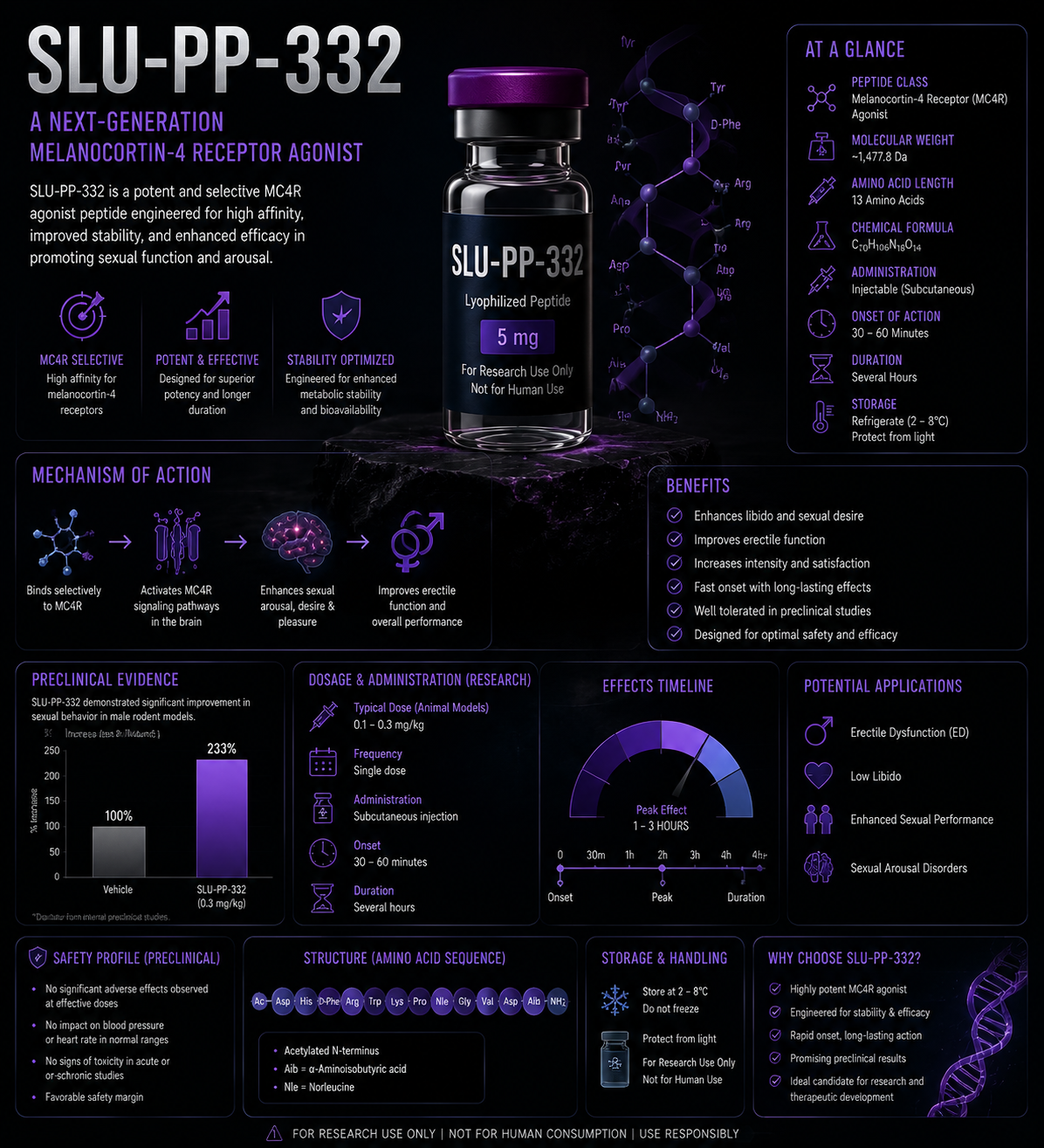
SLU-PP-332: What It Is, How It Works, Benefits, and Research Overview What Is SLU-PP-332? SLU-PP-332 is an investigational small molecule (not techn
SLU-PP-332: What It Is, How It Works, Benefits, and Research Overview
What Is SLU-PP-332?
SLU-PP-332 is an investigational small molecule (not technically a peptide) studied for its potential role in metabolic health, endurance, mitochondrial function, fat metabolism, and “exercise mimetic” biology. It was developed by researchers studying how to activate cellular pathways normally stimulated by aerobic exercise. Researchers describe SLU-PP-332 as a:
Pan-estrogen-related receptor (ERR) agonist
with strongest activity at ERRα, while also activating ERRβ and ERRγ. These receptors help regulate:
- Mitochondrial function
- Fat oxidation
- Cellular energy production
- Endurance metabolism
- Skeletal muscle oxidative capacity
SLU-PP-332 gained attention because preclinical studies suggested it may reproduce certain metabolic adaptations associated with endurance exercise—even in sedentary animals.
Important: SLU-PP-332 is not FDA approved, remains investigational, and human clinical data are extremely limited or absent. Most evidence comes from mouse models, cell studies, and mechanistic research.
What Is SLU-PP-332 Made Of?
Unlike many compounds discussed in peptide circles:
SLU-PP-332 is not a peptide.
It is a synthetic small molecule compound developed as an:
ERR agonist (Estrogen-Related Receptor agonist)
designed to activate transcriptional programs involved in:
- Oxidative metabolism
- Fat utilization
- Mitochondrial biogenesis
- Skeletal muscle endurance pathways
How Does SLU-PP-332 Work?
SLU-PP-332 primarily acts through:
Estrogen-related receptor (ERRα, ERRβ, ERRγ)
These are orphan nuclear receptors involved in regulating cellular metabolism.
1. “Exercise Mimetic” Signaling
SLU-PP-332 is often called an:
Exercise mimetic
because it appears to activate metabolic programs normally seen with endurance training.
Researchers observed increased expression of genes involved in:
- Oxidative phosphorylation
- Fatty-acid metabolism
- Endurance metabolism
- Mitochondrial respiration
In simple terms:
SLU-PP-332 says:
“Shift the body toward an endurance-style metabolic state.”
2. Fat Oxidation and Energy Expenditure
In mouse models, SLU-PP-332 increased:
- Fat oxidation
- Resting energy expenditure
- Lipid utilization as fuel
Researchers observed a reduction in:
Respiratory exchange ratio (RER)
which indicates a shift toward:
Burning more fat and fewer carbohydrates for energy. In one study, treated mice showed ~25% higher fatty-acid oxidation without major changes in food intake.
Importantly:
This evidence comes from animals, not robust human trials.
3. Mitochondrial Function and Endurance Biology
Researchers are especially interested in SLU-PP-332 because it appears to increase:
- Mitochondrial respiration
- Oxidative metabolism
- Cellular oxygen consumption
- Skeletal muscle energy efficiency
Preclinical studies reported activation of genes associated with:
- Mitochondrial biogenesis
- Fat metabolism
- Oxidative phosphorylation
In theory, this may support:
Endurance-like metabolic adaptations.
4. Metabolic Syndrome and Obesity Research
SLU-PP-332 has been investigated in mouse models of:
- Obesity
- Metabolic syndrome
- Fatty liver disease
- Glucose dysregulation
Researchers reported:
- Reduced fat accumulation
- Higher energy expenditure
- Lower hepatic fat accumulation
- Improved metabolic markers in some models
However:
Animal success ≠ proven human efficacy.
5. Aging and Cardiometabolic Research
Emerging animal research explores SLU-PP-332 in:
- Aging-associated mitochondrial dysfunction
- Heart failure metabolism
- Inflammation and metabolic resilience
Some studies reported improved mitochondrial signaling and cardiac function in experimental models.
These findings remain:
Early-stage and preclinical.
Why Is SLU-PP-332 Getting Attention?
SLU-PP-332 attracts attention because it combines several high-interest research themes:
- “Exercise mimetic” biology
- Fat oxidation and body composition research
- Mitochondrial enhancement
- Metabolic syndrome and obesity research
- Endurance signaling and oxidative metabolism
Researchers are especially interested in:
Activating exercise-like cellular pathways without exercise itself.
Potential Research Areas of Interest
1. Fat Loss and Metabolic Research
Researchers investigate whether SLU-PP-332 may influence:
- Fat oxidation
- Energy expenditure
- Metabolic flexibility
- Body composition signaling
2. Endurance and Performance Biology
Experimental work explores:
- Muscle oxidative capacity
- Cellular endurance pathways
- Aerobic metabolism signaling
3. Mitochondrial Research
Researchers study:
- Mitochondrial biogenesis
- Cellular respiration
- Oxidative phosphorylation pathways
4. Aging and Cardiometabolic Health
Researchers investigate:
- Heart failure metabolism
- Mitochondrial aging
- Metabolic resilience in aging models
SLU-PP-332 vs MOTS-C vs SS-31 vs Tesofensine
| Feature | SLU-PP-332 | MOTS-C | SS-31 | Tesofensine |
|---|---|---|---|---|
| Main Focus | Exercise mimetic & fat oxidation | Metabolic signaling | Mitochondrial protection | Appetite suppression |
| Primary Mechanism | ERR agonism | Mitochondrial signaling peptide | Mitochondrial membrane targeting | Monoamine reuptake inhibition |
| Fat Metabolism | High interest | Moderate–high | Indirect | Moderate |
| Mitochondrial Effects | High | Moderate | High | Minimal |
| FDA Approved? | No | No | No | No |
Researchers generally view:
- SLU-PP-332 → endurance/metabolic signaling compound
- MOTS-C → metabolic mitochondrial peptide
- SS-31 → mitochondrial protection peptide
- Tesofensine → appetite/weight-loss compound
Potential Side Effects and Safety Considerations
Because SLU-PP-332 remains investigational:
- Human safety data are lacking
- Long-term metabolic effects are unknown
- Optimal pharmacokinetics and dosing are poorly understood
- Potential off-target metabolic consequences remain uncertain
Researchers emphasize:
Preclinical promise does not equal proven safety in humans.
Frequently Asked Questions
Is SLU-PP-332 a peptide?
No. SLU-PP-332 is a synthetic small-molecule ERR agonist, not a peptide.
What is SLU-PP-332 studied for?
Researchers study SLU-PP-332 for fat oxidation, endurance signaling, mitochondrial function, metabolic syndrome, and exercise mimetic biology.
Does SLU-PP-332 mimic exercise?
In animal models, it appears to activate some exercise-associated metabolic pathways, which is why it is called an exercise mimetic.
Does SLU-PP-332 burn fat?
Mouse studies suggest increased fat oxidation and energy expenditure, but there is no robust human evidence yet.
Is SLU-PP-332 FDA approved?
No. SLU-PP-332 is investigational only.
Final Thoughts
SLU-PP-332 is an investigational metabolic small molecule studied for exercise mimetic activity, mitochondrial function, endurance signaling, and fat metabolism. By activating ERR metabolic pathways, it appears to shift cells toward an endurance-style, oxidative metabolic state in preclinical research. While animal findings are intriguing, SLU-PP-332 remains experimental, with limited human data and unknown long-term safety.
