
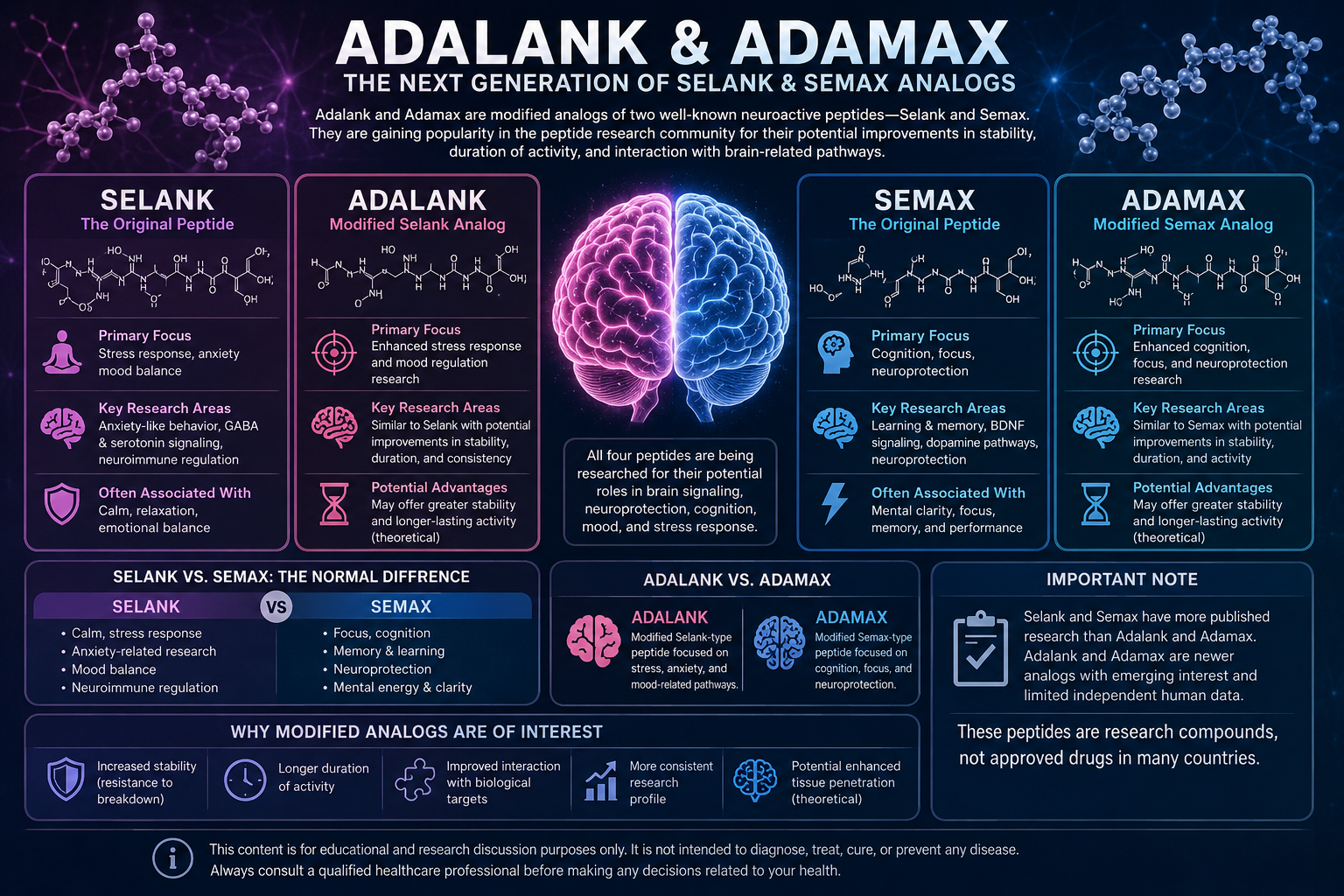
Adalank and Adamax: Why These Selank and Semax Analogs Are Gaining Attention In the peptide research community, few neuroactive peptides have gained
Adalank and Adamax: Why These Selank and Semax Analogs Are Gaining Attention
In the peptide research community, few neuroactive peptides have gained as much attention as Selank and Semax. Both were originally developed in Russian scientific research settings and have been studied for their potential roles in stress response, cognition, mood-related pathways, neuroprotection, and brain signaling. More recently, two related compounds — Adalank and Adamax — have become increasingly popular among researchers looking at modified versions of these well-known peptides.
Adalank is commonly described as a modified analog of Selank, while Adamax is commonly described as a modified analog of Semax. In simple terms, they are newer peptide derivatives designed to build on the same general research interest as Selank and Semax, but with structural modifications that may influence stability, duration of activity, and tissue interaction.
Why Adalank and Adamax Are Becoming More Popular
The rising interest in Adalank and Adamax comes from a few major trends.
First, researchers are increasingly interested in neuroactive peptides. Compounds that may interact with stress response, neurotransmitter signaling, cognitive function, and neuroplasticity have become popular topics in both academic and private research settings.
Second, many researchers are already familiar with Selank and Semax. Because those two peptides have been discussed for years, analogs such as Adalank and Adamax naturally attract attention as “next generation” versions.
Third, modified peptides are often marketed as having improved stability. One limitation of many peptides is that they can be broken down quickly by enzymes. Structural modifications may be intended to make a peptide more resistant to degradation, potentially giving it a longer or more consistent research profile.
Fourth, the nootropic and performance-research space has grown rapidly. Interest in focus, stress resilience, memory, mood, and mental clarity has pushed more attention toward peptides that may interact with brain-related pathways.
However, popularity does not automatically mean stronger evidence. Selank and Semax have more published research behind them than Adalank and Adamax. Adalank and Adamax are newer and less established, so they should be discussed as research compounds with emerging interest rather than proven replacements.
What Is Selank?
Selank is a synthetic peptide related to tuftsin, a naturally occurring immune-modulating peptide fragment. It has been studied for its potential influence on anxiety-like behavior, stress response, neurotransmitter systems, immune signaling, and mood-related pathways.
Selank is often described as the more “calming” or anxiolytic-style peptide when compared with Semax. In research discussions, Selank is typically associated with:
- Stress response modulation
- Anxiety-related pathways
- GABA and serotonin-related signaling
- Immune system interaction
- Mood and emotional balance research
This does not mean Selank is simply a sedative. It is better understood as a regulatory peptide studied for its potential role in balancing stress-related signaling without the same traditional profile as sedating drugs.
What Is Semax?
Semax is a synthetic analog of a fragment of ACTH, specifically ACTH 4-10. It has been studied for potential nootropic, neuroprotective, cognitive, and brain-repair-related effects.
Semax is usually described as the more “cognitive” or “stimulating” peptide compared with Selank. Research discussions commonly associate Semax with:
- Focus and mental performance
- Memory and learning pathways
- BDNF-related signaling
- Neuroprotection
- Dopamine and attention-related systems
- Recovery pathways after neurological stress or injury
Where Selank is often framed around calm and stress regulation, Semax is usually framed around alertness, cognition, and neurotrophic signaling.
What Is Adalank?
Adalank is commonly discussed as a modified analog of Selank. It is typically positioned as a more advanced or structurally altered version of Selank, with the goal of improving certain properties such as peptide stability, resistance to breakdown, or duration of activity.
Because Adalank is connected to Selank, its research interest usually centers around similar areas:
- Stress response
- Anxiety-related pathways
- Mood regulation research
- Neurotransmitter balance
- Possible immune-modulating effects
The key difference is that Adalank is viewed as a modified version, not simply another name for Selank. The modification is what creates interest, because researchers often look for analogs that may perform differently from the parent compound.
That said, Adalank has much less established published research than Selank. Many of the claims surrounding Adalank are based on its relationship to Selank and theoretical expectations from its structure, not large-scale human clinical evidence.
What Is Adamax?
Adamax is commonly discussed as a modified analog of Semax. It is often described as a more structurally enhanced version intended to improve stability, lipid interaction, or overall activity compared with standard Semax.
Because Adamax is related to Semax, it is usually discussed in connection with:
- Cognitive performance research
- Focus and attention pathways
- Neuroprotection
- BDNF and neuroplasticity-related signaling
- Dopamine-related pathways
- Mental energy and clarity research
Adamax has gained popularity because many researchers are already familiar with Semax and are interested in whether a modified version may offer a stronger, longer-lasting, or more efficient research profile.
However, like Adalank, Adamax should be treated as less established than its parent compound. Semax has more published research. Adamax is newer, and many claims about it remain theoretical or based on early research discussion rather than broad clinical confirmation.
Adalank vs. Selank: Main Differences
The easiest way to understand Adalank is to compare it with Selank.
Selank is the original, better-known compound. It has more history, more research discussion, and more published data. It is commonly associated with stress, anxiety, mood balance, and neuroimmune regulation.
Adalank is a newer modified analog. It is generally discussed as being designed to improve upon Selank’s limitations, especially in terms of stability or duration. The appeal is that it may have a more refined research profile, but the downside is that it has less direct evidence.
In simple terms:
Selank = better-known, more researched, classic stress-regulation peptide.
Adalank = newer modified Selank analog, potentially more stable or longer-acting, but less proven.
Adamax vs. Semax: Main Differences
Adamax relates to Semax in the same way Adalank relates to Selank.
Semax is the original and better-known compound. It has been studied for cognitive, neuroprotective, and neurotrophic pathways. It is usually associated with focus, memory, BDNF signaling, and neurological resilience.
Adamax is the newer modified analog. It is commonly described as being designed to improve the Semax structure, potentially increasing stability, duration, or interaction with brain-related systems. This is why it has gained attention in nootropic peptide research.
In simple terms:
Semax = better-known, more researched, classic cognitive/neuroprotective peptide.
Adamax = newer modified Semax analog, potentially more stable or longer-acting, but less established.
Selank vs. Semax: The Normal Difference
Many people confuse Selank and Semax because both are neuroactive peptides, but they are not the same.
Selank is generally thought of as the calmer, stress-focused peptide. It is more commonly discussed in relation to anxiety-like behavior, mood regulation, stress resilience, and immune-neuroendocrine balance.
Semax is generally thought of as the more cognitive and performance-focused peptide. It is more commonly discussed in relation to focus, learning, memory, neuroprotection, and brain-derived neurotrophic factor pathways.
A simple comparison:
Selank = calm, stress response, anxiety-related research, mood balance.
Semax = focus, cognition, memory, neuroprotection, mental energy.
This is why Selank and Semax are often discussed together but used in very different research contexts.
Adalank vs. Adamax
Adalank and Adamax are not interchangeable.
Adalank is tied to the Selank side of research. It is generally discussed in relation to stress response, anxiety-related pathways, and mood-regulation research.
Adamax is tied to the Semax side of research. It is generally discussed in relation to cognition, focus, neuroprotection, and neuroplasticity research.
A simple way to remember it:
Adalank is to Selank what Adamax is to Semax.
Adalank = modified Selank-type peptide.
Adamax = modified Semax-type peptide.
Why Researchers Are Interested in Modified Analogs
Modified analogs are common in peptide research because small structural changes can make a major difference in how a peptide behaves. A modification may influence:
- How quickly the peptide breaks down
- How long it remains active in a research model
- How it interacts with enzymes
- How it binds to biological targets
- How well it passes through certain tissues
- How predictable its activity may be
This is the reason analogs like Adalank and Adamax attract attention. Researchers are not only interested in the original peptide but also in whether a modified version may offer a more efficient or durable research profile.
Important Evidence Limitations
It is important to be honest about the evidence.
Selank and Semax have more published research than Adalank and Adamax. Even with Selank and Semax, much of the research comes from Russian or post-Soviet scientific literature, and they are not approved drugs in many countries, including the United States.
Adalank and Adamax have even less independent published research. Much of their popularity comes from peptide research communities, supplier descriptions, and theoretical comparisons to Selank and Semax.
That does not mean they are meaningless compounds. It simply means they should be discussed accurately. They are emerging research analogs, not fully established clinical treatments.
Final Summary
Adalank and Adamax are gaining popularity because they are newer modified analogs of two already well-known neuroactive peptides: Selank and Semax.
Selank is generally associated with stress response, anxiety-related pathways, mood balance, and neuroimmune regulation. Adalank is commonly viewed as a modified Selank analog that may be designed for improved stability or duration.
Semax is generally associated with focus, memory, cognitive performance, neuroprotection, and BDNF-related signaling. Adamax is commonly viewed as a modified Semax analog that may be designed for enhanced stability, longer activity, or improved research performance.
The simplest distinction is this:
Selank and Adalank are more connected to calm, stress, and mood-related research.
Semax and Adamax are more connected to cognition, focus, memory, and neuroprotection research.
Adalank and Adamax may represent a growing interest in “next generation” neuropeptide analogs, but they should be approached with scientific caution. Their popularity is increasing, but the strongest research foundation still belongs to the original compounds: Selank and Semax.
