
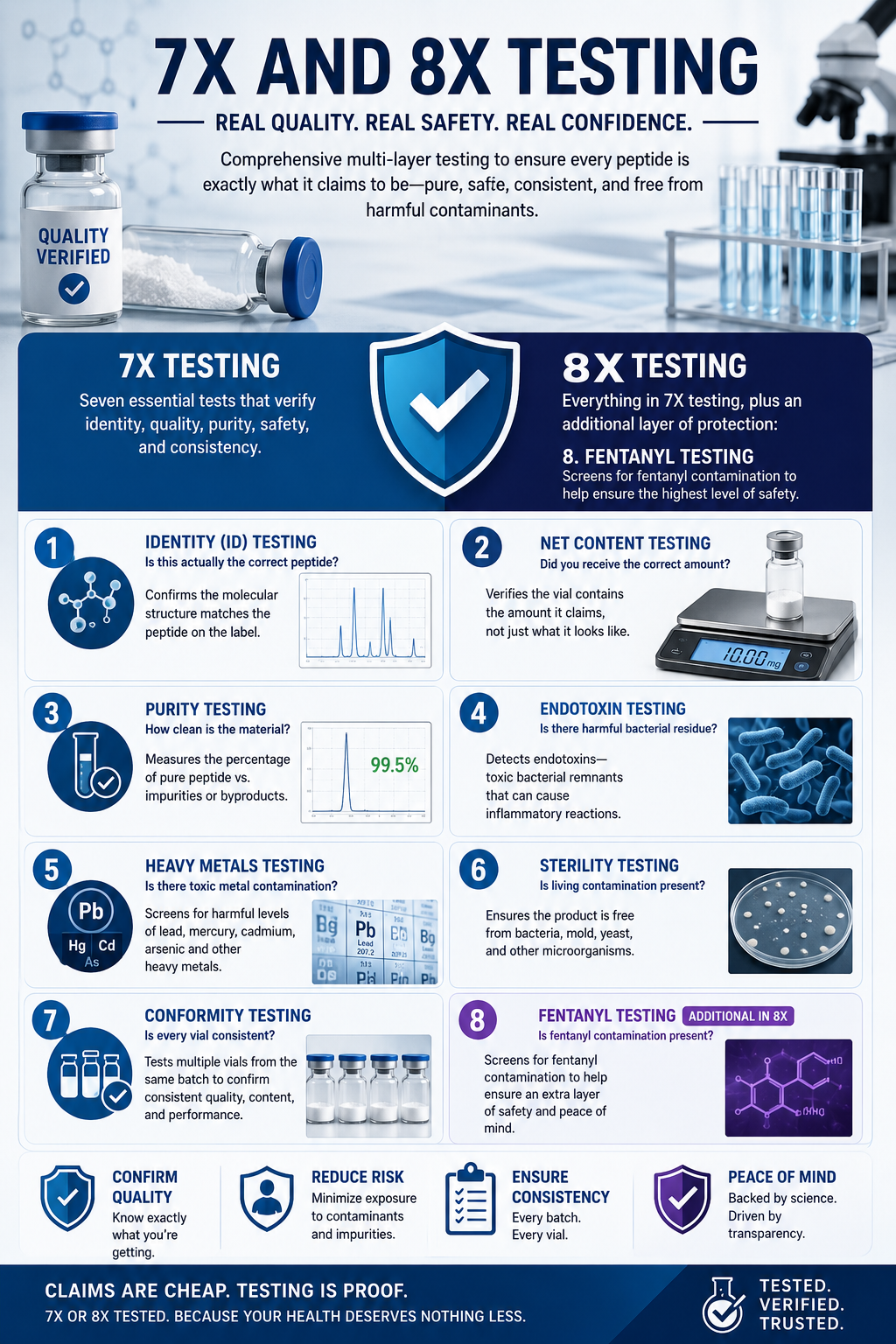
What Is 7X and 8X Peptide Testing? Understanding What Real Quality Control Actually Means In the peptide industry, you will often hear companies make
What Is 7X and 8X Peptide Testing? Understanding What Real Quality Control Actually Means
In the peptide industry, you will often hear companies make vague claims like:
“Lab tested.”
“Third-party verified.”
“COA included.”
“Pharmaceutical grade.”
But what does that actually mean?
The reality is that testing standards vary dramatically between companies. Some businesses only perform one or two basic tests, while others implement far more extensive quality-control programs designed to verify identity, safety, consistency, and contamination risks.
This is where the concept of 7X and 8X testing comes into play.
7X testing refers to a broader testing standard that evaluates multiple quality and safety factors beyond simply “Does this peptide exist?” or “Is it pure?”
8X testing builds upon that by adding an additional layer of contamination screening — Fentanyl testing.
The goal of these testing systems is simple:
To verify that a peptide is what it claims to be, contains what it claims to contain, is free of dangerous contaminants, and is consistent from vial to vial.
Let’s break down what each category actually means and why it matters.
Why Basic Testing Is Often Not Enough
Many customers mistakenly assume that a single Certificate of Analysis (COA) automatically means a product is high quality.
That is not true.
A COA is only as meaningful as:
- What was actually tested
- How many samples were tested
- Which laboratory performed the testing
- Whether the testing is recent and batch specific
- Whether contamination screening occurred
- Whether consistency testing was performed
For example, a peptide may test correctly for identity and still fail sterility.
A peptide may test pure but contain unacceptable endotoxin levels.
A peptide may be the correct peptide while containing inconsistent fill amounts from vial to vial.
This is why broader testing standards matter.
What Is 7X Testing?
7X testing is a multi-category testing process designed to evaluate:
- Identity (ID)
- Net Content
- Purity
- Endotoxins
- Heavy Metals
- Sterility
- Conformity
Rather than relying on a single measurement, this system evaluates multiple dimensions of product quality and safety.
Think of it like buying a car.
You would not want someone to say:
“The engine works, therefore the car is good.”
You would also want to know:
- Are the brakes working?
- Are the tires safe?
- Does it leak?
- Is it assembled consistently?
- Is anything contaminated or defective?
Peptide testing works the same way.
1. Identity (ID) Testing — “Is This Actually the Correct Peptide?”
Identity testing answers the most basic but critical question:
Did the manufacturer actually provide the peptide they claim to be selling?
This testing verifies that the molecular composition matches the expected peptide sequence.
For example:
If a vial claims to contain BPC-157, NAD+, Semax, or Selank, identity testing confirms that the material actually corresponds to that peptide and not something substituted, degraded, mislabeled, or incorrectly synthesized.
Without ID testing, you are essentially relying on trust alone.
A product label means nothing without verification.
Identity testing is often performed using advanced analytical techniques such as:
- Mass spectrometry
- HPLC confirmation
- Molecular characterization methods
In simple terms:
ID testing confirms the peptide is what the label says it is.
2. Net Content Testing — “Did You Receive the Correct Amount?”
One of the biggest misconceptions in peptides is assuming vial appearance determines content.
It does not.
Lyophilized peptide cakes can look nearly identical despite having different milligram quantities due to density, excipients, hydration, or manufacturing variables.
Net content testing verifies:
Does the vial actually contain the amount it claims?
If a product says:
“10mg”
Testing verifies whether the product truly contains approximately that amount rather than being underfilled.
This protects against:
- Underfilled vials
- Manufacturing inconsistencies
- False labeling
- Misleading assumptions based on visual appearance
A vial may look identical and still contain different verified net content.
Looks are not science.
Testing is.
3. Purity Testing — “How Clean Is the Material?”
Purity testing measures:
How much of the material is actually the intended peptide versus impurities or unwanted byproducts?
During peptide synthesis, side products can occur.
No manufacturing process is perfectly clean.
Purity testing evaluates how much of the sample consists of:
- Intended peptide
- Fragmentation products
- Synthesis byproducts
- Degraded compounds
- Unwanted impurities
For example:
A peptide may be identified correctly through ID testing but still contain poor purity.
Meaning:
Yes, the peptide exists — but it contains excessive unwanted material.
Purity testing helps ensure the batch meets acceptable quality standards.
Higher purity generally indicates cleaner manufacturing and better refinement.
4. Endotoxin Testing — “Is There Dangerous Bacterial Residue?”
This is one of the most misunderstood and most important tests.
Endotoxins are:
Toxic bacterial remnants that can remain even when bacteria themselves are dead.
Many people wrongly assume:
“No bacteria means safe.”
Not necessarily.
Even if bacteria are gone, endotoxins can remain behind and may trigger inflammatory responses.
Endotoxins are associated with:
- Inflammatory reactions
- Fever responses
- Injection irritation
- Immune activation
- Serious contamination concerns in high concentrations
Sterility alone does not automatically mean endotoxin-free.
You can have:
Sterile but endotoxin-contaminated material.
That is why endotoxin testing matters.
This category evaluates whether bacterial contamination byproducts remain within acceptable limits.
5. Heavy Metals Testing — “Did Contamination Occur During Manufacturing?”
Heavy metals testing screens for contamination from industrial processes, raw materials, manufacturing equipment, or environmental exposure.
Common screened contaminants include:
- Lead
- Mercury
- Cadmium
- Arsenic
These metals may enter production through:
- Contaminated raw inputs
- Equipment exposure
- Manufacturing environments
- Chemical processing contamination
Heavy metal screening helps verify:
The material is not contaminated with unacceptable levels of toxic metals.
This category becomes increasingly important with international sourcing and complex supply chains.
Testing removes guessing.
6. Sterility Testing — “Is Living Contamination Present?”
Sterility testing evaluates:
Are living microorganisms present?
This includes screening for contamination such as:
- Bacteria
- Mold
- Yeast
- Microbial growth
Sterility testing matters because injectable materials must be manufactured in controlled environments.
A product can:
- Be the correct peptide
- Have good purity
- Pass identity testing
…and still fail sterility.
That is why multiple layers of testing matter.
Sterility testing helps verify the absence of active microbial contamination.
7. Conformity Testing — “Is Every Vial Consistent?”
This is one of the most overlooked but arguably most important categories.
Conformity testing evaluates:
Batch consistency across multiple vials.
Many companies test:
One vial.
That creates a major problem.
What if the tested vial is excellent but the rest of the batch is inconsistent?
Conformity testing reduces this risk by evaluating multiple vials from the same production batch.
The goal:
To verify consistency across the lot rather than relying on one “perfect sample.”
This helps identify:
- Fill inconsistencies
- Manufacturing variability
- Batch instability
- Nonuniform production quality
A batch should behave consistently.
Not just one showcase vial.
What Is 8X Testing?
8X testing includes everything in 7X testing plus one additional screening:
8. Fentanyl Testing — “Is Dangerous Cross-Contamination Present?”
Fentanyl testing screens for:
The presence of fentanyl contamination.
While fentanyl contamination is not expected in legitimate peptide manufacturing, cross-contamination risks exist in poorly controlled environments, shared production facilities, unsafe handling, or unregulated supply chains.
The reason some companies now include fentanyl testing is simple:
An extra layer of safety verification.
This test helps verify the absence of one of the most dangerous contaminants imaginable.
Even trace contamination concerns justify caution.
Adding fentanyl screening represents an additional risk-mitigation step rather than a claim that contamination is common.
It is about precaution.
Not fear.
Why Multi-Layer Testing Matters
Too many people focus on one number:
Purity.
But purity alone tells only part of the story.
Imagine this:
A peptide could be:
✔ Correct identity
✔ High purity
Yet still fail:
✘ Sterility
✘ Endotoxins
✘ Heavy metals
✘ Batch conformity
Would you still consider that acceptable?
Probably not.
Real quality control means evaluating the entire picture.
Not just one attractive number.
7X vs. 8X Testing — Simple Breakdown
7X Testing
- Identity (ID)
- Net Content
- Purity
- Endotoxins
- Heavy Metals
- Sterility
- Conformity
8X Testing
Everything in 7X, plus:
- Fentanyl Screening
Final Thoughts
When people hear “tested,” they often assume that means quality.
But testing means very different things depending on what was actually performed.
One company may test identity and purity only.
Another may test identity, net content, purity, endotoxins, sterility, heavy metals, conformity, and fentanyl contamination.
Those are not the same level of quality assurance.
The goal of comprehensive testing is not marketing hype.
The goal is verification.
Verification that the material is:
- The correct compound
- The correct quantity
- Appropriately pure
- Free of microbial contamination
- Low in endotoxin burden
- Free of concerning heavy metal contamination
- Consistent across batches
- Screened for additional contamination risks
Because in the end:
Claims are cheap. Testing is proof.
