
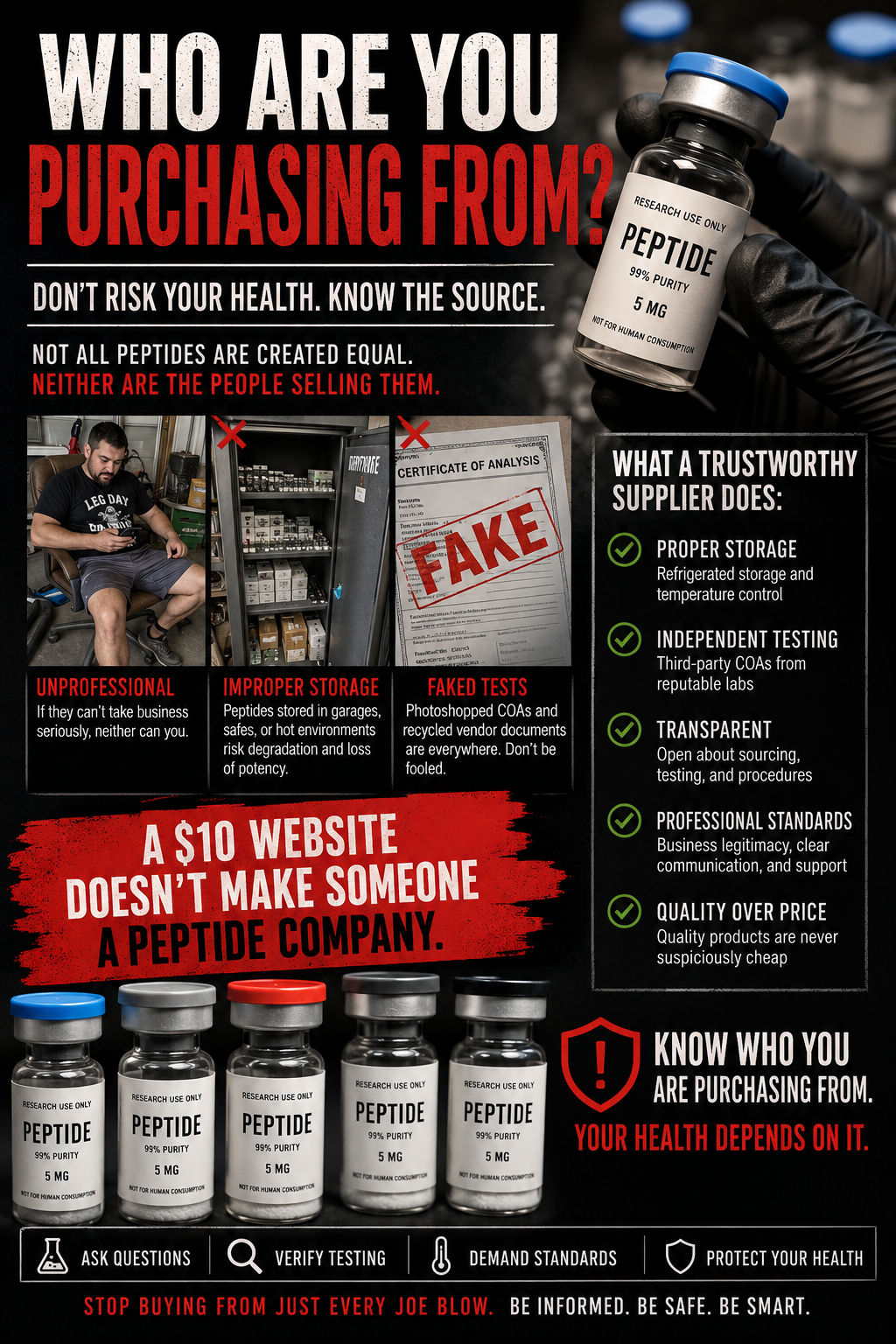
Who Are You Purchasing From? The Hard Truth About the “Research Peptide” Industry The peptide market has exploded in popularity over the last severa
Who Are You Purchasing From?
The Hard Truth About the “Research Peptide” Industry
The peptide market has exploded in popularity over the last several years. With that growth has come innovation, competition, and increased access to products that were once difficult to obtain.
But it has also created a serious problem:
Anyone with a cheap website, a TikTok account, and a wholesale supplier can suddenly call themselves a peptide company.
And frankly, consumers need to start asking a difficult—but necessary—question:
Who exactly are you purchasing from?
Because when you are purchasing research compounds, quality control matters. Storage matters. Testing matters. Supplier standards matter. Professionalism matters.
Yet many buyers appear to ignore all of that in exchange for one thing:
Cheap pricing.
The Rise of the “Garage Lab” Business Model
Spend enough time scrolling social media and you will eventually come across them:
- The “CEO” livestreaming from a cluttered garage
- Products stacked on shelves next to random household items
- Vials stored in uncontrolled environments
- Owners appearing careless, unprepared, or entirely unprofessional
- Businesses seemingly operated with little structure or quality oversight
Let’s ask an uncomfortable but fair question:
If someone cannot maintain professionalism in the way they present themselves, how much attention are they truly paying to sourcing, storage, documentation, vendor qualification, and testing?
That may sound harsh—but it is a valid question.
Because peptide procurement is not supposed to be casual.
You are not selling novelty stickers or T-shirts.
A legitimate operation should involve:
- Supplier vetting
- Batch tracking
- Independent testing
- Documentation verification
- Proper environmental storage
- Inventory controls
- Quality assurance procedures
- Consistency standards
If those things are absent—or worse, never even discussed—that should concern you.
The Garage Safe Full of Peptides
One of the most alarming things seen repeatedly online is improper storage.
There are social media videos showing operators storing products in garages, sheds, safes, closets, or uncontrolled environments.
In one particularly concerning example, an owner openly displayed a gun safe filled with peptide inventory sitting inside a garage environment.
Think about that for a moment.
A garage.
No visible climate control.
Unknown temperatures.
Unknown humidity exposure.
Unknown environmental stability.
Even when a product is lyophilized (freeze-dried), that does not mean it should be treated carelessly. Temperature extremes, moisture, handling practices, packaging integrity, and storage consistency all matter in maintaining product stability and quality.
Yet consumers watch this content and still think:
“Seems legit.”
Why?
Would you trust medication, supplements, or laboratory materials being casually stored in a hot garage?
Most rational people would not.
So why lower your standards here?
Fake Testing: The Industry’s Dirty Secret
Let’s talk about another uncomfortable reality:
Testing fraud exists.
And it is far more common than many people want to believe.
Examples include:
1. Photoshopped Certificates of Analysis (COAs)
Some businesses alter documents.
Dates get changed.
Batch numbers disappear.
Results are manipulated.
Brand names are added to generic reports.
Formatting gets suspiciously inconsistent.
Sometimes the “testing” document looks more like a graphic design project than a laboratory report.
If a company cannot produce consistent, traceable, verifiable testing, that should be a major red flag.
2. Vendor COAs Presented as Independent Testing
This one is rampant.
A business purchases inventory from an overseas supplier and simply reposts the supplier’s COA as if it represents independent verification.
That is not independent testing.
That is called recycling paperwork.
A manufacturer’s document is not the same thing as third-party verification.
Independent testing should involve a separate laboratory analyzing the actual batch being sold.
Consumers should be asking:
- Was this tested independently?
- Does the batch number match?
- Was this performed by a legitimate laboratory?
- Is there evidence of consistency?
- Are multiple quality indicators being evaluated?
If those answers are vague, defensive, or nonexistent—you should pay attention.
Cheap Does Not Equal Smart
One of the biggest mistakes consumers make is shopping based entirely on price.
Someone launches a $10 website.
Throws together a flashy logo.
Runs TikTok ads.
Offers products for half the market price.
And suddenly people line up to buy.
But ask yourself:
How exactly are they able to be dramatically cheaper?
Possible explanations include:
- Cutting testing costs
- Skipping testing entirely
- Using supplier paperwork instead of independent verification
- Poor storage practices
- No quality assurance process
- No rejected inventory standards
- No consistency checks
- Operating with virtually no overhead or safeguards
Of course, low price alone does not automatically mean poor quality.
But when pricing seems impossibly low while quality systems remain vague, invisible, or undocumented, consumers should become skeptical—not excited.
Professionalism Matters
This part makes some people uncomfortable, but it needs to be said:
Professionalism matters.
No, a business owner does not need to wear a suit.
No, a business owner does not need to look perfect.
But presentation, discipline, organization, consistency, and credibility do matter.
If an owner appears careless about the business itself, consumers should reasonably question what is happening behind the scenes.
Because what you do see publicly is often the polished version.
If the polished version already looks chaotic, disorganized, careless, or improvised—what does the backend operation look like?
That is not “judging.”
That is called risk assessment.
Ask Better Questions
Before purchasing from anyone, stop asking only:
“How cheap is it?”
Start asking:
- Who owns this company?
- What are their standards?
- How are products stored?
- Is testing independent?
- Can testing be verified?
- Do batch numbers match?
- What happens if a batch fails?
- Is there consistency across lots?
- Do they discuss quality systems openly?
- Does this operation appear organized and professional?
Because when it comes to research compounds:
You are not just buying a vial.
You are buying the standards, competence, judgment, storage practices, sourcing decisions, and quality systems behind that vial.
Final Thoughts: Stop Buying From “Anyone”
The uncomfortable truth is this:
Too many people purchase from random operators they discovered five minutes ago on social media because the price looked attractive.
A website alone does not equal credibility.
A TikTok following does not equal competence.
A flashy logo does not equal quality.
And a cheap price certainly does not equal value.
Consumers need to stop blindly buying from every random seller who throws up a website, copies a product list, reposts supplier paperwork, and suddenly calls themselves a peptide company.
Know who you are purchasing from.
Ask questions.
Verify standards.
Think critically.
And most importantly:
Stop confusing “cheap” with “trustworthy.”
