Why Your Peptide Vial Looks the Same — No Matter the MG
“Did I Get Ripped Off?”
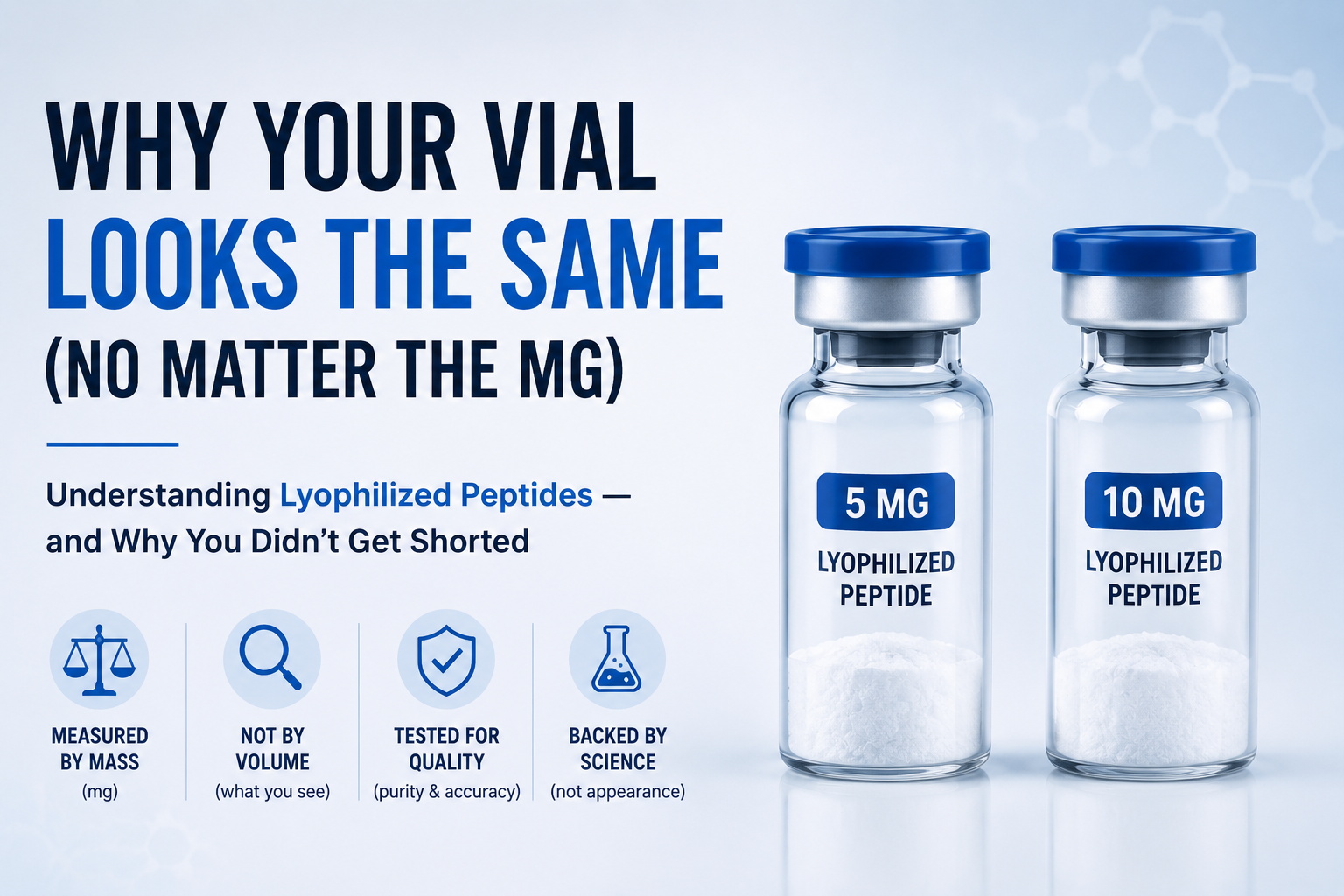
If you’ve ever compared two peptide vials—perhaps a 5mg vial next to a 10mg vial—you may have noticed something surprising:
They often appear to contain roughly the same amount of powder.
For many people, that immediately raises concern:
“Did I get ripped off?”
“Why doesn’t the 10mg vial look twice as full?”
The short answer: No, you were not shorted.
Understanding how peptides are manufactured and supplied helps explain why appearance can be misleading.
Understanding Lyophilized Peptides
Most peptides are supplied as lyophilized (freeze-dried) powder.
Lyophilization is a preservation process that removes water from the peptide, leaving behind a dry, stable material often referred to as a “cake” inside the vial.
This process helps improve stability and shelf life while protecting the integrity of the compound.
Here is the important part:
The physical size of the powder inside the vial is not a reliable indicator of peptide amount (mg content).
What MG Strength Actually Means
When a vial is labeled:
- 5mg
- 10mg
- 15mg
That number refers to:
The mass of the active peptide compound
It does not refer to:
- How much physical space the powder takes up
- How “full” the vial looks
- The visual size of the freeze-dried cake
In other words:
Milligrams measure mass—not volume.
Why a 10mg Vial May Look the Same as a 5mg Vial
There are several scientific reasons why two peptide vials can appear nearly identical while containing different amounts of peptide.
1. Density Differences
Not all lyophilized peptide powders have the same density.
Some peptides form a more compact, dense structure after freeze-drying, while others appear lighter or fluffier.
This means:
10mg of a dense peptide may visually occupy similar space as 5mg of a less dense peptide.
Think of it like comparing sand and feathers:
Same volume. Completely different weight.
2. Freeze-Drying (Lyophilization) Structure
During lyophilization, peptides form a porous matrix—the dry “cake” seen in the vial.
The appearance of that structure depends on several variables, including:
- Freezing conditions
- Manufacturing process
- Formulation characteristics
- Stability considerations
As a result:
Two vials can look nearly identical while containing different actual masses of peptide.
3. Stabilizers and Formulation Variables
Some formulations may contain trace stabilizing components used to maintain peptide integrity during processing and storage.
These formulation variables can influence:
- Texture
- Density
- Visual appearance
- Cake structure
Without changing the actual labeled peptide amount.
4. Standardized Vial Presentation
In many cases, peptide manufacturers use standardized vial sizes and filling practices for consistency, handling, and product stability.
The visual presentation of the vial is not designed to represent dosage by appearance.
A 10mg vial is not intended to look “twice as full” as a 5mg vial.
The Common Misconception: “More Powder = More Product”
It is completely natural to assume:
More product should look like more powder.
That logic makes sense for many everyday items—but lyophilized peptides do not work that way.
With freeze-dried compounds:
Volume and mass are not the same thing.
What your eyes see is space (volume).
What the label measures is weight (mass).
Those are very different measurements.
How Peptide Quality Is Actually Verified
When evaluating peptide quality, appearance should never be the primary metric.
What matters is proper manufacturing and testing, including:
- Accurate peptide mass (mg content)
- Batch consistency
- Purity analysis
- Analytical testing methods such as HPLC
The true measure of quality is found in verified manufacturing standards—not how “full” a vial looks.
The Simple Takeaway
Here is the easiest way to understand it:
Your eyes see volume.
Peptide labels measure mass.
Those are not the same thing.
So if your 10mg vial looks similar to your 5mg vial, that alone is not evidence of being shorted—it is simply how lyophilized peptides commonly appear.