
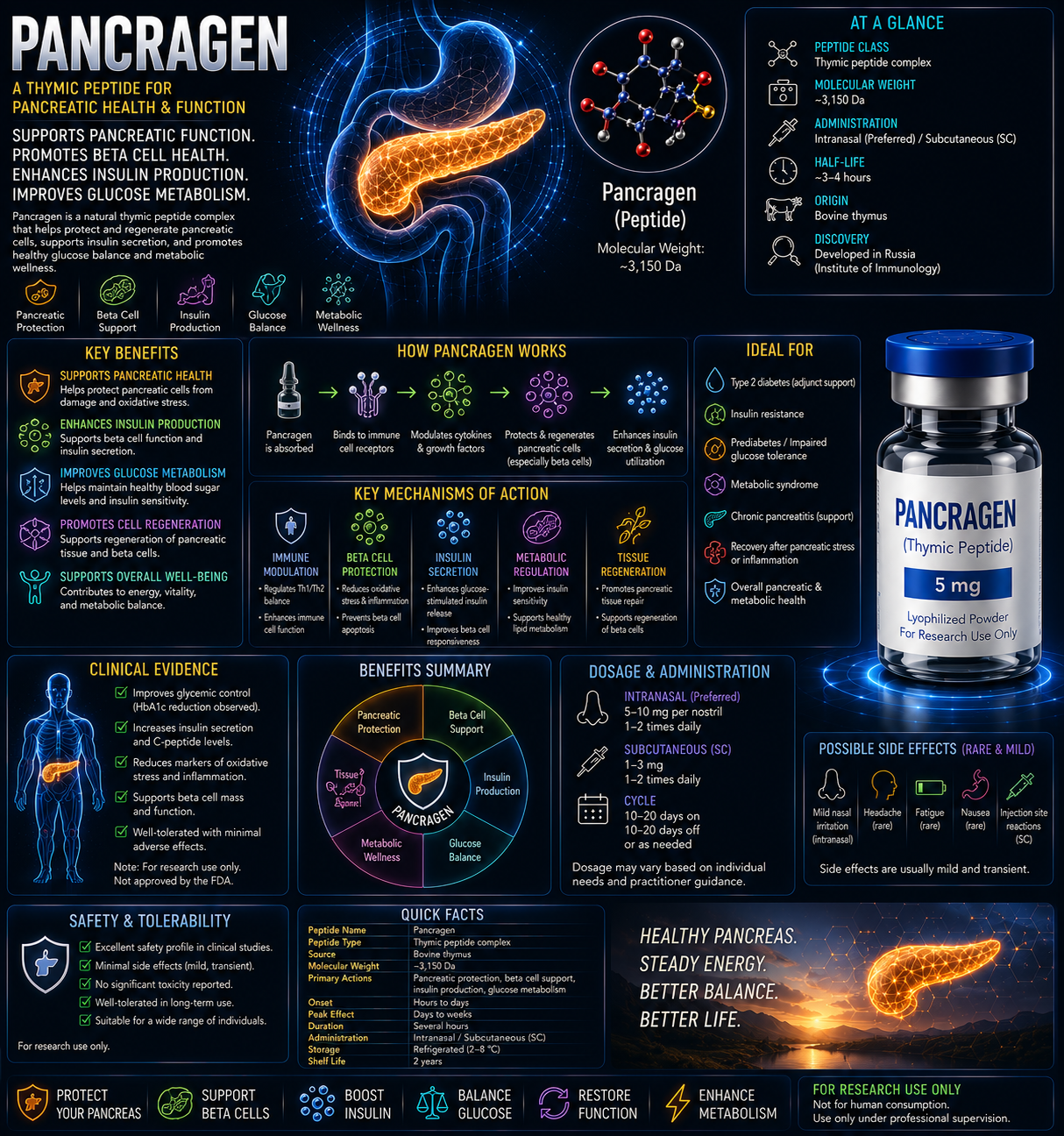
Pancragen: Overview, Mechanism, Benefits, and Research Summary What Is Pancragen? Pancragen is an investigational peptide bioregulator studied for i
Pancragen: Overview, Mechanism, Benefits, and Research Summary
What Is Pancragen?
Pancragen is an investigational peptide bioregulator studied for its potential role in pancreatic tissue signaling, cellular resilience, metabolic regulation, and healthy aging research. It is associated with the family of Khavinson peptide bioregulators, which are short peptides developed and studied, particularly in Russian and Eastern European peptide‑regulation research, for possible effects on tissue‑specific signaling, gene expression, and cellular adaptation.
Pancragen is also commonly referred to as:
AEDG (Ala‑Glu‑Asp‑Gly) — a synthetic tetrapeptide investigated for its proposed activity in pancreatic systems and metabolic tissues. Despite close similarity in sequence to peptides studied in other contexts, Pancragen’s primary research focus is its pancreatic signaling and cell‑regulatory potential rather than classification as a hormone or metabolic enzyme.
Important: Pancragen is not FDA approved and remains investigational, with evidence coming primarily from cellular work, animal studies, peptide bioregulator literature, and mechanistic model research rather than large modern clinical trials.
What Is Pancragen Made Of?
Pancragen is a synthetic tetrapeptide (4 amino acids) composed of:
Alanine – Glutamic Acid – Aspartic Acid – Glycine
Ala‑Glu‑Asp‑Gly (AEDG).
This small peptide sequence is the same tetrapeptide motif seen in some other investigational peptides (e.g., similar to the sequence used in bronchopulmonary or metabolic peptide investigations), but in the context of Pancragen research it is specifically linked to pancreatic regulatory models.
- Small and structurally simple
- Designed for tissue‑targeted signaling research
- Experimentally practical for mechanistic studies
How Does Pancragen Work?
Because Pancragen is investigational, its exact mechanism remains under research. Researchers theorize that Pancragen may influence:
- Pancreatic cellular signaling pathways
- Metabolic regulation and insulin‑related pathways
- Cellular stress and oxidative signaling in pancreatic tissue
- Gene transcription and chromatin signaling in metabolic cells
These hypotheses are based on preclinical studies utilizing peptide fragments with similar sequences and the broader premise of peptide bioregulators acting on tissue‑specific gene expression and cellular communication patterns.
1. Pancreatic Cellular Signaling
Researchers explore whether Pancragen may influence:
- Cellular communication within pancreatic acinar and ductal cells
- Cytoprotective signaling in metabolic tissues
- Stress response modulation in metabolic tissue environments
The underlying hypothesis is that short signaling peptides may interact with gene promoters or signaling pathways relevant to cellular adaptation and metabolism.
2. Metabolic Regulation Pathways
Pancragen is sometimes discussed in contexts involving:
- Metabolic homeostasis
- Pancreatic endocrine signaling
- Beta‑cell resilience
- Insulin production and secretion pathways (preclinical models)
In theory, Pancragen could help modulate cellular pathways that affect insulin sensitivity or secretion, though direct experimental evidence remains limited and indirect.
3. Oxidative Stress and Cellular Resilience
Like many investigational peptides, Pancragen is studied for possible effects on:
- Oxidative stress adaptation
- Antioxidant signaling pathways
- Cellular stress protein regulation
- Gene expression patterns that influence cell survival
These pathways may play roles in tissue resilience under metabolic and oxidative load.
What Pancragen Is Studied For
Pancragen is most commonly investigated in preclinical or mechanistic models for its potential involvement in:
- Pancreatic tissue signaling and cell communication
- Metabolic regulation and cellular adaptation
- Oxidative and stress‑response signaling in metabolic cells
- Healthy aging and cellular resilience research
Researchers are interested in how short peptides may influence internal signaling pathways without the complexity of full‑length proteins or hormones.
Pancragen Compared With Other Investigational Peptides
| Peptide | Main Focus | Structure | Tissue Focus | FDA Approved? |
|---|---|---|---|---|
| Pancragen | Pancreatic/metabolic signaling | Tetrapeptide (AEDG) | Pancreas/Metabolism | No |
| Epitalon | Aging, circadian biology | Tetrapeptide (AEDG) | Pineal/Aging Research | No |
| Livagen | Liver signaling & chromatin | Tetrapeptide (KEDA) | Liver/Immune System | No |
| Bronchogen | Bronchial/Respiratory repair | Tetrapeptide (AEDL) | Bronchi/Lung Tissue | No |
| Cortagen | Neuroprotection & nerve repair | Tetrapeptide (AEDP) | Nervous System | No |
| Thymogen | Immune signaling support | Dipeptide (EW) | Thymus/Immune System | No |
Although several of these peptides share identical or similar amino acid motifs, their research application varies based on the tissues or systems they are hypothesized to influence.
Safety and Side Effects
Because Pancragen remains highly investigational:
- There are no established clinical dosing or safety guidelines
- Human therapeutic evidence is very limited or absent
- Most evidence comes from preclinical, in vitro, and tissue‑specific mechanistic models, not from large‑scale clinical research
Side‑effect profiles in animal or cell models are not well defined, and Pancragen should not be interpreted as a validated therapeutic agent.
Frequently Asked Questions
Is Pancragen a peptide?
Yes. Pancragen is a synthetic tetrapeptide (Ala‑Glu‑Asp‑Gly / AEDG) investigated for pancreatic and metabolic tissue signaling.
Is Pancragen FDA approved?
No. Pancragen is not FDA approved and remains investigational.
What is Pancragen studied for?
Researchers explore Pancragen for pancreatic cellular signaling, metabolic regulation, stress‑response pathways, and healthy aging research, mostly in preclinical models.
Does Pancragen affect insulin production?
There is no reliable human evidence that Pancragen improves insulin production; any such effects remain hypothetical and limited to preclinical investigation.
Are there known side effects?
Because it is investigational, no formal safety profile or clinical side‑effect data exist.
Final Thoughts
Pancragen is an experimental peptide bioregulator primarily investigated for how small peptides may influence pancreatic cell signaling, metabolic pathways, and cellular adaptation in aging or stress contexts. While it fits within the broader class of investigational peptide regulators studied across multiple tissues, Pancragen remains experimental, with limited evidence and no clinical approval. Its proposed mechanisms are largely theoretical and based on basic research models, and human relevance remains unverified.
