
<!doctype html> :root { --ink: #172033; --muted: #647084; --paper: #ffffff; --canvas: #f1f3f8;
Analytical chemistry · evidence review
Adamax 984 vs 1032 Da: What the Numbers Actually Mean
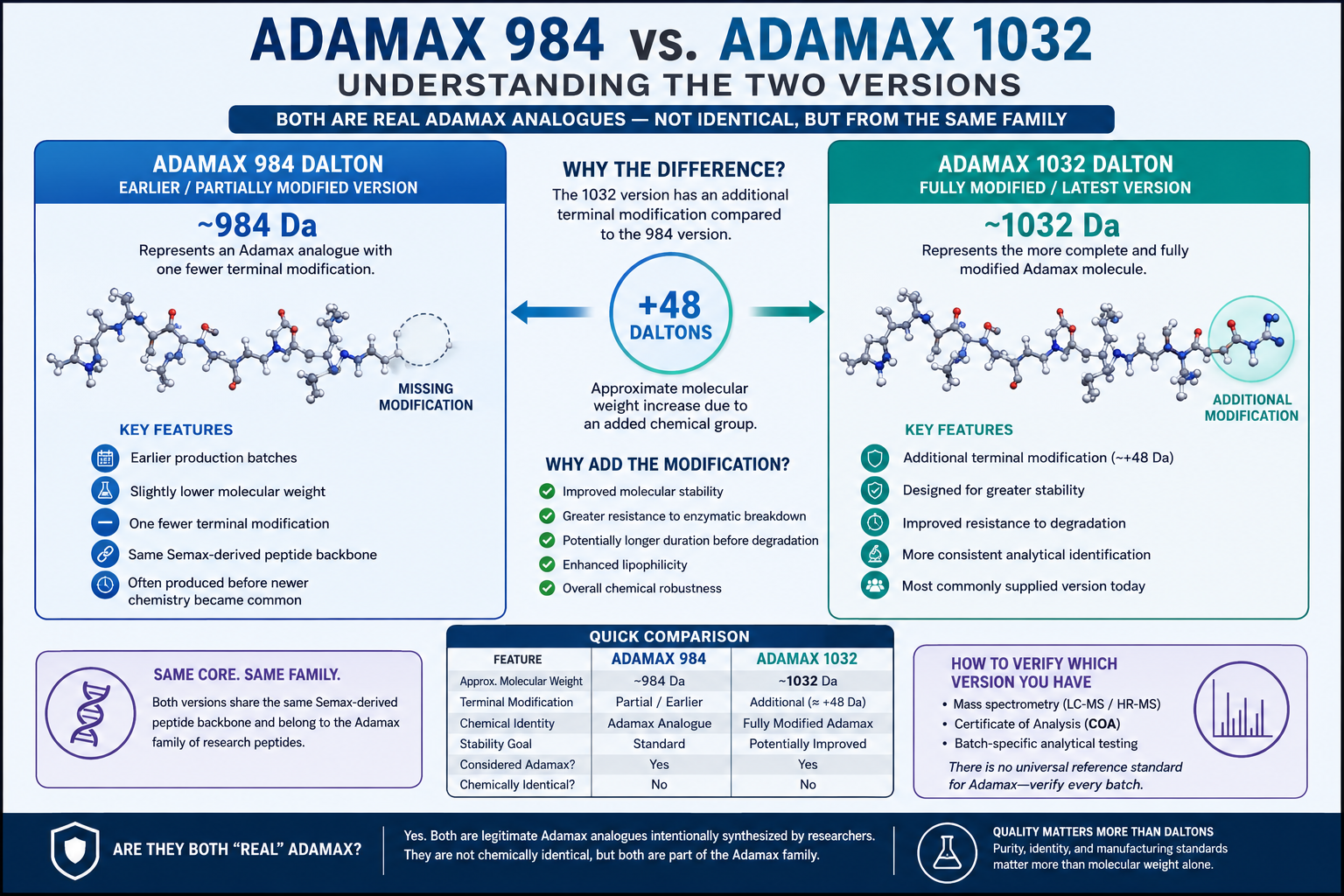
Adamax 984 vs 1032 Da compares two proposed structures sold under one informal name. First, this review explains what the formulas support, what the shorthand obscures, and what researchers need to verify.
984 Da and 1032 Da do not describe two grades of the same molecule. Instead, published marketplace formulas point to different terminal chemistry. Moreover, no public pharmacopeial or peer-reviewed Adamax standard makes either version “official.” Therefore, researchers must define identity by structure rather than by the product name.
“Adamax” is a market name, not a complete chemical identity
A chemical name should point to one defined structure. However, the current research-supply market does not use “Adamax” reliably.
This review located no Adamax monograph, official reference standard, recognized nonproprietary name, or peer-reviewed structural paper. For example, New Zealand’s Medsafe lists Adamax as an adrenocorticotropic hormone analogue encountered in border shipments, but the submission does not define a canonical formula, sequence, or molecular mass.1
As a result, supplier pages and batch documents fill the gap, yet those documents conflict. Some sources specify approximately 984.10 g/mol and a conventional N-acetylated peptide. By contrast, others specify approximately 1032.23 g/mol and describe an adamantylated C-terminus. In addition, several listings flatten both structures into nearly identical letter strings.
A product label can be broad or informal. However, a molecular formula provides a specific atom count. Therefore, products with different formulas and covalent structures represent different chemical entities, even when sellers use the same trade name.
Adamax 984 vs 1032 Da: the two structures in current listings
The comparison below reports the two most common marketplace assignments. However, it does not endorse either assignment as an official Adamax definition.
- Commonly stated formula
- C44H61N11O13S
- Structure implied by that formula
Ac‑MEHFPGPAG‑OH- Terminal interpretation
- Alanine followed by glycine; free C-terminal acid.
- Calculated neutral monoisotopic mass
- 983.4171 Da
- Adamantane present?
- No—not in this formula or literal sequence.
- Commonly stated formula
- C50H69N11O11S
- Structure commonly intended
Ac‑MEHFPGP‑AdG‑NH₂- Terminal interpretation
- An adamantane-containing nonstandard residue or cap; amidated terminus.
- Calculated neutral monoisotopic mass
- 1031.4899 Da
- Adamantane present?
- Yes—if the stated structure and formula are correct.
For example, a vendor certificate for the lower-mass material reports 984.10 Da and an alanine/glycine-extended sequence, while current higher-mass listings report 1032.23 Da and an adamantane-containing structure.23 However, these documents show marketplace usage rather than independent structural standards.
For instance, some pages pair the 1032 formula with a literal alanine–glycine sequence, while others pair the 984 formula with prose claiming an adamantane modification. Therefore, the formula, sequence, and structural drawing must agree before a specification becomes chemically coherent.
The “AG” notation trap
The abbreviation at the end of the sequence creates a major source of confusion. Specifically, standard one-letter amino-acid notation uses A for alanine and G for glycine. By contrast, descriptions borrowed from Peptide 021 may use stylized AdG, aG, or superscripted AG for an adamantylated glycine building block.
…P‑A‑G‑OH
Specifically, this notation shows two ordinary amino-acid residues: proline–alanine–glycine, ending in a free carboxylic acid.
…P‑AdG‑NH₂
By contrast, this notation shows a nonstandard adamantane-containing terminal unit that ends in a carboxamide.
…PAG‑NH₂
However, this notation remains ambiguous unless a supplier defines whether “AG” means Ala–Gly or a special adamantyl-glycine symbol.
The design precedent comes from Peptide 021 (P021). In that literature, researchers added adamantylated glycine at the C-terminus to increase lipophilicity and reduce exopeptidase degradation.4 Likewise, the corresponding patent describes a CNTF-derived peptide with C-terminal adamantylated glycine.5
However, a design rationale proposed for P021 does not prove the identity, pharmacokinetics, brain penetration, stability, or biological effects of a separately marketed Adamax product.
The 48 Da gap is not “the weight of an added adamantane”
The claim that the 1032 version simply adds a small 48 Da terminal group to the 984 version is chemically misleading. An adamantane molecule is much heavier than 48 Da. Instead, the observed difference reflects a net change from replacing one terminal composition with another.
Therefore, this atom-count difference supports substantially different C-terminal chemistry. It does not show that one product merely equals the other plus a 48 Da protecting group.
Why a mass-spectrum peak may show a different number
Supplier pages often mix average molecular weight, neutral monoisotopic mass, and observed mass-to-charge ratio. However, those terms describe different quantities. For example, electrospray spectra commonly report protonated, sodiated, or multiply charged ions rather than the neutral average formula mass. IUPAC recommends describing spectra in terms of m/z, because the plotted value depends on both ion mass and charge.6
| Quantity | 984 formula | 1032 formula | Why it differs |
|---|---|---|---|
| Average formula mass | ≈984.10 g/mol | ≈1032.23 g/mol | Specifically, this value uses natural isotopic abundance averages. |
| Neutral monoisotopic mass | 983.4171 Da | 1031.4899 Da | Instead, this value uses the principal isotope of each atom. |
| Observed LC–MS ion | Depends on charge/adduct | Depends on charge/adduct | For example, the spectrum may show [M+H]+, [M+2H]2+, or [M+Na]+. |
What the evidence supports—and what it does not
Meanwhile, Medsafe’s 2025 review gives the broader regulatory context: novel peptides sold “for research purposes only” were being imported for intended therapeutic use, while product quality, efficacy, and interactions were unknown. Adamax was listed as an example in the ACTH-analogue group.1 Therefore, the committee’s inclusion of the name shows that the product circulates in the market; it does not validate a particular structure or health claim.
Identity and purity answer different questions
A high HPLC area percentage can describe how strongly one chromatographic peak dominates under a particular method. However, that percentage alone does not prove that the main peak is the intended molecule.
| Test | What it can show | What it cannot prove alone |
|---|---|---|
| HPLC–UV | First, this test shows the separation profile and relative peak area under a defined method. | Sequence, exact formula, stereochemistry, or the identity of an unknown main peak. |
| Intact HRMS | Next, this test provides accurate precursor mass, isotope pattern, and a formula-compatible ion assignment. | Unique sequence or linkage when isomers share the same composition. |
| LC–MS/MS | In addition, this test provides fragment evidence that supports sequence and modification location. | Every structural detail if fragmentation around the nonstandard residue is incomplete. |
| NMR / reference comparison | Moreover, this approach provides stronger evidence for linkage, local structure, and a match to a defined standard. | Batch purity or biological activity without additional tests. |
| Fill-mass assay | Finally, this assay measures how much total material the vial contains. | How much is target peptide rather than water, counterion, excipient, or impurity. |
Likewise, FDA guidance warns that a single chromatographic retention time does not provide a specific identity test and describes combinations such as HPLC/MS as more appropriate.7 In addition, FDA recommends sensitive high-resolution methods to identify peptide-related impurities during synthetic peptide characterization.8
A 99% pure wrong molecule is still the wrong molecule. First, establish identity. Next, evaluate purity, content, impurities, and fitness for the intended research.
What a defensible batch record should contain
For a compound with an unstable market name, the batch documentation must carry the scientific identity.
- An unambiguous structure A structural drawing or machine-readable identifier that explicitly defines the adamantane linkage, terminal groups, and stereochemistry.
- A defined sequence notation Specifically, spell out every nonstandard residue. Moreover, “AG” alone does not provide enough detail.
- A formula and theoretical masses that agree In addition, include both average molecular weight and neutral monoisotopic mass with clear labels.
- Annotated high-resolution LC–MS data For example, report observed m/z, charge state, adduct, calculated value, and mass error rather than merely stating “MS: pass.”
- Sequence or linkage confirmation Use interpretable MS/MS fragments and, for the noncanonical terminal unit, an orthogonal method or comparison to a qualified reference material.
- A complete chromatographic method Include the HPLC trace, wavelength, column, mobile phases, gradient, integration rules, and system suitability.
- Composition beyond peak-area purity Report peptide content, water, counterion, residual solvents, relevant synthesis impurities, and any excipients.
- Controls appropriate to the research use Where relevant, include bioburden, endotoxin, sterility, stability, and container-closure data. A “research use only” label is not a quality test.
In conclusion, Adamax 984 vs 1032 Da does not describe two potency tiers. First, decide which covalent structure the experiment requires. Then, obtain a batch whose formula, sequence, structural drawing, and analytical data support that exact identity.
Sources & research notes
Regulatory context- New Zealand Medicines and Medical Devices Safety Authority (Medsafe). Classification of unscheduled peptide groups. Medicines Classification Committee submission, agenda item 5.7. 2025.
- Example vendor certificate assigning Adamax a mass of 984.10 Da. The sequence, stated length, and formula in the document are not fully internally consistent; it is cited as evidence of market usage, not independent validation.
- Example supplier listing assigning Adamax the formula C50H69N11O11S and mass 1032.23 g/mol. Cited as evidence of market usage, not an official standard or endorsement.
- Kazim SF, et al. Prevention of dendritic and synaptic deficits and cognitive impairment with a neurotrophic compound. Alzheimer’s Research & Therapy. 2017;9:45.
- Iqbal K, et al. Neurotrophic peptides for the treatment of tauopathies. U.S. Patent 9,327,011. 2016.
- International Union of Pure and Applied Chemistry. Standard definitions of terms relating to mass spectrometry. Pure and Applied Chemistry.
- U.S. Food and Drug Administration. ICH Q6A: Specifications—test procedures and acceptance criteria.
- U.S. Food and Drug Administration. Guidance for Industry: ANDAs for Certain Highly Purified Synthetic Peptide Drug Products. 2021.
Search note: Searches of PubMed and public patent/clinical-trial records through July 14, 2026 did not identify a peer-reviewed paper or completed clinical study that directly characterizes a compound named Adamax, compares 984 and 1032 Da variants, or establishes an official Adamax reference structure.
The calculated masses in this article use the formulas printed above; they do not authenticate any commercial batch. Finally, this article provides scientific information rather than medical advice or a use protocol.