Reference pricing · perceived savings · sale psychology
Why Peptide Companies Run Almost Continuous Sales
Why a company may intentionally keep higher base prices and routinely advertise 20–30% off instead of permanently lowering those prices—and why that structure can make a true 50–55% event feel dramatically larger.
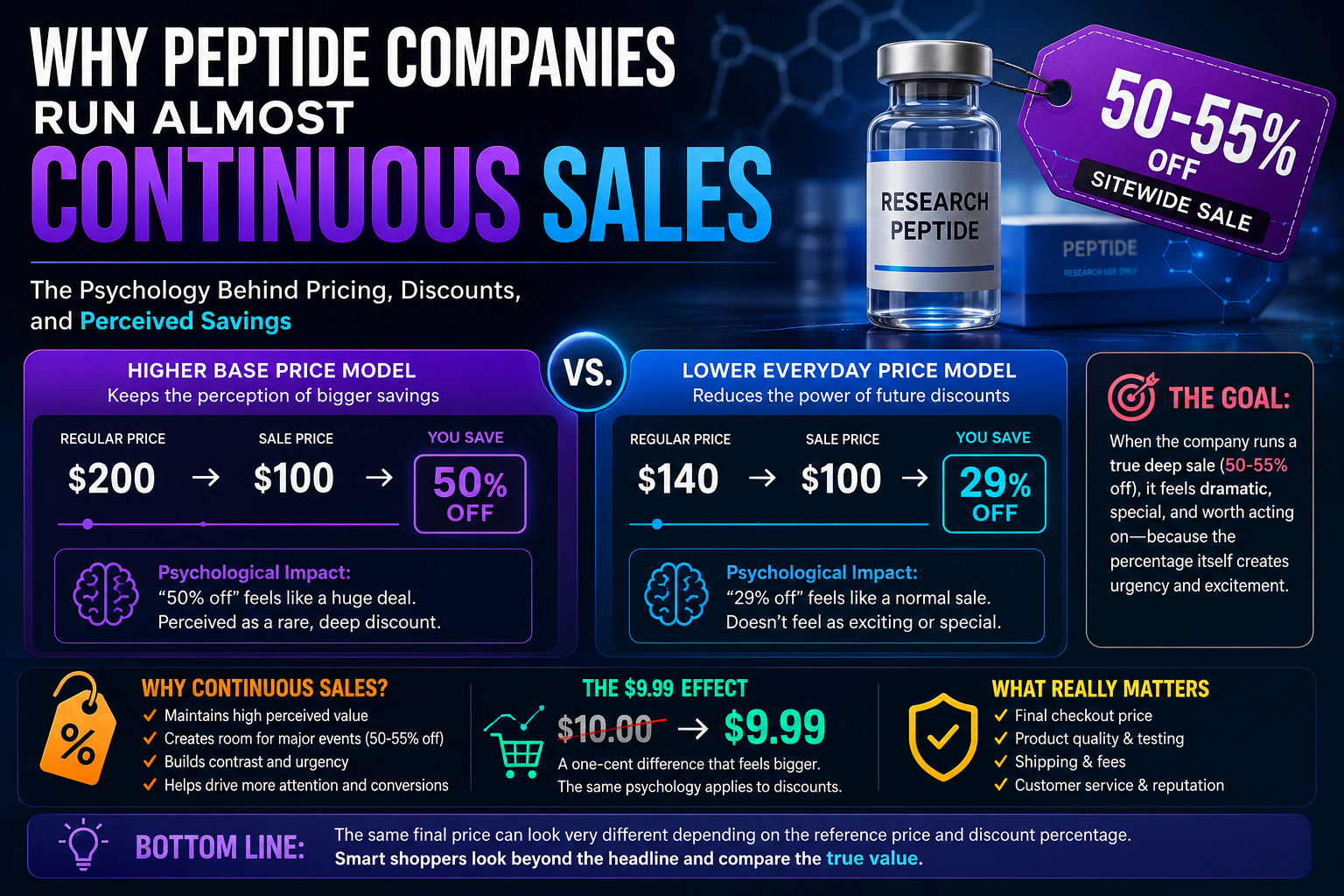
The customer pays $100 either way. The promotional message is what changes.
Pricing strategy and consumer psychology. This article explains why businesses may structure everyday and promotional pricing differently. A large advertised percentage does not automatically mean the lowest final price, and businesses should ensure pricing representations are accurate and compliant with applicable advertising requirements.
Article contents
1 Executive summary: pricing is mathematical and psychological
Many research peptide companies appear to run promotions almost continuously. A company may advertise 20%, 25% or 30% off during ordinary periods, then announce a substantially deeper 40%, 50% or even 55% sale during an anniversary, holiday or special event.
This leads to an understandable question: if a company regularly sells products at 30% off, why not simply lower the regular prices by 30% and stop calling it a sale?
One major answer is pricing psychology. Permanently lowering the base price can substantially reduce the percentage discount a company is able to advertise when it later reaches the same deep-sale price.
2 Base price and effective selling price are not the same thing
Understanding this strategy starts with separating two prices that customers sometimes treat as interchangeable.
The listed price before the current promotional discount is applied.
The amount the customer actually pays after the active promotion is applied.
Consider a hypothetical product with a regular price of $200.
A company could theoretically eliminate the 30% promotion and permanently change the product price to $140. For an ordinary transaction, that may produce approximately the same economic result. But it changes what happens when the business later wants to run a genuinely exceptional sale.
3 It is the same basic psychology as $9.99 instead of $10.00
One of the easiest ways to understand promotional pricing psychology is to compare it with one of the most familiar pricing techniques in retail: $9.99 instead of $10.00.
The financial difference between $9.99 and $10.00 is only one cent. From a purely mathematical standpoint, the two prices are essentially identical.
Psychologically, however, customers may not process them identically. A shopper may mentally place $9.99 in the "nine-dollar range" while $10.00 crosses into the "ten-dollar range."
Percentage-off promotions operate on a closely related principle.
| Pricing model | Starting price | Sale price | Advertised savings |
|---|---|---|---|
| Higher base-price model | $200 | $100 | 50% OFF |
| Lower everyday-price model | $140 | $100 | 28.6% OFF |
The customer pays exactly the same $100
The difference is psychological presentation. 50% off immediately communicates "half price." Approximately 29% off can sound like a more ordinary sale even though the customer's final checkout price is identical.
4 Customers evaluate prices against a reference point
Consumers do not necessarily evaluate a price in isolation. They often compare it with another number that functions as a reference point.
That reference might be:
This means a business is managing more than the final dollar amount. It is also managing the reference point from which customers judge whether a promotion is ordinary, strong or exceptional.
5 Why 50% off feels dramatically different from 20–30% off
Discount percentages function as very fast marketing signals. A customer seeing an advertisement may not have the time or desire to compare the exact final price of 30 different products across five different suppliers.
Instead, the percentage can become a mental shortcut.
These perceptions are not universal, but the important principle is that the displayed discount percentage itself becomes part of the product's marketing message.
6 The same final prices under two completely different strategies
Assume a hypothetical peptide company lists a product for $200 and commonly runs a 30% promotion.
| Promotion level | Discount | Customer price | How it may be perceived |
|---|---|---|---|
| Regular price | 0% | $200 | Reference point |
| Routine sale | 30% | $140 | Normal promotional environment |
| Enhanced event | 40% | $120 | Clearly stronger than normal |
| Deep sale | 50% | $100 | Half price |
| Exceptional promotion | 55% | $90 | Rare / unusually aggressive |
Now permanently lower the regular price to $140
If $140 becomes the official everyday price, reaching those same final sale prices requires much smaller advertised percentages.
| Target price | Discount from $200 | Discount from $140 | Difference in headline |
|---|---|---|---|
| $120 | 40% OFF | 14.3% OFF | Major sale → modest promotion |
| $100 | 50% OFF | 28.6% OFF | Half price → ordinary-looking percentage |
| $90 | 55% OFF | 35.7% OFF | Exceptional event → strong but less dramatic sale |
7 Sales create contrast and urgency that everyday prices do not
A permanently lower price and a temporary promotional price can communicate two very different messages.
Straightforward value, but there may be little reason for the customer to purchase today rather than next week.
The same $140 is framed as a temporary opportunity relative to a higher reference point.
The effect becomes stronger when customers are familiar with a company's ordinary promotions.
If customers normally see 30% off and suddenly see 50% off, the contrast itself tells them that the current event is substantially different from the ordinary promotional environment.
8 Why this strategy appears frequently in the peptide market
Research peptide shoppers often have access to many suppliers and can compare dozens of products relatively quickly. This makes promotional messaging highly visible.
Before a customer examines every individual price, they may first encounter headlines such as:
A large percentage can attract attention before the shopper has evaluated final prices, testing programs, shipping costs, customer service, batch documentation, reputation or other factors.
As a result, companies may design pricing architecture not only around what they expect a product to sell for today, but also around how much promotional range they want available throughout the year.
9 Promotional architecture gives companies more flexibility
A relatively stable catalog price allows a company to create several different promotional levels without continually rebuilding its entire pricing structure.
Under this model, a company effectively operates with a regular reference price, a normal promotional price and one or more deep-sale prices.
10 Customers often compare the discount before comparing the final price
Consider two hypothetical suppliers offering comparable products.
The actual difference is only $5, yet an advertisement saying 50% OFF may initially appear dramatically more aggressive than an advertisement saying 25% OFF. The shopper may only discover how close the final prices are after visiting both websites.
11 Why major promotions need to feel different from normal promotions
If every promotion looks the same, a major event can lose much of its impact.
A business may therefore create an intentional promotional hierarchy:
The specific percentages vary by business. The strategic idea is that each promotional level should be recognizable as meaningfully different from the one below it.
12 Why companies do not simply compete on the lowest everyday price
An everyday-low-price strategy is completely valid, and some customers strongly prefer it. It is simple, predictable and reduces the feeling that a customer needs to wait for a sale.
But there is a tradeoff.
If a company permanently prices an item near its lowest sustainable selling price, there is much less room for a dramatic sale without cutting deeply into margin.
If a company already sells a product for $110 every day, advertising a true 50% discount would require selling it for $55. A business that maintains a higher legitimate regular price has more promotional room between its ordinary catalog price and its most aggressive temporary price.
That flexibility may be especially valuable during Black Friday, Cyber Monday, company anniversaries, customer-appreciation events, flash sales and major inventory promotions.
13 Product price has to support more than product cost
Another reason pricing cannot be analyzed solely by looking at product acquisition cost is that a research supplier may have many other expenses associated with operating the business.
Promotional tiers allow a company to decide how much margin it is willing to sacrifice during different events rather than permanently committing every transaction to its deepest promotional price.
14 Where continuous-sale pricing can backfire
Frequent promotions are not automatically better. If a company handles the strategy poorly, customers can become skeptical.
The strongest version of the strategy therefore requires real differentiation between routine pricing and genuinely exceptional events.
15 A large percentage does not automatically mean the best deal
None of this means customers should choose a supplier simply because it advertises the largest percentage.
A 50% sale from one company can still produce a higher final price than a 20% sale from another.
A more complete comparison considers:
Compare what actually leaves your wallet and what you receive in return—not simply the largest number printed beside the words "OFF."
16 Frequently asked questions
Why not just lower the price instead of advertising 30% off?
Because permanently lowering the base price also lowers the percentage that can be advertised when the company later reaches a much deeper sale price. The ordinary checkout price may remain similar while the company's future promotional flexibility changes significantly.
Is this really similar to $9.99 instead of $10.00?
Yes in the broader sense that both use psychological presentation. The financial difference between $9.99 and $10.00 is tiny, but the numbers can be perceived differently. Similarly, "50% off" can feel dramatically larger than "29% off" even when both promotions produce the same final $100 price.
Does 50% off always mean a better price than 25% off?
No. The original price matters. A 25%-off supplier can still have a lower checkout price than another supplier advertising 50% off.
Why do companies care so much about the percentage?
Because the discount percentage can communicate the size of the event almost instantly. Customers may see "50% off" and understand "half price" without performing any additional calculations.
Can customers become used to continuous sales?
Yes. When a promotion appears frequently enough, customers may begin treating the promotional price as the normal price. That makes it especially important for a true deep-sale event to be visibly different from the routine promotion.
Why might a company normally run 30% off but later offer 50–55%?
The routine promotion establishes one selling level while leaving room for a major anniversary, holiday, flash sale or other event to reach a substantially lower price and still communicate that difference clearly.
What should customers actually compare?
The final checkout price, product quantity, shipping, fees, testing documentation, service, reputation and overall value. The headline discount is useful information, but it should not be the only comparison.
The central idea
The bottom line
A peptide company running frequent promotions does not necessarily mean the company simply forgot to lower its regular prices. The pricing structure may be deliberately designed around reference pricing, promotional flexibility and consumer psychology.
If a company normally offers around 30% off and later runs a genuine 50–55% event, customers can instantly recognize that the new promotion is significantly deeper than normal.
Permanently lowering the base price to the former 30%-off price changes the mathematics. The exact same $100 sale price that previously represented 50% off may suddenly represent only about 29% off.
That is why the strategy can be compared to pricing an item at $9.99 instead of $10.00. The customer's perception of the number can matter beyond the mathematical difference itself.
For consumers, the most useful approach remains simple: look past the headline percentage and compare the actual final price and overall value.