Label literacy / Brand identity
eBAC, Hospitiva & Hospira:Similar look. Different brands.
A pink cap and a familiar-looking label do not establish that a vial is Pfizer’s Hospira product. Before buying, look past the packaging and confirm whose product you are actually getting.
The brand name is not a minor detail.
When a buyer is specifically looking for Hospira, receiving a product labeled eBAC or Hospitiva is not the same thing as receiving the requested brand. A familiar color scheme should never be the reason someone assumes otherwise.
There is a documented distinction to start with: Pfizer publishes an official product listing and prescribing information for its Hospira bacteriostatic water. eBac’s own storefront identifies its product under the eBac name and designates it for research use. Those are different product identities, not merely different ways of writing the same brand name.[1][2][3]
The concern here is clarity at the point of purchase. Buyers should be able to tell which brand they are ordering without discovering the difference only after the package arrives.
Why the packaging can be easy to mix up
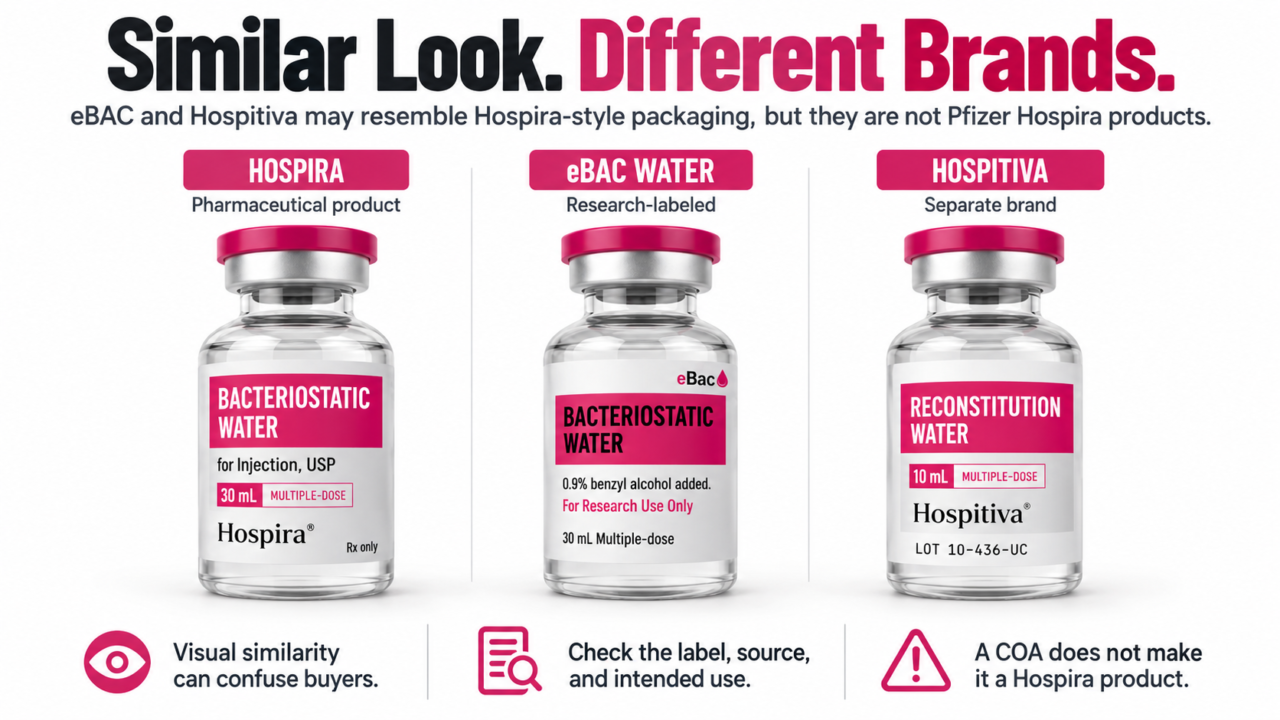
In the supplied comparison, all three vials share a similar visual arrangement: pink or garnet-colored tops, silver-colored collars, white labels and prominent pink product-name panels. The eye can register that familiar overall appearance before it registers the smaller brand details.
The differences become clearer on closer inspection. The center vial carries the small eBac mark. The right-hand vial says Hospitiva, a name that visually resembles Hospira but is spelled differently. Its main panel also uses different product wording.
That resemblance is a reason to slow down—not evidence that the products share a manufacturer, an approval, a quality system or an endorsement. Our concern is the potential for mistaken identity; appearance alone does not establish deliberate deception.
There is a public report of buyer confusion.
In a May 14, 2026 reader comment beneath a published article discussing these brands, a purchaser reported initially believing their order was Hospira and later noticing that the vial was eBac. That is a self-reported example of the exact misunderstanding this comparison addresses.[6]
It is not independently verified purchase evidence, and it does not establish how many buyers have been confused. It does, however, illustrate why the name on the label deserves attention before checkout.
What the available documentation actually says
Hospira: the product identified in Pfizer’s records
Pfizer’s U.S. catalog identifies a 30 mL presentation of Bacteriostatic Water for Injection, USP. Its linked prescribing information names Hospira, carries prescription-only labeling and describes a medical diluent with specific instructions and warnings. The catalog specifies a garnet cap and a multiple-dose plastic vial for this presentation.[1][2]
Those official records are the appropriate comparison point—not a promotional illustration or a seller’s use of similar colors. They also do not make a particular vial authentic simply because it looks similar.
eBAC: its own research-labeled product
eBAC, styled “eBac” on its website, markets a 30 mL water product containing 0.9% benzyl alcohol and states “For research use only.” The product page also advertises testing and a certificate of analysis. These are the seller’s published descriptions, not independent findings from this article.[3]
Its FAQ explains that the vial’s lot code should match the posted COA and describes testing for sterility, pH and benzyl alcohol concentration. That documentation can be relevant to evaluating the eBac product; it does not make it a Hospira-branded product.[4]
Hospitiva: a different name, not proof of a Pfizer connection
The comparison image identifies the right-hand product as Hospitiva reconstitution water. Separately, the UK Companies House register contains an entry for HOSPITIVA LTD, company number 16783460. A corporate-registration entry is not documentation of a particular vial’s manufacturer or pharmaceutical authorization.[5]
An authoritative Hospitiva product insert or manufacturer-issued regulatory record was not verified for this article. Accordingly, the graphic’s research-use description should not be treated as an independently confirmed regulatory classification. The similar name and appearance are not a basis for assuming that this is Pfizer’s Hospira product.
| Brand | Evidence reviewed | What buyers should not assume |
|---|---|---|
| Hospira | Pfizer’s official catalog and linked prescribing information.[1][2] | A matching color scheme authenticates a particular vial. |
| eBAC / eBac | The brand’s own research-use product listing and COA explanation.[3][4] | Its testing claims establish Hospira identity or Pfizer endorsement. |
| Hospitiva | The supplied graphic and a same-name UK company record; authoritative product documentation not verified.[5] | A similar name establishes a Pfizer relationship or equivalent product status. |
A COA does not settle brand identity.
A certificate of analysis is worth examining, but the questions it addresses are different from “Was this made or supplied as a Pfizer/Hospira product?” A result for an identified sample is not, by itself, a record of brand authorization or the complete supply chain.
FDA explains that pharmaceutical quality depends on manufacturing controls as well as testing. Its CGMP overview describes quality-management systems, controlled processes, appropriate materials, investigations and reliable laboratories—and explains why sampling and testing alone are not enough to ensure quality.[7]
The practical distinction is straightforward: examine a report’s sample identification, lot, methods and results for what they actually establish. Do not turn a passing result into a claim about an untested property, an entire manufacturing operation or a relationship to a different brand.
Four checks before you buy
Read the exact brand and complete label.
Look for the actual company name, product description, intended-use wording, lot and expiration details. Request clear photographs of all sides of the current packaging rather than relying on a stylized listing image.
Ask the seller to identify the product in writing.
When Hospira is the brand you intend to buy, ask whether the item is genuine Hospira-branded stock or a separately branded alternative. Request the relevant manufacturer or distributor information. Keep the listing and the seller’s answer with the order record.
Cross-check documentation—not just badges.
For a claimed Hospira product, compare the stated presentation and identifiers with Pfizer’s official documentation. For any COA, check that it relates to the product and lot supplied. An NDC number is an identifier, not an authentication seal; FDA specifically warns that an NDC assignment or directory listing does not establish FDA approval.[1][4][8]
Keep intended use separate from appearance.
Do not interpret a research-use label as permission for medical use. For prescribed treatment, have a pharmacist or clinician confirm the appropriate product and follow the relevant prescribing information—not a packaging comparison. Hospira’s labeling itself requires attention to the drug manufacturer’s instructions and compatibility.[2]
Clear branding should remove the guesswork.
Our editorial position is simple: a seller offering its own brand should make that identity prominent. The product title, photographs and purchase confirmation should make the distinction clear enough that a buyer does not have to discover it in fine print.
There is nothing inherently wrong with offering an alternative brand. The important point is that an alternative should be chosen knowingly—not purchased because a familiar-looking presentation was mistaken for the brand the buyer intended to order.
Scope: This is an editorial comparison of branding, visible label differences and the linked public records. No physical products were authenticated or independently tested. Buyer-confusion prevalence was not established, and authoritative Hospitiva product documentation was not verified.
Medical context: This article is not medical advice or a guide to reconstitution, dosing or injection. It does not recommend using research-only materials in people or animals. Brand names are used for identification and comparison, not to imply endorsement.
Sources & documentation
Public pages checked September 11, 2026. Seller statements are identified as seller statements. Product presentations and published pages may change.
- [1] Pfizer Hospital USBacteriostatic Water for Injection, USP — 30 mL product listing
Official product presentation, cap color, packaging and NDC information.
- [2] Pfizer / HospiraOfficial prescribing information
Product identity, prescription labeling and labeled medical purpose.
- [3] eBac Water30 mL bacteriostatic water — product page
The seller’s research-use designation, formulation and testing claims.
- [4] eBac WaterFrequently asked questions
The seller’s description of lot matching and test documentation.
- [5] UK Companies HouseHOSPITIVA LTD — company 16783460
A corporate-registration record; not a product authorization or manufacturing certificate.
- [6] Krysia / SubstackMay 2026 article and public reader discussion
The May 14 reader comment is cited only as a self-reported example of brand confusion, not verified technical evidence.
- [7] U.S. Food and Drug AdministrationFacts About the Current Good Manufacturing Practice (CGMP)
Why testing alone does not establish pharmaceutical manufacturing quality.
- [8] U.S. Food and Drug AdministrationNational Drug Code Directory
FDA’s explanation that an NDC assignment or listing is not evidence of approval.