Adamax: What It Is, Proposed Structure, Mechanism, and Research Overview
An evidence-graded review of Adamax, a recently marketed modified Semax analogue whose exact chemistry, nomenclature, pharmacology, toxicology, and research record are not standardized in peer-reviewed scientific literature.
What Is Adamax?
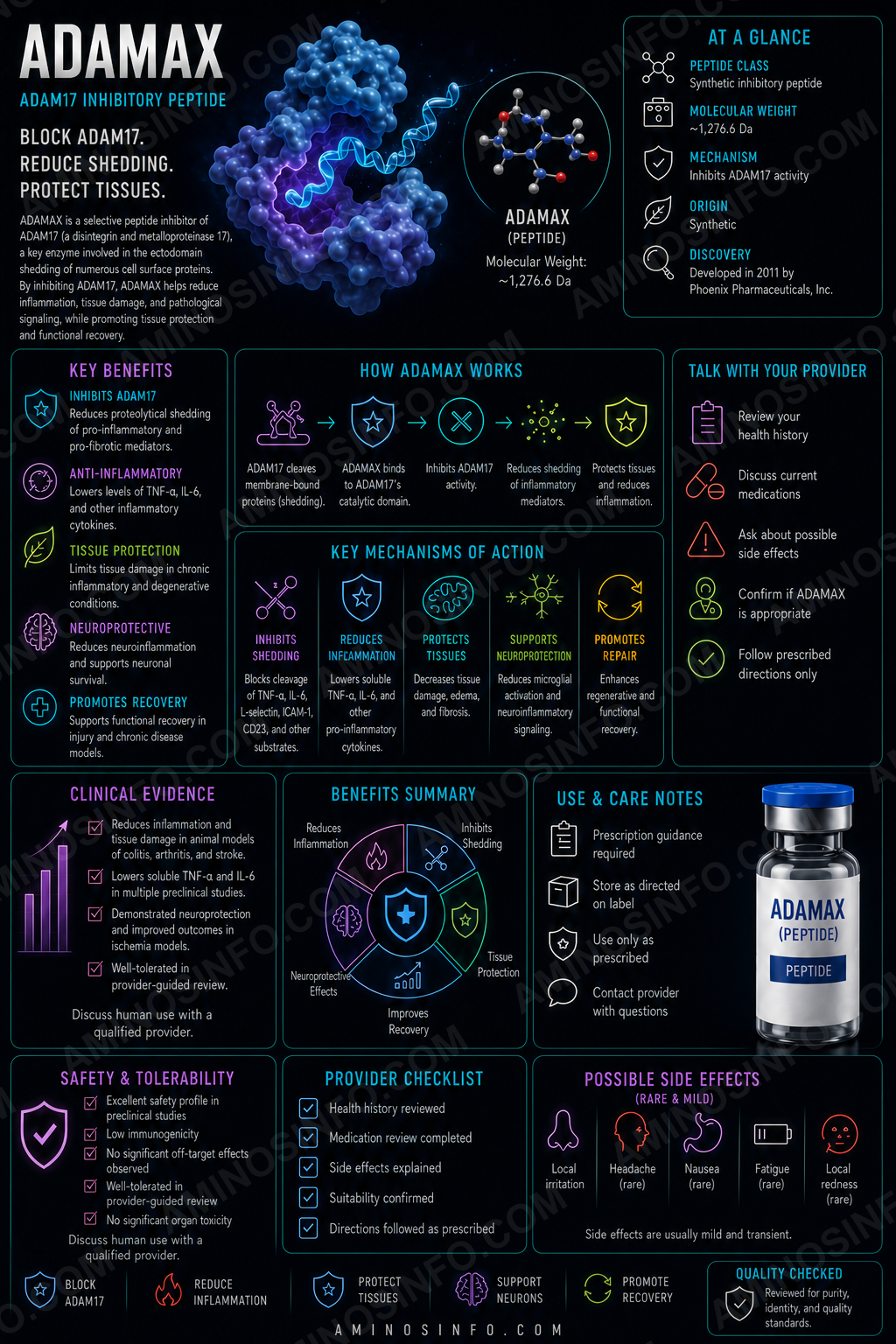
Adamax is a commercial name used for a modified analogue of Semax, the synthetic heptapeptide Met-Glu-His-Phe-Pro-Gly-Pro.
The compound appears to have originated in the designer-peptide market rather than through a conventional academic or pharmaceutical-development program. Public descriptions usually claim two changes to Semax:
- N-terminal acetylation
- A C-terminal adamantane-derived residue or group, often described as analogous to the terminal modification used in P021
Adamax
Semax
Ac-MEHFPGP-AG-NH₂
No
None identified
No
Identity and Nomenclature Conflicts
Most commonly repeated identity
Ac-Met-Glu-His-Phe-Pro-Gly-Pro-AG-NH₂
The abbreviation AG is commonly described as an adamantane-containing amino-acid residue related to the C-terminal modification of P021.
Alternative commercial descriptions
Ac-MEHFPGP-adamantaneAc-MEHFPGP-[adamantane cage]-CONH₂Ac-Met-Glu-His-Phe-Pro-Gly-Pro-Ala-Gly-OH- Unmodified
MEHFPGP, which is simply Semax
Conflicting formulas and masses
Public sellers report formulas and molecular weights that cannot all describe the same molecule.
| Reported formula | Reported molecular weight | Source type | Problem |
|---|---|---|---|
| C₅₀H₆₉N₁₁O₁₁S | Not consistently stated | Recent public chemical listing | Includes a larger adamantane-amide structure and unresolved stereochemistry. |
| C₄₄H₆₁N₁₁O₁₃S | 984.10 g/mol | Commercial catalogs | Conflicts with other proposed structures. |
| C₃₆H₅₁N₉O₁₀ | 773.85 g/mol | Commercial supplier | Too low to match many claimed adamantane-modified structures. |
| C₃₂H₄₉N₉O₁₀ | 719.8 g/mol | Commercial supplier | Essentially presented with the Semax sequence and no validated Adamax modification. |
| C₂₂H₅₂N₁₆O₆ | 1032.24 g/mol | Commercial supplier | Formula and mass are chemically inconsistent with the commonly claimed peptide. |
Conclusion
“Adamax” cannot be authenticated by name alone. Every batch requires complete structural disclosure and orthogonal analytical confirmation.
🧬 Proposed Molecular Structure
Semax parent sequence
H-Met-Glu-His-Phe-Pro-Gly-Pro-OH
One-letter notation: MEHFPGP
Most frequently proposed Adamax notation
Ac-Met-Glu-His-Phe-Pro-Gly-Pro-AG-NH₂
Why “AG” is ambiguous
In this context, AG does not simply mean alanine-glycine. It is usually intended to denote a noncanonical adamantane-derived amino-acid residue resembling the C-terminal amino-adamantane modification found in P021. A complete structure must specify:
- The precise adamantane scaffold
- The carbon bearing the amino and amide groups
- Stereochemistry
- Linker length
- Attachment to the terminal proline
- Whether the final carboxyl group is amidated
⚛️ Molecular Weight and 🧫 Formula
| Identity | Formula | Molecular weight | Confidence |
|---|---|---|---|
| Semax | C₃₇H₅₁N₉O₁₀S | Approximately 813.9 g/mol | Well documented |
| Public Adamax chemical listing | C₅₀H₆₉N₁₁O₁₁S | Must be independently calculated and verified | Provisional |
| Commercial Adamax specification | C₄₄H₆₁N₁₁O₁₃S | 984.10 g/mol | Commercial claim only |
| Other commercial listings | Multiple incompatible formulas | Approximately 719.8–1032.2 g/mol | Not reliable as a unified identity |
📅 Discovery Timeline and Research History
1980s: Semax developed
Semax was developed in Russia from the ACTH(4–7) sequence extended with Pro-Gly-Pro to improve stability and preserve neuroactive properties without corticosteroid activity.
1990s–2010s: Semax research expands
Studies examined learning, memory, ischemic injury, gene expression, neurotrophic factors, monoamines, inflammation, and human functional connectivity.
2010s: P021 developed
P021 was developed from a CNTF-derived tetrapeptide and modified with an adamantane-based residue to improve metabolic stability and brain availability in experimental models.
Before 2018: Adamax appears in designer-peptide market
Adamax is commonly attributed to the former commercial research company Ceretropic. No original peer-reviewed synthesis or pharmacology paper was identified.
2025: Regulatory attention
Adamax was identified in regulatory discussions concerning unscheduled peptides and designer products in New Zealand.
2025–2026: Commercial availability expands
Multiple suppliers list Adamax with inconsistent structures, formulas, and claimed mechanisms.
Current status
No direct Adamax publication, clinical trial, validated pharmacology program, or standardized compendial identity was identified.
Relationship to Semax and ACTH Fragments
Semax sequence
Semax is the heptapeptide:
Met-Glu-His-Phe-Pro-Gly-Pro
ACTH origin
The first four residues—Met-Glu-His-Phe—correspond to ACTH(4–7). The Pro-Gly-Pro tail was added to improve metabolic resistance.
Semax research themes
- Ischemic-brain injury
- Learning and memory
- BDNF and neurotrophin signaling
- Monoamine regulation
- Gene-expression changes
- Inflammatory and vascular responses
Adamax modifications
Adamax is claimed to preserve the Semax core while adding terminal modifications intended to increase stability and lipophilicity.
Why direct testing is required
N-terminal acetylation and a large C-terminal noncanonical residue may alter peptide conformation, target binding, enzymatic cleavage, solubility, distribution, and toxicity.
Relationship to P021 and Adamantane Chemistry
What P021 is
P021 is a modified peptide derived from a short ciliary neurotrophic factor sequence. Its adamantane-derived terminal residue was designed to improve stability and central exposure.
Adamax design claim
Adamax is commonly described as combining an N-acetyl Semax backbone with the adamantane-containing terminal chemistry of P021.
Adamantane medicinal chemistry
Adamantane is a rigid, hydrophobic cage used in several approved drugs and experimental compounds. It can alter:
- Lipophilicity
- Protein binding
- Membrane association
- Metabolic stability
- Tissue retention
- Off-target pharmacology
Not automatically brain penetrant
An adamantane group can improve brain exposure in some molecules but worsen solubility or transport in others. Human or animal pharmacokinetic measurements are required.
P021 evidence is not Adamax evidence
Even if Adamax uses the same terminal residue, the much larger Semax backbone creates a different molecule.
🧠 Proposed Mechanism of Action
No direct Adamax mechanism has been established. The following pathways are hypotheses based on Semax and P021.
1. Neurotrophin signaling
Semax research reports changes in BDNF, NGF, and related gene expression. Adamax has not been directly tested.
2. Trk receptor pathways
Commercial pages claim improved TrkB sensitivity, but no direct Adamax receptor-binding or phosphorylation study was identified.
3. Gene-expression modulation
Semax changes expression of genes involved in immune, vascular, and neuronal pathways after ischemia. Chemical modification may change this profile.
4. Monoamine systems
Semax affects dopamine, serotonin, and norepinephrine-related signaling in selected models. Adamax data are absent.
5. Protease resistance and distribution
N-acetylation, C-terminal amidation, and a bulky adamantane-derived residue could reduce enzymatic degradation, but this remains unmeasured.
🎯 Receptor and Pathway Profile
| Target or pathway | Adamax evidence status |
|---|---|
| BDNF expression | Semax-derived hypothesis; no direct Adamax study. |
| TrkB activation or sensitivity | Commercial claim; no direct binding or signaling study identified. |
| NGF signaling | Semax-derived hypothesis only. |
| Dopamine, serotonin, norepinephrine | Semax-derived hypothesis only. |
| Melanocortin receptors | Not established for Adamax; Semax lacks a simple classical ACTH endocrine profile. |
| Specific Adamax receptor | None established. |
BDNF, TrkB, and Neurotrophic Claims
Semax evidence
Semax has been associated with increased BDNF expression or concentration in selected animal and human stroke-related studies.
BDNF biology
BDNF supports neuronal survival, synaptic plasticity, learning, and adaptation through TrkB and other signaling systems.
Adamax claims
Suppliers commonly claim that Adamax increases BDNF and improves TrkB receptor sensitivity more strongly than Semax.
Missing evidence
No Adamax dose-response, BDNF assay, TrkB phosphorylation study, receptor-binding experiment, or comparative Semax study was identified.
More BDNF is not always better
Neurotrophin effects depend on brain region, timing, injury, receptor balance, dose, and disease state.
Cognition, Memory, and Plasticity Claims
Semax learning research
Semax improved learning, memory, and attention in selected animal and regional human studies.
Functional-connectivity study
A study in 52 healthy participants examined resting-state brain connectivity after Selank and Semax.
Adamax evidence
No controlled Adamax memory, attention, executive-function, long-term-potentiation, synaptogenesis, or neurogenesis study was found.
Subjective reports are not clinical trials
Online anecdotes about focus, stimulation, endurance, or mental clarity cannot determine efficacy, dose-response, or safety.
No proven cognitive enhancer
Adamax has not been shown to improve cognition in healthy people, older adults, dementia, ADHD, brain injury, or neurodegenerative disease.
Neuroprotection and Ischemia Claims
Semax ischemia research
Semax has demonstrated neuroprotective and gene-expression effects in experimental cerebral ischemia and has regional clinical use in Russia.
Adamax extrapolation
Commercial sources infer that a longer-lasting Semax analogue should provide stronger neuroprotection.
No Adamax ischemia study
No direct infarct-volume, neuronal-survival, cerebral-blood-flow, oxidative-stress, apoptosis, excitotoxicity, or functional-recovery study was identified.
Not a stroke treatment
Adamax must not be presented as a substitute for emergency stroke evaluation, thrombolysis, thrombectomy, antiplatelet therapy, rehabilitation, or standard secondary prevention.
Monoamine and Stress-Response Claims
Semax monoamine research
Semax altered dopamine, serotonin, and norepinephrine-related measures in selected animal models.
Stress and anxiety effects
Some studies report changes in anxiety-like behavior and stress responses after Semax.
Adamax evidence gap
No direct Adamax microdialysis, receptor-binding, transporter, behavioral, or stress-hormone study was identified.
Stimulatory claims
Supplier and community reports describe Adamax as more stimulating than Semax, but such reports cannot establish pharmacology or safety.
Potential interaction uncertainty
Interactions with stimulants, antidepressants, antipsychotics, MAO inhibitors, sedatives, anticonvulsants, or recreational substances are unknown.
Direct Evidence and Major Limitations
No primary Adamax study identified
Searches of PubMed and PubMed Central did not identify a distinct Adamax pharmacology or clinical paper.
No standardized identity
Suppliers report mutually incompatible formulas, molecular weights, and sequences.
No validated pharmacokinetics
Half-life, nasal bioavailability, plasma exposure, brain exposure, metabolism, tissue distribution, and excretion are unknown.
No toxicology package
Acute, repeated-dose, genotoxic, reproductive, developmental, immunotoxic, cardiac, and neurobehavioral safety studies were not identified.
No validated potency assay
There is no accepted test linking Adamax batch quality to BDNF, TrkB, memory, or neuroprotection.
Designer-product risk
Commercial availability can precede scientific characterization, creating a high risk of incorrect identity and unsupported claims.
Safety and Regulatory Considerations
Unknown human safety
No controlled human dose-ranging or adverse-event study was identified.
Unknown central nervous system effects
Potential agitation, insomnia, anxiety, mood changes, headaches, blood-pressure effects, seizures, or cognitive impairment have not been systematically assessed.
Unknown drug interactions
Potential interactions with psychiatric, neurologic, cardiovascular, and stimulant medications are unknown.
Adamantane-related uncertainty
A bulky hydrophobic modification may alter tissue accumulation, renal or hepatic clearance, membrane interactions, and off-target binding.
Methionine oxidation
The N-terminal methionine in the Semax core is susceptible to oxidation, creating a distinct impurity with potentially altered activity.
Nasal-formulation risks
Finished nasal products require control of microbial quality, pH, osmolality, preservatives, delivered dose, plume geometry, droplet size, and mucosal toxicity.
Regulatory status
Adamax is not FDA approved and has no recognized approved indication.
🧪 Laboratory Testing Methods
| Method | Purpose | Important limitation |
|---|---|---|
| Complete structural disclosure | Defines exact adamantane residue, linker, termini, sequence, and stereochemistry. | Essential before other tests can be interpreted. |
| RP-HPLC / UPLC | Measures chromatographic purity and separates related impurities. | Cannot establish sequence or adamantane connectivity alone. |
| LC-HRMS | Confirms exact intact mass and elemental composition. | Isomers and linkage variants may share mass. |
| MS/MS sequencing | Confirms MEHFPGP core and terminal modifications. | Noncanonical adamantane residues require custom interpretation. |
| NMR spectroscopy | Confirms atom connectivity, linker, adamantane structure, and terminal chemistry. | Requires adequate high-purity material. |
| Amino-acid analysis | Confirms peptide composition. | Does not establish sequence or noncanonical-residue identity. |
| Chiral analysis | Confirms residue stereochemistry. | Hydrolysis may introduce artifacts. |
| Net peptide-content assay | Measures actual Adamax amount. | Cannot be inferred from HPLC area purity. |
| Semax and deprotected-analogue assay | Detects incomplete modification or hydrolysis. | Requires authentic reference standards. |
| Methionine-oxidation assay | Detects sulfoxide and related oxidative impurities. | Requires controlled sample handling. |
| Adamantane-linker impurity assay | Detects free modifier and synthesis by-products. | Impossible without exact chemistry. |
| Solubility and aggregation testing | Evaluates hydrophobicity and formulation behavior. | Must reflect actual concentration and excipients. |
| Plasma-stability assay | Measures proteolytic degradation and metabolite formation. | In vitro stability does not prove in vivo exposure. |
| Brain and plasma pharmacokinetics | Measures bioavailability, half-life, metabolism, and CNS exposure. | No public Adamax data identified. |
| Receptor and signaling assays | Tests TrkB, neurotrophin, monoamine, or melanocortin hypotheses. | Must use predefined direct endpoints. |
| Microbial limits, sterility, and endotoxin | Evaluates route-specific microbiological quality. | Requirements depend on final dosage form. |
| Nasal spray performance testing | Measures delivered dose, plume, droplet size, priming, and uniformity. | Raw-peptide COA does not cover finished-product performance. |
| Stability-indicating assay | Tracks oxidation, hydrolysis, aggregation, modifier loss, and assay. | Requires a fully defined reference compound. |
📄 How to Interpret an Adamax COA
- Demand a complete chemical drawing: “Adamax” or “AG” alone is inadequate.
- Verify the core sequence: Met-Glu-His-Phe-Pro-Gly-Pro.
- Confirm N-terminal acetylation: This must be demonstrated separately.
- Identify the exact terminal adamantane residue: Structure, linker, attachment, stereochemistry, and amidation are required.
- Reject contradictory formula and mass data: The reported structure, HRMS result, and theoretical formula must agree.
- Use MS/MS and NMR: HPLC purity alone cannot prove Adamax identity.
- Measure net content: Area purity is not the labeled milligram amount.
- Review free Semax, methionine sulfoxide, incomplete modifications, free adamantane reagent, water, salts, and residual solvents.
- For nasal products, require finished-product data: Dose uniformity, microbial quality, preservative effectiveness, spray performance, pH, and osmolality.
- Do not infer biological efficacy: A COA cannot prove BDNF induction, TrkB activation, brain penetration, memory enhancement, neuroprotection, endurance, or longer duration.
📊 Adamax vs Semax vs N-Acetyl Semax Amidate
| Feature | Adamax | Semax | N-Acetyl Semax Amidate |
|---|---|---|---|
| Identity | Conflicting designer analogue | Defined MEHFPGP heptapeptide | Defined terminally protected Semax analogue if fully specified |
| Adamantane group | Claimed in most definitions | No | No |
| Direct peer-reviewed evidence | None identified | Substantial preclinical and regional clinical literature | Very limited |
| FDA approved? | No | No | No |
Adamax vs P021
| Feature | Adamax | P021 |
|---|---|---|
| Parent peptide | Semax / ACTH-derived core | CNTF-derived tetrapeptide |
| Adamantane-derived residue | Claimed | Documented in published research |
| Main research theme | Commercial nootropic claims | Neurogenesis, tau, and cognition in animal models |
| Direct literature | None identified | Multiple preclinical studies |
Adamax vs Dihexa vs FGL vs DNSP-11
| Compound | Main proposed pathway | Evidence distinction |
|---|---|---|
| Adamax | Semax-like signaling plus adamantane-dependent distribution | No direct studies identified |
| Dihexa | HGF/c-Met-related synaptogenic research | Chemically unrelated |
| FGL | NCAM/FGFR-related plasticity research | Chemically unrelated |
| DNSP-11 | GDNF-derived dopamine-neuron research | Chemically unrelated |
Adamax vs Evidence-Based Cognitive and Neurologic Care
| Approach | Established role | Difference from Adamax |
|---|---|---|
| Stroke emergency treatment | Thrombolysis, thrombectomy, and acute supportive care | Time-sensitive evidence-based treatment |
| Sleep, exercise, and vascular-risk control | Supports cognitive and brain health | Established risk-benefit framework |
| Approved dementia drugs | Selected symptomatic or disease-modifying indications | Defined manufacturing and clinical evidence |
| ADHD medications | Approved for diagnosed ADHD | Known pharmacology and monitoring |
| Adamax | Unvalidated designer peptide | No standardized identity or clinical evidence |
🔗 Related Peptides and Pathways
- Semax: Defined MEHFPGP parent peptide.
- ACTH(4–7): Met-Glu-His-Phe core from which Semax was designed.
- Pro-Gly-Pro: C-terminal glyproline motif added to Semax.
- P021: CNTF-derived peptide containing a published adamantane-based modification.
- BDNF and TrkB: Semax-associated pathways claimed—but not proven—for Adamax.
- NGF: Another neurotrophin discussed in Semax literature.
- Monoamines: Dopamine, serotonin, and norepinephrine systems studied with Semax.
- Adamantane: Hydrophobic medicinal-chemistry scaffold claimed in Adamax.
🖼️ Original Diagram Specifications
Diagram 1: Adamax identity tree
Show Semax as the parent molecule branching into N-acetyl Semax, N-acetyl Semax amidate, proposed Adamax with an adamantane-derived residue, and mislabeled unmodified Semax products.
Diagram 2: Complete versus incomplete notation
Contrast the shorthand Ac-MEHFPGP-AG-NH₂ with a fully specified atom-level structure, highlighting the missing definition of AG.
Diagram 3: Semax–P021 hybrid concept
Show the Semax backbone joined conceptually to the terminal adamantane chemistry of P021, with a warning that shared substructures do not confer shared evidence.
Diagram 4: Hypothetical pharmacokinetic changes
Show how acetylation, amidation, and adamantane conjugation could alter proteolysis, solubility, membrane binding, clearance, and CNS exposure.
Diagram 5: Claimed neurotrophic pathway
Show BDNF, TrkB, synaptic plasticity, memory, and neuronal survival, with every Adamax arrow labeled “unverified extrapolation.”
Diagram 6: Evidence ladder
Show commercial claim, structural confirmation, in vitro pharmacology, animal PK/toxicology, controlled human trials, and regulatory approval.
Diagram 7: COA workflow
Show full structural disclosure, HRMS, MS/MS, NMR, chiral analysis, methionine oxidation, modifier impurities, net content, nasal testing, and stability.
❓ Frequently Asked Questions
Is Adamax a peptide?
It is marketed as a modified Semax peptide analogue, but its exact standardized identity is unresolved.
What is Adamax’s sequence?
The most common notation is Ac-MEHFPGP-AG-NH₂, but AG is often not chemically defined.
What does AG mean?
It is generally intended to represent an adamantane-derived amino-acid residue related to P021, not ordinary alanine-glycine.
What is its molecular formula?
No universally verified formula exists. Public sources report mutually incompatible formulas.
What is its molecular weight?
Commercial listings range from roughly 719.8 to 1032.2 g/mol, demonstrating unresolved identity.
Is Adamax the same as Semax?
No. Adamax is claimed to be an acetylated, adamantane-modified Semax analogue.
Is Adamax FDA approved?
No.
Has Adamax been studied in humans?
No direct peer-reviewed human study was identified.
Does Adamax increase BDNF?
This is extrapolated from Semax research. No direct Adamax BDNF study was identified.
Does it activate TrkB?
No direct Adamax TrkB-binding or signaling study was identified.
Does it improve memory?
No controlled Adamax memory study was identified.
Does it cross the blood–brain barrier?
Unknown. No direct brain-exposure pharmacokinetic study was identified.
Is the adamantane group automatically beneficial?
No. It may improve stability or distribution but can also reduce solubility or create new off-target effects.
Does 99% HPLC prove Adamax identity?
No. A full structure, HRMS, MS/MS, NMR, and suitable reference standards are required.
Final Thoughts
Adamax should currently be described as an unstandardized designer Semax analogue rather than a well-characterized neuroprotective or cognitive peptide. The original draft incorrectly presented neurotrophic, BDNF, synaptic-plasticity, oxidative-stress, apoptosis, memory, and neurodegenerative-disease claims as though they came from direct Adamax studies.
The available evidence supports a narrower conclusion: Semax and P021 each have separate preclinical research records, while Adamax appears to combine structural concepts from both without a direct published pharmacology or safety program.
The first requirement for credible Adamax research is unambiguous chemical identity. This must be followed by validated analytical methods, pharmacokinetics, brain-distribution measurements, receptor and signaling studies, toxicology, and controlled human research before cognitive or therapeutic claims can be supported.
📚 References
- Ashmarin IP, et al. Semax, an analogue of ACTH(4–10), is a potential agent for the treatment of ischemic stroke. 2006.
- Dergunova LV, et al. Neuroprotective Peptides and New Strategies for Ischemic Stroke Therapy. 2023.
- Medvedeva EV, et al. The peptide Semax affects expression of genes related to immune and vascular systems in rat brain after ischemia. 2014.
- Glazova NY, et al. Semax attenuates behavioral and monoamine alterations in rats. 2021.
- Lebedeva IS, et al. Functional Connectomic Approach to Studying Selank and Semax Effects. 2020.
- Ashmarin IP, et al. Natural and hybrid stable regulatory glyproline peptides. 2005.
- Dolotov OV, et al. Semax and BDNF expression in experimental brain ischemia. Bulletin of Experimental Biology and Medicine.
- Agapova TY, et al. Semax effects on neurotrophin expression in rat brain. Molecular Biology.
- Medvedeva EV, et al. Semax transcriptomic effects after cerebral ischemia. BMC Genomics and related literature.
- Storozhevykh TP, et al. Semax and neuronal survival under glutamate toxicity. Bulletin of Experimental Biology and Medicine.
- Shadrina MI, et al. Semax effects on dopamine and serotonin systems. Neuroscience and Behavioral Physiology.
- Manchenko DM, et al. Semax and learning in animal models. Bulletin of Experimental Biology and Medicine.
- Myasoedov NF, et al. Semax design and ACTH-derived peptide research. Russian Journal of Bioorganic Chemistry.
- Vanhee C, et al. The occurrence of putative cognitive enhancing research peptides in products available on the internet. 2020.
- New Zealand Medicines and Medical Devices Safety Authority. Classification of Unscheduled Peptides. Medicines Classification Committee submission. 2025.
- Peptide 021 chemical and preclinical literature concerning CNTF-derived neurotrophic peptide analogues.
- Chohan MO, et al. P021, a CNTF-derived peptide, enhances neurogenesis and cognition in animal models. Journal of Alzheimer's Disease.
- Baazaoui N, et al. P021 effects on tau pathology and cognition in transgenic mouse models. Journal of Alzheimer's Disease.
- Li B, et al. P021 and neurogenesis in aged and Alzheimer-like animals. Neurobiology of Aging.
- Wanka L, Iqbal K, Schreiner PR. The lipophilic bullet hits the targets: medicinal chemistry of adamantane derivatives. Chemical Reviews.
- Liu J, et al. The many faces of the adamantyl group in drug design. European Journal of Medicinal Chemistry.
- Lamoureux G, Artavia G. Use of the adamantane structure in medicinal chemistry. Current Medicinal Chemistry.
- Pardridge WM. Blood–brain barrier drug targeting. NeuroRx.
- Begley DJ. Delivery of therapeutic peptides to the central nervous system. Pharmaceutical Research.
- Di L, Kerns EH. Blood–brain barrier in drug discovery. Drug Discovery Today.
- Wang CK, Craik DJ. Designing peptide therapeutics for membrane permeability. Nature Chemical Biology.
- Lau JL, Dunn MK. Therapeutic peptides: historical perspectives and current development trends. Bioorganic & Medicinal Chemistry.
- Fosgerau K, Hoffmann T. Peptide therapeutics: current status and future directions. Drug Discovery Today.
- Craik DJ, Fairlie DP, Liras S, Price D. The future of peptide-based drugs. Chemical Biology & Drug Design.
- Vlieghe P, Lisowski V, Martinez J, Khrestchatisky M. Synthetic therapeutic peptides: science and market. Drug Discovery Today.
- Park JW, et al. Methionine oxidation in therapeutic peptides and proteins. Pharmaceutical Research.
- Manning MC, et al. Stability of protein pharmaceuticals. Pharmaceutical Research.
- International Council for Harmonisation. ICH Q2(R2): Validation of Analytical Procedures.
- International Council for Harmonisation. ICH Q3A and Q3B: Impurities in New Drug Substances and Products.
- International Council for Harmonisation. ICH Q3C: Residual Solvents.
- International Council for Harmonisation. ICH Q1A(R2): Stability Testing of New Drug Substances and Products.
- International Council for Harmonisation. ICH M10: Bioanalytical Method Validation.
- United States Pharmacopeia General Chapter <621>: Chromatography.
- United States Pharmacopeia General Chapter <71>: Sterility Tests.
- United States Pharmacopeia General Chapter <85>: Bacterial Endotoxins Test.
- United States Pharmacopeia General Chapter <51>: Antimicrobial Effectiveness Testing.
- FDA guidance concerning nasal spray and inhalation solution, suspension, and spray drug products.
- European Pharmacopoeia guidance concerning nasal preparations and peptide quality.
- Public Adamax commercial listings reviewed solely to document conflicts in proposed sequence, formula, and molecular weight; these are not evidence of efficacy or validated identity.
Adamax identity, Semax parent evidence, P021-related adamantane chemistry, commercial specification conflicts, safety uncertainty, and analytical requirements were reviewed in July 2026. No direct peer-reviewed Adamax pharmacology or clinical study was identified.