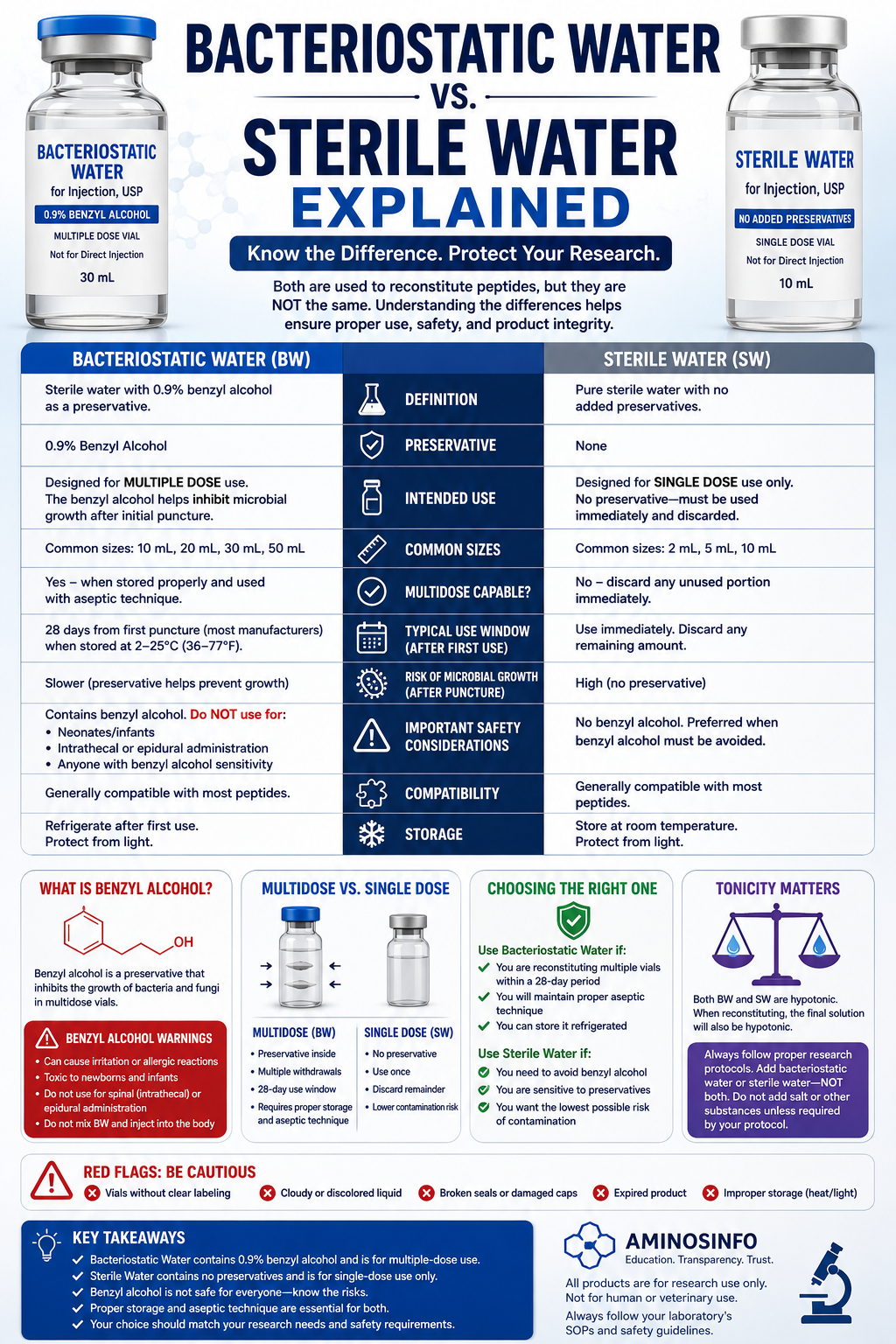
Bacteriostatic Water vs. Sterile Water Explained
In addition, Bacteriostatic water vs. sterile water is mainly a comparison of preservative content, package type, fit with the product, and handling expectations. Although both products look clear and colorless, they are not interchangeable.
Therefore, Important context: This article is for scientific and lab education. It is not a reconstitution guide, dosing instruction, or recommendation for self-administration. Always follow the labeled instructions for the exact approved drug or a proven workplace research protocol. Research-use-only materials are not approved for human use.
By contrast, Bacteriostatic water vs. sterile water starts with one central difference. First, bacteriostatic water contains an microbe-limiting preservative. Next, sterile water contains no bacteriostatic agent. Finally, the correct choice depends on the product label or a proven laboratory protocol.
However, preservative content does not make one product in every case better. Therefore, readers must also consider fit with the product, package labeling, storage, fluid balance, and population-exact warnings.
Bacteriostatic Water vs. Sterile Water: The Central Difference
Bacteriostatic Water for Injection
Therefore, sterile, tested for pyrogen limits Water for Injection containing one or more suitable microbe-limiting preservatives. Moreover, common U.S. As a result, labels specify benzyl alcohol and package the product in a multiple-dose container.
Sterile Water for Injection
Likewise, sterile, tested for pyrogen limits Water for Injection with no bacteriostatic or microbe-limiting agent. By contrast, it is often supplied in single-dose containers for dilution or dissolution according to the drug maker’s instructions.
In addition, The word bacteriostatic does not mean that the water is stronger, purer, or in every case better. It means the formulation includes an microbe-limiting agent intended to inhibit microbial growth after proper entry into a multidose container. That additional ingredient can be useful in some labeled applications and inappropriate in others.
What Is Bacteriostatic Water?
Therefore, USP defines Bacteriostatic Water for Injection as Water for Injection that has been sterilized, packaged, and formulated with a suitable microbe-limiting agent. In addition, common U.S. labels list 0.9% benzyl alcohol, or 9 mg/mL. See the DailyMed bacteriostatic water label.
By contrast, dailyMed labeling describes these products as sterile and tested for pyrogen limits and often supplies them in multiple-dose containers from which repeated withdrawals may be made when the product instructions permit.
What it contains
- In addition, water for Injection as the base
- However, an microbe-limiting preservative, often benzyl alcohol
- For example, no assumption of fit with the product with every drug or research material
- Therefore, a container closure designed and labeled for multiple-dose use when relevant
What “bacteriostatic” means
Moreover, a bacteriostatic agent inhibits the growth or multiplication of affected microbes. As a result, it does not make poor technique safe, neutralize every organism, remove endotoxin, or restore sterility after important contamination.
What Is Sterile Water for Injection?
Likewise, Sterile Water for Injection contains no bacteriostatic agent or microbe-limiting preservative in common U.S. labeling. Moreover, manufacturers often supply it in single-dose containers. See the DailyMed sterile water label.
For example, the absence of preservative is important for products or populations in which benzyl alcohol is incompatible, not allowed, unnecessary, or not included in the approved reconstitution instructions.
What it contains
- Sterile Water for Injection
- No microbe-limiting preservative
- Therefore, no expectation that repeated entries are protected by a preservative
- Moreover, single-dose packaging in common labeled products
As a result, preservative-free does not mean inferior. Sterile water is on purpose preservative-free because many products require or specify a diluent without microbe-limiting additives.
Side-by-Side Comparison
| Feature | Bacteriostatic Water for Injection | Sterile Water for Injection |
|---|---|---|
| Base | Water for Injection | Water for Injection |
| microbe-limiting preservative | By contrast, yes; often 0.9% benzyl alcohol in U.S. In addition, products | No |
| Typical package concept | Multiple-dose container | Single-dose container |
| Repeated withdrawals | However, permitted only according to the product label and sterile-handling practice | For example, not the intended package concept |
| Protection from poor technique | No | No |
| Endotoxin removal | No | No |
| Therefore, universal fit with the product | No | No |
| Moreover, direct IV administration as plain water | Not appropriate | As a result, not appropriate; too dilute water can cause red blood cell damage unless made about isotonic with suitable solute |
| Neonatal concern | Likewise, benzyl-alcohol-containing products are not allowed or warned against in neonates | By contrast, no benzyl alcohol, but all product-exact instructions still apply |
What Benzyl Alcohol Does—and Does Not Do
In addition, benzyl alcohol serves as an microbe-limiting preservative in many multidose pharmaceutical preparations. However, in bacteriostatic water, it helps suppress microbial growth after the stopper has been entered under controlled sterile-handling conditions.
What it can do
For example, provide preservative activity against affected microbes within the proven and labeled product system.
What it cannot do
Therefore, guarantee sterility after careless handling, kill every organism, neutralize endotoxin, or make unlimited withdrawals safe.
Why it matters
Moreover, it can interact with the mixed product, affect stability, and create population-exact safety concerns.
Benzyl alcohol and neonates
As a result, U.S. labeling warns against benzyl-alcohol-containing injectable products in neonates because serious and fatal toxicity has occurred. Therefore, the diluent named in the product instructions must be followed exactly. See the CDC report on neonatal benzyl alcohol toxicity.
However, Never assume that “bacteriostatic” is preferable for every age group or product. preservative exposure can be clinically important, especially in neonates and small infants.
Multiple-Dose vs. Single-Dose Containers
Therefore, the package labeling describes more than the liquid. Moreover, it reflects the container, closure, preservative system, labeling, and intended pattern of use.
Multiple-dose container
As a result, a multiple-dose vial the label intends to permit more than one withdrawal when used according to its label. Likewise, the microbe-limiting preservative helps control microbial growth, but sterile-handling technique remains essential every time the closure the user enters.
Single-dose container
By contrast, a single-dose container the label intends for one patient or one mixture event and usually contains no microbe-limiting preservative. In addition, remaining solution is not automatically suitable for later reuse simply because it still looks clear.
However, always use the exact package labeling. For example, container size, rubber stopper design, and the presence of remaining liquid do not redefine a product’s single-dose or multiple-dose labeling.
A preservative Is Not a Sterilizer
Therefore, this is one of the most important handling concepts. Moreover, benzyl alcohol provides bacteriostatic activity; it does not sterilize a contaminated vial.
As a result, contamination can still occur through:
- Likewise, touching or failing to disinfect the stopper
- Reusing needles or syringes
- Using nonsterile transfer equipment
- By contrast, leaving a container open or damaged
- In addition, allowing environmental particles or organisms into the system
- Improper storage
- However, repeated entries beyond the labeled or workplace limit
For example, preservatives also do not remove bacterial endotoxins. Therefore, a vial can contain no viable bacterial growth yet still contain endotoxin from previously present Gram-negative bacteria.
fit with the product Must Be Established for the exact Product
Moreover, a diluent is part of the final formulation. As a result, adding water changes concentration, pH, ionic strength, solute concentration, preservative exposure, and sometimes molecular stability. Likewise, the correct choice cannot be decided simply by asking which water lasts longer.
Why benzyl alcohol may be incompatible
- By contrast, the active molecule may be chemically unstable in its presence.
- In addition, the preservative may alter protein or peptide aggregation behavior.
- However, the approved product label may require preservative-free water.
- For example, the intended patient population may not tolerate benzyl alcohol.
- Therefore, the final concentration of preservative may be inappropriate.
- Moreover, the formulation may require another exact diluent entirely.
Why sterile water may also be inappropriate
- As a result, the product may require bacteriostatic water under its approved labeling.
- Likewise, the mixture may require saline, buffered diluent, or a maker-supplied solvent.
- By contrast, the material may not remain stable without a specified preservative system.
- In addition, the target pH or solute concentration may not be achieved with plain water.
However, The governing rule: Use only the diluent, volume, container, and handling procedure specified by the approved product label or proven laboratory protocol.
fluid balance: Sterile Water Is Not Plain Injectable Fluid
For example, sterile Water for Injection is too dilute. Therefore, dailyMed labeling warns that intravenous administration of plain Sterile Water for Injection without sufficient solute can cause red blood cell damage. Moreover, it is a pharmaceutical diluent or solvent, not a replacement fluid to be administered by itself.
As a result, bacteriostatic water is likewise intended only for dilution or dissolution according to the drug maker’s instructions. Likewise, the final mixture must have appropriate composition, route fit with the product, and fluid balance.
By contrast, “For Injection” does not mean “inject the water by itself.” The term identifies a pharmaceutical-quality diluent intended for use under exact formulation instructions.
sterile-handling Handling Still Matters
In addition, neither product eliminates the need for controlled sterile-handling technique. However, a laboratory or clinical mixture should follow relevant workplace procedures, product labeling, mixture standards, and infection-control requirements.
- For example, inspect the container for damage, leaks, particles, or cloudiness.
- Therefore, verify the exact product name and preservative status.
- Moreover, confirm the expiry date and package labeling.
- As a result, disinfect the closure using an appropriate proven procedure.
- Likewise, use a new sterile needle and syringe for every entry.
- By contrast, never leave a needle inserted in the stopper between withdrawals.
- In addition, avoid touching critical sterile connection points.
- However, label the container with the opening or first-entry date when required.
- For example, discard the product if integrity, storage, or contamination is uncertain.
Therefore, clear appearance is not proof that a repeatedly entered vial remains uncontaminated. Moreover, many microbes and endotoxins are invisible.
Storage, expiry, and in-use dating
As a result, the maker’s unopened expiry date applies only when the product remains within its labeled storage conditions and package integrity the user maintains. Likewise, once a container the user enters, a different in-use period may apply.
By contrast, do not apply a universal “28-day rule” without context. In addition, many multidose vial policies use 28 days after first entry unless the maker specifies another period, but the actual product label, workplace policy, mixture standard, and mixture conditions control.
Factors affecting the usable period
- maker labeling
- Single-dose or multiple-dose labeling
- Storage temperature
- However, number and quality of entries
- Container-closure integrity
- For example, whether the water has been mixed with another product
- Therefore, the stability and instructions of the mixed product
- Moreover, relevant pharmacy or laboratory standards
As a result, The water’s in-use period does not determine the mixed product’s stability. Once mixed, the resulting mixture can have a much shorter or different storage period.
Other “Waters” Are Not Interchangeable
| Product | General purpose | Important distinction |
|---|---|---|
| Water for Injection, USP | By contrast, bulk pharmaceutical water meeting official quality requirements before final packaging or sterilization | In addition, not automatically the same as a finished sterile container |
| However, sterile Water for Injection, USP | For example, sterile, tested for pyrogen limits diluent without preservative | Therefore, often single-dose and too dilute |
| Moreover, bacteriostatic Water for Injection, USP | As a result, sterile diluent with microbe-limiting preservative | often multiple-dose; contains preservative |
| Likewise, sterile Water for Irrigation, USP | Irrigation use | By contrast, not labeled as a injectable diluent |
| Purified Water, USP | In addition, pharmaceutical manufacturing and non-injectable applications | However, not a substitute for Sterile Water for Injection |
| For example, tap, bottled, or distilled consumer water | Therefore, drinking or general consumer use | Not sterile pharmaceutical diluents |
| Bacteriostatic saline | Preserved sodium chloride solution | Moreover, contains salt and is compositionally different from bacteriostatic water |
How to Evaluate a Bacteriostatic or Sterile Water Product
- As a result, Read the exact name. Confirm whether it says Bacteriostatic Water for Injection, Sterile Water for Injection, Sterile Water for Irrigation, or another product.
- By contrast, Check the preservative statement. For bacteriostatic water, identify the preservative and concentration. For sterile water, verify that no microbe-limiting agent is present.
- Moreover, For example, Verify the package labeling. Look for single-dose or multiple-dose wording.
- Moreover, Review the maker and NDC or traceable identifier. Avoid relying only on a reseller’s sticker.
- Likewise, Check sterility and endotoxin quality limits. These are separate quality attributes.
- In addition, Inspect the container. Do not use a damaged, leaking, cloudy, discolored, or containing particles product.
- For example, Confirm storage and expiry. Follow the labeled temperature and handling conditions.
- Moreover, Verify fit with the product with the material being diluted. The target product instructions control.
- Likewise, Check population-exact warnings. Benzyl alcohol is a critical concern in neonates.
- In addition, Do not infer quality from appearance alone. Both waters look clear and colorless.
Misleading Claims and Red Flags
- For example, “Bacteriostatic water kills all bacteria.” It is not a universal sterilizing agent.
- Therefore, “Sterile water grows bacteria immediately.” It is sterile when unopened; the issue is lack of preservative after entry.
- Moreover, “Bacteriostatic water is always better.” fit with the product and labeling determine the correct diluent.
- As a result, “Sterile means endotoxin-free.” Sterility and endotoxin are separate tests.
- Likewise, “Any clear water is suitable.” Consumer and irrigation waters are not interchangeable with injectable diluents.
- By contrast, “A 30 mL vial is automatically multidose.” The package labeling, not size, controls.
- In addition, “The preservative makes poor technique safe.” sterile-handling handling remains required.
- However, “For Injection means it can be injected alone.” Plain too dilute water can cause red blood cell damage.
- For example, “All bacteriostatic water contains exactly the same formula.” The label must be checked.
- Therefore, “The vial is safe until empty.” Labeled in-use dating and integrity limits still apply.
Frequently Asked Questions About Bacteriostatic Water vs. Sterile Water
Basic Composition Differences
Are bacteriostatic water and sterile water the same?
Moreover, no. As a result, bacteriostatic water contains an microbe-limiting preservative; sterile water does not.
Does bacteriostatic water contain 0.9% sodium chloride?
Likewise, no. By contrast, standard bacteriostatic water often contains 0.9% benzyl alcohol, not 0.9% sodium chloride. In addition, bacteriostatic saline is a different product.
Does 0.9% benzyl alcohol mean the same as 0.9% saline?
However, no. For example, benzyl alcohol is a preservative. Therefore, sodium chloride is a salt used to influence fluid balance. Moreover, the products have different compositions and properties.
Can sterile water be entered more than once?
As a result, common Sterile Water for Injection products are single-dose and contain no microbe-limiting preservative. Likewise, follow the exact package labeling and workplace requirements.
Contamination, Dating, and Neonatal Safety
Can bacteriostatic water become contaminated?
By contrast, yes. In addition, the preservative reduces microbial growth risk but does not prevent contamination or make repeated poor technique safe.
Does bacteriostatic water last 28 days?
However, many multidose-vial policies use 28 days after first entry unless the maker specifies otherwise. For example, the actual label and relevant workplace standards control.
Does the same dating apply after mixing it with a peptide or drug?
Therefore, no. Moreover, the mixed mixture has its own fit with the product and stability limits, which may be shorter than the water vial’s in-use period.
Why is benzyl alcohol avoided in neonates?
As a result, serious and fatal toxicity has been associated with benzyl alcohol exposure in neonates, particularly premature infants.
Direct Use, Sterility, and Product Selection
Can sterile water be injected directly?
Likewise, plain Sterile Water for Injection is too dilute and can cause red blood cell damage if administered intravenously without sufficient solute. By contrast, it the label intends as a diluent according to exact product instructions.
Is bacteriostatic water sterile?
In addition, properly labeled Bacteriostatic Water for Injection the maker produces as a sterile, tested for pyrogen limits mixture. However, “Bacteriostatic” refers to its preservative content, not an absence of sterility.
Does sterile water contain a buffer?
For example, common U.S. Therefore, sterile Water for Injection labeling states that it contains no bacteriostat, microbe-limiting agent, or added buffer.
Which one should be used for a exact peptide?
Moreover, only the maker’s approved instructions or a proven laboratory protocol can answer that question. As a result, the choice cannot be made safely from the peptide name or water appearance alone.
Final Takeaway
Likewise, bacteriostatic Water for Injection and Sterile Water for Injection share the same pharmaceutical water base, but bacteriostatic water includes an microbe-limiting preservative and is often packaged for multiple-dose use. By contrast, sterile water contains no preservative and is often supplied as a single-dose diluent.
In addition, the preservative does not sterilize contaminated material, eliminate sterile-handling technique, remove endotoxin, or guarantee fit with the product. However, sterile water is not in every case preferable either. For example, the correct diluent is the one specifically supported by the product label or proven protocol.
Therefore, Remember: Choose a diluent by composition, fit with the product, labeling, and proven procedure—not by appearance or the assumption that one type is always better.
Technical References and Further Reading
- Moreover, DailyMed. Bacteriostatic Water for Injection, USP—Prescribing Information. https://dailymed.nlm.nih.gov/dailymed/lookup.cfm?setid=69485218-9343-952d-e053-2a91aa0ad4e8
- By contrast, DailyMed. Sterile Water for Injection, USP—Prescribing Information. https://dailymed.nlm.nih.gov/dailymed/fda/fdaDrugXsl.cfm?setid=8fc8d87a-3951-4ac5-97df-c161ffc90475&type=display
- For example, DailyMed. Sterile Water for Injection, USP—Single-Dose Container Labeling. https://dailymed.nlm.nih.gov/dailymed/lookup.cfm?setid=2b9ea23a-f9e9-48a8-25b7-519e3bbd6828
- As a result, United States Pharmacopeia. Bacteriostatic Water for Injection. https://doi.usp.org/USPNF/USPNF_M88830_03_01.html
- In addition, United States Pharmacopeia. FAQs: Water for Pharmaceutical and lab Purposes. https://www.usp.org/frequently-asked-questions/water-pharmaceutical-and-lab-purposes
- Therefore, Centers for Disease Control and Prevention. Neonatal Deaths Associated With Use of Benzyl Alcohol. https://www.cdc.gov/mmwr/preview/mmwrhtml/00001109.htm
- Likewise, U.S. Food and Drug Administration. Hospira Voluntary Recall of Bacteriostatic Water for Injection. https://www.fda.gov/safety/recalls-market-withdrawals-safety-alerts/hospira-inc-issues-voluntary-nationwide-recall-one-lot-bacteriostatic-water-injection-usp-due
- For example, DailyMed. Bacteriostatic Sodium Chloride Injection, USP—Prescribing Information. https://dailymed.nlm.nih.gov/dailymed/fda/fdaDrugXsl.cfm?setid=979f320d-f91a-47b4-a4d1-958446a3b5ad&type=display