Thymosin Beta-4 vs. TB-500: What Is the Difference?
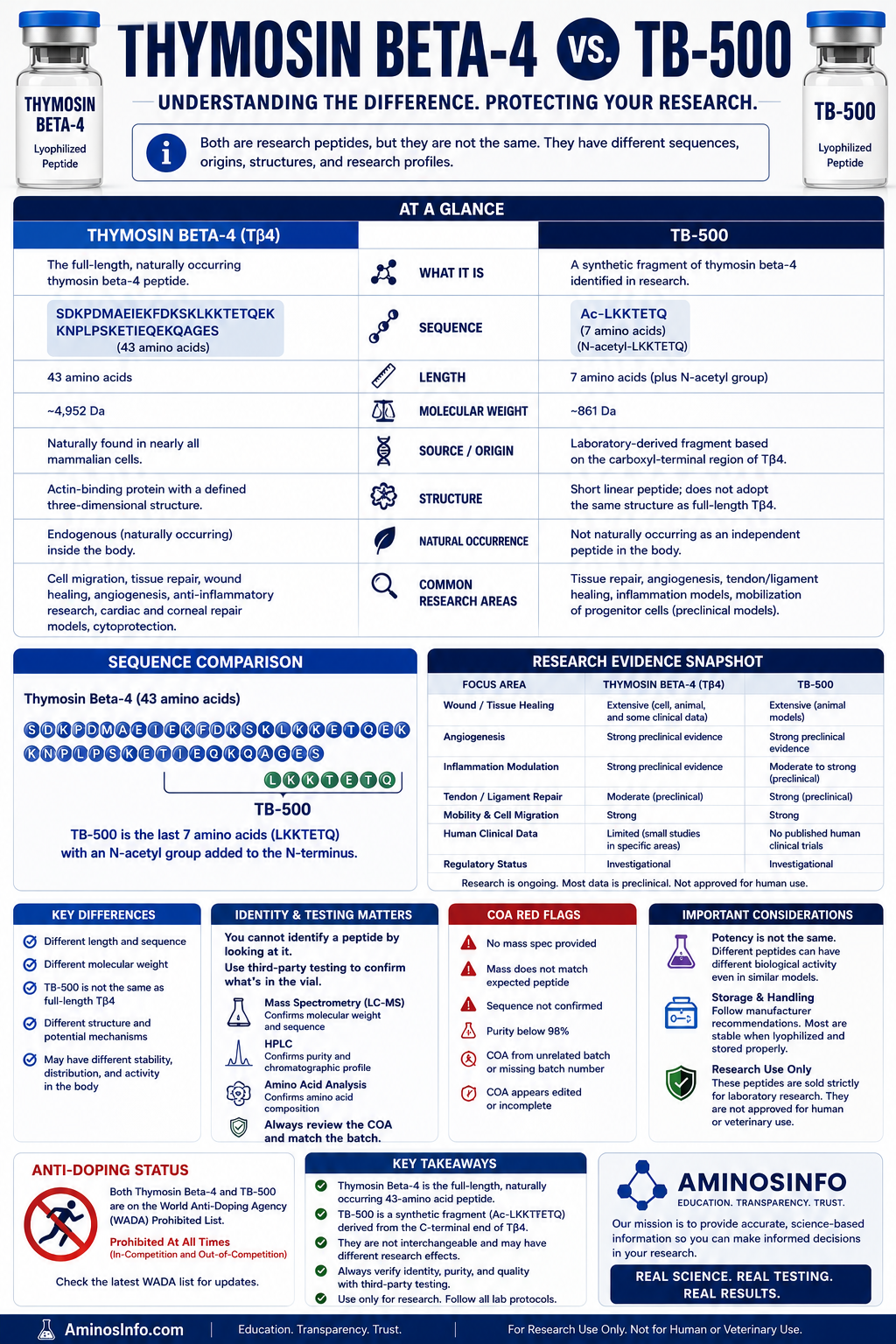
In addition, Thymosin beta-4 vs. TB-500 is often presented as a comparison between two names for the same molecule. However, full-length thymosin beta-4 is a defined 43-amino-acid peptide, while published analysis linked TB-500 to the seven-amino-acid fragment Ac-LKKTETQ.
Therefore, Important context: This article is for scientific education only. It does not provide dosing, administration, medical, veterinary, or performance-enhancement advice. Products marketed as TB-500 or thymosin beta-4 may be unapproved and in different ways labeled. Athletes should also know that thymosin beta-4 and its derivatives, including TB-500, are prohibited at all times under the 2026 World Anti-Doping Code Prohibited List.
By contrast, Thymosin beta-4 vs. TB-500 requires an exact sequence comparison rather than a label comparison. First, full-length Tβ4 contains 43 amino acids. Next, published TB-500 testing identified Ac-LKKTETQ, a seven-residue fragment. Finally, laboratories can distinguish them through mass spectrometry and sequence-specific testing.
However, sellers use the term TB-500 in different ways. Therefore, a credible COA should state the complete sequence, molecule mass, N-terminal modification, lot number, identity method, purity result, and measured vial content.
Thymosin Beta-4 vs. TB-500: The Short Answer
Thymosin beta-4 (Tβ4)
For example, A highly conserved naturally produced peptide encoded by the TMSB4X gene. It contains 43 amino acids, has an acetylated N-terminus, and is a major inside cells G-actin-binding molecule.
TB-500
Moreover, a non-brand-specific marketplace and anti-doping term. As a result, published chemical analyses of a veterinary TB-500 preparation identified its active content as N-terminally acetylated LKKTETQ—the seven-residue 17–23 region of Tβ4.
Likewise, the confusion arises because sellers sometimes call full-length synthetic thymosin beta-4 “TB-500,” while other products bearing the same name may contain Ac-LKKTETQ, a different fragment, another sequence, or material that has not been independently confirmed.
What Is Thymosin Beta-4?
By contrast, thymosin beta-4 is a small, acidic, naturally occurring peptide found widely in mammalian cells and body fluids. In addition, early chemical identification established that it contains 43 amino-acid residues, an acetylated N-terminal serine, and a molecule mass of about 4.96–4.98 kDa depending on the mass convention used.
However, although originally isolated from thymic tissue, Tβ4 is not restricted to the thymus. For example, it is broadly expressed and is especially associated with the regulation of actin dynamics, cell migration, tissue organization, inflammation-related signaling, and responses to injury.
Core characteristics
- 43 amino acids
- Endogenously encoded by TMSB4X
- N-terminally acetylated
- about 5 kDa
- Major G-actin-binding beta-thymosin
- Therefore, widely distributed in cells and tissues
- Moreover, studied in wound, corneal, cardiovascular, neurological, renal, and inflammation-related models
What Is TB-500?
As a result, tB-500 is not a standardized biochemical name comparable to thymosin beta-4. Likewise, the term became associated with a veterinary preparation and later with gray-market research products and sports-doping cases.
By contrast, In peer-reviewed chemical studies published in 2012, researchers analyzed material sold as TB-500 and identified the main peptide as Ac-LKKTETQ. In addition, this sequence matches residues 17–23 of thymosin beta-4. See the PubMed record for the TB-500 doping-control analysis.
N-terminally acetylated Leu-Lys-Lys-Thr-Glu-Thr-GlnFor example, this seven-amino-acid sequence corresponds to residues 17–23 of human thymosin beta-4. Therefore, the artificial N-terminal acetyl group distinguishes the isolated fragment from the same internal sequence as it exists inside the full-length protein.
Moreover, Marketplace warning: The name “TB-500” does not reliably tell you which molecule is in a vial. Some listings describe Ac-LKKTETQ; others list the full 43-amino-acid Tβ4 sequence; some do not disclose a sequence at all.
Why the Naming Is So Confusing
marketed origin
Likewise, tB-500 entered common usage as a product name rather than a universally accepted scientific name.
Fragment association
By contrast, lab publications linked TB-500 with the acetylated 17–23 fragment of Tβ4.
Marketplace drift
In addition, online vendors later began using TB-500 for full-length Tβ4, fragments, and poorly defined preparations.
Loose shorthand
However, articles sometimes use TB-500 as shorthand for the entire Tβ4 research category, obscuring molecular differences.
Anti-doping language
For example, wADA lists thymosin beta-4 and its derivatives, including TB-500, together for official coverage—not because every derivative is chemically identical.
Label ambiguity
Therefore, labels may omit the sequence, molecular formula, salt form, or molecule weight needed to determine what is actually claimed.
Sequence and Structural Comparison
| Feature | Thymosin beta-4 | TB-500 as identified in published analysis |
|---|---|---|
| Length | 43 amino acids | 7 amino acids |
| Sequence relationship | Full native sequence | Residues 17–23 of Tβ4 |
| Core sequence | Contains LKKTETQ internally | Ac-LKKTETQ |
| N-terminus | Moreover, n-terminal serine is naturally acetylated | As a result, leucine is artificially N-terminally acetylated |
| Approximate molecular scale | about 5 kDa | Well under 1 kDa |
| Actin-binding context | Likewise, full actin-binding peptide with surrounding residues | By contrast, short isolated segment derived from the actin-binding region |
| Scientific naming | Defined naturally produced peptide | marketed/non-standard name |
Full-length human thymosin beta-4 sequence
Ac-SDKPDMAEIEKFDKSKLKKTETQEKNPLPSKETIEQEKQAGESIn addition, The sequence contains the central LKKTETQ motif, but the rest of the molecule is not biologically meaningless. Regions outside residues 17–23 contribute to structure, protein interactions, inside cells processing, enzymatic cleavage products, and biological effects reported for full-length Tβ4.
Actin Binding and the LKKTETQ Motif
For example, thymosin beta-4 is best known as a G-actin-binding peptide. Therefore, by binding monomeric actin, it helps regulate the pool of actin available for filament assembly. Moreover, actin remodeling is fundamental to cell shape, motility, adhesion, division, and wound-edge migration.
As a result, The LKKTETQ region plays a central role in actin binding. Moreover, experimental work found that this short region can affect cell migration and blood-vessel growth in model systems. See the PubMed study on the Tβ4 actin-binding site.
In addition, Important nuance: Identifying an active motif does not mean the isolated motif reproduces every property, stability characteristic, tissue distribution pattern, or biological effect of the complete 43-amino-acid peptide.
Why fragment behavior can differ
- However, different molecular size and charge distribution
- For example, different risk to enzyme breakdown
- Therefore, loss of N- and C-terminal regions
- Different three-dimensional shape preferences
- Moreover, different cellular uptake and distribution
- As a result, different binding partners and binding strengths
- Likewise, artificial N-terminal modification in Ac-LKKTETQ
Biological Research Areas
By contrast, full-length thymosin beta-4 has been studied across many early laboratory and animal systems. In addition, reported research areas include:
Actin regulation
However, binding of monomeric G-actin and regulation of cell-structure dynamics.
Wound models
For example, cell migration, surface-tissue repair, matrix remodeling, and repair responses.
Angiogenesis
Therefore, endothelial migration, vessel formation, and vascular responses in experimental models.
Inflammation
Moreover, change of inflammation-related signaling and leukocyte-related responses.
Cell survival
As a result, research into apoptosis, oxidative stress, and tissue protection.
Fibrosis
Likewise, investigation of anti-scarring pathways and Tβ4-derived breakdown products such as Ac-SDKP.
By contrast, these observations do not establish that an unapproved marketed vial is safe or effective, and they should not be automatically transferred from full-length Tβ4 to TB-500 fragments.
Evidence Base: Full-Length Tβ4 vs. TB-500 Fragment
In addition, the scientific literature for full-length thymosin beta-4 is much broader than the literature for material specifically defined as TB-500 or Ac-LKKTETQ.
| Evidence category | Full-length thymosin beta-4 | TB-500 / Ac-LKKTETQ |
|---|---|---|
| Natural biology | However, widely studied as an naturally produced actin-binding peptide | For example, not an naturally produced full-length protein; derived synthetic fragment |
| molecule biology | Therefore, broad literature on actin binding and cellular functions | Moreover, literature focused on fragment identification, metabolism, detection, and selected model effects |
| Animal research | As a result, many wound, cardiovascular, neurological, corneal, renal, and inflammation-related studies | Likewise, much narrower and less consistently defined product-specific evidence |
| Human clinical development | By contrast, research-stage formulations have entered clinical research for selected indications | In addition, no the same broad clinical evidence base for gray-market TB-500 products |
| lab literature | However, established sequence, mass, and identification methods | For example, anti-doping publications identify Ac-LKKTETQ and breakdown products |
| marketed consistency | Therefore, can be precisely defined when the full sequence is stated | Moreover, name is frequently ambiguous across sellers |
As a result, Do not cite a full-length Tβ4 study as direct proof for a TB-500 fragment. A fragment may retain, lose, weaken, or alter specific functions. Direct evidence must use the same exact molecule being discussed.
Why They Should Not Be Treated as Interchangeable
- In addition, they can have different amino-acid lengths.
- However, they have different molecular masses.
- For example, the fragment has a different N-terminal context.
- Therefore, they may have different degradation rates and breakdown products.
- Moreover, the full peptide contains functional regions outside LKKTETQ.
- As a result, the evidence base is not the same.
- Likewise, lab methods and reference standards differ.
- By contrast, a dose expressed by mass does not represent the same molar amount for both molecules.
- In addition, a COA for one cannot authenticate the other.
However, even when a vendor uses “TB-500” to mean full-length Tβ4, the label should explicitly disclose the 43-amino-acid sequence and expected molecule mass. For example, without those details, the name alone is insufficient.
How Laboratories Distinguish Them
| Test | What it can reveal | Why it matters here |
|---|---|---|
| High-resolution mass spectrometry | Therefore, observed molecule mass and charge-state pattern | Moreover, immediately distinguishes a ~5 kDa full-length peptide from a sub-1 kDa fragment |
| LC-MS | As a result, chromatographic retention linked to molecule mass | Likewise, helps identify the main component and related impurities |
| Tandem MS | Fragment-ion sequence information | By contrast, can confirm Ac-LKKTETQ or sequence regions of full-length Tβ4 |
| Amino-acid analysis | Composition and measured content | In addition, supports sequence composition and net peptide content |
| Peptide mapping | However, characteristic fragments from a larger peptide | For example, useful for confirming full-length sequence identity |
| HPLC/UPLC purity | Relative chromatographic impurity profile | Therefore, does not identify the peptide without second-method evidence |
Expected mass is a basic identity check
Moreover, a report claiming “TB-500” should state which exact molecule is being tested. As a result, a mass result near full-length Tβ4 cannot simultaneously represent the seven-residue Ac-LKKTETQ fragment. Likewise, the calculated sequence and observed mass must agree.
How to Read a Thymosin Beta-4 or TB-500 COA
- By contrast, find the complete amino-acid sequence.
- In addition, check whether the product claims full-length Tβ4 or Ac-LKKTETQ.
- However, compare the stated molecule weight with the sequence.
- Confirm the N-terminal modification.
- For example, look for mass spectrometry identity data.
- Therefore, review the full chromatogram and integration table.
- Moreover, separate HPLC purity from peptide quantity.
- As a result, confirm the lot number matches the vial.
- Likewise, verify whether the sample was a finished vial or bulk powder.
- By contrast, do not accept “TB-500” as a complete chemical identity.
Questions a credible report should answer
- In addition, is the molecule 43 amino acids or 7 amino acids?
- However, what is the exact sequence?
- For example, what is the calculated neutral mass?
- What mass was observed?
- Therefore, was the material N-terminally acetylated?
- Moreover, how much peptide is present per vial?
- As a result, which related impurities the test detected?
official and Anti-Doping Status
Likewise, thymosin beta-4 and TB-500 products promoted online for whole-body self-use are generally not the same to an approved, standardized medicine simply because scientific studies exist. By contrast, research compounds may be research-stage, unapproved, mislabeled, or produced outside pharmaceutical quality systems.
In addition, For sport, the 2026 WADA Prohibited List names thymosin beta-4 and its derivatives, including TB-500, under growth factors and growth-factor modulators. Therefore, athletes subject to the World Anti-Doping Code should treat these substances as prohibited at all times. See the official 2026 WADA Prohibited List.
Therefore, Athlete warning: “Research use only,” “veterinary,” “fragment,” or “not for human use” labeling does not prevent an anti-doping violation if a prohibited substance serves or detected.
Misleading Claims and Red Flags
- Moreover, No sequence the source lists. “TB-500” alone is not a complete identity.
- Likewise, The label says 43 amino acids but the COA shows fragment mass.
- By contrast, The product claims Ac-LKKTETQ but uses full-length Tβ4 literature as direct proof.
- In addition, HPLC purity serves as the only identity evidence.
- However, The molecule weight does not match the stated sequence.
- For example, TB-500 and thymosin beta-4 are called chemically identical without clear limits.
- Therefore, No lot-specific mass spectrum the report provides.
- Moreover, A veterinary product history is presented as human clinical approval.
- As a result, early laboratory and animal findings sellers market as guaranteed treatment outcomes.
- Likewise, Anti-doping status is omitted from performance-oriented marketing.
Frequently Asked Questions About Thymosin Beta-4 vs. TB-500
Sequence and Naming Basics
Are thymosin beta-4 and TB-500 the same molecule?
By contrast, not always. In addition, full-length thymosin beta-4 contains 43 amino acids. However, published analyses identified a TB-500 preparation as Ac-LKKTETQ, a seven-amino-acid fragment corresponding to Tβ4 residues 17–23. For example, some sellers nevertheless use TB-500 for full-length Tβ4, so the sequence must be checked.
What is the sequence of TB-500?
Therefore, in the best-known lab publications, TB-500 researchers identified as Ac-LKKTETQ. However, marketplace products may use the name differently.
What is the sequence of thymosin beta-4?
As a result, human Tβ4 is a 43-amino-acid N-terminally acetylated peptide: Ac-SDKPDMAEIEKFDKSKLKKTETQEKNPLPSKETIEQEKQAGES.
Why is LKKTETQ important?
Likewise, it is located within the principal actin-binding region of Tβ4 and has been investigated for effects on actin-related cell migration and blood-vessel-growth behavior.
Testing and Product Identity
Does the fragment have all the effects of full-length Tβ4?
By contrast, that has not been established. In addition, the molecules differ greatly in size, sequence context, stability, processing, and evidence base.
Can HPLC purity distinguish full-length Tβ4 from TB-500?
However, not by purity percentage alone. For example, mass spectrometry and sequence-specific evidence are needed to establish which molecule produced the main chromatographic peak.
Can the vial label settle the question?
Therefore, no. Moreover, the exact sequence, observed mass, lot-specific COA, and laboratory data should support the label claim.
Is TB-500 approved for human use?
As a result, gray-market TB-500 products should not be assumed to be approved medicines. Likewise, official status depends on the specific country or region and product, but marketed research-market material is commonly unapproved.
Approval, Sport, and Marketplace Terminology
Is thymosin beta-4 prohibited in sport?
By contrast, yes. In addition, wADA’s 2026 Prohibited List includes thymosin beta-4 and its derivatives, including TB-500, as prohibited at all times.
Why do vendors call full-length Tβ4 “TB-500”?
However, the term has become marketed shorthand, but that usage is chemically imprecise and inconsistent with published identification of the TB-500 fragment.
Final Takeaway
For example, thymosin beta-4 is a clearly defined, naturally occurring 43-amino-acid actin-binding peptide. Therefore, tB-500 is a non-standard term historically linked by chemical analysis to the acetylated seven-amino-acid fragment Ac-LKKTETQ. Moreover, modern sellers may use the name for either the fragment or full-length Tβ4, creating serious opportunities for confusion.
As a result, Remember: Do not identify a peptide by the name “TB-500” alone. Check the complete sequence, molecule mass, N-terminal modification, lot-specific mass spectrum, purity data, and measured content.
Technical References and Further Reading
- By contrast, Low TLK, Hu SK, Goldstein AL. Complete amino acid sequence of bovine thymosin beta 4. Proceedings of the National Academy of Sciences. 1981;78:1162–1166.
- Therefore, Low TLK, et al. Chemical identification of thymosin beta 4. Journal of Biological Chemistry. 1982. PMID: 7054160.
- In addition, Sosne G, et al. Biological activities of thymosin beta 4 defined by active sites in short peptide sequences. FASEB Journal. 2010. PMID: 20179146.
- As a result, Philp D, et al. The actin binding site on thymosin beta 4 promotes angiogenesis. FASEB Journal. 2003. PMID: 14500546.
- For example, Ho ENM, et al. Doping control analysis of TB-500, a synthetic version of an active region of thymosin beta 4, in equine urine and plasma. Journal of Chromatography A. 2012. PMID: 23084823.
- By contrast, Esposito S, et al. Synthesis and identification of the N-terminal acetylated 17–23 fragment of thymosin beta 4 identified in TB-500. lab and Bioanalytical Chemistry. 2012. PMID: 22962027.
- Moreover, Rahaman KA, et al. Simultaneous quantification of TB-500 and its breakdown products in equine urine and plasma. Drug Testing and Analysis. 2024. PMID: 38382158.
- However, Xing Y, et al. Progress on the function and application of thymosin beta 4. Frontiers in Endocrinology. 2021;12:767785.
- As a result, Goldstein AL, Hannappel E, Kleinman HK. Thymosin beta 4: actin-binding protein moonlights to repair injured tissues. Trends in Molecular Medicine. 2005.
- However, World Anti-Doping Agency. 2026 Prohibited List. https://www.wada-ama.org/sites/default/files/2025-09/2026list_en_final_clean_september_2025.pdf