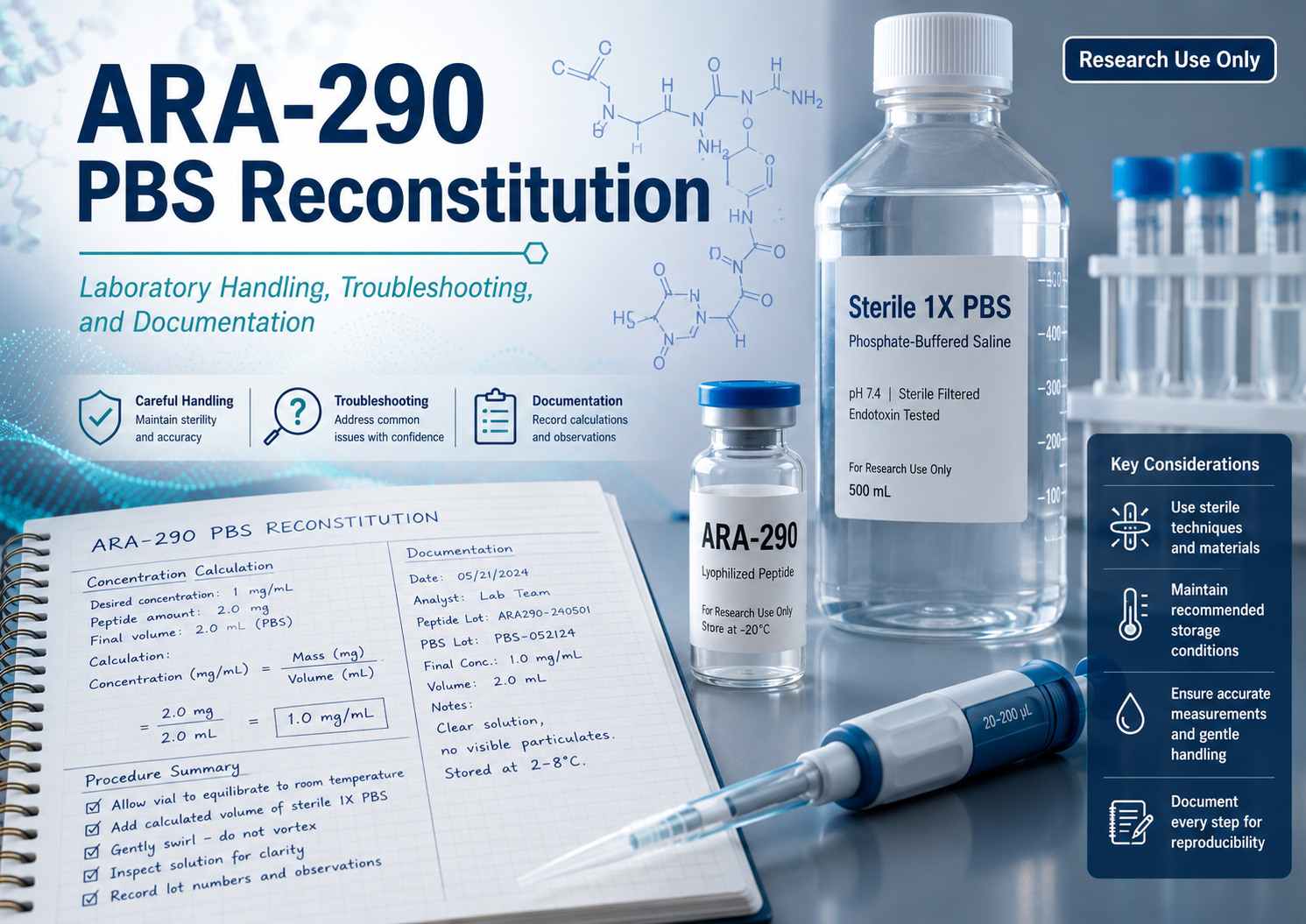
ARA-290 PBS Reconstitution: Laboratory Handling, Troubleshooting, and Documentation
For example, This ARA-290 PBS reconstitution guide covers phosphate-buffered saline specifications, laboratory concentration calculations, controlled handling, troubleshooting, aliquoting, storage, documentation, and common preparation errors.
Why ARA-290 May Require Special Reconstitution Handling
First, ARA-290 is an 11-amino-acid, erythropoietin-derived peptide. Its sequence contains several ionizable and acidic amino-acid residues that can affect hydration, surface charge, aggregation, and apparent solubility.
Moreover, a peptide’s ability to dissolve does not depend on purity alone. Reconstitution behavior can change according to the peptide’s salt form, concentration, lyophilization conditions, excipients, solvent composition, temperature, mixing technique, and solution pH.
- For example, Amino-acid sequence and charge distribution
- Moreover, Peptide amount and target concentration
- In addition, Counterion or salt form
- However, Buffer composition and ionic strength
- Solution pH
- Temperature during preparation
- Therefore, Mixing force and hydration time
- Likewise, Container and surface adsorption
Why Researchers May Evaluate Phosphate-Buffered Saline
First, phosphate-buffered saline, commonly abbreviated as PBS, is a water-based salt solution formulated to resist major changes in pH. Standard 1X PBS is usually maintained near neutral pH, commonly between approximately 7.2 and 7.4.
Moreover, published preclinical ARA-290 research has reported preparing ARA-290 stock solutions in PBS. This supports evaluating PBS as a laboratory solvent, although it does not establish one universal formulation for every batch, vial size, concentration, or experimental application.
Controlled pH
Moreover, PBS provides greater resistance to pH changes than sterile water or bacteriostatic water.
Reproducible Composition
In addition, Commercially prepared PBS offers documented salt concentrations and more consistent experimental conditions.
Common Research Buffer
However, PBS is widely used in biochemical, molecular, cellular, and preclinical research workflows.
Exactly What Type of PBS Researchers Should Purchase
Importantly, researchers should not purchase a product labeled only as “saline” and assume that it is phosphate-buffered saline. PBS, normal saline, sterile water, and bacteriostatic water are different solutions.
Sterile 1X PBS
First, select PBS labeled as 1X or ready to use. A 1X solution does not require dilution before laboratory use.
pH 7.2–7.4
Next, confirm the manufacturer’s stated pH range. Do not rely only on a shortened marketplace listing.
No Calcium or Magnesium
Moreover, calcium- and magnesium-free PBS is often the simpler general-purpose option for laboratory peptide preparation.
No Phenol Red
In addition, phenol red may affect color-based observations, optical measurements, or certain downstream assays.
Preferably Preservative-Free
Likewise, preservatives may alter cell viability, protein behavior, membranes, or analytical outcomes.
Appropriate Endotoxin Specification
Finally, cell-based or inflammation-related studies may require PBS with a documented endotoxin limit.
Suitable product wording to look for
- First, phosphate-buffered saline
- 1X concentration
- Sterile filtered
- pH approximately 7.2–7.4
- Calcium-free formulation
- Magnesium-free formulation
- Phenol-red-free formulation
- Preservative-free formulation
PBS Compared With Other Common Liquids
| Liquid | Buffered | Typical Contents | Equivalent to PBS? |
|---|---|---|---|
| 1X PBS | Meanwhile, Yes; PBS is buffered. | Therefore, Phosphate salts, sodium chloride, and related salts | Consequently, Yes, after correct preparation. |
| Bacteriostatic Water | For example, No; this is not PBS. | Likewise, Water with an antimicrobial preservative, commonly benzyl alcohol | Moreover, Not equivalent to PBS. |
| Sterile Water | In addition, No phosphate buffer is present. | Meanwhile, Sterile purified water without a meaningful buffer system | However, No; this is not PBS. |
| Normal Saline | Generally no | Sodium chloride solution | Therefore, Not equivalent to PBS. |
| 10X PBS | Buffered: yes. | Likewise, Concentrated PBS requiring accurate dilution | For example, Only after correct dilution to 1X |
Bacteriostatic Water
First, bacteriostatic water contains an antimicrobial preservative but does not provide the phosphate-buffer system found in PBS. It should not be described as chemically equivalent to PBS.
Sterile Water
Next, sterile water may be free of viable microorganisms, but it remains unbuffered. Sterility does not provide pH control.
Normal Saline
Moreover, normal saline supplies sodium chloride and ionic strength but generally does not contain the phosphate-buffer pair used in PBS.
10X PBS
However, ten-times-concentrated PBS is not ready to use. It must be diluted accurately with suitable laboratory-grade water before use. Using 10X PBS directly would create substantially different salt and osmotic conditions.
Additional Laboratory Supplies
Importantly, the exact equipment required will depend on the laboratory’s validated procedures, aseptic requirements, analytical methods, and intended experiment.
- Moreover, Sterile calibrated pipette or transfer syringe
- Meanwhile, Sterile single-use pipette tips
- Alcohol preparation pads
- Powder-free laboratory gloves
- Suitable eye protection
- In addition, Clean workspace or biological safety cabinet
- Consequently, Sterile low-protein-binding aliquot tubes
- For example, Laboratory labels and permanent marker
- However, Calibrated pH meter for formulation development
- Moreover, Appropriate waste and sharps containers
Before Reconstituting ARA-290
Review and document the product
First, before opening the vial, record the product identity, nominal amount, lot number, certificate-of-analysis reference, date received, vial condition, planned solvent, target concentration, and intended experiment.
- Product name
- In addition, Batch or lot number
- Nominal peptide amount
- However, Measured content, when available
- Certificate-of-analysis reference
- Intended experimental use
- Therefore, Selected PBS product and lot
- Target laboratory concentration
Confirm compatibility with the experiment
Next, determine whether PBS is compatible with the assay, instrument, cell type, tissue system, detection chemistry, enzymes, chromatography method, and downstream reagents.
Inspect the vial
Finally, examine the vial before use. Do not proceed if the vial is cracked, leaking, incorrectly labeled, visibly contaminated, or shows evidence of moisture intrusion.
Selecting a Laboratory Concentration
Importantly, the validated experiment should determine the target concentration rather than the vial’s maximum liquid capacity.
Example calculations for a nominal 10 mg vial
| PBS Volume Added | Nominal Resulting Concentration |
|---|---|
| 0.5 mL | 20 mg/mL |
| 1.0 mL | 10 mg/mL |
| 2.0 mL | 5 mg/mL |
| 2.5 mL | 4 mg/mL |
| 3.0 mL | 3.33 mg/mL |
However, very concentrated peptide solutions may be more difficult to dissolve and may show greater surface adhesion, localized precipitation, or aggregation. When the experimental design permits it, a less concentrated stock may be easier to prepare and evaluate.
Controlled Laboratory Reconstitution Procedure
First, the following workflow describes general laboratory handling principles. A validated laboratory standard operating procedure and product-specific technical documentation should take priority.
Prepare the Work Area
First, disinfect the work surface and gather all supplies before beginning. Use a validated biological safety cabinet or other suitable clean environment when aseptic control is required.
Verify the PBS
Next, confirm that the product is sterile 1X PBS, approximately pH 7.2–7.4, properly stored, within its validated use period, and free from visible contamination.
Calculate the Required PBS Volume
Moreover, determine the exact liquid volume needed to achieve the laboratory’s planned concentration. Do not estimate the volume by eye.
Disinfect the Vial Stopper
In addition, when applicable, disinfect the elastomeric stopper according to the laboratory’s aseptic procedure and allow the surface to dry fully.
Measure the PBS Accurately
Likewise, use a calibrated pipette, sterile syringe, or other validated liquid-transfer device. Measurement errors directly alter the final concentration.
Add the PBS Slowly
Then, introduce the PBS gently against the inside wall of the vial. Avoid forcefully directing the liquid onto the lyophilized material.
Allow Initial Hydration
Afterward, let the vial remain undisturbed while the lyophilized material begins absorbing the buffer. Dissolution time may vary according to concentration, formulation, temperature, and vial geometry.
Mix Gently
Moreover, use slow vial rotation, controlled swirling, or careful inversion when permitted by the laboratory protocol. Avoid vigorous shaking.
Inspect the Solution
Next, examine the preparation under suitable lighting for clumps, flakes, fibers, gel-like strands, foam, surface film, discoloration, or other visible material.
Allow Additional Dissolution Time
Finally, when material remains, permit additional hydration time under the temperature conditions defined by the laboratory protocol. Gentle intermittent rotation may be appropriate.
Why the PBS Should Be Added Slowly
Gentle Addition May Reduce
- Localized high-concentration zones
- Foaming and bubbles
- Splashing
- Likewise, Material entering the stopper area
- Mechanical stress
- Meanwhile, Difficulty visually inspecting the solution
Aggressive Addition May Increase
- Foaming
- Surface adsorption
- Mechanical agitation
- Consequently, Material dispersion onto the stopper
- Localized precipitation
- For example, Inconsistent handling between samples
What to Do if ARA-290 Clumps, Gels, or Does Not Fully Dissolve
Stop and document the conditions
First, before changing the formulation, record all preparation details. This information is necessary when evaluating whether the issue relates to the peptide, buffer, concentration, preparation technique, or experimental conditions.
- Moreover, ARA-290 batch or lot
- In addition, PBS manufacturer and lot
- However, PBS concentration and pH
- Volume added
- Calculated peptide concentration
- Preparation temperature
- Mixing method
- Elapsed hydration time
- Therefore, Photographs of the preparation
- Likewise, Appearance before and after mixing
Confirm that the correct PBS was used
Next, verify that the product was actually PBS rather than normal saline, that it was 1X rather than 10X, that the pH was within specification, and that it had been stored correctly.
Evaluate the concentration
Moreover, a highly concentrated solution may behave differently from a more dilute solution. When permitted by the experimental plan, researchers may conduct a controlled small-scale solubility study rather than repeatedly modifying the entire vial.
Avoid aggressive mechanical force
However, vortexing, hard shaking, repeated forceful transfer, or uncontrolled sonication may increase aggregation or alter peptide behavior. Such methods should only be used when supported by a validated protocol.
Do not make uncontrolled pH adjustments
In addition, because ARA-290 contains ionizable residues, pH may affect its apparent solubility. However, adding household bicarbonate, unmeasured acid, or unmeasured base is not an acceptable laboratory procedure.
Do not assume visible material is harmless
Finally, persistent visible material could represent undissolved peptide, aggregated peptide, excipients, foreign particulate matter, stopper material, glass particles, environmental contamination, or a precipitate caused by incompatible conditions.
Should PBS and Bacteriostatic Water Be Mixed?
Importantly, researchers should not combine PBS and bacteriostatic water simply because both products are available. Creating a mixed-solvent system changes the chemical environment of the preparation.
- Phosphate concentration
- Sodium-chloride concentration
- Preservative concentration
- Ionic strength
- Osmolarity
- Final peptide concentration
- Cell compatibility
- Analytical compatibility
Aliquoting the Reconstituted Solution
First, researchers may divide the reconstituted stock into smaller aliquots when repeated access to the main vial would create contamination risk or repeated temperature cycles.
Next, use sterile, low-protein-binding tubes when appropriate. The aliquot size should match the amount normally required for one experiment.
Each aliquot label should include
- Compound name
- Meanwhile, Batch or lot number
- Concentration
- Buffer composition
- Preparation date
- Preparer’s initials
- Storage condition
- Intended experiment
- Consequently, Freeze-thaw count, when applicable
Storage After Reconstitution
Importantly, no single storage period can be guaranteed for every ARA-290 preparation. Stability depends on the exact peptide material, buffer, concentration, container, temperature, light exposure, contamination control, and number of temperature cycles.
Factors Affecting Stability
- For example, Peptide identity and salt form
- Concentration
- Buffer composition
- pH
- Container material
- Moreover, Oxygen and light exposure
- Microbial control
- Freeze-thaw cycles
Possible Stability Tests
- Reversed-phase HPLC
- LC-MS
- Peptide-content testing
- pH measurement
- Particle analysis
- Biological-activity testing
- Sterility testing
- Endotoxin testing
Moreover, published preclinical research has reported preparing ARA-290 in PBS, dividing the solution into aliquots, and storing the stock under refrigerated conditions during the study. A study-specific procedure does not establish a universal shelf life.
- Therefore, Minimize unnecessary time at room temperature
- In addition, Protect the solution from contamination
- However, Avoid repeated warming and cooling
- Likewise, Follow the laboratory’s established stability period
- Therefore, Document all temperature excursions
- Meanwhile, Discard material that fails acceptance criteria
Refrigeration and Freezing Considerations
First, refrigeration may slow some degradation pathways, but it does not guarantee chemical stability, sterility, or preservation of biological activity.
However, freezing may be suitable for some peptide formulations, but it can also produce freeze concentration, pH changes during ice formation, precipitation, adsorption, aggregation, and container stress.
Common ARA-290 Reconstitution Mistakes
Buying Saline Instead of PBS
Consequently, Confirm that the label specifically states phosphate-buffered saline.
Using 10X PBS Undiluted
For example, Concentrated PBS must be accurately diluted to the required working strength.
Shaking Aggressively
Moreover, Vigorous shaking may increase bubbles, foaming, adsorption, and aggregation.
Estimating Volume by Eye
In addition, An inaccurate volume creates an inaccurate final concentration.
Using Heat to Force Dissolution
However, Uncontrolled heating may accelerate degradation or alter aggregation behavior.
Assuming Clear Means Acceptable
Therefore, A visually clear solution may still contain degradation products or subvisible particles.
Reusing Transfer Supplies
Likewise, Reused equipment may introduce contamination, carryover, or measurement errors.
Using One Protocol for Every Peptide
Meanwhile, Peptides differ in sequence, charge, hydrophobicity, counterions, and stability.
ARA-290 PBS Purchasing Checklist
Purchase or Obtain
- Sterile 1X PBS
- pH approximately 7.2–7.4
- Calcium-free
- Magnesium-free
- Phenol-red-free
- Preferably preservative-free
- Appropriate endotoxin specification
- Likewise, Calibrated sterile transfer equipment
- Low-protein-binding aliquot tubes
- Laboratory labels
Avoid Purchasing
- Consequently, A product labeled only as saline
- Meanwhile, 10X PBS without dilution capability
- Consequently, PBS with an unknown pH
- Expired PBS
- For example, Cloudy or contaminated PBS
- Unverified homemade buffer
- Household bicarbonate products
- Moreover, Unmeasured acids or bases
- Unidentified preserved solutions
- In addition, Products without lot traceability
Example Laboratory Reconstitution Record
Consequently, A complete laboratory record makes it easier to investigate unexpected dissolution behavior and reproduce successful preparations.
Frequently Asked Questions
Key Laboratory Considerations
PBS Selection and Handling
Can ARA-290 be reconstituted with PBS?
Moreover, published preclinical research has reported preparing ARA-290 stock solutions in PBS. Each laboratory must still confirm suitability for its specific material, concentration, assay, and analytical method.
What type of PBS should be purchased?
For example, A practical starting specification is sterile, ready-to-use 1X PBS, approximately pH 7.2–7.4, without calcium, magnesium, phenol red, or antimicrobial preservatives.
Is bacteriostatic water the same as PBS?
Moreover, No. Bacteriostatic water is preserved water and does not provide the phosphate-buffer system or controlled ionic composition of PBS.
Is normal saline the same as PBS?
In addition, No. Normal saline typically contains sodium chloride but does not contain the phosphate-buffer pair found in PBS.
Should researchers purchase 1X or 10X PBS?
Researchers who do not routinely prepare buffers should generally select sterile, ready-to-use 1X PBS. However, ten-times-concentrated PBS requires accurate dilution and verification.
Troubleshooting and Stability
Should the vial be shaken if material remains?
However, Vigorous shaking is not recommended as a general peptide-handling method. Allow additional hydration time and use gentle rotation or swirling under the laboratory’s validated procedure.
What does cloudiness mean?
Therefore, Cloudiness may indicate incomplete dissolution, aggregation, precipitation, contamination, or incompatibility. The preparation should be documented and evaluated according to laboratory acceptance criteria.
Can additional PBS be added?
Likewise, A laboratory may determine that additional solvent is appropriate during a controlled solubility study. Every added volume must be measured, recalculated, and documented.
Should sodium bicarbonate be added?
Meanwhile, Uncontrolled bicarbonate addition should not be recommended. Any pH adjustment should be performed as part of a validated formulation study using defined reagents and analytical verification.
How long is reconstituted ARA-290 stable?
Consequently, A universal shelf life cannot be established for every formulation. Stability depends on the exact material, buffer, concentration, container, temperature, contamination control, and analytical acceptance criteria.
Does sterile PBS make ARA-290 suitable for human use?
For example, No. Dissolving a research peptide in sterile PBS does not make it an approved medication, establish sterility of the final preparation, eliminate endotoxin, confirm potency, or make it suitable for human or veterinary administration.
ARA-290 PBS Reconstitution: Final Laboratory Guidance
In conclusion, sterile 1X phosphate-buffered saline at approximately pH 7.2–7.4 may be evaluated as a research solvent for ARA-290. Researchers should verify the PBS concentration, pH, additives, sterility status, endotoxin specification, lot traceability, and compatibility with the intended experimental system.
Moreover, the selected PBS should be measured accurately and introduced slowly against the inside wall of the vial. Researchers should allow adequate hydration time, use gentle mixing, document the preparation, inspect the solution, and apply analytical acceptance criteria appropriate to the experiment.
Therefore, no solvent can compensate for an unsuitable target concentration, contaminated supplies, excessive mechanical agitation, poor documentation, or an unvalidated experimental procedure.