Peptide formulation and stability
Peptide Reconstitution and Gelling: What Visible Changes Mean
Peptide reconstitution and gelling can produce thick, cloudy, stringy, or gel-like solutions. However, appearance alone cannot prove whether a peptide remains intact, active, sterile, or suitable for a laboratory method.
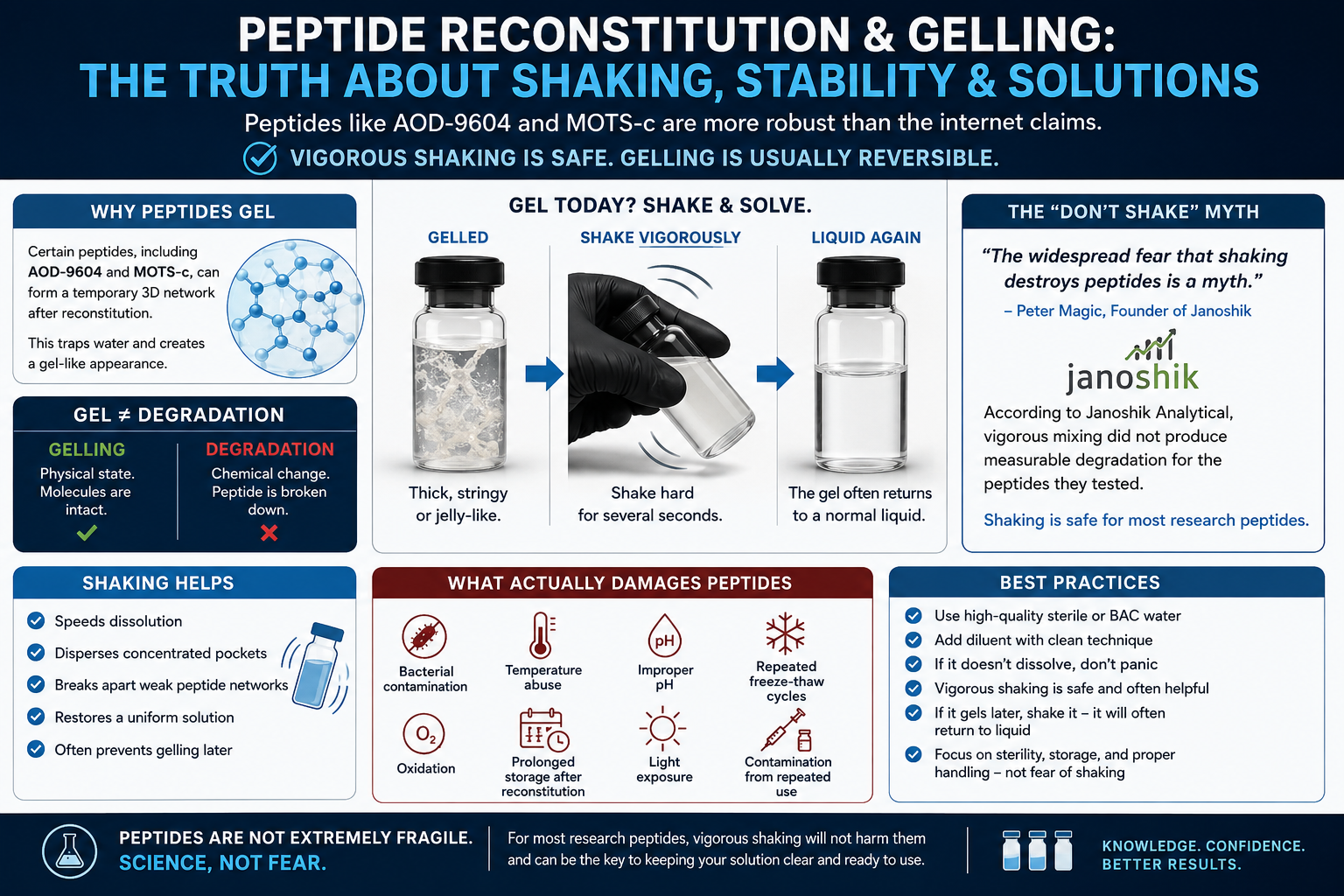
Peptides may self-associate through non-covalent forces and create networks that trap water.
Visual inspection cannot rule out aggregates, impurities, contamination, or chemical degradation.
Agitation does not simply snap peptide bonds. Nevertheless, foam, interfaces, and formulation conditions can affect physical stability.
How Peptide Reconstitution Changes the System
However, peptide reconstitution and gelling begin when a dry formulation returns to an aqueous environment. Therefore, at that point, concentration, pH, salts, excipients, temperature, surfaces, and time begin to influence behavior.
In addition, a freeze-dried cake may contain buffers, bulking agents, stabilizers, counterions, residual moisture, and process-related impurities. Therefore, two vials with the same peptide name can dissolve differently.
In addition, lyophilization slows many reactions by reducing water and molecular motion. However, it does not guarantee permanent stability, and the drying cycle itself can affect conformation or later aggregation.
For example, a peptide name alone is not a handling protocol. Instead, the validated instructions for the exact molecule, salt form, formulation, concentration, container, and intended assay should guide the work.
Why a Reconstituted Peptide Can Become Gel-Like
As a result, some peptide sequences self-associate through hydrogen bonding, hydrophobic interactions, electrostatic forces, aromatic stacking, and van der Waals forces. As a result, molecules may organize into fibers, oligomers, or other higher-order structures.
Moreover, when those structures form a three-dimensional network, they can trap water and create a soft gel. However, the process the process may reverse in one system and irreversible in another.
Factors that can shift the balance
- Meanwhile, concentration: Higher local concentration often increases molecular contact and association.
- By contrast, pH and charge: Changes in charge can increase or reduce electrostatic repulsion.
- Likewise, ionic strength and counterions: Salts can screen charge or alter intermolecular forces.
- Finally, temperature and time: Both factors can change assembly rate, solubility, and structure.
- However, interfaces and surfaces: Air, vial, stopper, filter, and particle surfaces can promote adsorption or nucleation.
- Therefore, excipients and impurities: Formulation components can stabilize a peptide or push it toward instability.
Gelling, Aggregation, and Degradation Are Different
In addition, people often use the word degradation for every visible change. By contrast, formulation science separates physical instability from chemical change because each process answers a different quality question.
| Change | What it means | Can appearance prove it? | Potential consequence |
|---|---|---|---|
| Self-association | Multiple peptide molecules associate through non-covalent forces. | No. The process may remain invisible or appear as haze, particles, or gel. | The association may reverse or progress into persistent aggregates. |
| Gelation | A molecular network immobilizes part of the liquid. | Texture researchers can observe, but composition and reversibility cannot. | The gel may affect handling, concentration uniformity, and assay performance. |
| Precipitation | Material leaves solution as solid particles or crystals. | Sometimes. Subvisible particles still require testing. | Soluble material may decrease, and particles may interfere with research. |
| Chemical degradation | Covalent changes alter the molecule, such as oxidation, hydrolysis, or fragmentation. | Usually not. A clear solution may still contain degraded material. | Identity, potency, activity, or impurity profile may change. |
| Contamination | Microorganisms, endotoxin, or foreign matter enter the sample. | No. Contaminated samples can look normal. | The contamination can invalidate research and create serious safety concerns. |
If mixing makes a gel flow again, it only shows that the visible structure changed. Therefore, researchers still need appropriate methods to assess identity, monomer content, activity, sterility, endotoxin, and suitability.
Does Shaking Destroy Peptides?
That statement is not a universal scientific rule. Routine mixing does not normally cleave peptide bonds directly. However, agitation can increase exposure to air–liquid and solid–liquid interfaces, create foam, accelerate nucleation, or change aggregate size.
Laboratories use agitation in stress studies because it can accelerate physical instability. Nevertheless, the forces and effects vary by mixing method, formulation, container, and molecule.
This does not mean that every brief shake damages every peptide. Instead, both extreme claims—never move a vial and shake every vial vigorously—go beyond the available evidence.
Follow validated product instructions. When molecule-specific mixing data are unavailable, gentle mixing that avoids foam offers a conservative starting point for laboratory work.
What Public Evidence Says About AOD‑9604 and MOTS‑c
Online discussions often describe these peptides as “known to gel.” However, public molecule-specific formulation data remain more limited than those claims suggest.
AOD‑9604
FDA’s 2024 review describes AOD‑9604 as a 16-amino-acid peptide with a disulfide bond. The agency also noted limited public information about reduction, dimer formation, aggregates, and impurity controls.
What that means: visible thickening cannot be labeled harmless without formulation-specific analytical evidence.
MOTS‑c
FDA’s 2026 review states that public sources describe MOTS‑c as water-soluble. However, the agency found insufficient concentration-specific solubility and aggregate data for a proposed injectable formulation.
What that means: anecdotes about refrigeration, gelling, or re-liquefaction do not replace a validated stability study.
AOD‑9604 and MOTS‑c do not appear in FDA-approved drug products in the cited evaluations. Therefore, a research-use product should not be assumed sterile, endotoxin-controlled, correctly formulated, or suitable for human or animal use.
What to Do When a Peptide Becomes Cloudy, Stringy, or Gel-Like
The safest response is an investigation rather than a visual guess. For legitimate laboratory work, use a structured review.
- Pause and quarantine the sample.Do not treat a changed appearance as normal simply because someone reported it online.
- Check the exact protocol.Confirm identity, salt form, formulation, intended concentration, diluent, pH, storage history, container, and instructions.
- Document the change.Record lot, dates, temperatures, freeze–thaw history, appearance, mixing method, and timing.
- Match the response to the experiment.A screening assay and a regulated, sterile, or in vivo workflow do not carry the same quality threshold.
- Use appropriate testing.Depending on the question, use chromatography, mass spectrometry, aggregate methods, particle analysis, concentration assay, pH, sterility, or endotoxin testing.
- Replace the sample when quality remains uncertain.Re-liquefaction after mixing is an observation, not a release test.
ICH stability guidance calls for monitoring appearance, visible particles after reconstitution, pH, and other quality attributes. Moreover, the guidance emphasizes methods that can detect both chemical degradation and aggregation.
What Actually Controls Peptide Stability
Agitation is only one variable in a larger system. Therefore, the better question is whether the formulation stayed within its validated quality envelope.
Peptide reconstitution and gelling may reflect reversible self-assembly, persistent aggregation, precipitation, contamination, or a formulation problem. Finally, treat visible change as a quality question that requires evidence rather than folklore.
Peptide Reconstitution and Gelling: Frequently Asked Questions
Does gelling prove that a peptide degraded?
No. Gelling can reflect self-association, network formation, precipitation, or another physical change. However, appearance alone cannot identify the cause.
Does vigorous shaking break peptide bonds?
Not usually in the simple way online claims suggest. Nevertheless, vigorous agitation can increase foam, interfaces, and physical instability.
Can a gel-like solution become usable again after mixing?
Re-liquefaction only proves that the visible structure changed. Therefore, it does not establish identity, potency, sterility, endotoxin status, or suitability.
Why can two vials behave differently after reconstitution?
Formulation, salt form, excipients, concentration, pH, residual moisture, impurities, and storage history can all differ.
Sources and Further Reading
Related reading: How to read a peptide COA without being misled.
- Zapadka KL, Becher FJ, Gomes dos Santos AL, Jackson SE. Factors affecting the physical stability (aggregation) of peptide therapeutics. Interface Focus. 2017;7(6):20170030.
- Wang J, Liu K, Xing R, Yan X. Peptide self-assembly: thermodynamics and kinetics. Chemical Society Reviews. 2016;45(20):5589–5604.
- Fu K, Wu H, Su Z. Self-assembling peptide-based hydrogels: fabrication, properties, and applications. Biotechnology Advances. 2021;49:107752.
- Nugrahadi PP, Hinrichs WLJ, Frijlink HW, Schöneich C, Avanti C. Designing formulation strategies for enhanced stability of therapeutic peptides in aqueous solutions: a review. Pharmaceutics. 2023;15(3):935.
- U.S. Food and Drug Administration. FDA evaluation of AOD‑9604-related bulk drug substances. Pharmacy Compounding Advisory Committee briefing document. November 5, 2024.
- U.S. Food and Drug Administration. FDA evaluation of MOTS‑c-related bulk drug substances. Pharmacy Compounding Advisory Committee briefing document. 2026.
- International Council for Harmonisation / U.S. Food and Drug Administration. ICH Q5C: Quality of biotechnological products—stability testing of biotechnological/biological products.
Editorial note: This article prioritizes peer-reviewed reviews, primary regulatory documents, and international quality guidance. Online anecdotes and commercial-laboratory interviews were not treated as sufficient evidence for molecule-specific stability claims. This is general scientific information, not medical advice or a reconstitution protocol.