Amylin Receptors Explained
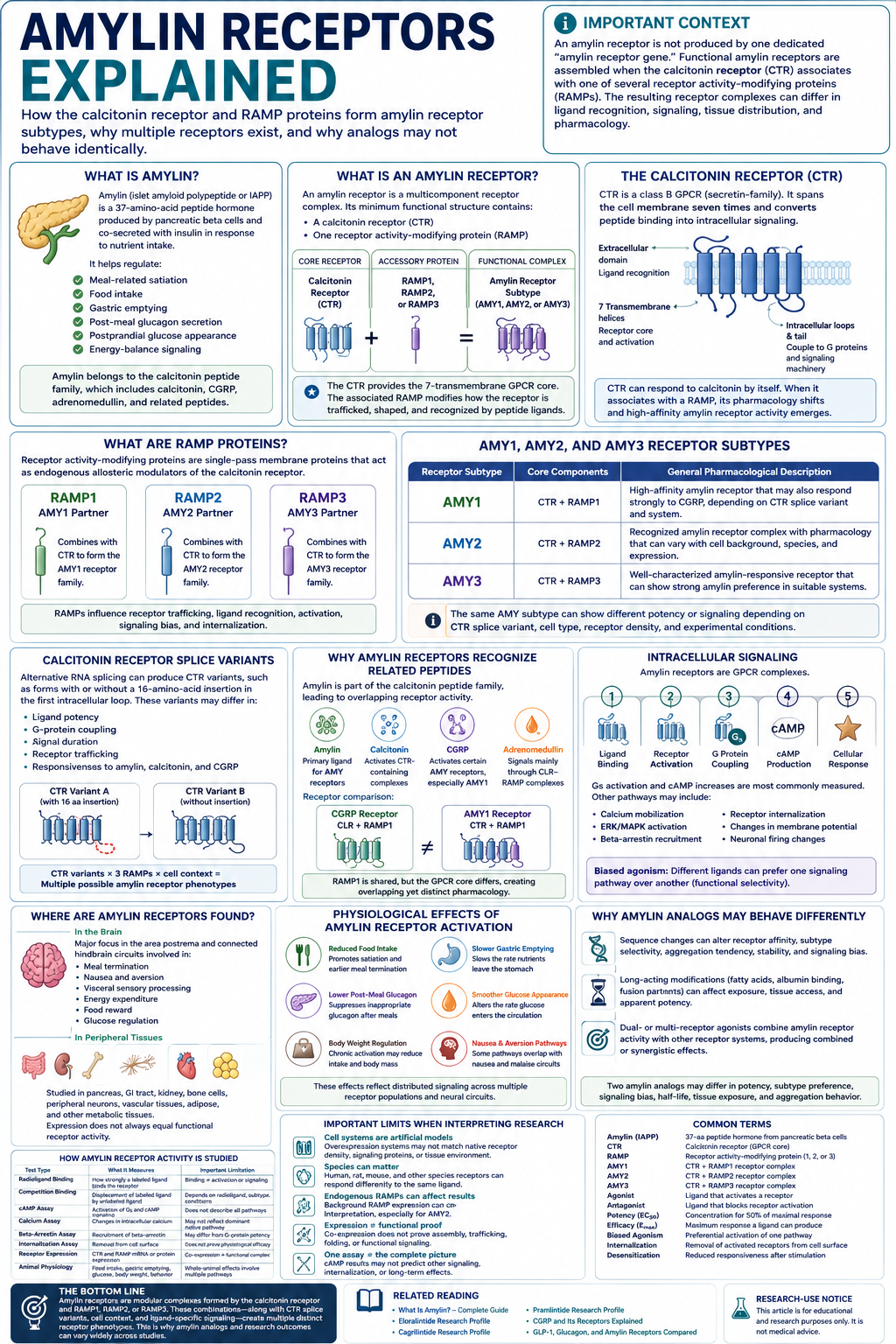
Amylin receptors explained in clear terms: how the calcitonin receptor and receptor activity-modifying proteins form AMY1, AMY2, and AMY3 receptors, how these receptor complexes signal, and why amylin related peptides may behave differently.
In addition, This guide provides amylin receptors explained for non-specialists. First, it shows how the calcitonin receptor and RAMP proteins work together. Next, it explains the AMY1, AMY2, and AMY3 subtypes. Finally, it covers signaling, tissue roles, related peptide design, and the limits of receptor studies.
What Is Amylin?
In addition, With amylin receptors explained, it helps to begin with the hormone itself. Amylin, also called islet amyloid polypeptide or IAPP, is a 37-amino-acid peptide hormone produced primarily by pancreatic beta cells.
In addition, it is released in response to nutrient intake and is commonly co-secreted with insulin.
As a result, amylin helps regulate:
- Meal-related satiation
- Food intake
- Gastric emptying
- Post-meal glucagon secretion
- Postprandial glucose appearance
- Energy-balance signaling
In addition, Amylin is part of the broader calcitonin peptide family, which also includes calcitonin, calcitonin gene-related peptide, adrenomedullin, and related peptides. Members of this family share structural and receptor-receptor behavior relationships that create large signal molecule overlap. For a formal receptor-family overview, see the IUPHAR/BPS Guide to receptor behavior.
Amylin Receptors Explained: What Is an Amylin Receptor?
In addition, An amylin receptor is a receptor complex made from more than one part.
More specifically, its minimum working structure contains:
- A calcitonin receptor, abbreviated CTR
- One receptor activity-modifying protein, abbreviated RAMP
First, the calcitonin receptor supplies the seven-part membrane G-protein receptor core. Meanwhile, the linked RAMP changes how that receptor reaches the cell surface, takes shape, and recognizes peptide signals.
In addition, This modular design creates several distinct amylin receptor subtypes rather than one single universal receptor. The IUPHAR/BPS receptor guide lists the recognized amylin receptor complexes.
In addition, This receptor core is the signaling engine. In addition, the RAMP acts as a receptor-modifying partner that changes signal recognition and receptor behavior.
The Calcitonin Receptor Is the Core of the Amylin Receptor
The calcitonin receptor belongs to the class B family of G-protein receptors, also called secretin-family GPCRs.
Therefore, like other GPCRs, it crosses the cell membrane seven times and converts an outside-the-cell peptide-binding event into inside-the-cell signaling.
outside the cell domain
Helps recognize and bind peptide hormones.
Seven transmembrane helices
In addition, Form the receptor core and participate in turning on.
inside the cell loops and tail
Moreover, couple the receptor to G proteins, arrestins, and signaling machinery.
On its own, the calcitonin receptor can respond to calcitonin. Likewise, when it associates with a RAMP, its response profile shifts and it can display high-affinity amylin-receptor characteristics.
How the Core Receptor Shapes the Final Response
RAMPs do not simply attach a new label to an otherwise identical receptor. In addition, this receptor core contributes directly to signal molecule binding, receptor turning on, G-protein linking, and uptake.
Therefore, the final receptor behavior depends on:
- The calcitonin receptor subtype
- The linked RAMP
- The signal molecule being tested
- The host cell
- Receptor-production levels
- Available signaling proteins
What Are Receptor Activity-Modifying Proteins?
Receptor activity-modifying proteins are small single-pass membrane proteins.
In practice, three main RAMPs are recognized:
AMY1 partner
Therefore, combines with the calcitonin receptor to form the AMY1 receptor family.
AMY2 partner
In addition, Combines with the calcitonin receptor to form the AMY2 receptor family.
AMY3 partner
Moreover, combines with the calcitonin receptor to form the AMY3 receptor family.
As a result, RAMPs can affect receptor behavior in several ways.
1. Receptor trafficking
Likewise, a RAMP can influence whether a receptor is properly transported to the cell surface.
2. signal molecule recognition
By contrast, the outside-the-cell portion of the RAMP contributes to the shape and chemical environment of the signal molecule-binding complex.
3. Receptor turning on
For example, RAMP binding can change how easily a signal molecule turns the receptor on.
4. Signaling bias
Likewise, different receptor complexes may favor different cell pathways or produce signals of different strength.
5. Receptor uptake and recycling
Therefore, RAMPs may influence how rapidly an activated receptor is removed from the cell surface, recycled, or degraded.
In addition, Modern receptor studies describe RAMPs as natural proteins that change receptor behavior rather than simple accessory proteins. Moreover, their presence changes the receptor complex itself and can alter both binding strength and later cell signals.
AMY1, AMY2, and AMY3 Receptor Subtypes
| Receptor subtype | Core components | General receptor description |
|---|---|---|
| AMY1 | Calcitonin receptor + RAMP1 | High-affinity amylin receptor that may also respond strongly to CGRP, depending on the receptor splice variant and test system. |
| AMY2 | Calcitonin receptor + RAMP2 | Likewise, a recognized amylin receptor complex whose measured receptor behavior can vary greatly with cell background and receptor production. |
| AMY3 | Calcitonin receptor + RAMP3 | By contrast, a well-characterized amylin-able to respond receptor that can show strong amylin preference in suitable systems. |
In addition, The International Union of Basic and Clinical receptor behavior recognizes AMY1, AMY2, and AMY3 receptor families based on which RAMP pairs with the calcitonin receptor. See the official amylin receptor entry for receptor naming and signal molecule data.
AMY1 receptor
First, the AMY1 receptor is formed by the calcitonin receptor and RAMP1.
However, this subtype is important because it may respond not only to amylin but also to calcitonin gene-related peptide, commonly abbreviated CGRP.
Moreover, the extent of CGRP response depends partly on which calcitonin-receptor splice variant is present. Some AMY1 forms may display large CGRP strength.
AMY2 receptor
Next, the AMY2 receptor is formed by the calcitonin receptor and RAMP2.
AMY2 receptor behavior has historically been more difficult to define consistently than AMY1 and AMY3 receptor behavior. In addition, test outcomes can be affected by natural RAMP production, receptor background, species, and cell-system differences.
AMY3 receptor
Finally, the AMY3 receptor is formed by the calcitonin receptor and RAMP3.
Therefore, RAMP3 link can increase calcitonin-receptor response to amylin and alter the relative response to calcitonin-family peptides.
Subtype names do not guarantee identical behavior in every test
However, the same AMY subtype can produce different strength or signaling results when expressed in different cells, at different receptor densities, or with different calcitonin-receptor forms.
Calcitonin-Receptor Splice Variants Add Another Layer of Complexity
Moreover, the calcitonin-receptor gene can produce more than one receptor form through RNA splicing.
Therefore, a commonly discussed distinction involves receptor forms with or without a 16-amino-acid insertion in the first inside-the-cell loop.
These receptor variants may differ in:
- signal molecule strength
- G-protein linking
- Signal duration
- Receptor trafficking
- Relative response to amylin, calcitonin, and CGRP
Likewise, earlier receptor-receptor behavior work noted that at least two calcitonin-receptor forms combined with three RAMPs could theoretically generate six amylin-receptor forms.
As a result, one paper may describe an related peptide as very potent while another reports a different value.
Why Amylin Receptors Can Recognize Related Peptides
In addition, amylin is part of the calcitonin peptide family. Because of those shared features, these peptides can act on some of the same receptors.
Therefore, primary natural signal molecule linked with AMY receptor receptor behavior.
Therefore, binds the calcitonin receptor core and may activate several CTR-containing complexes.
Moreover, can activate certain AMY receptor forms, especially AMY1-related complexes.
As a result, share family relationships but primarily signal through CLR–RAMP receptor complexes.
The CGRP receptor is not an amylin receptor
The standard CGRP receptor contains:
- Calcitonin receptor-like receptor, abbreviated CLR
- RAMP1
By contrast, the AMY1 receptor contains:
- This receptor core, abbreviated CTR
- RAMP1
Likewise, this receptors share RAMP1 but use different GPCR cores. In addition, this creates overlapping but nonidentical receptor behavior.
signal molecule target choice is relative, not absolute
However, a peptide called “amylin-selective” may still activate calcitonin or CGRP-family receptors at high enough levels.
Meaningful target choice comparisons require:
- The same assay format
- The same species receptor
- Comparable receptor-production levels
- Moreover, the same signaling endpoint
- Full dose-response curves
- Appropriate control signal molecules
How Amylin Receptors Signal Inside Cells
For example, at the cell level, amylin receptors are G-protein receptor complexes.
For instance, one of the most often measured responses is turning on of Gs, which raises cyclic AMP inside the cell.
Amylin or an related peptide binds the outside-the-cell receptor complex.
The receptor changes shape.
In addition, Gs and potentially other signaling proteins are engaged.
Adenylyl cyclase increases inside-the-cell cyclic AMP.
As a result, downstream kinases, ion channels, transcription, or neuronal activity are altered.
cAMP is not the only possible signal
In addition, depending on the receptor subtype and cell setting, researchers may observe:
- Calcium mobilization
- ERK or MAP-kinase turning on
- Beta-arrestin binding
- Receptor uptake
- Changes in membrane potential
- Neuronal firing changes
What is biased agonism?
By contrast, in some cases, a signal molecule activates one pathway more strongly than another through the same receptor.
In addition, This phenomenon is called biased agonism or pathway preference.
Two related peptides may therefore produce similar cAMP strength but differ in:
- Beta-arrestin binding
- Receptor uptake
- Signal duration
- reduced response
- Downstream body-level effects
Amylin Receptors in the Brain
For example, many of amylin’s best-known effects are linked to the brain and spinal cord.
A major research focus is the area postrema, a hindbrain structure that is relatively accessible to blood-borne signals because it lies near a region with reduced blood-brain barrier protection.
Moreover, researchers study connected regions involved in:
- Meal termination
- Nausea and aversive signaling
- Visceral sensory processing
- Energy expenditure
- Food reward
- Glucose regulation
In addition, reviews of amylin biology describe actions across several brain networks rather than one isolated center. A useful open-access overview is available through PubMed Central.
Receptor location is technically difficult
Likewise, identifying a functional amylin receptor requires evidence that CTR and a relevant RAMP are present in the same cells and form an active receptor complex.
Moreover, measuring RAMP1 alone does not prove the presence of AMY1 receptors because RAMP1 also participates in standard CGRP receptors.
In addition, measuring CTR alone does not prove which RAMP-linked receptor subtype is present.
Amylin Receptors Outside the Brain
However, components capable of forming amylin receptors are also expressed in several tissues outside the brain, although production patterns vary by species, tissue, cell type, and test method.
Therefore, research has examined CTR and RAMP production in:
- Pancreatic tissue
- digestive tissues
- Kidney
- Bone-related cells
- Peripheral sensory neurons
- Vascular and heart and blood vessel tissues
- Adipose and energy-related tissues
However, production of single receptor parts should be read with care. Moreover, a tissue may express a RAMP but not the necessary GPCR core, or may express CTR without enough of a specific RAMP to create a dominant amylin-receptor phenotype.
Gene production does not automatically equal functional receptor activity
Messenger RNA, protein staining, signal molecule binding, and functional signaling provide different levels of evidence. Likewise, the strongest receptor-location claims combine several methods.
body Effects linked With Amylin-Receptor turning on
Overall, amylin-receptor signaling is linked to several linked effects in the body.
Satiation signaling
In addition, promotes earlier meal termination and can reduce meal size in test systems.
Slower stomach emptying
Can slow the rate at which ingested nutrients leave the stomach.
Reduced post-meal glucagon
Therefore, can suppress inappropriate meal-related glucagon secretion under suitable energy-related conditions.
Smoother post-meal nutrient delivery
However, slower stomach emptying can alter the rate at which glucose enters the circulation.
Body-weight regulation
Moreover, chronic receptor turning on is being studied for effects on food intake, energy balance, and body mass.
Nausea and aversion pathways
Therefore, some receptor pathways overlap with circuits involved in nausea, malaise, and learned taste avoidance.
Likewise, these effects are not necessarily generated by one receptor subtype in one tissue. They can reflect spread signaling across several receptor populations and neural circuits.
Why Different Amylin related peptides May Behave Differently
For example, an amylin related peptide can be modified to improve stability, solubility, resistance to clumping, half-life, receptor activity, or ease of production.
In addition, Those changes may also alter receptor receptor behavior.
Sequence substitutions
Therefore, replacing one or more amino acids can change:
- Receptor affinity
- Subtype target choice
- clumping tendency
- Protease resistance
- Secondary structure
- Signaling bias
Long-acting changes
Fatty-acid attachments, albumin-binding groups, fusion partners, or other half-life-extension technologies may affect:
- blood-borne exposure
- Tissue access
- Receptor binding speed
- Receptor release speed
- Apparent strength in cell assays
Dual- or multi-receptor agonism
In addition, some research peptides are designed to activate amylin receptors along with another energy-related receptor.
Therefore, in those molecules, the observed biological effect may reflect:
- Amylin-receptor activity
- Activity at the second receptor
- Relative strength at each target
- Different tissue exposure
- Combined or synergistic signaling
Likewise, amylin related peptide development has expanded because receptor agonism can influence food intake and energy-related regulation, while native human amylin presents formulation challenges related partly to clumping.
As a result, two molecules described as amylin related peptides may have different receptor strength, subtype preference, signaling bias, half-life, tissue exposure, and clumping behavior.
How Is Amylin-Receptor Activity Studied?
Therefore, researchers use several test approaches to study receptor activity.
| Test type | What it measures | Important limitation |
|---|---|---|
| Radioligand binding | How strongly a labeled signal molecule associates with the receptor preparation | Therefore, binding does not automatically establish receptor turning on or signaling strength. |
| Competition binding | How effectively an unlabeled signal molecule displaces a labeled reference signal molecule | Moreover, results depend on the radioligand, receptor subtype, and assay conditions. |
| cAMP assay | turning on of Gs-linked cyclic AMP signaling | Likewise, does not describe every later cell signals pathway. |
| Calcium assay | Changes in inside-the-cell calcium | May require artificial coupling and may not reflect the dominant normal pathway. |
| Beta-arrestin assay | As a result, binding of beta-arrestin to the activated receptor | In addition, results may differ from G-protein strength and can be system-dependent. |
| uptake assay | By contrast, removal of activated receptors from the cell surface | Therefore, does not by itself establish body-level maximum effect. |
| Receptor-production analysis | Presence of CTR and RAMP messenger RNA or protein | Moreover, co-production does not prove that a functional receptor complex formed. |
| Animal physiology studies | Food intake, stomach emptying, glucose, body weight, or behavior changes | Likewise, whole-animal outcomes may involve several receptor subtypes and indirect pathways. |
Understanding EC50
In addition, The EC50 is the amount that produces 50% of the maximum response in a particular assay.
In addition, Generally, a lower EC50 means greater strength in that specific test system.
It does not automatically mean:
- That signal molecule binds more tightly in every receptor subtype
- Therefore, the signal molecule will be more effective in a whole organism
- That signal molecule has a longer half-life
- However, the signal molecule is more selective
- That signal molecule produces a greater maximum effect
Understanding Emax
In addition, The Emax is the maximum response produced in the assay.
For example, a compound may be:
- Moreover, a full agonist with a high maximum response
- Likewise, a partial agonist with a lower maximum response
- Likewise, a biased agonist favoring one pathway
- An antagonist that blocks another signal molecule
Important Limits When Interpreting Amylin-Receptor Research
Cell systems are artificial models
For example, many receptor studies use engineered cells that produce high levels of CTR and one RAMP.
In addition, this is useful for isolating receptor receptor behavior, but it may not reproduce native receptor level, signaling proteins, membrane makeup, or tissue environment.
Species can matter
Likewise, human, rat, mouse, and other species receptors may not respond identically.
Likewise, signal molecules can differ across species. Human amylin, rat amylin, salmon calcitonin, and synthetic related peptides should not be assumed to produce identical strength rankings.
natural RAMPs can affect results
Moreover, a host cell may naturally express its own RAMPs or related receptors. Likewise, those background proteins can complicate interpretation, especially in AMY2 research.
Receptor-component production is not functional proof
Therefore, finding CTR and RAMP messenger RNA in the same tissue suggests an amylin receptor may be present, but it does not prove:
- In addition, production in the same individual cell
- Assembly at the cell surface
- Correct protein folding
- Functional signal molecule signaling
- Which subtype dominates body-levelly
One signaling assay does not describe the complete receptor
A cAMP result may not predict beta-arrestin binding, receptor uptake, calcium signaling, or long-term cell changes.
“Activates the amylin receptor” is an incomplete statement
In addition, a rigorous description should identify the receptor subtype, species, splice variant, assay, signaling endpoint, strength, maximum effect, and comparison signal molecule.
Common Amylin-Receptor Terms
| Term | Plain-language meaning |
|---|---|
| Amylin | Therefore, a 37-amino-acid pancreatic peptide hormone also called IAPP. |
| CTR | Therefore, the calcitonin receptor that forms the GPCR core of amylin receptors. |
| RAMP | As a result, a receptor activity-modifying protein that alters receptor movement and receptor behavior. |
| AMY1 | Moreover, a receptor complex formed from CTR and RAMP1. |
| AMY2 | A receptor complex formed from CTR and RAMP2. |
| AMY3 | Likewise, a receptor complex formed from CTR and RAMP3. |
| CLR | This receptor core-like receptor used in standard CGRP and adrenomedullin receptors. |
| Agonist | For example, a signal molecule that activates a receptor. |
| Antagonist | In addition, a signal molecule that blocks receptor turning on by another signal molecule. |
| strength | The amount required to produce a defined response. |
| maximum effect | Therefore, the maximum response a signal molecule can produce in a particular system. |
| Biased agonism | Preferential turning on of one signaling pathway over another. |
| uptake | Moreover, removal of activated receptors from the cell surface. |
| reduced response | Reduced receptor response after repeated or prolonged stimulation. |
Frequently Asked Questions
Is there one amylin receptor?
Likewise, no. For example, functional amylin receptors are formed when the calcitonin receptor associates with RAMP1, RAMP2, or RAMP3, creating AMY1, AMY2, and AMY3 receptor families.
What is the main component of an amylin receptor?
In addition, the signaling core is the calcitonin receptor. Moreover, a RAMP modifies its trafficking, signal recognition, and receptor behavior.
What does RAMP stand for?
RAMP stands for receptor activity-modifying protein.
What forms the AMY1 receptor?
Therefore, the AMY1 receptor is formed from the calcitonin receptor and RAMP1.
Receptor Subtypes and Related Signals
What forms the AMY2 receptor?
By contrast, the AMY2 receptor is formed from the calcitonin receptor and RAMP2.
What forms the AMY3 receptor?
Moreover, the AMY3 receptor is formed from the calcitonin receptor and RAMP3.
Can CGRP activate amylin receptors?
However, some amylin-receptor forms, particularly certain AMY1 receptor forms, can respond to CGRP. Likewise, the strength depends on receptor subtype, splice variant, species, and assay conditions.
Is the CGRP receptor the same as AMY1?
In addition, No. In addition, the standard CGRP receptor contains CLR and RAMP1. AMY1 contains the calcitonin receptor and RAMP1.
Research Meaning and Limits
Do all amylin related peptides activate every AMY subtype equally?
Therefore, no. Sequence changes and long-acting changes can alter strength, receptor-subtype preference, maximum effect, signaling bias, and tissue exposure.
What is the main signaling pathway?
In addition, Increased cyclic AMP through Gs coupling is one of the most commonly measured pathways, although other signals can also occur.
Where are amylin receptors found?
Functional receptor components are studied in the brain and several tissues outside the brain. Likewise, major body-level research has focused on hindbrain circuits involved in satiation and visceral signaling.
Does receptor binding prove body-level effectiveness?
In addition, No. In addition, binding is only one part of receptor receptor behavior. Functional signaling, how the body handles a compound, tissue exposure, and whole-organism studies are also needed.
Amylin Receptors Explained: A Family of Receptor Complexes
Functional amylin receptors are assembled from:
- The calcitonin receptor
- RAMP1, RAMP2, or RAMP3
These combinations create:
- AMY1 receptors: CTR + RAMP1
- AMY2 receptors: CTR + RAMP2
- However, aMY3 receptors: CTR + RAMP3
Additional complexity comes from:
- Calcitonin-receptor splice variants
- Cell-specific receptor production
- natural RAMP production
- Overlapping activity from calcitonin-family peptides
- Different inside-the-cell signaling pathways
- Species differences
- signal molecule-specific signaling bias
Therefore, statements such as “strong amylin receptor agonist” should be interpreted carefully.
A complete receptor description should identify:
- The AMY receptor subtype
- The calcitonin-receptor variant
- The species receptor
- The test cell system
- However, the measured signaling pathway
- In addition, the signal molecule’s strength and maximum effect
- Its activity at related calcitonin-family receptors
Amylin receptor receptor behavior is therefore better understood as a family of related receptor complexes rather than a single universal molecular switch.