Peptide Salt Forms: Acetate vs. TFA Explained
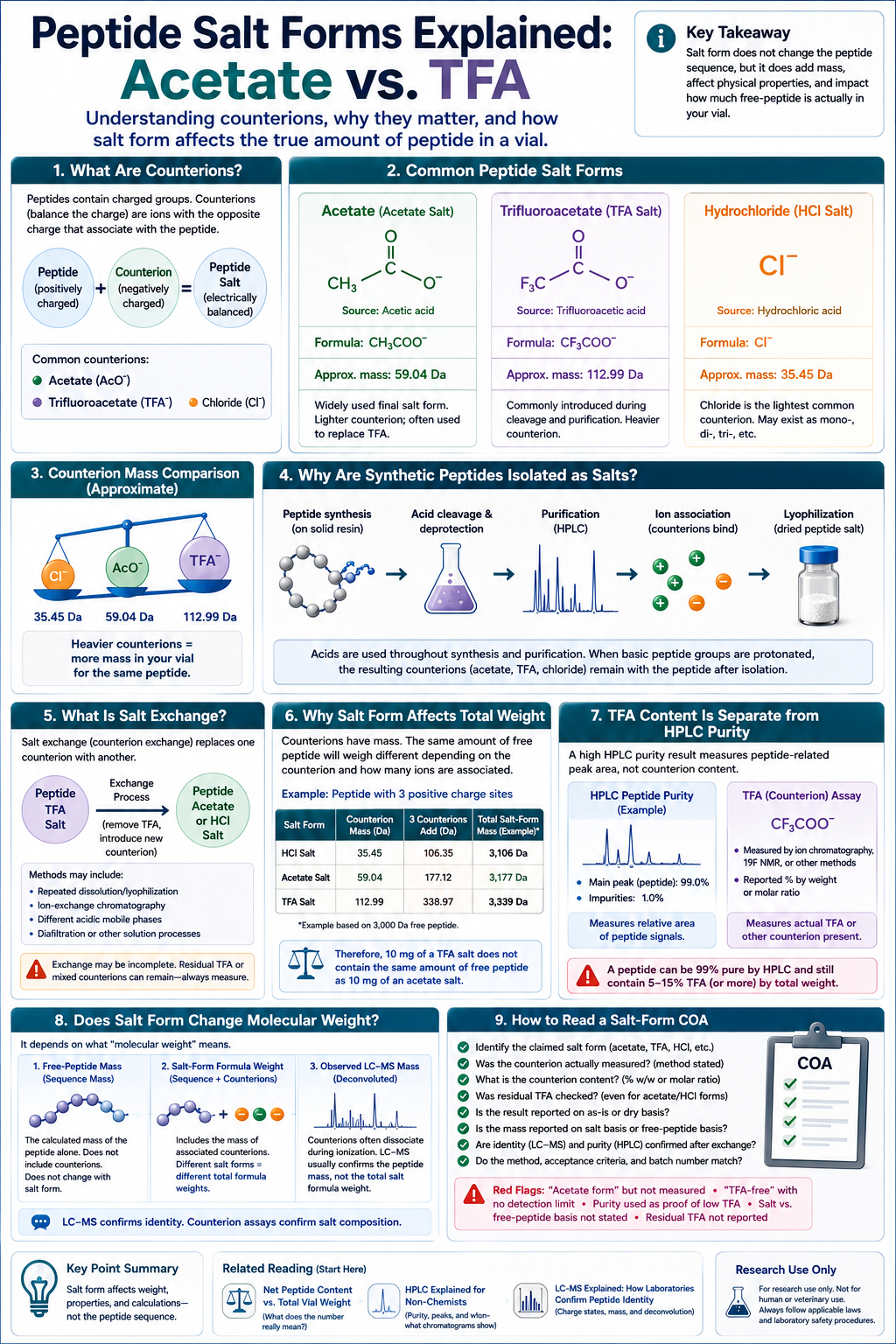
In addition, Peptide salt forms affect total powder weight, moisture action, solubility, and how a COA should be read. This guide explains acetate, TFA, and hydrochloride forms, why counterions remain after synthesis, and why salt form is separate from peptide sequence and HPLC purity.
For example, Peptide salt forms describe the ions that balance a charged peptide after synthesis and purification. First, the peptide gains or loses protons. Next, ions with the reverse charge remain with the material. As a result, acetate, TFA, or chloride can add real mass without changing the amino-acid sequence.
However, the salt name alone does not prove the actual ion amount. Therefore, a strong report should identify the counterion, measure its amount, state whether remaining TFA remains, and explain whether content the report lists on a salt basis or free-peptide basis.
Peptide Salt Forms: What Is a counterion?
Likewise, A counterion is an ion with an electric charge reverse to that of another charged molecule or group.
Likewise, peptides contain amino-acid residues with chemical groups that can gain or lose protons. Depending on the peptide sequence and nearby pH, the peptide may carry a positive or negative net charge.
In addition, that charge must be balanced by ions of the reverse charge.
However, for many synthetic peptides, the most relevant positively charged sites include:
- N-terminal amino group
- Lysine side chains
- Arginine side chains
- Therefore, histidine side chains under suitable conditions
Acidic groups can include:
- C-terminal carboxyl group
- Aspartic-acid side chains
- Glutamic-acid side chains
Therefore, the balance between these groups affects the peptide’s net charge and the amount of counterions that may associate with it.
Moreover, scientific reviews of peptide counterions identify trifluoroacetate, acetate, and chloride among the common anions linked with positively charged peptide groups.
Why Are Synthetic Peptides often dried as Salts?
Likewise, Synthetic peptides are frequently produced through solid-phase peptide synthesis. During this process, amino acids are added one by one while the growing peptide remains attached to a solid resin.
By contrast, after assembly is complete, the peptide must be:
- However, removed from the synthesis resin
- Freed from temporary protecting groups
- Therefore, separated from unfinished sequences and process impurities
- Purified under set HPLC conditions
- However, converted into an dried dried material
For example, acids are often used during cleavage, protecting-group removal, purification, and final isolation. By contrast, when an acid donates protons to basic peptide groups, the negatively charged remainder of that acid can become the peptide’s counterion.
Moreover, the resulting material is not simply a neutral peptide molecule. As a result, it may be a peptide salt containing one or more linked counterions.
The amino-acid sequence is assembled on a resin.
By contrast, the peptide is removed and protecting groups are released.
In addition, acidic mobile phases may help HPLC separation.
As a result, the peptide is dried with its linked counterions.
The salt form can affect physical properties
For example, salt selection is not merely a naming detail. Therefore, the counterion may influence:
- Solubility
- moisture uptake and moisture uptake
- Physical appearance
- clumping tendency
- heat action
- Solution pH
- HPLC retention
- Stability under particular conditions
- prepared mixture fit
Moreover, The European Medicines Agency notes that acetate is a common peptide counterion, while TFA and chloride forms may also occur. In addition, the agency expects salt form and related impurities to be set as part of synthetic peptide quality. See the EMA synthetic peptide guideline.
What Is a Trifluoroacetate Peptide Salt?
Moreover, Trifluoroacetate, often abbreviated TFA when discussed as part of a peptide salt, is the negatively charged form of trifluoroacetic acid.
TFA−
Trifluoroacetate counterion
In addition, trifluoroacetic acid is useful in peptide manufacturing because it is often used for:
- Cleaving peptides from synthesis resins
- Removing acid-sensitive protecting groups
- Acidifying purification mobile phases
- However, improving peak shape or HPLC action in some methods
As a result, cationic synthetic peptides are often at first obtained in trifluoroacetate-linked form following synthesis and purification. Therefore, scientific literature describes this as a common consequence of solid-phase synthesis and reverse-phase purification workflows.
TFA can have two related lab descriptions
Moreover, depending on the peptide and manufacturing process, Researchers may describe TFA as:
A counterion
Therefore, trifluoroacetate balances positively charged groups on the peptide.
A remaining process part
Likewise, remaining trifluoroacetic acid or trifluoroacetate may remain from cleavage and purification.
USP General Chapter <503.1> treats TFA as both a common process-related impurity and a counterion in peptide materials. Therefore, TFA content may need a separate test instead of being inferred from peptide purity. See the USP chapter on TFA in peptides.
Not all TFA is necessarily in the same state
A material may contain:
- For example, in a fixed ratio linked trifluoroacetate counterions
- However, excess outside a fixed ratio TFA-related residue
- Mixed counterions
- Moreover, trace TFA remaining after an unfinished exchange
Therefore, simply calling a material “TFA-free” or “TFA salt” may not provide enough measured information. A useful report should state whether TFA the lab measured and how much was found.
What Is an Acetate Peptide Salt?
Acetate is the negatively charged form of acetic acid. It is widely used as a peptide counterion and manufacturers often select as an other option to trifluoroacetate.
AcO− or OAc−
Acetate counterion
By contrast, acetate is greatly lighter than trifluoroacetate. For example, for the same number of linked counterions, an acetate salt therefore adds less counterion mass than a TFA salt.
Acetate forms may be produced through a planned counterion-exchange process after initial peptide synthesis and purification.
Acetate may be selected because it can provide an suitable balance of:
- Manufacturing practicality
- Solubility
- Stability
- prepared mixture fit
- lab control
- Reduced remaining TFA
Acetate form does not mean no acid is present
As a result, an acetate peptide is still a salt. Likewise, acetate adds mass and should be considered when converting total dried weight into free-peptide-equal content.
What Is a Hydrochloride Peptide Salt?
A hydrochloride salt the process produces when hydrochloric acid protonates basic groups on the peptide and chloride ions balance the resulting positive charges.
Peptide·HCl
Chloride-linked peptide salt
In addition, chloride adds less mass per counterion than acetate or trifluoroacetate.
However, hydrochloride forms can be produced by exchanging TFA or another counterion for chloride. Researchers have described repeated freeze-drying in hydrochloric-acid-containing solutions, ion-exchange steps, and other approaches for TFA-to-chloride exchange.
“Hydrochloride” may not describe a simple one-to-one salt
Therefore, a peptide with several protonatable groups may associate with more than one chloride ion. Moreover, the material might therefore be described using terms such as:
- Monohydrochloride
- Dihydrochloride
- Trihydrochloride
- Therefore, hydrochloride salt without fully stated ion ratio
Likewise, the actual ion content should ideally be measured rather than inferred solely from a product name.
Acetate vs. TFA vs. Hydrochloride
| Salt form | counterion | Approximate counterion mass | Why it may be present |
|---|---|---|---|
| Acetate | CH3COO− | 59.04 Da | By contrast, planned final salt form, purification conditions, or counterion exchange. |
| Trifluoroacetate | CF3COO− | 112.99 Da | often introduced during resin cleavage, protecting-group removal, and TFA-containing purification. |
| Hydrochloride | Cl− | 35.45 Da | However, planned chloride salt formation or exchange from TFA or another counterion. |
counterion mass is only part of the math
For example, the exact salt added mass depends on how many counterions are present per peptide molecule. However, a peptide linked with three TFA ions carries far more counterion mass than a peptide linked with one TFA ion.
What Is Salt Exchange?
Moreover, Salt exchange, also called counterion exchange, is the process of replacing one type of counterion with another.
As a result, a common example is converting a peptide at first obtained as a TFA salt into an acetate or hydrochloride form.
Common exchange approaches
Depending on the peptide and manufacturing process, counterion exchange may involve:
- By contrast, repeated dissolution and freeze-drying in another acid
- Ion-exchange HPLC separation
- In addition, reverse-phase HPLC separation using a different acidic modifier
- Resin-based exchange
- By contrast, diafiltration or related solution-processing methods
- set deprotonation and reprotonation
Published work on peptide counterion exchange shows that steps may provide partial or near-complete replacement depending on the peptide, method, and exchange conditions.
Exchange may be unfinished
For example, a peptide labeled as acetate may still contain remaining TFA. Therefore, similarly, a hydrochloride form may contain a mixture of chloride and remaining trifluoroacetate.
Therefore, unfinished exchange can result from:
- Strong ion link
- too few exchange cycles
- Inappropriate acid concentration
- Peptide solubility limits
- Losses during purification
- Sequence-dependent charge action
- lab detection limits
Recent lab research emphasizes that both the departing counterion and the replacement ion should be measured rather than assuming a complete exchange occurred.
Why Salt Form Affects Total Material Weight
As a result, counterions have physical mass. Likewise, that mass becomes part of the total dried material placed in a vial or weighed by a laboratory.
By contrast, the same amount of free peptide can therefore produce different total weights depending on:
- The counterion’s molecule mass
- In addition, the number of counterions linked with each peptide molecule
- remaining water
- However, excess unbound acid or process residue
- Other salts and non-peptide material
A simplified example
Therefore, consider a hypothetical peptide with:
- Free-peptide molecule weight: 3,000 Da
- Three positively charged sites
- Three linked single-charge counterions
| Reported form | Free peptide | Approximate counterion added mass | Approximate salt-form mass |
|---|---|---|---|
| Trihydrochloride-linked form | 3,000 Da | 3 × 35.45 Da | about 3,106 Da |
| Triacetate-linked form | 3,000 Da | 3 × 59.04 Da | about 3,177 Da |
| Tri-TFA-linked form | 3,000 Da | 3 × 112.99 Da | about 3,339 Da |
As a result, all three examples contain the same underlying 3,000-dalton peptide molecule. However, their approximate total formula weights differ because their counterions differ.
Moreover, the TFA-linked material would contain a larger counterion mass fraction than the acetate- or chloride-linked material.
Why this matters for vial content
Suppose two vials each contain 10.0 milligrams of dried peptide salt:
- However, one is an acetate salt.
- One is a TFA salt.
Likewise, if all other factors are equal, the TFA vial may contain a lower free-peptide-equal amount because a larger portion of its total material weight is attributable to the heavier TFA counterions.
By contrast, this is one reason a total powder weight cannot be interpreted without knowing the salt form.
In addition, See Net Peptide Content vs. Total Vial Weight for a detailed explanation of water, counterion, purity, and reference-standard corrections.
Why TFA Content Is Separate From HPLC Purity
For example, a routine reverse-phase HPLC purity result usually evaluates the relative area of peptide-related ultraviolet signals.
It may report:
- Main peptide peak: 99.0%
- Peptide-related impurities: 1.0%
That result does not necessarily include a measured measurement of TFA.
TFA may not appear like a peptide impurity
Moreover, tFA is much smaller than a peptide and behaves differently during HPLC separation. As a result, depending on the method, detector wavelength, integration window, and sample conditions, TFA may:
- Therefore, elute near the solvent front
- Produce a weak response at the peptide-detection wavelength
- By contrast, be excluded from the HPLC integration range
- In addition, be treated as a mobile-phase or system part
- By contrast, require an entirely separate lab method
Evaluates peptide-related peak area
For example, often reports the relative area assigned to the main peptide compared with included peptide-related signals.
Measures TFA, acetate, or chloride
Therefore, uses a method directly designed to identify or quantify the relevant ion.
A sample can therefore be:
- Therefore, 99% pure by peptide HPLC area
- As a result, 10% or more TFA by total dried weight
- As a result, several percent water by weight
- Likewise, lower in free-peptide equal than its total powder weight suggests
By contrast, these results do not necessarily contradict one another because they measure different parts of the sample.
In addition, USP maintains a separate test for TFA in peptide materials. Moreover, this supports the key point that TFA content is a different quality measure from ordinary peptide HPLC purity. See the USP TFA method.
“99% pure” does not mean “1% everything else” by total vial weight
Therefore, hPLC area purity is usually a relative detector-response math. Moreover, counterions, water, remaining solvents, and other weakly found materials may not be represented in the 99% figure.
See HPLC Explained for Non-Chemists for more information about area percentage, solvent fronts, excluded peaks, and why HPLC purity is not assay.
Can Two Salt Forms Have Different Apparent Molecular Weights?
Likewise, yes—but the answer depends on what “molecule weight” is intended to describe.
Free-peptide mass
By contrast, the calculated mass of the peptide molecule itself, without counterions.
Salt-form formula weight
The free-peptide mass plus the mass of the defined linked counterions.
Observed LC-MS mass
However, the mass inferred from ions that fully entered the mass spectrometer.
The free-peptide sequence mass usually remains the same
For example, exchanging acetate for TFA does not normally alter the peptide’s chemical-bonded amino-acid sequence.
Therefore:
- Therefore, the calculated free-peptide mass remains the same.
- Moreover, the intact peptide ion may produce the same calculated LC-MS mass.
- As a result, the total dried salt-form weight changes.
The salt-form formula weight changes
A peptide-TFA salt has a larger formula weight than the corresponding peptide-acetate or peptide-hydrochloride form when the same number of counterions is present.
Peptide sequence mass: Usually unchanged by counterion exchange.
In addition, Total salt-form mass: Changes because acetate, TFA, and chloride have different masses.
Why LC-MS may not show the complete salt mass
However, during electrospray, peptide salts dissolve and form gas-phase ions. For example, the mass spectrum often emphasizes positively charged peptide ions such as:
- [M + H]+
- [M + 2H]2+
- However, [M + 3H]3+
Therefore, the original acetate or TFA counterions may separate during solution preparation and ion formation. As a result, deconvolution can therefore return the mass of the peptide molecule rather than the total formula weight of the dried peptide salt.
As a result, in some conditions, counterion-related adducts or clusters may appear, but their presence and intensity depend on the method and ion formation action.
Likewise, this is why an LC-MS mass match can confirm that the expected peptide mass is present while providing little information about how much acetate or TFA adds to the total powder weight.
In addition, See LC-MS Explained: How Laboratories Confirm Peptide Identity for a detailed discussion of observed mass, calculated mass, charge states, deconvolution, and adducts.
How Do Laboratories Measure Peptide Counterions?
In addition, counterions require methods suited to their chemical properties. However, a standard peptide HPLC purity method may not be adequate.
| Method | Potential use | Important limitation |
|---|---|---|
| Ion HPLC separation | Therefore, separation and measurement of acetate, chloride, TFA, and other ions using an suitable validated method. | Therefore, requires suitable setup check, standards, and separation from interfering ions. |
| Fluorine-19 NMR | Moreover, detection and measurement of fluorine-containing TFA. | Requires suitable equipment, standards, and measured conditions. |
| HPLC with special detection | Likewise, tFA or other counterion analysis using detectors such as conductivity, refractive index, or evaporative light scattering. | By contrast, a routine peptide UV method may not provide reliable counterion measurement. |
| infrared testing | However, finding or estimation of typical TFA-related signals. | However, measurement and specificity can depend heavily on the validated method. |
| capillary charge separation | For example, separation and measurement of charged species under suitable conditions. | Method development may be peptide- and ion-specific. |
| Mass balance | Moreover, counterion added mass may be included with water, purity, solvents, and other measured parts. | As a result, indirect assumptions can compound uncertainty when parts are not individually measured. |
By contrast, lab publications describe methods including ion HPLC separation, fluorine-19 NMR, infrared analysis, and HPLC with special detection for TFA finding and measurement.
A good report identifies both the ion and the amount
By contrast, merely stating “acetate form” is less informative than reporting:
- Acetate identified
- In addition, acetate content measured by a specified method
- Result expressed as percent by weight or molar ratio
- remaining TFA also tested
- Method pass limits stated
- Reporting basis clearly identified
Why counterion ion ratio Matters
For example, the amount of counterion linked with a peptide is not determined only by the counterion’s identity. Therefore, the number of ions linked with each peptide molecule also matters.
As a result, a peptide containing several basic residues may be capable of accepting several protons. As a result, in a simplified fully positively charged model, each positive charge would require one single-charge negative counterion.
about one single-charge counterion
about three single-charge counterions
Potentially six single-charge counterions
Likewise, real materials can be more complicated because:
- Not every charge-forming site is fully positively charged under all conditions.
- In addition, some positive and negative groups within the peptide can balance one another.
- Mixed counterions may be present.
- Therefore, excess process-related acid may remain.
- However, measured counterion ratios may be non-whole-number values.
- As a result, water and other parts can affect total mass balance.
Therefore, counterion studies have shown that peptide sequence and positive-charge distribution can affect the amount and action of linked anions.
Do not assume “one peptide equals one counterion”
Moreover, many peptides contain several charge-forming groups. The counterion added mass can therefore be much larger than the mass of a single acetate, TFA, or chloride ion.
Does Salt Form Change Peptide Purity?
Likewise, exchanging one counterion for another does not necessarily change the proportion of full-length peptide relative to peptide-related impurities.
A peptide can in theory remain:
- By contrast, 99% pure by peptide HPLC before exchange
- 99% pure by peptide HPLC after exchange
Yet its:
- Total material weight
- counterion percentage
- Water content
- Free-peptide-equal fraction
- Solubility or physical action
may be different.
Salt exchange can also introduce processing risk
However, although the goal may be to change only the counterion, an exchange process may expose the peptide to:
- Very low or high pH
- Additional HPLC separation
- Repeated dissolution and freeze-drying
- By contrast, heat or extended processing time
- Oxidative conditions
- Material loss
For example, these conditions can potentially affect recovery or create degradation if the process is not appropriately set. However, earlier research on TFA exchange noted that strongly acidic exchange conditions can present degradation concerns for some peptides.
Therefore, a well-set exchange method should evaluate both:
- As a result, whether the counterion was fully replaced
- Whether peptide identity, purity, and condition were kept
How to Read a Peptide Salt-Form COA
Identify the claimed salt form
By contrast, look for acetate, trifluoroacetate, hydrochloride, chloride, free base, or another clearly defined form.
Find the counterion assay
In addition, determine whether the relevant ion was actually measured or merely named on the report.
Check the units
By contrast, reports may express counterions as percent by weight, concentration, or moles per mole of peptide.
Look for remaining TFA
For example, an acetate or HCl form can still contain remaining TFA after an unfinished exchange.
Check the water basis
Therefore, determine whether counterion and peptide content reports list as-is or on a dry basis.
Separate purity from counterion content
A peptide HPLC purity result should not be treated as an acetate or TFA assay.
Review net peptide content
As a result, determine whether the reported milligram amount includes or excludes counterion mass.
Verify the calculated mass basis
Likewise, confirm whether the report lists free-peptide mass or the complete salt-form formula weight.
Check identity after exchange
As a result, lC-MS or another identity method should confirm that the underlying peptide remained consistent.
Inspect purity after exchange
In addition, additional processing should not be assumed to preserve purity without testing.
Match the batch number
However, counterion results must correspond to the actual batch being represented.
Read the method details
The report should list the counterion method, test standard, math, and pass limits.
Red Flags in Peptide Salt-Form Claims
Testing and COA Red Flags
- “Acetate form” appears on the label, but acetate was never measured. The label may be based only on a supplier statement or manufacturing assumption.
- “TFA-free” is claimed without a detection limit. Therefore, the result should state the method and what “not found” means.
- HPLC purity serves as proof of low TFA. Ordinary peptide HPLC purity and TFA measurement are separate tests.
- Total powder weight the report presents as free-peptide weight. counterion and water contributions may not have been removed.
- The COA does not state whether the mass is salt basis or free-peptide basis. The reported amount cannot be interpreted properly.
Salt Exchange and Mass-Basis Red Flags
- calculated counterion ion ratio the report presents as a measured result. Actual salt makeup may differ from the idealized formula.
- An acetate result the report lists but remaining TFA is omitted. Mixed counterions may remain after exchange.
- The salt form changed, but the laboratory did not retest identity and purity. Additional processing can affect peptide recovery or condition.
- The LC-MS result includes the counterion in one report but excludes it in another. The reports may be using different molecular-weight definitions.
- Two salt-form quantities are compared without conversion. Ten milligrams of a TFA salt is not automatically equal to ten milligrams of an acetate salt on a free-peptide basis.
Frequently Asked Questions About Peptide Salt Forms
Counterion Basics
As a result, what is a peptide counterion?
A counterion is an ion with a charge reverse to that of the charged peptide. In addition, it balances the peptide’s electric charge and adds mass to the dried material.
Why are synthetic peptides often obtained as TFA salts?
However, trifluoroacetic acid is often used during peptide-resin cleavage, protecting-group removal, and reverse-phase purification. Trifluoroacetate can remain linked with positively charged peptide groups after isolation.
Therefore, what is the difference between acetate and TFA?
Therefore, they are different counterions. Moreover, tFA is heavier and contains fluorine, while acetate is lighter and is derived from acetic acid. Their different properties and masses can affect the dried peptide material.
By contrast, is acetate part of the peptide sequence?
Likewise, no. By contrast, acetate is linked by charge with charged peptide groups but is not part of the chemical-bonded amino-acid chain.
TFA, Acetate, and Salt Exchange
Does TFA content lower HPLC purity?
Therefore, not necessarily. However, tFA may not be included in the standard peptide-purity integration. For example, a sample can show high peptide HPLC purity while still containing a substantial TFA mass fraction.
Can an acetate peptide still contain TFA?
By contrast, yes. Moreover, remaining TFA may remain if the counterion exchange was unfinished. As a result, both acetate and remaining TFA should be measured when that distinction matters.
Does changing the salt form change the amino-acid sequence?
Therefore, normally, no. By contrast, a proper counterion exchange changes the linked ion, not the peptide’s chemical-bonded sequence. However, the processing conditions should be set to prevent degradation.
Why does a TFA salt weigh more than an acetate salt?
By contrast, trifluoroacetate has a higher molecule mass than acetate. For example, when the same number of ions is linked with the same peptide, the TFA salt has a greater total formula weight.
Mass, LC-MS, and Free-Peptide Content
However, will LC-MS show whether a peptide is acetate or TFA?
Therefore, intact peptide LC-MS often reports the peptide ion’s mass after counterion separation. Therefore, it may confirm the peptide sequence mass without by amount establishing the original salt form. As a result, separate counterion analysis may be needed.
As a result, does 10 mg of peptide acetate equal 10 mg of free peptide?
Likewise, not automatically. By contrast, some of the 10 milligrams may be acetate, water, peptide-related impurities, or other material. In addition, the free-peptide-equal amount requires a clearly defined assay and correction basis.
However, which peptide salt form is best?
However, there is no in every case best form for every peptide and every lab purpose. Therefore, salt selection depends on the peptide’s physical and chemical properties, manufacturing process, stability, solubility, prepared mixture, and intended research method.
Peptide Salt Forms Change the Material, Not the Peptide Sequence
Therefore, synthetic peptides often exist as salts because their charge-forming groups carry electric charges that must be balanced by counterions.
Common forms include:
- Peptide acetate
- Peptide trifluoroacetate
- Peptide hydrochloride
Moreover, these forms can contain the same underlying amino-acid sequence while differing in:
- Total formula weight
- counterion mass fraction
- Free-peptide-equal content
- Solubility
- Moisture action
- HPLC action
- Other physical properties
A trustworthy lab report should clearly state:
- By contrast, which salt form is claimed
- Which counterion the lab measured
- However, how much counterion was found
- Whether remaining TFA the lab tested
- Likewise, whether the result the report lists on a salt or free-peptide basis
- By contrast, whether water and purity the lab measured separately
- As a result, whether identity and purity were confirmed after salt exchange
However, hPLC purity, LC-MS identity, counterion content, total material weight, and net peptide content answer different lab questions.
For example, the phrase “acetate form” or “TFA form” is useful only when the underlying makeup and reporting basis are clear.