Net Peptide Content vs. Total Vial Weight Explained
In addition, Net peptide content is not the same as total vial weight. This guide explains gross dried weight, free-peptide equivalent, salt basis, water correction, counterion correction, purity correction, and reference-standard potency.
For example, Net peptide content describes how much of a vial's material the report assigns to the peptide under a stated calculation basis. First, the laboratory identifies the starting measurement. Next, it checks water, counterions, purity, and the test standard. Finally, it reports the result on a defined salt basis or free-peptide basis.
However, a balance measures every solid in the sample. Therefore, the total powder weight can be higher than the amount of peptide itself.
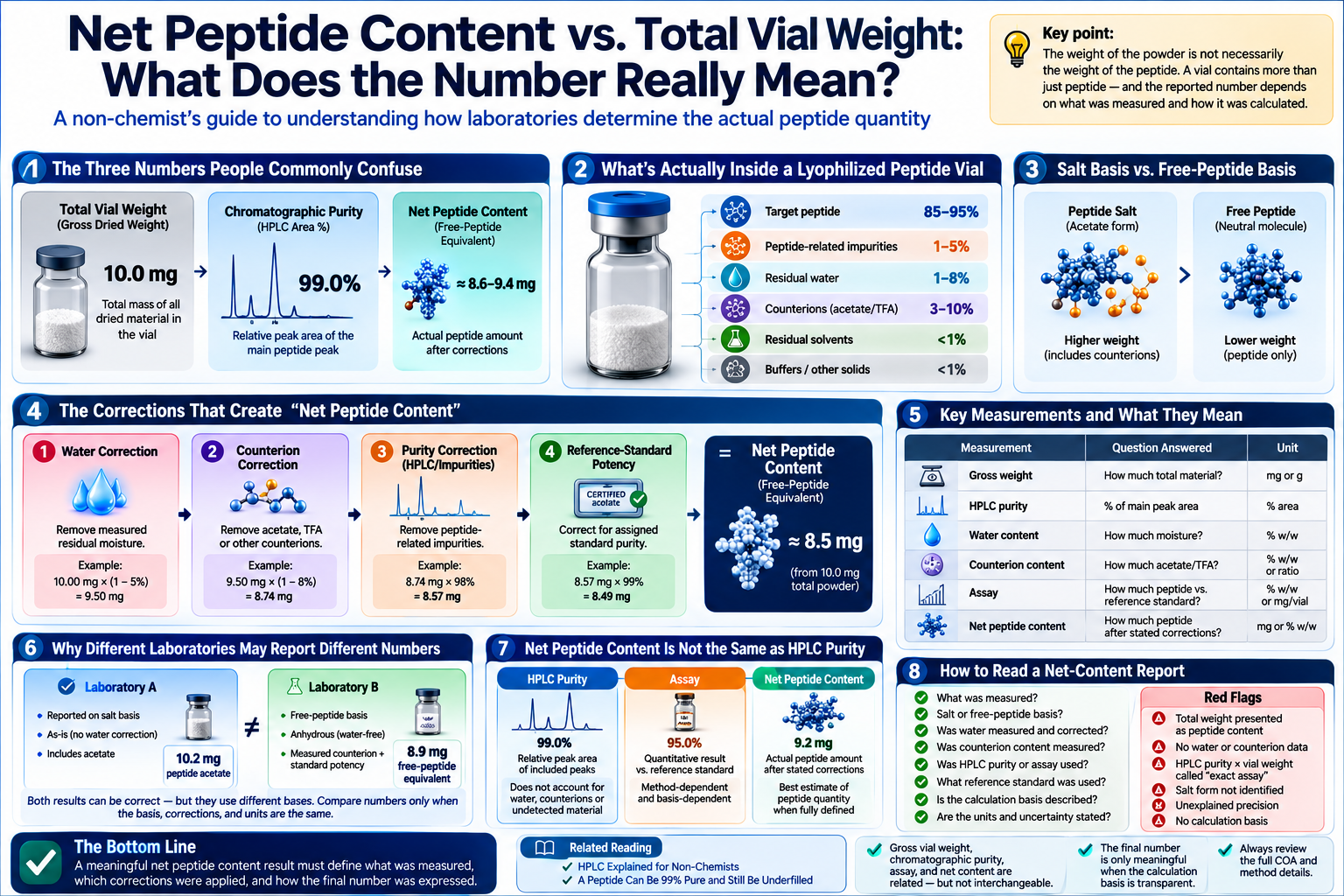
Net Peptide Content: Three Numbers People Often Confuse
Moreover, when someone asks how much peptide is in a vial, they may unknowingly be asking about three different measurements.
Total dried-material weight
As a result, the total mass of all dried solids in the vial, including peptide and non-peptide material.
Peptide-containing material
Likewise, the portion associated with the peptide material after some impurities or non-peptide components are considered.
Free-peptide equivalent
By contrast, the amount expressed as the neutral peptide molecule after correcting for water, counterions, salts, purity, and other defined factors.
In addition, these values can be numerically different even when every laboratory performs its work correctly.
However, Total vial weight asks: “How much dried material is present?”
For example, Net peptide content asks: “How much of that material is linked to the peptide under the stated calculation basis?”
What Does “Net Peptide Content” Mean?
Therefore, Net peptide content generally refers to the amount of peptide in a sample after specified non-peptide parts or lab corrections have been considered.
Moreover, the term sounds straightforward, but it is not completely used the same way in casual commercial use. As a result, one report may use “net peptide content” to mean peptide amount after purity correction. Likewise, another may additionally correct for water and counterions. By contrast, a third may express the result as the full acetate or trifluoroacetate salt rather than as the free peptide.
Therefore, a net-content number is incomplete unless the report states:
- What was directly measured
- However, which components were subtracted or corrected
- For example, whether the result is on an as-is or dried basis
- Therefore, whether the result the report expresses as a salt or free peptide
- Moreover, whether HPLC purity was included in the calculation
- As a result, whether a test standard served
- Likewise, how the test standard’s assigned potency was handled
By contrast, official and official discussions of synthetic peptide standards treat peptide-related impurities, water, counterions, residual solvents, and inorganic residues as distinct contributors that may need to be measured when assigning content or potency.
What Is Gross Dried Weight?
In addition, Gross dried weight is the total weight of the dried material recovered or present in a container before determining how much of that material is the target peptide.
It may include:
- The target peptide
- Peptide-related impurities
- However, counterions such as acetate or trifluoroacetate
- Residual water
- Residual solvents
- Buffer salts
- Bulking agents or excipients
- Inorganic residues
- Other nonvolatile material
For example, Freeze-drying removes much of the water, but some moisture can remain. In addition, FDA describes the process as freezing, primary drying, and secondary drying rather than a guarantee of zero water. See the FDA freeze-drying Inspection Guide.
Gross weight is not automatically peptide content
As a result, if a laboratory weighs 12.0 milligrams of dried powder, it has established that about 12.0 milligrams of total dried material were weighed. Likewise, it has not established that the powder contains 12.0 milligrams of free peptide.
By contrast, the powder could in theory contain:
- In addition, 9.0 milligrams of peptide-related material
- 1.2 milligrams of water
- 1.0 milligram of counterions
- However, 0.8 milligram of impurities or other solids
For example, even so, the balance would still read 12.0 milligrams.
“Weighed 10 mg” does not always mean “contains 10 mg of peptide”
Therefore, weight-based weight measures everything placed on the balance. Moreover, it does not identify which portion is target peptide unless the makeup and correction factors are also known.
What Is Net Peptide Content?
As a result, in lab use, net peptide content attempts to move beyond total powder weight and estimate the actual amount linked to the peptide.
Likewise, a simplified calculation may look like:
However, the “assigned peptide fraction” may include several different measurements:
- HPLC purity
- Water content
- counterion content
- Residual solvent content
- Inorganic or noncombustible residue
- Reference-standard potency
- Assay recovery
In addition, a more complete basic equation is:
However, not every laboratory uses this exact mathematical sequence. For example, some components may be measured directly rather than calculated. Therefore, some methods report results separately rather than multiplying all factors together.
Moreover, the essential point is that the report should define the basis of calculation.
What Is Free-Peptide Equivalent?
As a result, Free-peptide equivalent means the amount expressed as the neutral or without linked ions peptide molecule rather than as the peptide plus its counterions or salt-form part.
Likewise, peptides often contain charge-forming groups. By contrast, during manufacturing and purification, charged peptide molecules may be associated with oppositely charged ions such as:
- Acetate
- Trifluoroacetate
- Hydrochloride or chloride-associated forms
- Other method-dependent counterions
In addition, these counterions contribute physical mass to the dried material. However, a result expressed as free-peptide equivalent removes the assigned counterion part so that the number represents the peptide portion alone under the stated model.
Free peptide does not mean the vial literally contains an isolated neutral molecule
For example, “Free-peptide equivalent” is normally a reporting basis. Therefore, it does not always mean the physical material exists in the vial entirely as uncharged, counterion-free molecules.
Moreover, it means the laboratory converted the measured amount to an equivalent quantity based on the molecule weight of the defined peptide form.
Salt Basis vs. Free-Peptide Basis
As a result, a peptide-content result may be reported on different chemical bases.
Salt basis
Likewise, reports the amount as the peptide plus the expected associated counterion or salt form.
Free-peptide basis
By contrast, reports the amount as the peptide molecule alone, after applying the defined counterion correction.
Why the basis changes the number
In addition, imagine that one mole of a peptide is associated with several acetate ions. However, the acetate ions add mass to the material but are not part of the peptide’s amino-acid chain.
For example, the peptide acetate salt therefore has a larger formula weight than the free peptide.
Therefore, for the same physical sample:
- Moreover, the quantity expressed as peptide salt may be numerically higher.
- As a result, the quantity expressed as free-peptide equivalent may be numerically lower.
Likewise, neither result is automatically incorrect. By contrast, they answer the question using different reporting conventions.
10.0 mg peptide salt
In addition, includes the mass assigned to the peptide and its defined counterion part.
8.9 mg free-peptide equivalent
However, excludes the mass attributed to the counterions in this simplified example.
For example, the example is illustrative only. Therefore, the actual conversion depends on the peptide’s sequence, charge state, counterion identity, counterion ion ratio, molecule weight, and lab result.
What Is Water Correction?
Moreover, freeze-dried powder can retain residual moisture. As a result, because water contributes to the weighed mass, a laboratory may measure water content and correct the result to a dry or water-free basis.
Likewise, common water-test approaches can include:
- Karl Fischer titration
- By contrast, loss on drying under defined conditions
- heat-and-weight approaches
- Other proven moisture methods
In addition, Water content is a separate quality feature because it affects both sample weight and storage behavior. Therefore, ICH guidance lists water as a test that may be important for a drug substance. See the ICH Q6A limits guideline.
Example of water correction
Suppose:
- Therefore, total sample weight: 10.00 mg
- Measured water content: 5.0%
Moreover, after water correction, the sample contains 9.50 milligrams of non-water material.
As a result, this still does not mean it contains 9.50 milligrams of pure peptide. Likewise, counterions, impurities, and other solids may remain.
As-is basis versus dried basis
| Reporting basis | Meaning |
|---|---|
| As-is basis | By contrast, reports the sample as tested, including its measured or uncorrected water part. |
| Dry or water-free basis | In addition, mathematically removes the measured water part from the reported result. |
However, two laboratories can report different-looking assay percentages if one reports the material as-is and the other reports it on an water-free basis.
What Is counterion Correction?
For example, a peptide may carry multiple positive or negative charges depending on its sequence and the test conditions. Therefore, counterions balance those charges.
Moreover, in synthetic peptide materials, common counterions can originate from:
- Purification solvents and acids
- Ion-exchange steps
- As a result, final formulation or freeze-drying conditions
- Deliberate salt conversion
Likewise, the counterion part can be measured using an suitable method, such as ion HPLC testing or another proven method, depending on the ion being evaluated.
By contrast, fDA reviews of peptide products may treat counterion assay, water content, assay, and related substances as separate limit quality features.
Why assumed counterion content can be misleading
In addition, a laboratory should not automatically assume that every peptide molecule carries the theoretical maximum number of counterions.
However, actual counterion content can vary because of:
- Incomplete salt exchange
- Mixed counterions
- Variable charge states
- Residual purification chemicals
- Manufacturing conditions
- Storage and moisture exposure
For example, a correction based on measured acetate content may therefore differ from a correction based only on theoretical molecular ion ratio.
counterion correction must identify the assumed chemical form
Therefore, a report should state whether the correction is based on measured counterion content, theoretical salt ion ratio, or another defined assumption. Moreover, otherwise, the free-peptide-equivalent result cannot be separately evaluated.
What Is Purity Correction?
As a result, a purity correction attempts to account for the portion of peptide-related material that is not the intended target peptide.
For example, a chromatogram may report:
- Main peptide peak: 98.0%
- Peptide-related impurities: 2.0%
By contrast, a simplified calculation might multiply the corrected solid material by 0.980.
Why HPLC area purity may not equal a true mass fraction
In addition, hPLC area percentage represents the relative detector response assigned to included peaks. However, it does not always prove that the same percentage of the sample’s physical mass is the target peptide.
Potential limitations include:
- For example, different response factors between the peptide and impurities
- Undetected non-UV-absorbing components
- Excluded peaks
- Co-eluting impurities
- Integration thresholds
- Solvent-front exclusions
Therefore, multiplying vial weight by HPLC area purity can provide an estimate under stated assumptions, but it should not automatically be described as an exact absolute assay.
Moreover, See HPLC Explained for Non-Chemists for a detailed explanation of area percentage, excluded peaks, integration, and why HPLC purity is not the same as assay.
What Is Reference-Standard Potency?
As a result, measured peptide analysis often compares the sample response with a test standard.
Likewise, a test standard is a characterized material used as a measurement benchmark. However, the material in the reference-standard container is not always 100.0% active peptide on every reporting basis.
In addition, its assigned value may account for:
- Peptide purity
- Water content
- counterion content
- Residual solvents
- Inorganic residues
- Other measured impurities
- However, the basis on which potency the lab assigns
For example, FDA expects laboratories to document the reference standards used for testing. Moreover, ICH validation guidance separates assay, purity, potency, and impurity testing because they answer different questions. See the ICH Q2(R2) lab validation guideline.
Example of reference-standard correction
As a result, suppose a laboratory prepares what appears to be a 1.00 mg/mL reference-standard solution. Likewise, the test standard’s certificate assigns a potency of 92.0% on the required basis.
By contrast, the actual assigned peptide concentration would be:
In addition, if the laboratory incorrectly treated the standard as 100% potent, the calculated sample result could be biased.
Potency does not always mean biological activity
However, in this context, “standard potency” may refer to the assigned content of the chemical reference material rather than a biological effect.
A report should distinguish:
- For example, chemical assay or assigned content
- HPLC purity
- Biological potency
- Free-peptide-equivalent content
Complete Simplified Calculation Example
Therefore, consider a vial containing 12.00 milligrams of total dried material.
Laboratory testing reports:
- Water content: 5.0%
- Moreover, counterion and other corrected non-peptide part: 8.0%
- HPLC main-peak purity: 97.5%
- Reference-standard correction: 98.0%
Total dried-material weight
12.00 × 0.950
11.40 × 0.920
10.49 × 0.975
10.22 × 0.980
Under this simplified model:
As a result, this example is intended to explain the concept. Likewise, a real laboratory may use a checked assay, amino-acid analysis, nitrogen analysis, mass-balance assignment, or another proven method rather than simply multiplying independent percentages.
Correction factors are not always directly multiplied
By contrast, some values may overlap or be expressed on different bases. For example, an assay result may already include reference-standard potency or water correction. However, applying the same correction a second time would produce an incorrect result.
Net Peptide Content Is Not the Same as HPLC Purity
| Measurement | Question answered | Common reporting unit |
|---|---|---|
| Gross vial weight | For example, how much total material was weighed? | mg or g |
| HPLC area purity | Therefore, what percentage of the included HPLC signal belongs to the main peak? | % area |
| Water content | Moreover, how much measured moisture is present? | % w/w |
| counterion content | As a result, how much acetate, TFA, chloride, or another ion is present? | Likewise, % w/w, molar ratio, or concentration |
| Assay | By contrast, how much target compound is present relative to a standard? | In addition, % w/w, mg/mL, mg/vial, or another defined unit |
| Net peptide content | However, how much peptide is present after the report’s stated corrections? | For example, mg, % w/w, or free-peptide equivalent |
Therefore, a sample can therefore be:
- Moreover, 99% pure by HPLC area
- 5% water by weight
- 8% counterion by weight
- As a result, underfilled relative to its label
Likewise, none of these statements always contradicts the others.
By contrast, See A Peptide Can Be 99% Pure and Still Be Underfilled for a focused explanation of why relative purity does not establish labeled vial quantity.
Why Different Laboratories May Report Different Numbers
In addition, two competent laboratories can analyze material from the same vial and report different-looking values without either laboratory always being dishonest.
However, differences may result from the reporting basis, lab method, sample preparation, or calculation model.
Different reporting bases
For example, one laboratory may report as-is content while another reports on an water-free basis.
Salt versus free-peptide basis
Therefore, one result may include acetate or another counterion, while another removes it.
Different water methods
Moreover, karl Fischer, loss on drying, and other methods may not measure exactly the same volatile part.
Measured versus assumed counterions
As a result, one laboratory may test acetate directly while another uses theoretical ion ratio.
Different reference standards
Likewise, standards can have different assigned values, source record, water content, or correction bases.
Different assay methods
By contrast, measured HPLC, amino-acid analysis, elemental analysis, and mass-balance approaches do not measure content in the same way.
Different HPLC integrations
In addition, peak inclusion, thresholds, co-elution, and response-factor assumptions can change purity corrections.
Sampling variation
However, different vials, sample portions, or portions of uneven material may produce different results.
moisture-absorbing behavior
For example, some materials absorb moisture during storage, shipping, opening, or sample preparation.
Rounding and uncertainty
Therefore, laboratories may use different shown digits, uncertainty estimates, and rounding rules.
Overlapping corrections
Moreover, a reported assay may already include corrections that another laboratory reports separately.
Different definitions
As a result, “Peptide content,” “net content,” “assay,” and “potency” may be used differently unless explicitly defined.
Example of two reports that may both be correct
10.8 mg peptide acetate
- Likewise, reported on an as-is basis
- Includes assigned acetate part
- By contrast, no separate water correction in the displayed result
9.6 mg free-peptide equivalent
- In addition, corrected to an water-free basis
- Excludes measured acetate
- Corrected using reference-standard potency
However, these numbers cannot be compared fairly until they are converted to the same basis.
For example, before comparing two laboratories, make sure both results use the same chemical form, water basis, counterion basis, purity model, reference-standard basis, and reporting units.
How to Review a Net Peptide Content Report
Identify the starting measurement
Therefore, determine whether the calculation began with vial weight, sample weight, solution concentration, or checked assay response.
Find the reporting basis
Moreover, look for terms such as as-is, dried basis, water-free basis, salt basis, or free-peptide basis.
Check the water result
As a result, confirm whether water the lab measured, which method served, and whether the final result the lab corrected.
Check the counterion
Likewise, identify whether acetate, TFA, chloride, or another ion was tested, assumed, or ignored.
Review peptide purity
By contrast, determine whether the correction used HPLC area purity, a checked impurity method, or another result.
Review the assay method
In addition, look for measured HPLC, amino-acid analysis, mass balance, or another defined lab method.
Inspect the test standard
However, confirm its identity, lot, assigned value, correction basis, and source record.
Watch for double correction
For example, determine whether water, purity, or standard potency was already built into the assay result.
Check the units
Therefore, distinguish milligrams per vial, percent by weight, milligrams per milliliter, and percentage of label claim.
Look for uncertainty
Moreover, a result presented to too much decimal precision may imply more certainty than the method supports.
Match the batch and vial
As a result, confirm that the report applies to the actual batch and sampling plan being represented.
Read the calculation notes
Likewise, a final number without its calculation basis is not enough to separately interpret net peptide content.
Red Flags in Net-Content Claims
Weight and Assay Red Flags
- By contrast, Total powder weight the report presents as peptide content. No water, counterion, purity, or assay information the report provides.
- However, The report says “10 mg confirmed” without naming the method. It is unclear whether the laboratory weighed powder, performed an assay, or calculated a free-peptide equivalent.
- Therefore, HPLC purity is multiplied by vial weight and called an exact assay. This may ignore water, counterions, undetected material, and response-factor differences.
- As a result, The salt form is not identified. The reader cannot determine whether the reported amount includes acetate, TFA, or another counterion.
- By contrast, Water content is not reported. A useful portion of the sample weight may be residual moisture.
Calculation and Reporting Red Flags
- However, The reference-standard potency is missing. The measured result cannot be fully reconstructed.
- However, The report mixes average and monoisotopic molecular weights. The salt or free-peptide conversion may be calculated incorrectly.
- As a result, The same correction the lab applies twice. Water, purity, or standard potency may already be included in the reported assay.
- By contrast, The result contains unexplained precision. Reporting 10.0037 mg does not mean the complete method supports accuracy to four decimal places.
- However, Different laboratories the lab compares without matching the basis. A salt-basis result cannot be directly compared with a free-peptide-equivalent result.
Frequently Asked Questions About Net Peptide Content
Weight, Content, and Free-Peptide Basics
Therefore, is total vial weight the same as peptide content?
Moreover, no. As a result, total vial weight may include peptide, water, counterions, impurities, salts, buffers, excipients, and other solids.
What is net peptide content?
By contrast, it is an estimate or measurement of the amount linked to the peptide after the report’s specified corrections or lab calculations have been applied.
What is free-peptide equivalent?
In addition, it is the amount expressed as the peptide molecule itself after removing the assigned mass part of counterions or the salt form.
However, can a vial weigh more than its labeled peptide amount?
For example, yes. Therefore, the additional mass may come from counterions, water, buffers, excipients, or other non-peptide components.
Purity, Water, and Counterions
Can a vial weigh 10 mg but contain less than 10 mg of peptide?
As a result, yes. Likewise, a balance measures the entire sample, not only the target peptide.
By contrast, does 99% HPLC purity mean 99% of the powder is peptide?
In addition, not always. However, hPLC area purity represents the proportion of included detector response attributed to the main peak. As a result, it does not automatically account for water, counterions, salts, or undetected material.
Therefore, why is water measured separately?
Moreover, residual water contributes to sample weight and may affect stability. As a result, it is not reliably represented by an ordinary peptide HPLC purity chromatogram.
Likewise, why does acetate content matter?
By contrast, acetate is a common peptide counterion. However, it contributes mass to the dried material but is not part of the peptide’s amino-acid sequence.
Comparing Laboratory Results
However, can two laboratories report different net content?
For example, yes. Therefore, they may use different assay methods, reference standards, water corrections, counterion assumptions, sample preparations, or reporting bases.
Moreover, which laboratory result should be trusted?
As a result, the stronger report clearly identifies the method, reporting basis, standard, measured corrections, calculations, uncertainty, sample identifiers, and limitations. As a result, the largest or most favorable number is not automatically the most accurate.
Net Peptide Content Depends on the Calculation Basis
By contrast, a freeze-dried vial can contain multiple contributors to its total dried weight:
- Target peptide
- Peptide-related impurities
- Residual water
- counterions
- Residual solvents
- In addition, buffers, excipients, or other solids
However, a useful net peptide content result must define what the lab measured and how the result was expressed.
Readers should ask:
- For example, was the material directly assayed or merely weighed?
- Therefore, was water measured and corrected?
- Therefore, was counterion content measured or assumed?
- As a result, is the result on a salt basis or free-peptide basis?
- Likewise, was HPLC purity used as a correction?
- By contrast, was a characterized test standard used?
- In addition, was standard potency included in the calculation?
- However, are the units and reporting basis clearly stated?
However, gross vial weight, HPLC purity, assay, and free-peptide-equivalent content relate to one another, but they do not mean the same thing.
Therefore, the final number is only useful when the calculation basis is transparent.