How to Read a Peptide COA Without Being Misled
First, Learning how to read a peptide COA helps you separate useful evidence from false confidence. Likewise, this guide explains identity, chromatographic purity, assay, vial quantity, impurities, and safety-related testing so one impressive number does not become proof of everything.
In addition, Important context: This article is for analytical and educational purposes. A COA is not regulatory approval, medical authorization, or proof that a research material is safe, sterile, effective, or appropriate for human use. Research-use-only materials researchers should handle only within properly controlled research settings and according to applicable laws, institutional requirements, and validated protocols.
How to Read a Peptide COA: Start With the Document
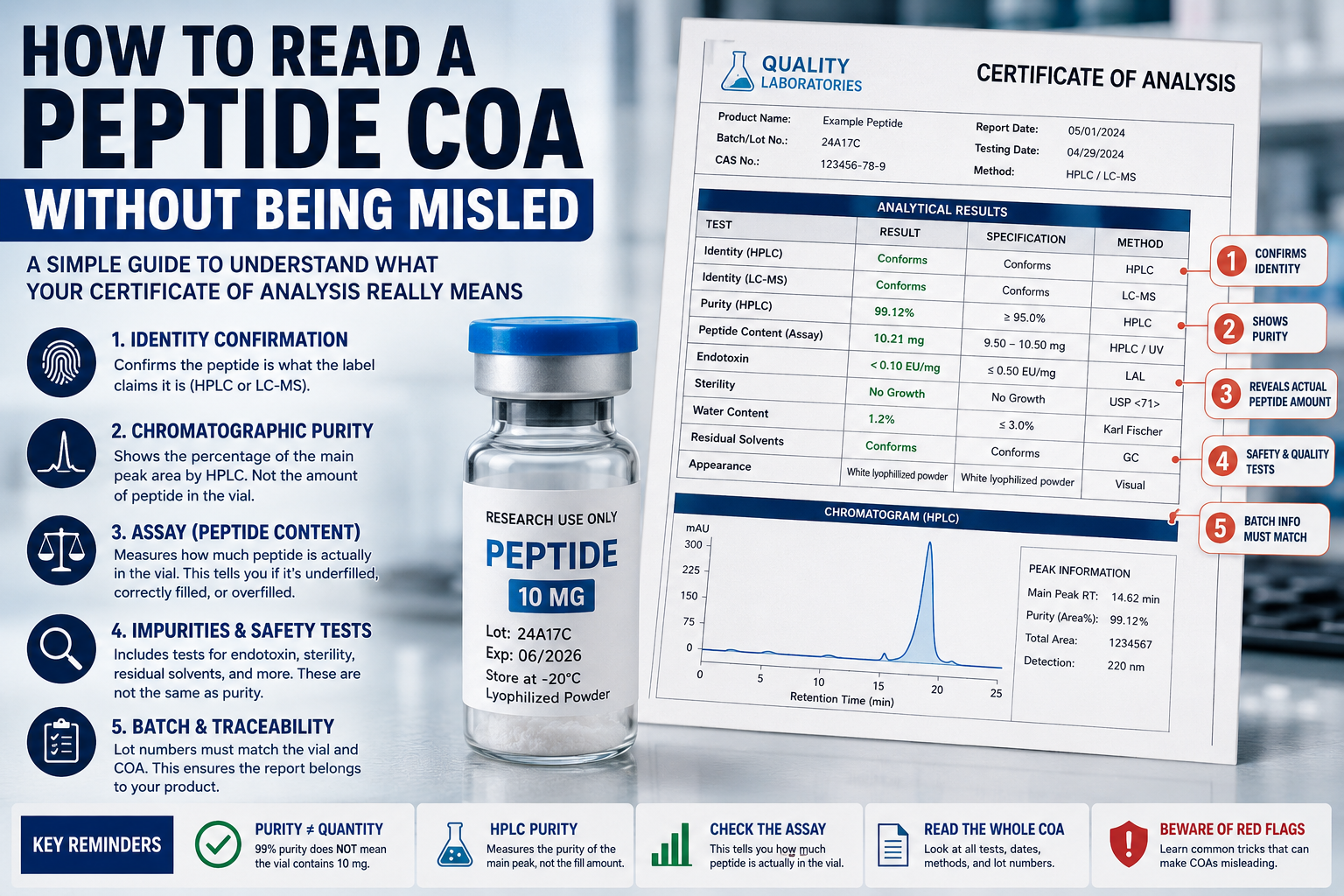
For example, a certificate of analysis, usually shortened to COA, is a document summarizing analytical testing performed on a defined sample. Ideally, it identifies the sample, the batch or lot, the methods used, the results obtained, the specifications or acceptance criteria applied, the laboratory that performed the work, and the date the testing the laboratory completed testing.
However, a COA read as a structured report about a particular sample under particular test conditions. It is not a universal guarantee. Its strength depends on the quality of the sample, the relevance of the methods, the competence and independence of the laboratory, the validity of the analytical procedures, the integrity of the data, and whether the tested sample actually represents the material being offered.
Therefore, The central rule: Never ask only, “Did it pass?” Ask, “What exactly the laboratory tested, by which method, against what standard, on which sample, from which batch, and what does that result actually establish?”
A COA is evidence, not a conclusion
Moreover, Different tests answer different questions. For example, reversed-phase HPLC with ultraviolet detection may estimate the proportion of detected chromatographic components represented by the main peak. Meanwhile, mass spectrometry may support molecular identity by showing that the observed mass is consistent with the expected peptide. A quantitative assay may estimate how much peptide the sample contains. Sterility and bacterial endotoxin tests address entirely different quality attributes.
Likewise, a document containing only a peptide name and “Purity: 99.4%” may look reassuring, but it leaves major questions unanswered. As a result, a scientifically meaningful assessment usually requires a combination of complementary tests rather than a single number.
The Five Questions Every Peptide COA Should Help Answer
Is it the expected molecule?
Meanwhile, this is an identity question. Mass spectrometry, retention-time comparison, peptide mapping, amino-acid analysis, or other orthogonal methods may contribute.
How much of the detected material is the main component?
As a result, this laboratories commonly report as chromatographic purity. It is not automatically the same as active content or labeled vial quantity.
How much peptide the sample contains?
By contrast, this is an assay or content question. It may require a calibrated quantitative method and a suitable reference standard.
Which impurities did the report evaluate?
Also, Related peptides, deletion sequences, oxidation products, residual solvents, counterions, water, and other contaminants require different analytical approaches.
Does the result apply to this batch?
Next, the lot number, sample source, collection process, testing date, and chain of custody determine whether a report is actually relevant to the material under review.
What the report did not test?
Instead, Absence from a report usually means “not reported,” not “tested and absent.” A purity COA may say nothing about sterility, endotoxin, bioburden, or elemental impurities.
Purity and Quantity Are Not the Same
For instance, this is the most important distinction in the entire article. By contrast, a peptide can produce a high chromatographic purity result and still contain less peptide than the labeled amount. Conversely, a vial can contain approximately the expected total peptide quantity while also containing a meaningful proportion of related impurities.
| Term | What it generally asks | What it does not automatically prove |
|---|---|---|
| Identity | Is the detected analyte consistent with the expected peptide? | Purity, amount, sterility, endotoxin status, or correct vial fill. |
| Chromatographic purity | What percentage of integrated detected peak area analysts assign to the main component under the stated method? | Total peptide mass, labeled milligrams, absence of non-detected contaminants, or biological activity. |
| Assay | How much of the specified analyte the sample contains relative to a calibrated standard or defined method? | Complete identity confirmation, all impurities, sterility, or uniformity across every vial. |
| Net peptide content | How much actual peptide the sample contains after accounting for components such as water, counterions, and sometimes purity? | That every supplier uses the term in exactly the same way. |
| Gross vial content | How much total dried material is in the vial? | How much of that material is active peptide. |
Why 99% purity can coexist with underfilling
Finally, Imagine a vial labeled as containing 10 mg of a peptide. Also, a laboratory analyzes a sample and reports 99.2% HPLC purity. That number may indicate that 99.2% of the integrated UV-detected chromatographic peak area belonged to the main peak. It does not necessarily show that 10 mg of peptide was present. The vial could theoretically contain 7 mg of highly pure peptide, 10 mg, or another amount unless a validated or otherwise fit-for-purpose quantitative content test the laboratory performed.
Why the dried cake cannot answer the question
First, the visible size of a lyophilized cake is not a reliable measurement of peptide mass. Excipients, buffers, salts, moisture, freezing conditions, vial geometry, concentration before drying, and the lyophilization cycle can dramatically change cake volume and appearance. A larger cake may contain more bulking agent rather than more peptide. A very small or nearly invisible deposit may still contain the stated peptide amount if little excipient was used. For more context, see what is actually inside a lyophilized peptide vial.
Anatomy of a Credible Peptide COA
In addition, a professional layout alone does not make a COA trustworthy. Next, review the document field by field and determine whether the information creates a traceable, technically coherent record.
Laboratory identity
For example, Look for the laboratory’s legal name, address, contact information, and report identifiers. Instead, accreditation scope can be relevant, but accreditation alone does not validate every method or every result.
Unique report number
However, a traceable report or job number helps distinguish an original test from a generic template and allows verification with the issuing laboratory.
Sample identification
Therefore, the sample description should be specific enough to connect it to the material tested, including peptide name, form, concentration when relevant, and sample condition.
Lot or batch number
Moreover, the batch identifier on the report should match the product label or supplier’s batch record. For instance, a generic product-name COA is weaker evidence than a lot-specific report.
Dates
Likewise, Check the sample-received date, test date, and report date. Finally, dates should follow a plausible sequence and align with the batch’s manufacturing and distribution timeline.
Methods
Meanwhile, the COA should identify the analytical technique and ideally the method number, version, detector, column, or other details sufficient to understand what the laboratory did.
Specifications
As a result, a result without an acceptance criterion may still provide data, but it does not show what standard was applied or whether “pass” was scientifically justified.
Results and units
By contrast, Results should include correct units, appropriate significant figures, and enough context to distinguish area percent, mass percent, concentration, and total content.
Raw-data attachments
Also, Chromatograms, spectra, integration tables, calibration information, and sample-preparation details allow a deeper review than a one-page summary alone.
Authorization
Next, Look for an electronic approval, analyst review, quality review, or authorized signature. First, a signature image by itself is not proof, but missing authorization weakens traceability.
Specifications versus results
Instead, a result is what the laboratory measured. A specification is the predefined acceptance criterion used to decide whether the result is acceptable. For example:
| Test | Example specification | Example result | Interpretation |
|---|---|---|---|
| Identity by MS | Observed mass consistent with theoretical mass | Conforms | Supports identity under the stated method. |
| Purity by RP-HPLC | Not less than 98.0% area | 99.1% area | Meets that chromatographic criterion. |
| Peptide content | 9.0–11.0 mg per vial | 9.7 mg per vial | Meets that quantitative content range. |
For instance, Teams should establish specifications before they know the result. In addition, a pass/fail statement is less meaningful when the acceptance criterion the report hides, altered after testing, or chosen solely to make the sample pass.
How to Read HPLC or UPLC Results
Finally, High-performance liquid chromatography (HPLC) and ultra-performance liquid chromatography (UPLC or UHPLC) separate components based on how they interact with a stationary phase and a flowing mobile phase. In peptide testing, reversed-phase chromatography analysts commonly use to examine the main peptide and related components.
What the chromatogram shows
First, a chromatogram plots detector response against time. Each detected component may appear as a peak. The time at which a peak appears is its retention time. The integrated area under a peak analysts often use to estimate its relative contribution to the total detected chromatographic area.
Main peak
In addition, the largest peak is often assigned to the target peptide, but size alone does not establish identity. For example, assignment should be supported by a reference standard, mass spectrometry, or another suitable identity method.
Impurity peaks
For example, Smaller peaks may represent synthesis-related impurities, degradation products, isomers, adducts, or other UV-active components. However, not every impurity is necessarily resolved or detected.
Baseline and solvent front
However, Early disturbances, injection artifacts, solvent peaks, and baseline drift should not automatically be interpreted as peptide impurities. Therefore, proper integration and method suitability matter.
What “area percent” actually means
Therefore, Many peptide COAs report purity using area normalization:
Moreover, this is a relative chromatographic calculation. Moreover, it generally assumes that the included components respond comparably at the selected detection wavelength, an assumption that may not always hold. Some impurities absorb ultraviolet light differently from the main peptide. Compounds with little or no response at the chosen wavelength may be underestimated or missed. Nonvolatile salts, water, some excipients, and certain contaminants may not appear as meaningful peaks in the same method.
Questions to ask about an HPLC result
- Was the method intended for identity, purity, assay, or more than one purpose?
- Which detector and wavelength the laboratory used?
- Was a suitable peptide reference standard analyzed?
- Did the report include the full chromatogram and integration table?
- Were all relevant peaks integrated, or were some excluded?
- What was the reporting threshold for small peaks?
- Did the laboratory demonstrate system suitability?
- Could the method separate known related impurities and degradation products?
- How did the report express the result: area percent, weight percent, concentration, or assay?
Retention time is supportive, not definitive by itself
Likewise, a peak appearing at approximately the same retention time as a known standard supports identification, but unrelated compounds can sometimes coelute or produce similar retention behavior. Likewise, identity is stronger when chromatographic comparison is paired with an orthogonal technique such as mass spectrometry.
Why a perfect-looking chromatogram may still be incomplete
Meanwhile, Chromatography only reveals what the method can separate and what the detector can detect under the chosen conditions. Meanwhile, a narrow monitoring window, unsuitable wavelength, poor resolution, high reporting threshold, overloaded column, or selective integration can create an overly reassuring picture. This is why raw-data context and method suitability matter more than the beauty of the graph.
How to Read Mass Spectrometry Results
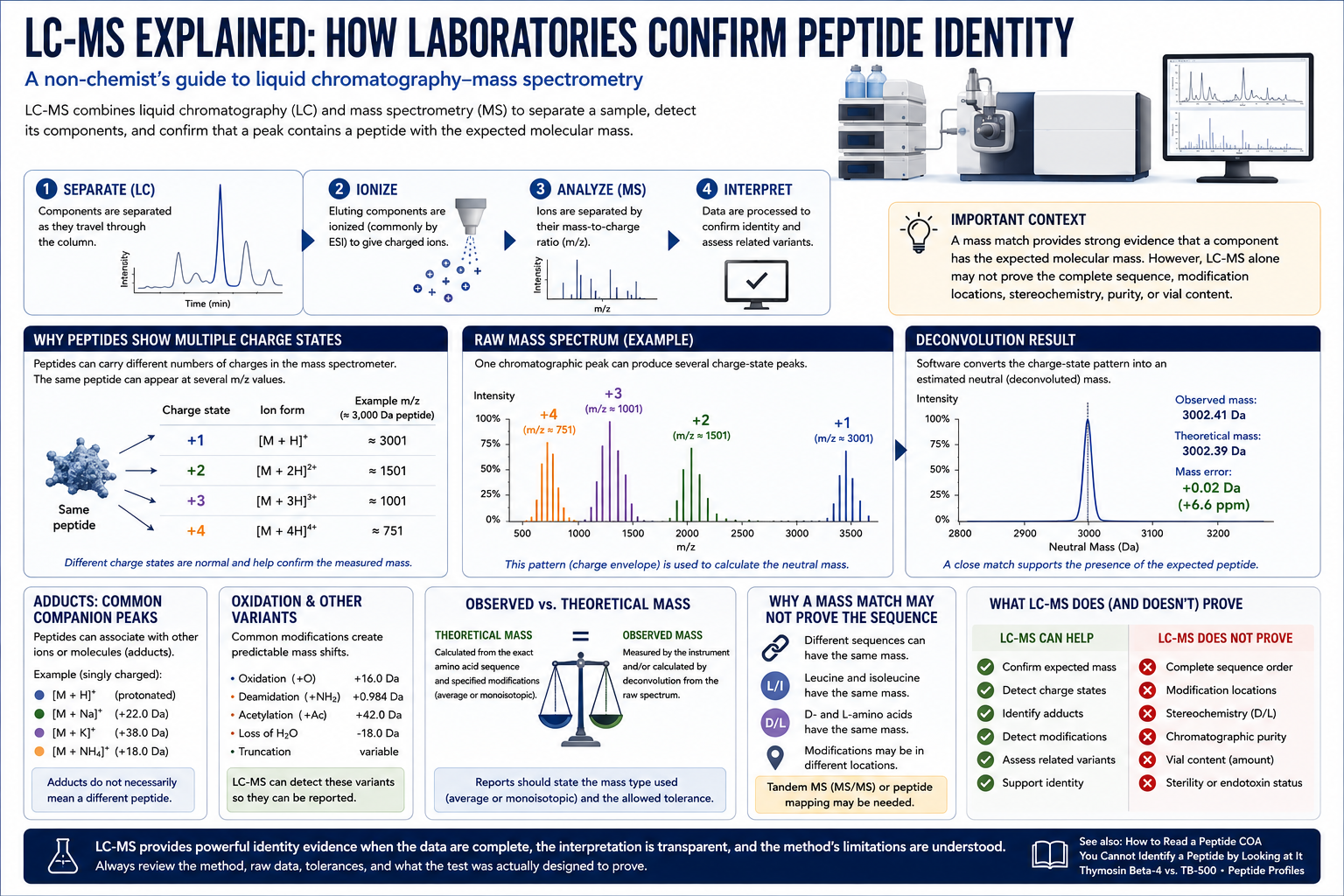
As a result, Mass spectrometry measures ions according to their mass-to-charge ratio, written as m/z. For peptides, electrospray ionization commonly produces several charge states. A peptide with a molecular mass of several thousand daltons may therefore generate peaks at much lower m/z values because each ion carries multiple charges.
Theoretical mass versus observed mass
By contrast, a COA may list a theoretical molecular mass calculated from the expected sequence and an observed mass derived from the spectrum. As a result, close agreement supports identity. However, interpretation depends on whether the report is using monoisotopic mass, average molecular weight, neutral mass, protonated ions, or a deconvoluted spectrum.
Also, Do not compare numbers blindly. A theoretical “molecular weight” from a product page may use average mass, while a laboratory spectrum may report monoisotopic mass or an ion with added protons, sodium, water, or another adduct.
Common features in peptide mass spectra
| Feature | Meaning | What to verify |
|---|---|---|
| Multiple charge states | The same peptide carrying different numbers of charges. | Whether the charge-state series deconvolutes to the expected neutral mass. |
| Deconvoluted mass | Software-estimated neutral molecular mass reconstructed from charged ions. | Mass tolerance, algorithm, and whether additional species the spectrum contained. |
| Sodium or potassium adduct | An ion associated with a metal cation, shifting the observed m/z. | Whether the shift is consistent with the proposed adduct. |
| Oxidized species | A mass shift that may reflect oxidation, often involving susceptible residues. | Whether the chromatographic method separates and quantifies the oxidized form. |
| Truncated sequence | A lower-mass species that may arise from incomplete synthesis or degradation. | Whether it was identified and included in impurity assessment. |
Mass match does not equal purity
Next, Mass spectrometry can detect a species consistent with the expected peptide even when substantial impurities are present. By contrast, a spectrum showing the correct mass answers an identity question; it does not automatically show that the sample is 99% pure or that the vial contains the labeled amount.
Mass match does not always prove sequence order
Instead, Two peptides can theoretically have the same elemental composition and intact molecular mass while differing in amino-acid order. Also, more extensive characterization—such as tandem mass spectrometry, peptide fragmentation, amino-acid analysis, comparison with a qualified reference standard, or other sequence-sensitive methods—analysts may require when sequence confirmation the purpose demands certainty.
Assay, Peptide Content, and Vial Quantity
For instance, When a label states a number of milligrams per vial, the most directly relevant analytical question is whether a quantitative test supports that content claim. Next, a purity percentage alone does not answer it.
What makes a quantitative method credible?
Finally, a meaningful assay normally requires a calibrated method, appropriate standards, controlled sample preparation, defined units, and evidence that the procedure is fit for its intended purpose. Instead, depending on the material and laboratory, quantitative approaches may include calibrated HPLC or UPLC, amino-acid analysis, quantitative NMR, mass-balance approaches, or other validated or scientifically justified methods.
Reference-standard potency matters
First, a reference standard is not always 100% peptide by mass. For instance, it may contain water, counterions, residual solvents, or other components. A well-controlled assay accounts for the assigned potency or content of the standard. Simply weighing a nominal amount of an unqualified standard can bias the result.
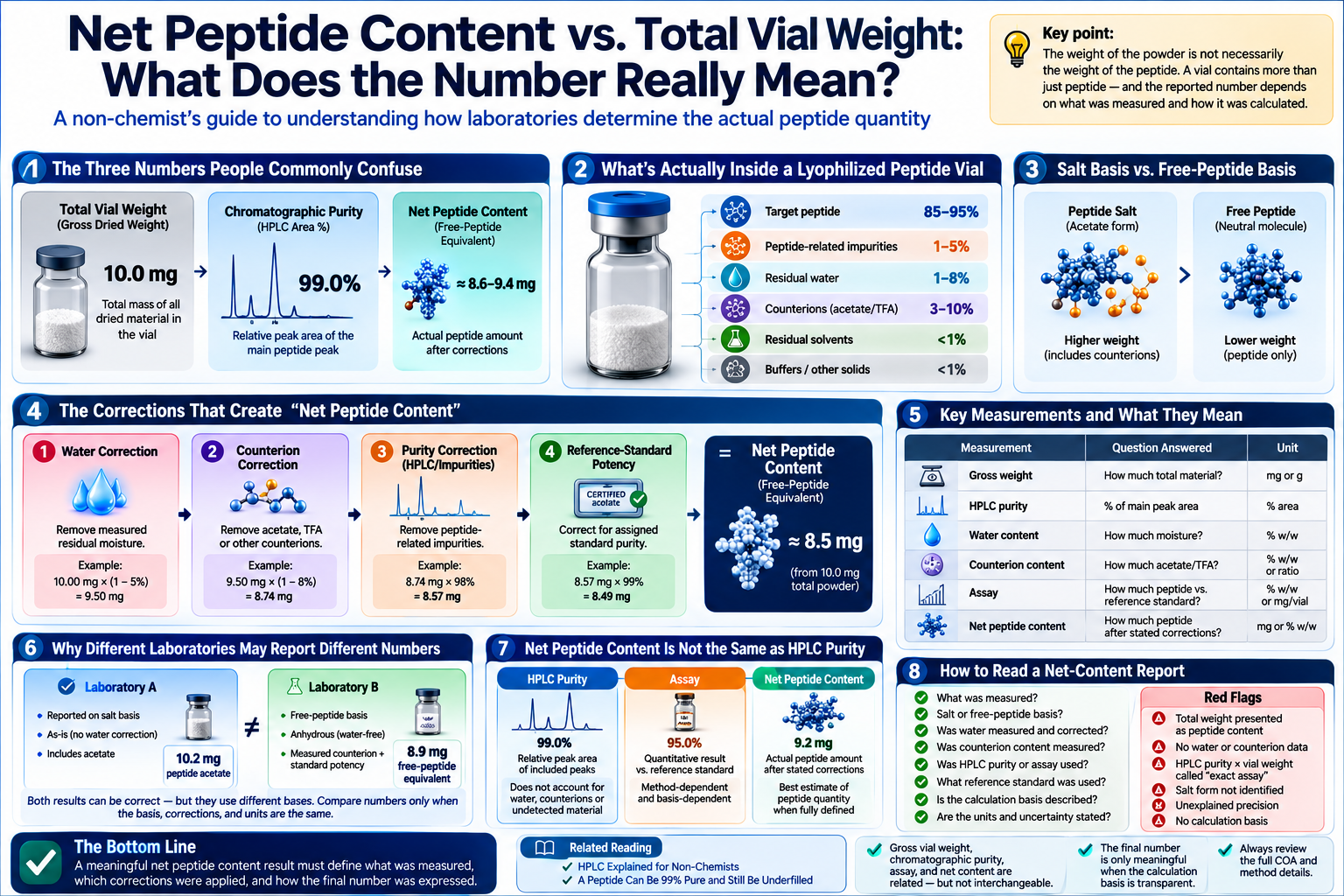
Gross dry weight versus net peptide content
A vial’s total dried mass may include:
- The target peptide
- Counterions such as acetate or trifluoroacetate
- Residual moisture
- Residual solvents
- Buffer components
- Bulking agents or stabilizing excipients
- Related peptide impurities
Therefore, weighing the total dried cake does not necessarily provide the net amount of target peptide.
Understand the reporting basis
In addition, Quantitative results laboratories may report “as is,” on an anhydrous basis, on a salt-free basis, as free peptide, as a specific salt, or after correction for purity. Finally, those bases are not interchangeable. A credible report should state what the number represents.
| Reported phrase | Possible meaning | Question to ask |
|---|---|---|
| “Content: 10.2 mg” | Could refer to target peptide, total material, or a calculated equivalent. | Content of what, measured by which method, and on what basis? |
| “Assay: 102%” | Often means measured content relative to a nominal target. | What was the target, reference standard, calculation, and acceptance range? |
| “Net peptide content: 8.7 mg” | May account for purity, water, and counterions. | Which correction factors the calculation included? |
| “Fill weight: 12 mg” | May be total dispensed or dried material. | How much of the fill is target peptide? |
One vial does not establish uniformity across an entire batch
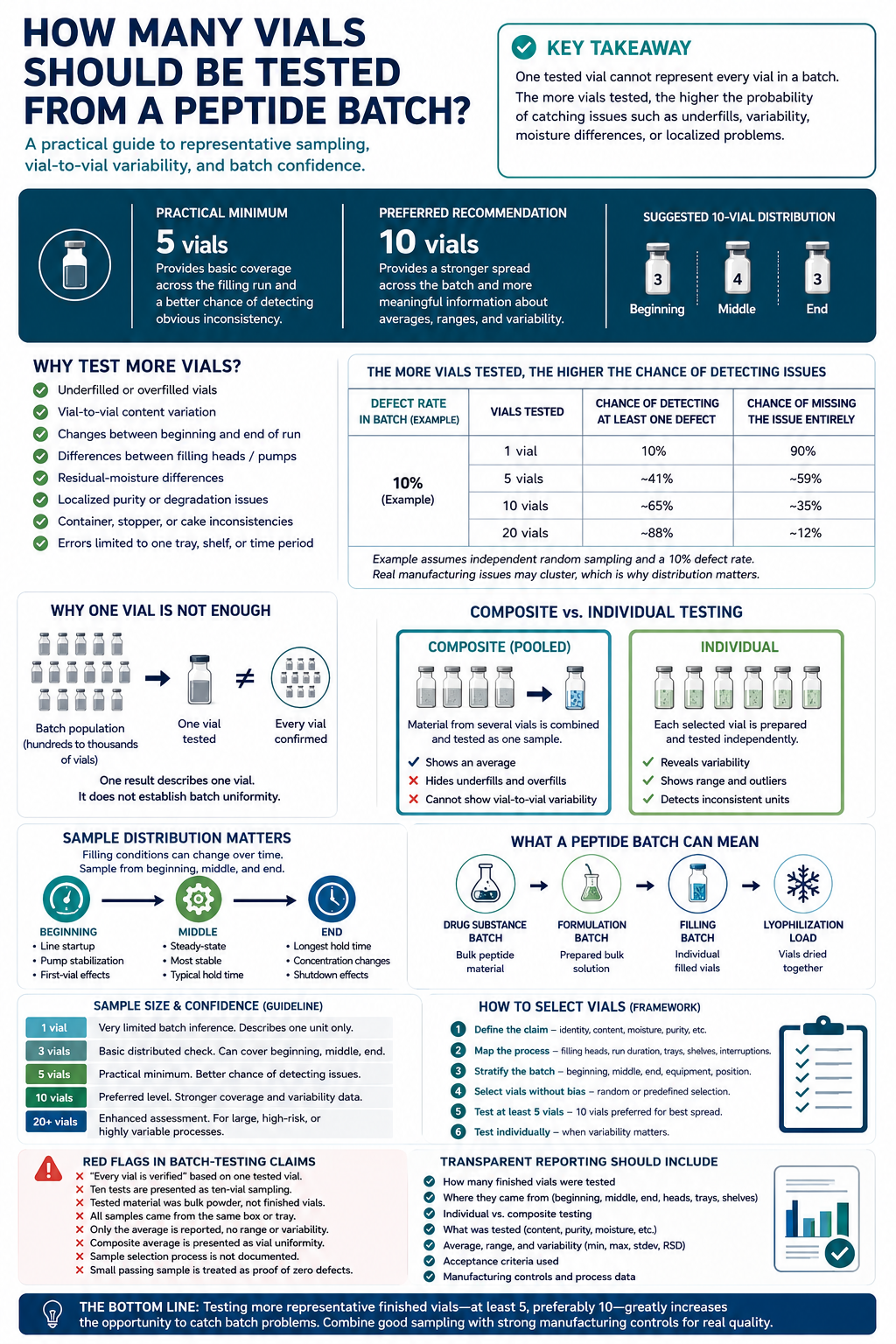
For example, a result from one vial describes that tested vial. First, it may support—but cannot by itself prove—uniformity across hundreds or thousands of vials. Confidence increases when sampling is randomized, multiple vials are tested, the filling process is controlled, and the sampling plan is justified.
Understanding Peptide Impurities
However, Synthetic peptides can contain process-related and degradation-related impurities. In addition, the impurity profile depends on sequence length, amino-acid composition, protecting groups, coupling efficiency, cleavage conditions, purification, storage, and formulation.
Common categories of peptide-related impurities
Deletion sequences
Therefore, One or more amino acids are missing because a coupling step was incomplete or a sequence failed to assemble as intended.
Truncated sequences
Moreover, the chain terminates early, creating a shorter peptide that may have a different mass and chromatographic behavior.
Insertion or addition products
Likewise, an extra residue or unintended sequence component may be incorporated.
Oxidation products
Meanwhile, Susceptible residues can oxidize during manufacturing, handling, or storage.
Deamidation or isomerization
As a result, Chemical changes can alter charge, structure, retention, and potentially biological behavior without producing an obvious visual change.
Disulfide-related variants
By contrast, Peptides containing cysteine may form incorrect disulfide bonds, mixed forms, or aggregates.
Unknown impurities still matter
Also, a chromatogram may label minor peaks as “unknown.” Unknown does not necessarily mean dangerous, but it means the peak has not been fully identified. For example, the significance depends on its amount, structure, toxicological relevance, manufacturing history, and intended use. A complete impurity-control strategy goes beyond simply adding the areas of visible minor peaks.
Related substances are not the only possible impurities
A peptide-purity method may not evaluate:
- Residual organic solvents
- Elemental impurities or metals
- Residual reagents and scavengers
- Counterion concentration
- Water content
- Microbial contamination
- Bacterial endotoxins
- Particulate matter
- Excipients or formulation errors
Next, each category may require a different test, such as gas chromatography for certain residual solvents, Karl Fischer titration for water, ion chromatography for counterions, inductively coupled plasma mass spectrometry for elemental impurities, or microbiological methods for bioburden and sterility-related attributes.
What a Standard Purity COA May Not Tell You
Instead, a common analytical packet includes HPLC purity and mass spectrometry identity. However, that combination can add value, but it does not cover every quality attribute.
| Quality attribute | Typical analytical approach | Can HPLC purity alone establish it? |
|---|---|---|
| Identity | Mass spectrometry, retention-time comparison, sequence-sensitive methods | Not reliably alone |
| Chromatographic purity | Validated or fit-for-purpose HPLC/UPLC method | This is its role |
| Peptide quantity | Calibrated quantitative assay | No |
| Water content | Karl Fischer titration or another suitable water method | No |
| Counterion content | Ion chromatography or another suitable method | No |
| Residual solvents | Gas chromatography or another suitable method | No |
| Elemental impurities | ICP-MS or related elemental analysis | No |
| Sterility | Compendial or validated microbiological sterility test | No |
| Bacterial endotoxins | Validated endotoxin test | No |
| Biological activity | Appropriate biological or binding assay | No |
Sterility and endotoxin are different
For instance, Sterility testing evaluates whether viable microorganisms are detected under the conditions of the test. Therefore, bacterial endotoxin testing evaluates pyrogenic lipopolysaccharides associated with Gram-negative bacteria. A material can pass one test and fail the other. Neither the test establishes by a clear solution, a sealed vial, a high HPLC purity result, or a correct mass spectrum.
“Not detected” has a limit
Finally, When a report states “not detected,” find the method’s detection limit or reporting limit. Moreover, the statement means the analyte was not detected above that method’s threshold in the tested sample. It does not necessarily mean absolute zero.
Sampling, Chain of Custody, and Batch Relevance
First, the quality of the laboratory method cannot compensate for an irrelevant, selectively chosen, mislabeled, or unrepresentative sample. Likewise, a sophisticated report may still be misleading if the tested sample cannot be connected to the batch being sold.
Ask who selected and submitted the sample
Possible sampling models include:
- In addition, the manufacturer selected a bulk sample before filling.
- The vendor selected a finished vial.
- The laboratory received a blinded retail sample.
- For example, an independent party purchased a sample from ordinary inventory.
- However, a composite sample an analyst prepared from multiple units.
Therefore, These models provide different levels of assurance. Meanwhile, a vendor-selected “best” vial may not represent the full batch. A bulk-powder result may not establish the content or integrity of finished vials after filling and lyophilization. A finished-vial test is more directly relevant to the distributed product, but one vial still cannot prove every vial is identical.
What chain of custody should establish
- Who collected the sample
- Where it came from
- When it the collector collected it
- How it the collector labeled and sealed
- How it the courier transported and stored
- Whether the laboratory verified package integrity
- Moreover, Whether the batch identifier remained traceable throughout testing
Batch matching matters
Likewise, the batch number on the vial or product listing should match the batch number on the COA. As a result, a report for an older lot, a different concentration, a different salt form, or an unnumbered generic sample should not be presented as proof for the current batch.
Testing date matters—but freshness alone is not enough
Meanwhile, a recent test may offer more value when degradation over time can occur, but the testing date must make sense in relation to manufacturing and distribution. By contrast, a report dated before the batch existed, or a report repeatedly reused over many unrelated lots, is a major concern.
Major Peptide COA Red Flags
Document Traceability
- As a result, No lot number. The report cannot be confidently connected to the product in hand.
- By contrast, The lot number does not match. A valid test for another batch is not proof for the current batch.
- Also, Only “99% purity” the report shows. No identity, amount, method, chromatogram, or supporting data the report provides.
- Next, No laboratory can be verified. The lab name, address, report number, or contact information the report omits or inconsistent.
- Instead, No method the report identifies. “Purity test” the report says without stating HPLC, UPLC, detector type, or method reference.
- For instance, No units or reporting basis. A number such as “10.3” appears without mg, mg/mL, percent, area percent, or calculation basis.
Analytical Data and Interpretation
- Finally, Purity the sample containsed as quantity. A 99% HPLC result is treated as proof of the labeled milligrams.
- First, Identity relies only on retention time. No orthogonal identity method or qualified reference comparison the report shows.
- In addition, Cropped chromatograms. The time axis, baseline, integration, or smaller peaks are hidden.
- For example, Missing integration table. The report shows a graph but not which peaks the calculation included or excluded.
- However, Every batch has exactly the same result. Repeated identical values may indicate copied reports or template reuse.
- Therefore, Impossible or inconsistent dates. Testing occurs before sample receipt, before production, or after the report was supposedly issued.
Claims, Authenticity, and Scope
- Moreover, Certificate edits or mismatched fonts. Formatting inconsistencies, blurred text, altered lot numbers, or layered PDF elements warrant verification.
- Likewise, A QR code proves nothing by itself. Confirm that it resolves to the issuing laboratory or a traceable report, not merely a vendor-hosted image.
- Meanwhile, “Pass” without a specification. The acceptance criterion is absent, vague, or appears chosen after testing.
- As a result, Accreditation the supplier overstates. A logo the supplier uses it to imply every test falls within the accredited scope even though the specific method may be outside the laboratory’s accredited scope.
- By contrast, Bulk-powder testing the sample containsed as finished-vial testing. The report does not evaluate fill amount, vial uniformity, or post-fill handling.
- Also, Safety claims exceed the tests. HPLC and MS results are used to imply sterility, endotoxin control, clinical safety, or regulatory approval.
A Step-by-Step Workflow for Reviewing Any Peptide COA
Step 1: Match the document to the product
Next, Confirm the exact peptide name, sequence or form when listed, strength, lot number, sample type, and testing date. Also, stop the review if the report cannot be tied to the relevant batch.
Step 2: Identify the laboratory and report
Instead, Verify the laboratory’s identity independently. Next, use the report number, not only the vendor’s link. When authenticity is uncertain, contact the laboratory through contact information obtained independently rather than relying only on information printed on the document.
Step 3: Separate each claim into a testable question
For instance, Write down the claims under review—identity, purity, amount, sterility, endotoxin, residual solvents, and so forth. Instead, then identify which test on the COA addresses each claim. Any claim without a corresponding suitable method remains unsupported by that COA.
Step 4: Review methods and specifications
Finally, Determine whether the method is appropriate for its stated purpose and whether an acceptance criterion the report provides. For instance, a method used for purity may not be suitable for assay. A method used for intact mass may not fully confirm sequence.
Step 5: Review the raw-data summary
First, For chromatography, inspect the full chromatogram, integration table, retention times, peak areas, and excluded peaks. Finally, for mass spectrometry, inspect the charge states, deconvoluted mass, expected mass, tolerance, and unexplained species.
Step 6: Check the units and calculation basis
In addition, Distinguish area percent from weight percent, concentration, total milligrams, and percent of label claim. First, determine whether water, counterions, purity, or salt form the calculation included in the calculation.
Step 7: Look for missing categories
For example, Make a deliberate list of what the report did not test. In addition, this prevents a narrow analytical result from being interpreted as a complete quality assessment.
Step 8: Evaluate sampling
However, Determine whether the result came from bulk powder, one finished vial, multiple vials, or an independently obtained sample. For example, consider whether the sample represents the material being sold.
Step 9: Compare claims with the actual evidence
Therefore, Marketing language should never go beyond the test data. However, “Identity consistent with expected mass” differs from “fully sequence-confirmed.” “99.1% HPLC area purity” differs from “99.1% of the vial is peptide.”
Step 10: Assign a confidence level
| Confidence | Typical characteristics |
|---|---|
| Higher | Moreover, Lot-specific finished-product testing; verifiable independent laboratory; complementary identity, purity, and quantitative methods; full data; clear specifications; representative sampling; traceable chain of custody. |
| Moderate | Likewise, Lot-specific report with credible HPLC and MS data but limited quantity testing, incomplete sampling information, or few supporting quality attributes. |
| Low | Meanwhile, Generic or mismatched lot; one unsupported purity number; no raw data; no verifiable laboratory; ambiguous units; altered-looking document; safety claims unsupported by testing. |
Worked Examples
Example 1: “Purity 99.4%, MS conforms”
As a result, What it supports: The main chromatographic component represented approximately 99.4% of included integrated detected area under the stated method, and the mass result the analyst considered consistent with the expected analyte.
By contrast, What it does not establish: Labeled milligrams, sterility, endotoxin, residual solvents, water, counterion content, vial-to-vial uniformity, or suitability for human use.
Next questions: Is the chromatogram complete? How was the main peak identified? Was the sample from a finished vial? Was a quantitative assay performed?
Example 2: “Assay 96% of label claim; purity 99.2%”
Also, Interpretation: The sample may be chromatographically clean yet contain approximately 96% of the nominal target amount under the assay method. For a nominal 10 mg claim, that might correspond to roughly 9.6 mg, depending on the calculation basis.
Next, Important caution: Confirm whether the assay was corrected for standard potency, water, counterions, and purity, and whether the result refers to one vial or an average across several units.
Example 3: “10.8 mg total material; 98.5% HPLC purity”
Instead, Interpretation: Total dried material and chromatographic purity are not enough to calculate target peptide mass unless the composition and analytical basis are known. The material may include water, counterions, excipients, and components not measured by the HPLC method.
Example 4: “Sterility: pass; endotoxin: not tested”
For instance, Interpretation: The sterility test result applies only under the test conditions and sample plan. It does not establish endotoxin status. Endotoxins can remain even when viable bacteria are not detected.
Example 5: A current product page shows an older batch COA
Finally, Interpretation: The report may be authentic but is not evidence for the current batch unless the vendor can demonstrate that the lot is the same. Each batch can have a different impurity profile, content, and manufacturing history.
How Suppliers Can Publish More Transparent COAs
First, Transparency improves when a supplier publishes more than a summary number. Therefore, a strong public testing packet may include:
- In addition, a clearly visible lot number that matches the product label
- For example, the laboratory’s full identity and a verifiable report number
- Sample-received, testing, and report dates
- However, HPLC or UPLC method purpose and detector details
- The full chromatogram and integration table
- Mass spectrum and theoretical-versus-observed mass
- Therefore, a quantitative peptide-content result when a milligram claim is made
- Clear units and calculation basis
- Specifications and actual results
- Moreover, a statement identifying whether bulk powder or finished vials were tested
- The number of units sampled
- Likewise, Separate results for any sterility, endotoxin, solvent, metal, or water testing
- Meanwhile, a plain-language explanation of what each test does and does not prove
As a result, the goal should not be to create the most impressive-looking certificate. Moreover, it should be to make the evidence understandable, traceable, and difficult to misinterpret.
Frequently Asked Questions
Purity, Identity, and Quantity
Does 99% purity mean a peptide is pharmaceutical grade?
By contrast, no. Likewise, “99% purity” typically refers to a particular analytical result, often chromatographic area purity. It does not by itself establish pharmaceutical manufacturing controls, validated processes, regulatory compliance, sterility, endotoxin limits, dosage-form quality, or approval status. “Pharmaceutical grade” should not be inferred from one purity number.
Can a peptide be 99% pure and still be underfilled?
Also, Yes. Meanwhile, purity and quantity are different measurements. A smaller-than-labeled amount of peptide can still be highly pure. Confirming labeled milligrams requires an appropriate quantitative content or assay method.
Is mass spectrometry enough to identify a peptide?
Next, an intact mass consistent with the expected molecule is strong supporting evidence, but the level of identity confirmation depends on the peptide and the purpose of testing. As a result, isomers or sequences with the same composition may require fragmentation, sequence-sensitive analysis, or comparison with qualified reference material.
Why does an HPLC chromatogram show more than one peak?
Instead, Minor peaks can represent related synthesis impurities, degradation products, isomers, adducts, solvent or injection artifacts, or other detected components. By contrast, the method, peak identification, reporting threshold, and integration rules determine how those peaks are interpreted.
Testing Limits and Visual Clues
Does a clean HPLC result prove a vial is sterile?
For instance, no. Also, chromatographic purity and sterility are unrelated quality attributes measured by different methods. A clear chromatogram cannot establish absence of viable microorganisms or bacterial endotoxins.
Can the size of the lyophilized cake confirm the amount?
Finally, no. Next, cake size and appearance several factors influence by excipients, water, salts, concentration, vial dimensions, freezing behavior, and the lyophilization cycle. Visual appearance is not a quantitative assay.
What does “not detected” mean?
First, it means the analyte was not detected above the stated or applicable detection or reporting threshold under that method. Instead, it should not automatically be interpreted as absolute absence.
Laboratory and Batch Questions
Is an accredited laboratory automatically trustworthy?
In addition, Accreditation can add confidence when the relevant method is within scope and quality systems are properly applied. For instance, it does not mean every method the laboratory performs falls within the accredited scope, nor does it eliminate the need to examine sampling, method suitability, raw data, and report authenticity.
Should every batch have its own COA?
For example, Batch-specific testing offers substantially more relevance than a generic product report because manufacturing and degradation-related variables can differ between lots. Finally, the COA should match the lot being distributed.
What is the single biggest COA mistake buyers make?
However, Treating one HPLC purity percentage as proof of identity, labeled quantity, sterility, safety, and overall quality. First, each claim requires evidence from an appropriate method.
Final Takeaway
Therefore, Knowing how to read a peptide COA means treating the document as a set of limited analytical claims rather than a simple badge of quality. In addition, identity, purity, quantity, impurity control, sterility, endotoxin, residual solvents, and batch representativeness remain separate questions. Therefore, the strongest evidence combines complementary methods, clear specifications, traceable batch details, transparent raw-data summaries, appropriate standards, and representative sampling.
Moreover, Remember this sentence: A COA proves only what the reported methods were capable of measuring in the sample that was actually tested—and only to the extent that the methods, data, sampling, and document are credible.
Technical References and Further Reading
- International Council for Harmonisation. ICH Q2(R2): Validation of Analytical Procedures . 2023. Official source
- International Council for Harmonisation. ICH Q14: Analytical Procedure Development . Official source
- U.S. Food and Drug Administration. Q6A Specifications: Test Procedures and Acceptance Criteria for New Drug Substances and New Drug Products: Chemical Substances . Official source
- European Medicines Agency. Guideline on the Development and Manufacture of Synthetic Peptides . 2025. Official source
- United States Pharmacopeia. Reference Standards to Support Quality of Synthetic Peptide Therapeutics . Official source
- United States Pharmacopeia. Peptide Standards . Official source
- International Council for Harmonisation. Q3A(R2): Impurities in New Drug Substances.
- International Council for Harmonisation. Q3C: Impurities—Guideline for Residual Solvents.
- International Council for Harmonisation. Q3D: Guideline for Elemental Impurities.
- Wang L, et al. Therapeutic peptides: current applications and future directions. Signal Transduction and Targeted Therapy. 2022;7:48. doi:10.1038/s41392-022-00904-4.