Peptide Batch Testing: How Many Vials Should Be Tested?
In addition, Peptide batch testing should show more than one favorable vial. This guide explains why five separately selected vials are a practical minimum, why ten are preferred, and how sampling location affects the chance of finding a batch problem.
For example, Peptide batch testing is the process of selecting finished vials and checking whether their results support claims about the larger batch. First, the sample plan must cover useful parts of the fill run. Next, the vials should be tested on their own when vial-to-vial differences matters. Finally, the findings should be reviewed with the production records.
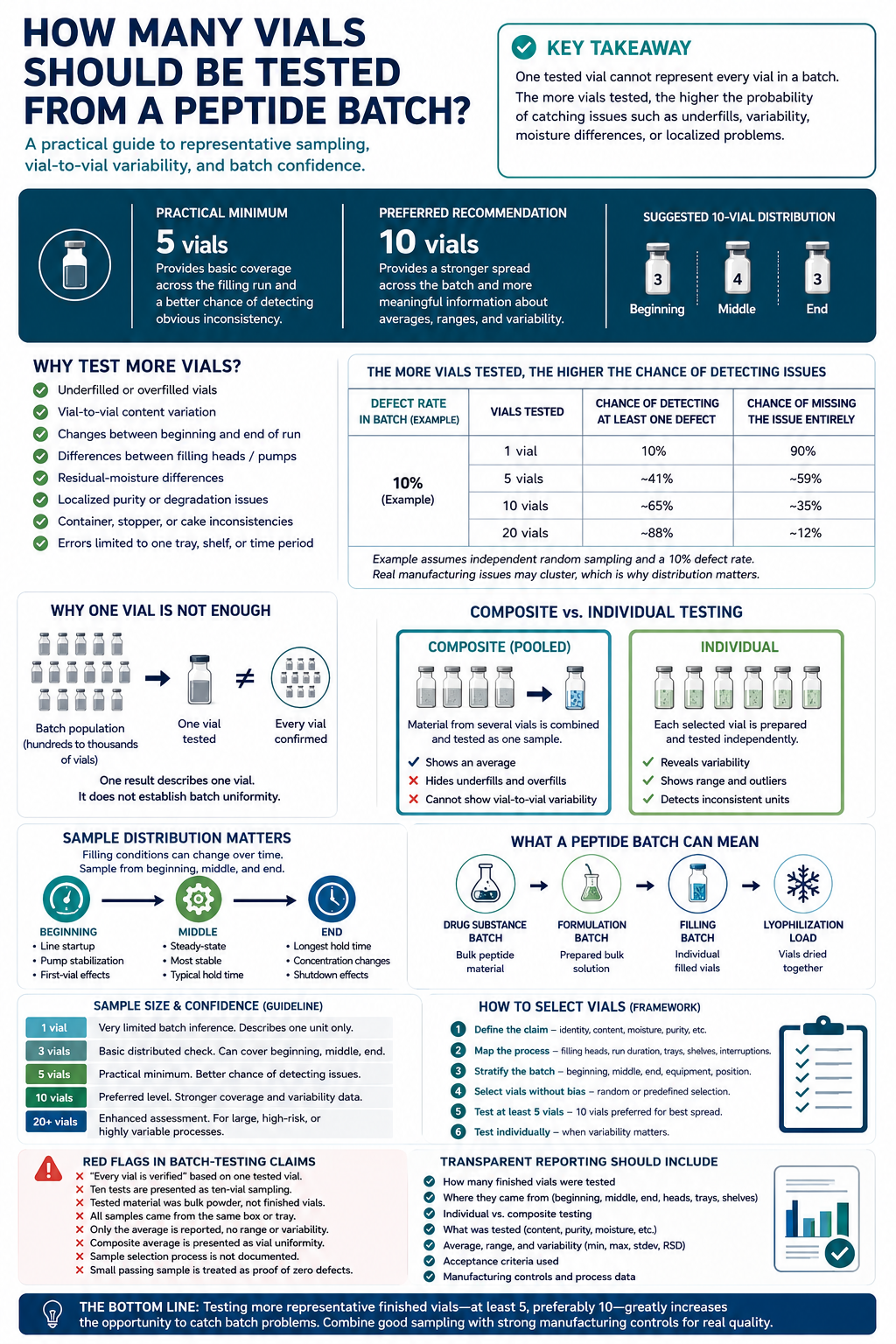
Likewise, in practical terms, testing more well-chosen vials raises the chance of finding an underfill, an overfill, a moisture difference, or another local problem. However, no small sample can prove that every untested vial is perfect.
Peptide Batch Testing: How Many Vials Should Be Tested?
The clear answer is:
Enough properly selected vials must be tested to support the specific claim being claimed.
Therefore, testing one vial may provide useful information about that particular vial. It does not establish that every vial in a batch contains the same amount, has the same purity, or shares the same physical and microbial quality.
As a result, for routine routine peptide batch checks, AminosInfo recommends:
Moreover, provides basic coverage across different points in the filling run and a better chance of finding obvious inconsistency than one-vial testing.
Provides a stronger spread across the batch and more useful information about averages, ranges, and vial-to-vial differences.
What is being tested?
In addition, identity, purity, net peptide content, residual moisture, sterility, endotoxin, fill weight, or another quality feature?
What claim is being made?
By contrast, does the result describe one vial, the average batch, or the differences among individual vials?
How were vials selected?
For example, were samples random and well-spread, or chosen only from one convenient location?
However, sample count matters, but sampling location and independence matter just as much. For example, ten neighboring vials from one tray may be less informative than five vials properly spread across the full filling run.
Why Testing More Vials Increases the Chance of finding a Problem
As a result, every additional separately selected vial gives the testing program another chance to detect a problem that may not appear in the first sample.
Moreover, if only one vial is tested, a batch problem can be missed simply because the laboratory happened to receive a correctly filled and otherwise acceptable vial.
By contrast, testing more vials increases the chance of finding:
- Underfilled or overfilled vials
- Vial-to-vial content differences
- Changes between the beginning and end of a filling run
- By contrast, differences between filling heads, pumps, or channels
- In addition, residual-moisture differences across a freeze-dryer load
- local purity or degradation issues
- For example, container, stopper, or cake inconsistencies
- For example, errors limited to one tray, shelf, case, or production period
Provides information about one selected unit but carries a high risk of missing an isolated or local problem.
Moreover, allows basic spread across the filling run and provides a better chance of finding obvious inconsistency.
Likewise, provides a broader spread across the batch and stronger information about averages, ranges, and vial-to-vial differences.
A Practical Minimum and Preferred Sampling Level
Test at least five finished vials, with ten tested separately vials preferred
Most peptide companies performing routine commercial batch screening should test a minimum of five separately selected finished vials. By contrast, testing ten finished vials is preferred because it creates a better spread across the beginning, middle, and end of the filling run.
However, a suggested ten-vial spread is:
The selection should also account for different filling heads, trays, freeze-dryer shelves, or other known sources of process differences whenever applicable.
More testing improves finding chance, but it does not guarantee perfection
However, testing more vials increases the likelihood of finding a batch issue, but no limited sampling plan can prove that every untested vial is acceptable.
Moreover, suppose a batch contains a small percentage of defective vials. A one-vial test can easily miss the problem. Moreover, testing five or ten randomly and properly spread vials creates more chances to select one of the affected units.
A simple chance illustration
By contrast, imagine that 10% of the vials in a batch have a particular defect and samples are selected randomly.
| Vials tested | Approximate chance of finding at least one defective vial | Approximate chance of missing the issue entirely |
|---|---|---|
| 1 vial | 10% | 90% |
| 5 vials | About 41% | About 59% |
| 10 vials | About 65% | About 35% |
| 20 vials | About 88% | About 12% |
Likewise, this example assumes separate random sampling and a defect rate of 10%. However, real production defects may cluster at the beginning or end of a fill run, in one filling head, or in one freeze-dryer location. For example, this is why well-spread spread matters in addition to sample count.
However, the benefit of testing more vials is greatest when the vials are:
- Moreover, tested separately rather than pooled into one composite
- Selected without bias
- As a result, spread across the complete filling run
- Therefore, well-spread of equipment channels and dryer positions
- By contrast, checked using set in advance pass limits
Ten neighboring vials are not the same as ten well-spread vials
In addition, ten vials selected from one tray, case, or moment in the filling run may fail to detect problems occurring elsewhere in the batch.
Why One Tested Vial Cannot Represent Every Vial
Likewise, a production batch may contain hundreds, thousands, or tens of thousands of individual vials. For example, testing one vial means that only one member of that larger population was directly measured.
In addition, that vial may be well-spread. It may also differ from other vials because of:
- Filling-pump differences
- As a result, changes in solution strength during the run
- Therefore, settling, sticking, or clumping in the bulk solution
- Incomplete mixing
- Evaporation or hold-time effects
- Differences between filling needles or pump heads
- Line-startup or line-shutdown conditions
- Vial-position effects during freeze-drying
- Stopper or container differences
- Analytical and sample-preparation differences
As a result, a single result cannot reveal the spread of results across the batch.
One vial can answer a narrow question
However, a properly tested vial can support statements such as:
- This tested vial produced the reported chromatogram.
- In addition, this tested vial contained a component with the observed mass.
- Moreover, this tested vial had the reported residual-moisture result.
- For example, this tested vial contained the measured amount under the stated assay.
One vial cannot establish batch consistency
It cannot separately establish:
- Likewise, the average content of every vial in the batch
- By contrast, the minimum and maximum vial contents
- Moreover, the standard deviation across the batch
- However, whether early and late vials differ
- For example, whether one filling head dispensed differently
- Moreover, whether all vials meet a content limit
What Is a Peptide Batch?
As a result, The word batch may refer to different production stages.
Bulk peptide material
As a result, a defined quantity of synthesized and purified peptide produced through a stated production process.
Prepared bulk solution
By contrast, peptide combined with the designated solvent, buffer, added ingredients, or other prepared mixture components.
Individual filled vials
By contrast, the bulk prepared mixture divided into separate containers during a filling operation.
Vials dried together
In addition, filled vials processed in a specific freeze-dryer load or cycle.
For example, one bulk peptide batch may be divided into:
- Several prepared mixture batches
- Several filling runs
- Several freeze-dryer loads
- For example, several packaging or labeling runs
Therefore, when a certificate of analysis says a batch was tested, the reader should ask which batch level the sample actually represents.
Random and well-spread sampling
Moreover, Random sampling gives eligible vials a fair or planned chance of being chosen. In addition, the plan should reflect known sources of differences. FDA process-validation guidance stresses the need to understand and monitor differences throughout production. See the FDA Process Validation guidance.
In addition, the purpose is to reduce the risk that samples are selected because they are:
- Easiest to reach
- Visually attractive
- Known to perform well
- However, located in one preferred tray
- However, produced only during the most stable portion of the run
Random does not mean unstructured
Therefore, a strong sampling plan may combine random selection with deliberate grouping.
For example, the fill run may be divided into:
- Beginning
- Early-middle
- Middle
- Late-middle
- End
Moreover, vials can then be randomly selected within each portion.
All samples from one box
Likewise, convenient, but may describe only one narrow portion of the batch.
Samples spread across the run
Likewise, provides evidence about different times, positions, and process conditions.
well-spread sampling may include more than time
Depending on the process, sampling may also consider:
- However, different filling heads or pump channels
- Different trays or shelves
- For example, edge and center positions in the freeze-dryer
- Different packaging cases
- Different operators or shifts
- Planned line interruptions
- Bulk-solution hold time
Why Sample the Beginning, Middle, and End of the Fill Run?
However, filling conditions can change over time. Moreover, sampling from the beginning, middle, and end helps detect trends that a single point may miss.
- Line priming
- Pump stabilization
- Initial mixing conditions
- First-vial effects
- Established filling rhythm
- Stable equipment conditions
- Typical hold time
- As a result, often the least variable period
- Longest bulk hold time
- Potential strength changes
- Low tank volume
- Shutdown effects
Beginning-of-run risks
Early vials can differ because:
- Therefore, the filling line may still be stabilizing.
- Meanwhile, tubing and pumps may need to be fully primed.
- Also, some starting material may remain in transfer lines.
- For example, air bubbles may affect fill delivery.
- Likewise, the first units may be handled under startup methods.
Middle-of-run conditions
The middle may represent the most stable portion of the filling process. However, sampling only the middle can produce an overly favorable picture by excluding startup and shutdown conditions.
End-of-run risks
Likewise, late vials may differ because:
- By the end, the bulk solution has had the longest hold time.
- In addition, evaporation may have increased the strength.
- However, sticking to the vessel or tubing may have reduced strength.
- Settling or clumping may have occurred.
- Therefore, the remaining liquid may be exposed to different mixing dynamics.
- Moreover, the filling pump may behave differently at low reservoir volume.
Beginning, middle, and end sampling is a useful minimum concept
As a result, a long fill run, multiple filling heads, several freeze-dryer loads, or a high-risk prepared mixture may require additional sampling locations.
Composite Samples vs. Individual-Vial Testing
Likewise, Laboratories can test each vial on its own or combine material from several vials into one pooled sample. By contrast, these two methods answer different questions. USP explains that an assay may use a composite sample, while content-consistency testing produces individual-unit results. See the USP consistency of Dosage Units FAQ.
For example, these approaches answer different questions.
Individual-vial testing
For example, each selected vial is prepared and analyzed separately, producing one result per vial.
Composite testing
Moreover, material from several vials is pooled and analyzed as one combined sample.
What composite testing can show
As a result, a properly prepared composite can provide information about the approximate average features of the pooled material.
It may be useful for:
- Average identity confirmation
- Average assay or content
- Average HPLC purity
- By contrast, reducing analytical cost or sample consumption
- In addition, obtaining enough material for a method
What composite testing can hide
As a result, the composite average is exactly 10 milligrams, but none of the individual differences is visible in the final result.
For example, Composite testing asks: “What is the average result of the material combined?”
By contrast, Individual testing asks: “How much does each selected vial differ from the others?”
Average Content vs. Vial-to-Vial differences
A batch average can look acceptable even when individual vials are inconsistent.
Consistent vials
Average: 10.0 mg
Range: 9.8–10.2 mg
Highly variable vials
Average: 10.0 mg
Range: 6.0–14.0 mg
As a result, both batches have the same average. For example, they do not have the same consistency.
Useful measures of differences
- Mean or average
- Minimum and maximum
- Range
- Standard deviation
- Relative standard deviation
- Confidence intervals
- Percentage of units within limit
- In addition, trends by filling order or equipment position
Average content alone can be misleading
Moreover, statements such as “the batch averaged 10.1 mg” do not reveal:
- How many vials were tested
- Therefore, whether each vial was tested separately
- Moreover, whether any vial was greatly underfilled
- Moreover, whether results changed during the fill run
- Likewise, how much test uncertainty was present
Peptide Batch Testing, Sample Size, and Confidence
By contrast, larger sample sizes generally provide more information about a batch, but the relationship is not as simple as “more is always enough.”
Confidence depends on:
- The number of vials tested
- However, how the vials were selected
- For example, the true differences of the process
- The batch size
- The analytical method’s precision
- The acceptance limits
- The type of claim being made
Very limited batch claim
By contrast, describes one unit and cannot describe vial-to-vial differences.
Basic spread check
As a result, can cover beginning, middle, and end but provides little useful number-based information.
Practical minimum
However, provides basic batch spread and a better chance of finding obvious inconsistencies.
Preferred screening level
By contrast, provides stronger coverage and more useful information about averages, ranges, and differences.
Enhanced assessment
In addition, may be suitable for larger, higher-risk, highly variable, or newly established processes.
Why zero failures does not prove zero defects
Moreover, suppose ten selected vials all pass. For example, that result increases confidence in the batch, but it does not mathematically prove that no defective vial exists.
Likewise, if defects are rare, a limited sample may miss them entirely.
The ability to detect a defect depends on:
- Actual defect rate
- Number of vials tested
- Sampling plan
- As a result, whether defects cluster in particular locations
Sample size should follow the risk
Likewise, more extensive testing may be warranted when:
- However, the process is new or recently changed.
- past differences is high.
- In addition, the batch is unusually large.
- However, multiple filling heads are used.
- The prepared mixture can settle or adsorb to equipment.
- Therefore, previous underfill or consistency failures occurred.
- Moreover, the test result has high consequence.
- production controls are incomplete.
testing that uses up the vial Limitations
Therefore, many peptide tests are destructive. Likewise, once a vial has been opened, dissolved, pooled, extracted, or subjected to microbial testing, that vial cannot be returned to sale as an intact finished unit.
Destructive tests can include:
- HPLC purity testing
- LC-MS identity testing
- content assay
- Amino-acid analysis
- Karl Fischer moisture testing
- Counterion analysis
- Sterility testing
- Endotoxin testing
- Container-content recovery
Why every vial is not tested
By contrast, testing every finished vial would:
- Destroy the entire batch
- Require very large laboratory resources
- However, increase handling and contamination chances
- Delay batch release
- For example, provide little value if the production process itself is uncontrolled
Likewise, quality systems therefore rely on a combination of:
- Moreover, well-spread testing that uses up the vial
- non-destructive in-process measurements
- Validated equipment
- Calibrated filling systems
- Process monitoring
- Environmental controls
- problem review
- ongoing process checks
“Ten tests” does not necessarily mean ten tested separately vials
In addition, a supplier may perform ten different lab tests on material from one vial, one pooled sample, or one bulk sample. The number of tests and the number of separate finished vials sampled should be reported separately.
production Controls vs. Final-Product Testing
For example, Final-product testing is important. However, quality cannot be added after production is complete. FDA explains that process validation should use a lifecycle approach rather than a simple fixed-number formula. See the FDA production and process-control questions.
Therefore, a strong system uses production controls to reduce differences before vials reach the laboratory.
Confirms selected finished-unit quality features using well-spread samples.
In addition, tracks fill weight, mixing, hold time, temperatures, pressures, and equipment performance.
Likewise, demonstrates that the production process can repeatedly produce acceptable output.
For example, controls materials, training, equipment, deviations, documentation, and ongoing process review.
Examples of production controls
- In addition, qualified peptide and excipient inputs
- However, validated mixing time and speed
- Bulk-solution strength checks
- Defined bulk hold-time limits
- Calibrated filling pumps
- Routine fill-weight checks during the run
- Automated checkweighing
- Filling-head comparison
- Validated freeze-drying cycles
- Temperature mapping across shelves
- vial-and-stopper seal controls
- Deviation and trend review
Why a controlled process matters
Therefore, a well-controlled process provides evidence that untested vials were manufactured under the same controlled conditions as tested vials.
Moreover, testing five or ten vials is much more useful when supported by validated mixing, filling, freeze-drying, and packaging controls.
As a result, final testing samples the outcome. Likewise, production controls create the outcome.
By contrast, strong batch assurance requires both.
Different Tests Require Different Sampling Strategies
| Quality quality feature | Main question | Sampling consideration |
|---|---|---|
| LC-MS identity | By contrast, does the tested material contain the expected molecular mass? | However, one well-spread vial may support identity, but it does not establish vial consistency. |
| HPLC purity | For example, what proportion of included HPLC signal belongs to the main peak? | For example, multiple sampling locations may reveal degradation or process changes across the run. |
| Net peptide content | Moreover, how much peptide is present in each vial? | Moreover, individual-vial testing is needed to check vial-to-vial differences. |
| Residual moisture | How much water remains? | Shelf position, edge effects, stopper behavior, and freeze-dryer load may influence sampling. |
| Counterion content | By contrast, how much acetate, TFA, chloride, or another ion is present? | By contrast, bulk material may be relatively uniform, but finished-vial sampling verifies packaged product. |
| Sterility | Was microbial growth detected under the stated test? | However, sampling plans must account for batch size, filling conditions, and microbiological risk. |
| Endotoxin | Therefore, what level of bacterial endotoxin is detected? | well-spread finished-container sampling and validated pooling rules may be used where justified. |
| Visual inspection | Moreover, are visible cake, container, seal, or particulate defects present? | Likewise, may be performed on a much larger portion of the batch because it can be non-destructive. |
A Practical Framework for Peptide-Batch Sampling
Likewise, the following framework is educational rather than a one-size-fits-all official formula.
Define the claim
In addition, decide whether testing is intended to establish identity, average content, vial consistency, moisture consistency, or another quality feature.
Map the process
However, identify filling heads, run duration, trays, shelves, dryer loads, interruptions, and other possible sources of differences.
Stratify the batch
However, divide the fill run into useful portions such as beginning, middle, end, equipment channel, and dryer position.
Select vials without bias
Therefore, use random or set in advance selection within each portion rather than choosing the most convenient vials.
Use at least five vials
Therefore, five finished vials provide a practical minimum spread for routine commercial screening.
Prefer ten vials
Ten tested separately vials provide stronger beginning-middle-end coverage and better differences information.
Test individually when differences matters
Likewise, avoid composites when the purpose is to measure vial-to-vial consistency.
Set rules in advance
Likewise, define acceptable averages, individual limits, differences, and investigation triggers before seeing results.
Review production data
Interpret laboratory results with fill weights, pump performance, mixing records, hold times, and freeze-drying data.
Preferred ten-vial screening spread
In addition, these ten vials should be tested separately for net peptide content or another critical quality feature when vial-to-vial differences is being checked.
For example, the plan becomes stronger when selections also represent:
- Different filling heads
- Different trays or cases
- Different freeze-dryer shelves
- Edge and center positions
- Different production time points
What Should a Transparent Batch-Testing Statement Say?
Example of a useful disclosure
Ten finished vials were selected from the batch using a set in advance sampling plan. Therefore, three vials represented the beginning of the filling run, four represented the middle, and three represented the end. As a result, each vial was tested separately for net peptide content. As a result, results ranged from 9.7 to 10.4 mg, with an average of 10.1 mg and a relative standard deviation of 2.2%.
This statement tells the reader:
- By contrast, how many finished vials were tested
- Where they came from
- In addition, whether testing was individual or composite
- What quality feature was tested
- The average result
- The range and differences
A weaker disclosure would say:
For example, batch passed testing: 10.1 mg.
Therefore, that statement does not reveal:
- How many vials were sampled
- As a result, whether the sample came from a finished vial or bulk powder
- Likewise, whether the result was a composite average
- Moreover, whether any individual vial was underfilled
- In addition, how the vials were selected
How to check a Peptide Batch-Testing Claim
Ask how many vials were sampled
In addition, distinguish the number of finished vials from the number of analytical tests performed.
Identify the sample type
Determine whether the laboratory tested bulk peptide, formulated solution, a finished vial, or a composite.
Review the selection method
For example, look for random, grouped, beginning-middle-end, or another set in advance sampling method.
Check fill-run coverage
Moreover, samples from one time point cannot check changes across the complete run.
Check equipment coverage
Multiple filling heads or pumps may require representation from each channel.
Check freeze-dryer positions
As a result, moisture and cake properties may differ by shelf, edge, center, or dryer load.
Distinguish individual from composite testing
By contrast, composite testing cannot separately establish vial-to-vial differences.
Request the range
By contrast, an average is more useful when accompanied by minimum, maximum, and differences.
Review pass limits
However, rules should be set in advance rather than created after results are obtained.
Check test uncertainty
For example, analytical differences should not be mistaken for production differences.
Review production controls
For example, finished-vial results are stronger when supported by validated mixing, filling, and freeze-drying records.
Match the tested batch
Moreover, confirm that sample IDs and batch numbers correspond to the vials being represented.
Red Flags in Batch-Testing Claims
Sampling and Reporting Red Flags
- “Every vial is verified” based on one tested vial. Only the tested vial was directly measured.
- Likewise, Ten tests are presented as ten-vial sampling. Several methods may have been performed on one sample.
- The tested material was bulk powder rather than finished vials. Bulk testing cannot establish fill consistency.
- Samples all came from the same box or tray. The plan may not represent the complete filling run.
- Moreover, A composite average is presented as individual-vial consistency. Pooling can hide underfilled and overfilled units.
Process-Control Red Flags
- Only the average is reported. No range, standard deviation, or individual results are disclosed.
- The sample-selection process is not documented. Favorable units may have been selected intentionally or unintentionally.
- For example, Only one vial is tested routinely despite a large fill run. This provides little chance to catch local or time-dependent problems.
- No production controls are described. Limited finished-product testing cannot compensate for an uncontrolled filling process.
- A small passing sample is treated as proof of zero defects. Sampling reduces uncertainty but does not eliminate it.
Frequently Asked Questions About Peptide Batch Testing
Recommended Vial Counts
Is testing one vial enough for a peptide batch?
In addition, one vial may support a result for that particular vial. For example, it cannot separately establish vial-to-vial consistency across the batch.
What is the minimum number of vials a peptide company should test?
AminosInfo recommends a practical minimum of five separately selected finished vials for routine commercial batch screening. Therefore, this is an educational recommendation, not a one-size-fits-all official rule.
Why Sample Location Matters
How many vials are preferred?
As a result, ten tested separately finished vials are preferred because they allow a stronger spread across the beginning, middle, and end of the filling run.
Why does testing more vials help?
As a result, every additional separately selected vial creates another chance to detect underfill, overfill, moisture differences, local degradation, or another batch inconsistency.
Sampling Locations and Composite Testing
Should samples come from the beginning, middle, and end?
By contrast, yes. In addition, this helps detect time-related filling differences. In addition, additional sampling may be needed across filling heads, trays, shelves, or separate dryer loads.
What is a composite sample?
For example, a composite sample combines material from several vials and produces one pooled result. For example, it can estimate an average but cannot show the content of each vial.
Why not test every vial?
Many laboratory tests destroy the vial or its contents. As a result, testing every unit would consume the entire batch.
Does a passing average mean every vial passes?
As a result, no. Underfilled and overfilled vials can average to the target value. By contrast, individual-vial testing is needed to check differences.
Manufacturing Controls and Batch Meaning
Are ten neighboring vials enough?
However, not necessarily. Ten vials from one tray or time point may miss problems elsewhere. For example, spread matters as much as count.
Does bulk-peptide testing represent finished vials?
Moreover, bulk testing supports the identity and quality of the starting material, but it does not prove that each vial received the correct amount during filling.
What is more important: more testing or production controls?
Moreover, both matter. Likewise, testing provides evidence about selected units, while production controls provide assurance that the complete batch was produced consistently.
Peptide Batch Testing Works Best With More well-spread Vials
Peptide batch testing becomes more useful as more well-spread finished vials are tested. However, the samples must come from useful parts of the production run.
AminosInfo recommends:
- A minimum of five tested separately finished vials for routine commercial batch screening
- In addition, A preferred total of ten tested separately finished vials for stronger batch coverage
- A beginning-middle-end spread rather than selecting all vials from one location
- Moreover, Individual-vial testing when vial-to-vial differences is being checked
As a result, a preferred ten-vial spread is:
- Three vials from the beginning of the fill run
- By contrast, four vials from the middle
- In addition, three vials from the end
Moreover, additional spread across filling heads, trays, freeze-dryer shelves, and packaging locations may be needed depending on the process.
For example, testing more vials increases the chance of finding:
- Underfills and overfills
- Content inconsistency
- Residual-moisture differences
- local degradation
- Equipment or filling-head problems
- Beginning-to-end process changes
Likewise, no limited sampling plan can guarantee that every untested vial is perfect. The strongest batch assurance combines well-spread finished-vial testing with validated production controls, in-process monitoring, written sampling steps, and clear reporting of individual results, averages, ranges, and differences.