Peptide Vial Education
Does a Peptide Vial Vacuum Seal Need to Make a “Pop”?
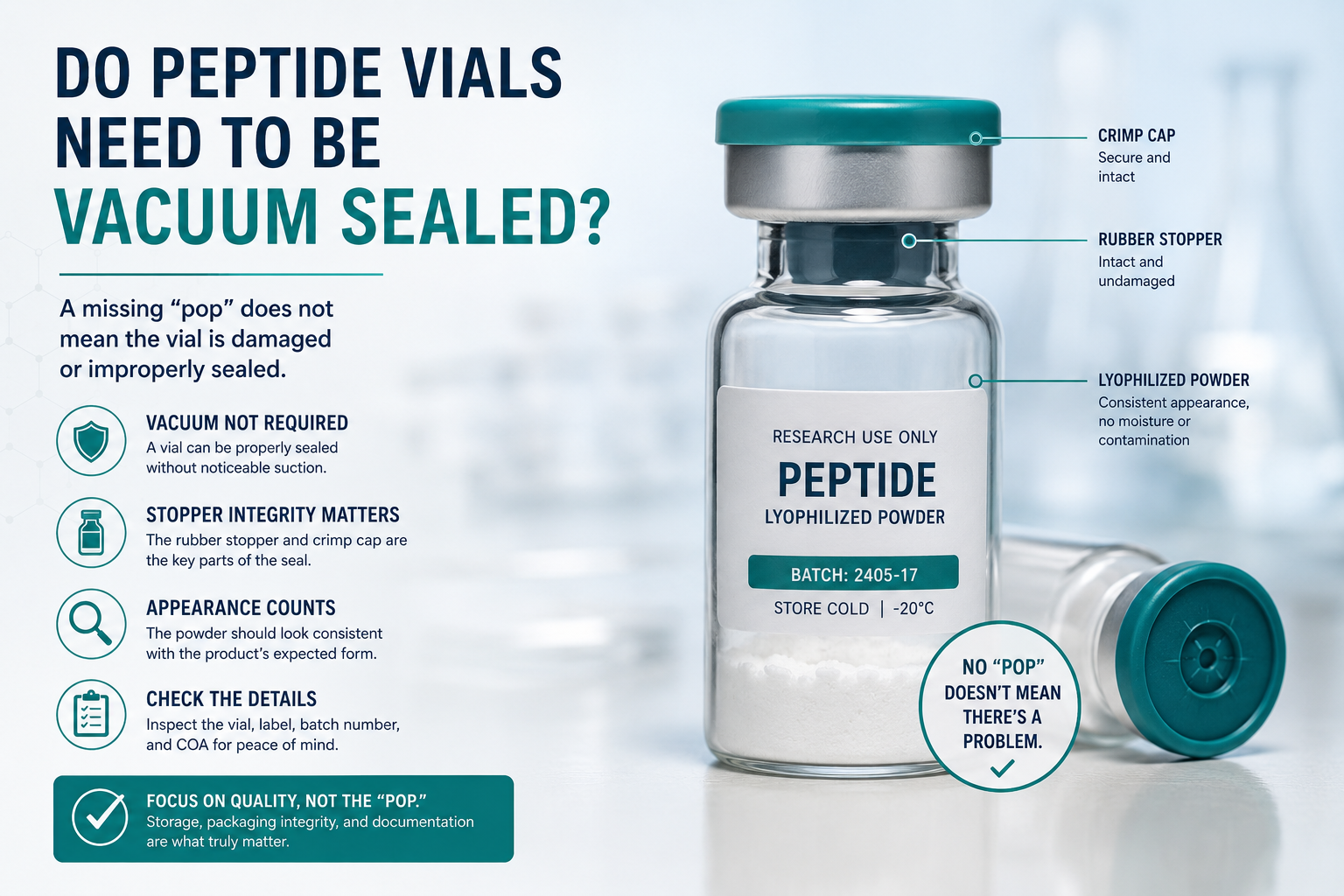
A peptide vial vacuum seal may create noticeable suction, but a missing “pop” does not automatically prove damage, counterfeiting, or an improper closure. Researchers should evaluate the complete container-closure system instead.
How Manufacturers Close Lyophilized Peptide Vials
First, manufacturers commonly package lyophilized material inside a glass vial with an elastomeric stopper and an aluminum overseal. Meanwhile, equipment may partially insert the stopper before the freeze-drying cycle ends. Then, the lyophilizer can fully seat the stopper while the chamber remains under controlled conditions.
Afterward, a crimping step secures the stopper against the vial finish. The stopper provides the primary seal, while the crimp helps maintain compression and protects the closure from movement. Therefore, closure quality depends on the complete vial-and-stopper system rather than on sound alone.
Vacuum Is Not the Only Condition
Some vials contain reduced headspace pressure, while others contain an inert gas or pressure closer to the surrounding atmosphere.
The Stopper Creates the Main Seal
Stopper fit, compression, material quality, vial geometry, and crimp placement all influence closure performance.
Testing Matters More Than Sound
Validated leak or container-closure integrity methods provide stronger evidence than an audible response during puncture.
Why a Peptide Vial Vacuum Seal May Feel Different
For instance, a noticeable inward pull can occur when the vial headspace pressure sits below room pressure. For example, a needle may allow outside air to move into the vial after it passes through the stopper. That pressure equalization can create a brief sound or visible movement.
However, several factors change what a researcher notices. In addition, needle gauge, puncture angle, stopper thickness, headspace volume, filling process, temperature, altitude, and residual headspace gas can all affect the sensation. As a result, two intact vials may not respond in the same way.
A missing “pop” does not establish leakage
However, silence during puncture cannot prove that a closure failed. Likewise, a strong vacuum sensation cannot prove sterility, correct identity, proper content, or acceptable storage. Therefore, the observation offers limited information because it does not measure leak rate or microbial barrier performance.
What Researchers Should Inspect Instead
- First, check for an intact vial with no cracks, chips, leakage, or damage around the neck
- Next, inspect the stopper for proper centering, lifting, tears, punctures, or displacement
- Also, confirm that the crimp and overseal remain secure without obvious tampering or severe deformation
- Then, compare the lyophilized cake or powder with the product’s documented appearance
- Moreover, look for unexpected liquid, visible debris, mold-like growth, or unusual discoloration
- In addition, verify clear product labeling, lot identification, and batch-matched analytical records
- Finally, review whether storage and shipping history match the supplier’s stated conditions
Container-Closure Integrity Is the Real Quality Question
The U.S. Food and Drug Administration defines a container-closure system as the full set of packaging components that contain and protect a product. For a vial, that system includes the glass container, stopper, overseal, and related components. Moreover, FDA guidance explains that manufacturers can use validated container-closure integrity methods to assess whether a sterile package continues to protect its contents.
For example, these methods may evaluate leaks through vacuum decay, tracer gas detection, laser-based headspace analysis, electrical methods, or microbial challenge testing. In contrast, listening for a “pop” does not provide a validated acceptance criterion.
Importantly, container-closure integrity and initial sterility are not the same claim. FDA guidance notes that integrity testing can support evidence that a closure continues to maintain a barrier, but it does not by itself prove that a product started sterile. Therefore, researchers should avoid treating one packaging observation as proof of overall product quality.
When a Vial Deserves Closer Review
Visible Warning Signs
Therefore, set the vial aside and contact the supplier when the package shows clear evidence of damage or an unexplained change.
- First, note any cracked, chipped, or leaking vial
- Next, check whether the stopper sits above the vial rim or appears displaced
- Also, look for a loose, missing, or visibly tampered crimp
- In addition, investigate unexpected liquid in a product supplied as dry lyophilized material
- Moreover, document foreign particles, mold-like material, or unexplained debris
- Likewise, note unusual discoloration that conflicts with the documented product appearance
- Finally, flag missing lot information or documentation that does not match the vial
First, researchers should document the concern with clear photographs before opening or manipulating the vial further. Next, they should preserve the original packaging and provide the lot number to the supplier. This process supports a more useful investigation than relying on whether the vial made a sound.
Storage and Handling Still Matter
However, even an intact closure cannot correct poor storage. Heat, moisture, light, oxygen, repeated temperature cycling, and prolonged exposure outside recommended conditions may affect a lyophilized product. Consequently, researchers should follow the documented storage instructions for the specific material.
In addition, avoid using the flip-off cap as evidence of sterility. Removing that cap exposes the stopper surface, which researchers should handle according to the laboratory’s aseptic procedures. The crimp and stopper protect the vial before access, but proper technique still matters after opening.
Peptide Vial Vacuum Seal: Final Takeaway
Evaluate the Whole System
A peptide vial vacuum seal does not need to produce a noticeable “pop” to indicate an intact package. Instead, assess the glass vial, stopper, crimp, product appearance, labeling, storage conditions, and batch records together.
Finally, remember that neither suction nor silence proves sterility, identity, purity, or potency. Validated analytical and container-closure testing provide the stronger evidence.