Social Media Peptide Dosing Advice: Why It Can Mislead
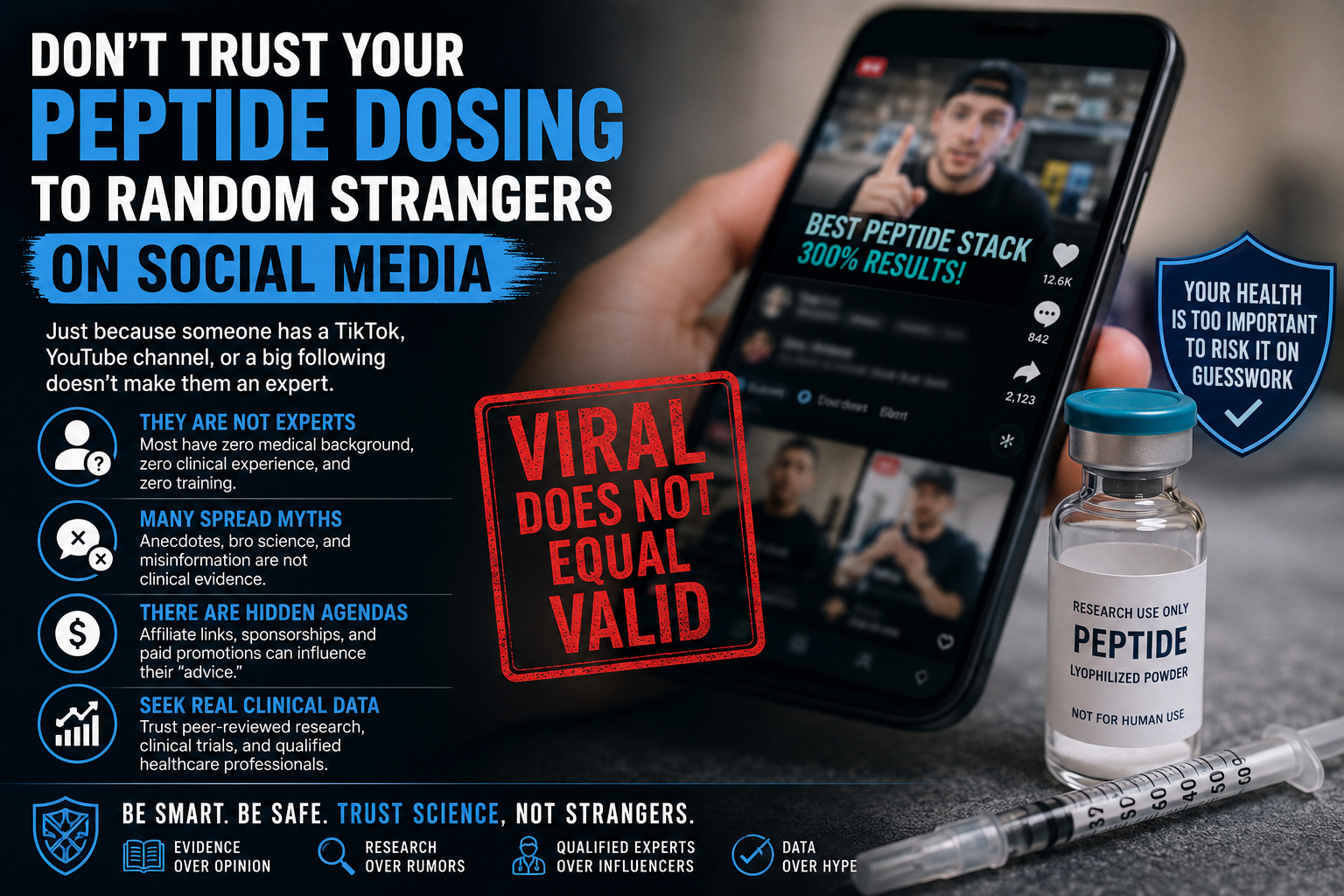
Social media peptide dosing advice often sounds certain, yet it may ignore diagnosis, medical history, medication interactions, product quality, and clinical evidence. Popularity is not proof.

Social-media engagement measures attention rather than accuracy. Therefore, views, likes, testimonials, and anonymous charts should not determine health decisions.
Why Social Media Peptide Dosing Advice Can Mislead
First, social-media platforms reward dramatic, simple, emotional, and shareable content. By contrast, medical evidence often includes uncertainty, patient-specific factors, limitations, adverse effects, and results that do not fit into a short video.
For example, a creator may speak confidently, show before-and-after photos, and cite personal experience. However, an anecdote cannot establish cause, safety, or an appropriate dose for another person.
! No Verified Qualifications
Moreover, many accounts that offer dosing guidance lack a medical license, pharmacy training, research experience, or responsibility for the people who follow their advice.
! Missing Medical Context
In addition, online posts rarely account for age, diagnosis, cardiovascular history, kidney or liver function, pregnancy, allergies, laboratory values, or current medications.
! Commercial Incentives
Meanwhile, affiliate commissions, referral codes, sponsorships, paid groups, and product sales may shape what a creator recommends and which risks they omit.
! Unverified Product Assumptions
Also, a dosing post may assume that a product contains the labeled amount, remained under proper storage, matches its claimed identity, and contains no contamination. Those assumptions require evidence.
Viral Content Does Not Equal Clinical Evidence
For instance, high view counts may reflect entertainment value, controversy, fear, or algorithmic promotion. Therefore, popularity does not establish scientific accuracy.
| Online Signal | What It Actually Shows | What It Does Not Prove |
|---|---|---|
| Large Following | For example, the creator has attracted an audience. | However, audience size does not prove medical expertise, scientific accuracy, or safe recommendations. |
| Thousands of Likes | Likewise, the post was engaging or popular. | Therefore, likes do not show that clinical evidence supports the claim. |
| Personal Testimonial | For instance, someone reports a personal experience. | However, one report does not establish cause and effect, general safety, or predictable results. |
| Before-and-After Photos | Meanwhile, the creator selected a visual comparison. | Also, the image does not prove product identity, dose accuracy, medical supervision, or a lack of editing. |
| Confident Language | Finally, the speaker sounds certain. | By contrast, certainty does not show that the speaker considered risks, uncertainty, or contradictory evidence. |
Why Copying Another Person’s Dose Creates Risk
A dose used by one person does not automatically apply to another person. Even clinicians select approved medications with patient-specific information. Moreover, investigational compounds may lack standardized dosing, consistent manufacturing, long-term safety data, or complete interaction data.
- Health histories differ: For example, heart disease, diabetes, blood-pressure conditions, hormonal disorders, and other diagnoses can change risk.
- Medication lists vary: In addition, prescription drugs, over-the-counter products, and supplements may interact or create overlapping effects.
- Concentrations may differ: As a result, reconstitution errors, mislabeled products, or confusion between milligrams, micrograms, and syringe units can produce major mistakes.
- Product quality varies: Moreover, identity, purity, net content, sterility, and storage conditions may differ between suppliers and batches.
- Individual responses differ: Finally, body size alone does not predict how every person will respond to a biologically active compound.
Common Red Flags in Online Peptide Content
! “Guaranteed Results”
For example, claims of guaranteed fat loss, healing, muscle gain, anti-aging effects, or disease reversal do not reflect responsible medical communication.
! One Protocol for Everyone
Likewise, universal charts that ignore medical history and concurrent medications oversimplify complex health decisions.
! No Discussion of Risks
However, content that promotes benefits while dismissing adverse effects, contraindications, uncertainty, or monitoring deserves caution.
! Urgency and Pressure
Finally, phrases such as “buy now” or “start this stack immediately” use urgency as a marketing tactic rather than evidence-based guidance.
Use Stronger Sources of Information
Instead, responsible research starts with sources that explain methods, limitations, study populations, outcomes, and conflicts of interest. PubMed helps readers locate biomedical literature, while ClinicalTrials.gov provides study records and results. However, a database listing does not itself prove that an intervention works or is safe.
- Peer-reviewed research: First, review the complete paper rather than relying only on a creator’s summary.
- Clinical trial records: Next, confirm whether research remains ongoing, has ended, or stopped early, and note the study phase.
- Regulatory information: Also, check whether regulators approved the compound and for which specific indication.
- Qualified healthcare professionals: Moreover, seek licensed professionals who can review personal history, medications, laboratory findings, and risk factors.
- Independent testing documentation: Finally, verify identity, batch traceability, and the actual scope of testing for research materials.
Questions to Ask When You See a Dosing Post
- First, is this person licensed or professionally qualified to provide medical advice?
- Next, are they discussing an approved medication or an investigational research compound?
- For example, do they cite full studies or only screenshots and personal stories?
- Also, did researchers study the claim in humans, animals, cells, or computer models?
- Moreover, do they explain adverse effects, contraindications, and limitations?
- Meanwhile, are they selling the product or earning an affiliate commission?
- In addition, do they know the viewer’s medical history, medications, and laboratory results?
- Likewise, are they confusing milligrams, micrograms, milliliters, and syringe units?
- Finally, can independent evidence verify the product’s identity, content, and batch testing?
- Would the advice still sound trustworthy without dramatic music, a testimonial, and a sales link?
Be Especially Careful With Reconstitution Math
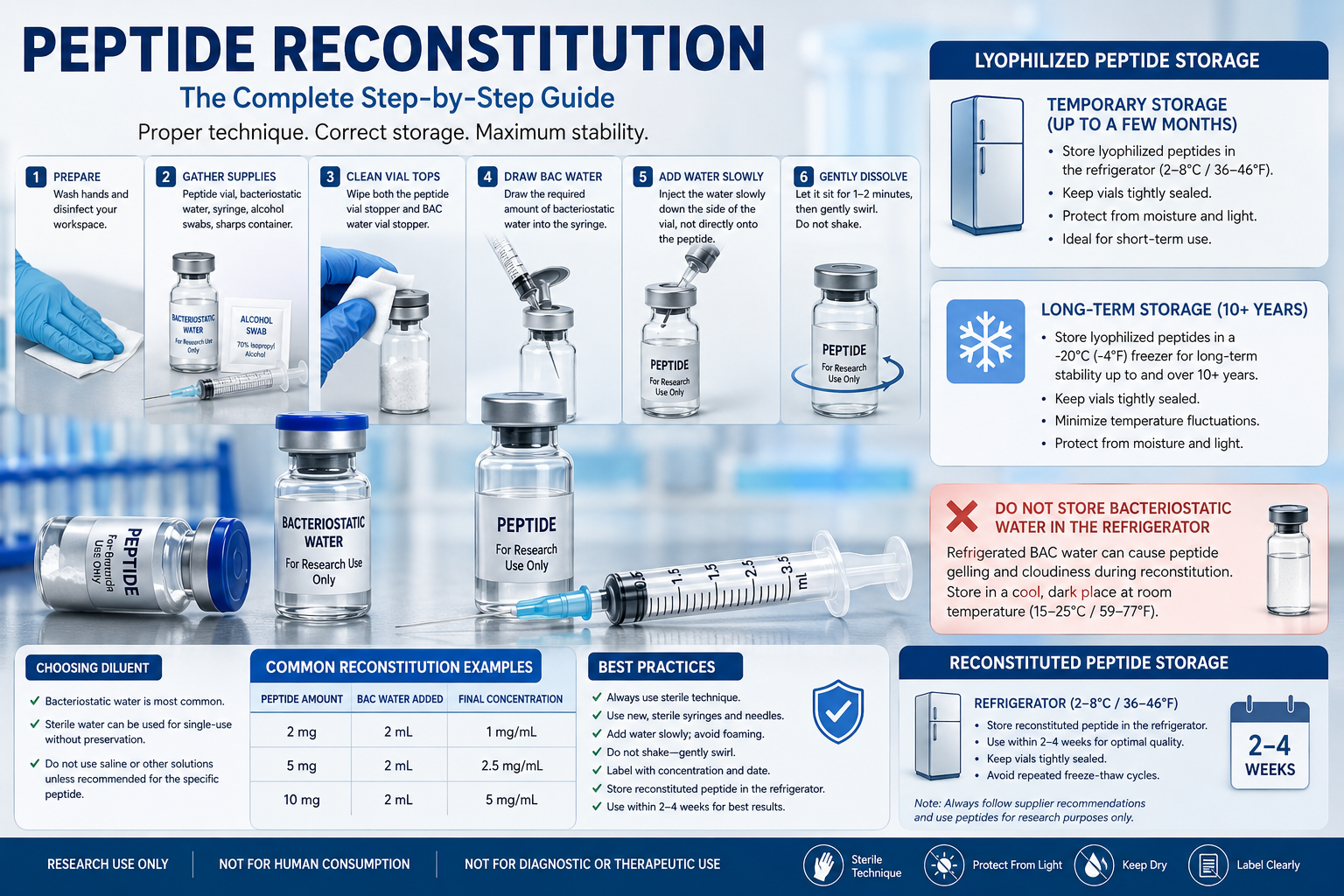
First, social-media discussions often mix vial content, diluent volume, concentration, syringe markings, and intended dose. As a result, a small mathematical error can create a large difference in the amount delivered.
Next, remember that syringe “units” mark volume rather than a universal peptide quantity. The amount at a given marking changes with vial content and added liquid. Therefore, copying a chart without understanding those variables can cause a serious error.
Choose Evidence Over Opinion
Good health information clearly separates known facts from uncertainty and identifies its evidence. For example, the FDA explains that unapproved drugs may not meet established standards for safety, effectiveness, quality, or labeling. Therefore, confidence from an influencer cannot replace regulatory review or qualified clinical judgment.
Finally, do not answer unsupported dosing advice by searching for another influencer who agrees. Instead, pause, verify the claim, review qualified sources, and speak with an appropriately licensed healthcare professional.
Authoritative Sources for Verification
For additional context, review FDA information on unapproved drugs, ClinicalTrials.gov study records, PubMed biomedical literature and FDA-approved drug information. In addition, confirm the study population, research phase, endpoints, limitations, and approval status before interpreting a claim.
Social Media Peptide Dosing Advice: The Bottom Line
Views are not credentials, and testimonials are not clinical trials. Moreover, affiliate links do not provide medical oversight.
In conclusion, social media peptide dosing advice should never replace evidence, product verification, or individualized medical care. Research the claim, verify the source, and protect your health.