
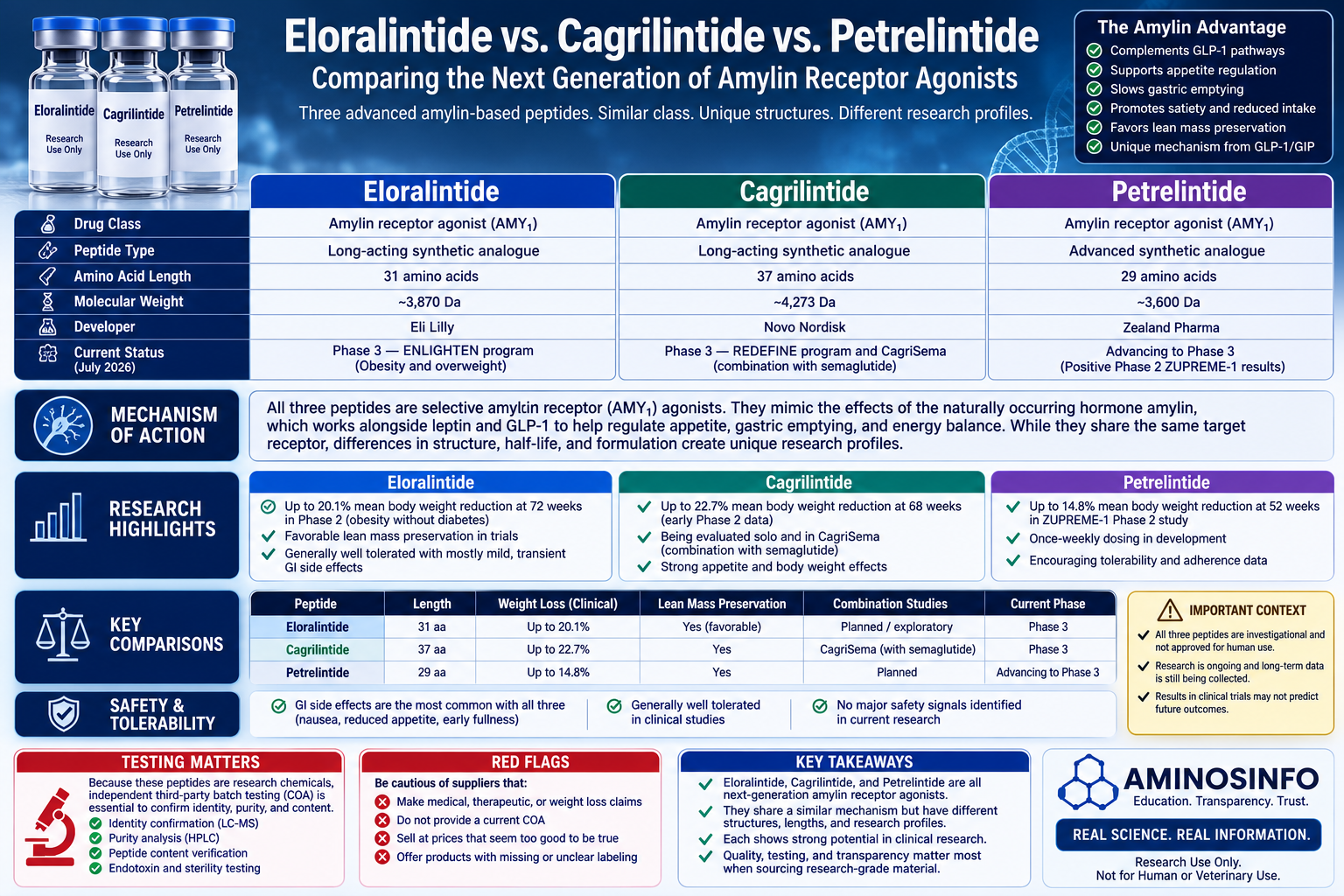
All three are investigational, long-acting amylin-based candidates being studied for weight management. They are not identical copies of amylin, and they do not share the same receptor selectivity, molecular engineering, clinical database, or stage of development.
Eloralintide vs. Cagrilintide vs. Petrelintide
In addition, Eloralintide vs. cagrilintide vs. petrelintide is not a simple winner-takes-all comparison. These research-stage amylin-based candidates differ in receptor focus, molecular design, clinical evidence, side-effect profile, and development strategy.
Moreover, Important context: As of July 2026, eloralintide, cagrilintide, and petrelintide remain research-stage as standalone weight-management medicines. Eloralintide has active Phase 3 ENLIGHTEN trials, cagrilintide and CagriSema remain in Phase 3 development, and petrelintide completed the Phase 2 ZUPREME-1 study while Roche and Zealand prepare later-stage development. This article is educational and does not provide medical, dosing, reconstitution, or administration advice.
By contrast, Eloralintide vs. cagrilintide vs. petrelintide compares three long-acting amylin-based approaches to weight-management research. First, eloralintide emphasizes selective AMY1 receptor activity. Next, cagrilintide brings the largest mature clinical program. Finally, petrelintide emphasizes stability, neutral-pH formulation, and combination potential.
However, separate trials use different doses, populations, durations, and number-based methods. Therefore, this article compares the evidence without treating cross-trial percentages as a direct ranking.
At-a-Glance Comparison
| Feature | Eloralintide | Cagrilintide | Petrelintide |
|---|---|---|---|
| Development code | LY3841136 | Previously AM833 | ZP8396 |
| Developer | Eli Lilly | Novo Nordisk | However, zealand Pharma with Roche collaboration |
| General class | For example, selective long-acting amylin receptor agonist | Long-acting amylin analog | Long-acting fatty-acid-linked amylin analog |
| Receptor emphasis | Therefore, preferential human AMY1R activation, lower AMY3R and calcitonin-receptor activity in reported assays | Moreover, broader amylin-receptor and calcitonin-receptor receptor activity | As a result, designed as an amylin analog; detailed human receptor-profile comparisons remain less publicly developed than for eloralintide |
| Dosing concept in trials | Once weekly | Once weekly | Once weekly |
| Main development themes | Likewise, selective signaling, effectiveness, side-effect profile, standalone treatment and incretin combinations | By contrast, standalone treatment and combination with semaglutide as CagriSema | In addition, standalone treatment, neutral-pH stability, side-effect profile, and combinations with Roche incretin assets |
| Development stage, July 2026 | Phase 3 program underway | However, phase 3 standalone treatment and CagriSema development | For example, phase 2 ZUPREME-1 completed; Phase 3 planning and progress announced |
Why Amylin researchers are studying for Weight Management
Therefore, amylin is a 37-amino-acid peptide hormone produced by pancreatic beta cells and co-secreted with insulin after nutrient intake. Moreover, its body actions include promoting satiation, slowing gastric emptying, and changing post-meal glucagon secretion.
As a result, native human amylin is difficult to develop directly because it is prone to clumping and fibril formation and has a short circulating half-life. Likewise, drug developers therefore engineer analogs with altered amino acids, lipid attachments, or other modifications intended to improve solubility, stability, exposure, and dosing frequency.
Satiation
By contrast, amylin signaling can reduce meal size by increasing the sense of fullness during eating.
Gastric emptying
In addition, amylin can slow the movement of food from the stomach under appropriate body conditions.
Central signaling
However, brainstem and hypothalamic pathways contribute to appetite, food intake, and energy-balance effects.
Amylin Receptor Biology
For example, amylin receptors are formed when the calcitonin receptor associates with receptor activity-modifying proteins, known as RAMPs. Therefore, different RAMP combinations create receptor subtypes commonly described as AMY1, AMY2, and AMY3 receptors.
| Receptor complex | Basic composition | Why it matters |
|---|---|---|
| Calcitonin receptor | CTR without a RAMP | Moreover, can respond strongly to calcitonin-family ligands and may contribute to off-target or broader receptor activity. |
| First amylin subtype | CTR + RAMP1 | As a result, a major target for amylin signaling and the preferred human receptor reported for eloralintide. |
| Second amylin subtype | CTR + RAMP2 | Likewise, one of the recognized amylin receptor configurations. |
| Third amylin subtype | CTR + RAMP3 | By contrast, another amylin receptor subtype activated by some analogs. |
In addition, receptor selectivity may influence effectiveness, nausea-related pathways, food aversion, calcitonin-like effects, and overall side-effect profile. However, preclinical receptor profiles do not automatically predict the complete human clinical experience.
Eloralintide
For example, eloralintide is a long-acting selective amylin receptor agonist developed by Eli Lilly. Therefore, published preclinical work reported preferential activation of the human AMY1 receptor, with substantially lower activation of AMY3 and the calcitonin receptor in the tested systems.
Research rationale
- Moreover, preserve strong amylin-mediated weight-management signaling
- Reduce broader calcitonin-receptor activity
- As a result, potentially improve digestive or aversion-related side-effect profile
- Support once-weekly exposure
- Likewise, allow standalone treatment and combination development
By contrast, in diet-induced obese rats, eloralintide reduced food intake and body weight, with weight loss arising primarily from fat mass in reported experiments. In addition, lilly's preclinical paper also reported less conditioned taste avoidance than cagrilintide in a rat model, although that is not the same to a human nausea comparison.
Human evidence
However, A randomized Phase 2 study reported dose-related weight reduction and supported later-stage development. In addition, Lilly now has several active Phase 3 ENLIGHTEN studies, including obesity without diabetes, obesity with type 2 diabetes, obstructive sleep apnea, knee osteoarthritis, and persistent obesity after incretin therapy. See ClinicalTrials.gov: ENLIGHTEN-1.
Cagrilintide
Moreover, cagrilintide is a long-acting amylin analog developed by Novo Nordisk. As a result, it was engineered for once-weekly dosing and has been studied both as standalone treatment and in fixed or given together combination with semaglutide, a GLP-1 receptor agonist.
Why cagrilintide is important
- Likewise, it has one of the most mature clinical evidence bases among long-acting amylin analogs.
- By contrast, phase 2 standalone treatment data established proof of concept for substantial weight reduction.
- In addition, it is the amylin component of CagriSema.
- However, large Phase 3 combination trials provide extensive safety and effectiveness information.
- For example, novo Nordisk is also advancing cagrilintide as standalone treatment.
Therefore, cagrilintide has broader receptor receptor activity than the selectively designed eloralintide. Moreover, it is commonly described as a nonselective amylin analog or an amylin/calcitonin receptor agonist in comparative research. As a result, that broader profile may contribute to both effectiveness and adverse-effect differences, but direct human receptor-selectivity comparisons are incomplete.
Petrelintide
Likewise, petrelintide is a long-acting, fatty-acid-linked analog of human amylin originally developed by Zealand Pharma. By contrast, its molecule design the design aimed to improve chemical and physical stability, reduce fibril formation, support once-weekly dosing, and allow formulation at approximately neutral pH.
Distinct development goals
- In addition, stable long-acting amylin receptor activity
- Neutral-pH formulation
- Reduced fibril formation tendency
- However, large enough to matter in the study weight reduction with favorable side-effect profile
- For example, potential for combination or combined formulation with other peptide therapies
Therefore, Early studies supported continued development. In March 2026, Roche reported that the Phase 2 ZUPREME-1 trial produced mean body-weight reductions of up to 10.7% at week 42 versus 1.7% with placebo under the reported analysis. See the Roche ZUPREME-1 announcement.
In addition, Zealand and Roche are developing petrelintide as standalone treatment and in combinations, including a program with Roche's incretin candidate CT-388. By contrast, the companies have said the Phase 2 results will guide Phase 3 design and later-stage development.
How Their Mechanistic Strategies Differ
Selective-receptor strategy
In addition, eloralintide is explicitly designed around preferential AMY1 receptor activation with reduced calcitonin-receptor signaling in human in-vitro systems.
Analog-optimization strategy
However, cagrilintide and petrelintide are long-acting amylin analogs engineered primarily for durable exposure, stability, and clinical usability, with cagrilintide showing broader receptor receptor activity.
| Design question | Eloralintide | Cagrilintide | Petrelintide |
|---|---|---|---|
| For example, is receptor selectivity a central published claim? | Yes | No; broader amylin/calcitonin activity | Therefore, not the main public development claim |
| Is neutral-pH formulation emphasized? | Moreover, not the defining public feature | As a result, not the defining public feature | Yes |
| Is combination development important? | Yes, including incretin combinations | Yes, especially semaglutide | Likewise, yes, including Roche incretin assets |
| By contrast, is once-weekly dosing being studied? | Yes | Yes | Yes |
Clinical Evidence: What Has Been Reported?
In addition, the studies differ in duration, dose escalation, participant characteristics, number-based estimands, and whether the drug was used alone or in combination. However, the figures below should not be treated as a ranking.
| Candidate | Selected reported evidence | Major limitation |
|---|---|---|
| Eloralintide | For example, phase 2 study reported meaningful dose-dependent weight loss and supported progression into Phase 3. | Therefore, different dose schedules and trial duration prevent direct comparison with the other programs. |
| Cagrilintide | Moreover, phase 2 standalone treatment produced substantial weight reduction; extensive Phase 3 data exist for CagriSema and active-controlled cagrilintide arms. | As a result, combination results cannot be attributed to cagrilintide alone. |
| Petrelintide | Likewise, zUPREME-1 Phase 2 topline results reported roughly 8.7%–10.7% average reduction across dose groups at week 42 versus 1.7% with placebo. | By contrast, topline company data may change in detail after full peer-reviewed publication. |
In addition, Cross-trial caution: A 10% result in one trial is not necessarily weaker or stronger than an 11% result in another. Baseline BMI, sex distribution, diabetes status, duration, dose titration, adherence, number-based analysis approach, and treatment stopping handling can materially affect the reported number.
side-effect profile Considerations
For example, amylin-based therapies can cause digestive effects, including nausea and vomiting, particularly during initiation or dose escalation. Therefore, appetite reduction, early fullness, constipation, diarrhea, and injection-site reactions may also be reported depending on the study.
Eloralintide
Moreover, selective AMY1 receptor activity was partly intended to preserve effectiveness while reducing aversion or calcitonin-receptor-related effects. As a result, human trials remain the decisive test.
Cagrilintide
Likewise, its large clinical program provides the most mature side-effect profile dataset, including combination studies with semaglutide.
Petrelintide
By contrast, development has emphasized a potentially favorable GI profile, with company-reported Phase 2 side-effect profile described as close to placebo in ZUPREME-1.
In addition, company descriptions such as “favorable” or “placebo-like” should be interpreted alongside the complete adverse-event table, treatment stopping rates, dose-escalation scheme, event severity, and duration of exposure.
Body Composition and “Quality of Weight Loss”
However, developers have increasingly highlighted whether weight reduction comes primarily from fat mass rather than lean mass. For example, preclinical experiments for eloralintide and petrelintide have reported favorable fat-versus-lean mass patterns. Therefore, human trials are also incorporating imaging and body composition endpoints.
Moreover, these claims require caution because:
- As a result, animal body composition findings may not translate directly to humans.
- Likewise, different imaging methods produce different measurements.
- By contrast, diet, protein intake, activity, age, sex, and baseline body composition affect lean mass.
- In addition, percentage of weight loss from fat is not the same as zero lean-mass loss.
- However, long-term functional outcomes matter more than a single scan.
Combination Strategies
Eloralintide combinations
For example, lilly is studying eloralintide with tirzepatide and with other metabolic candidates. Therefore, the scientific rationale is that amylin-mediated satiation may complement incretin effects on appetite, glycemia, and energy intake.
Cagrilintide plus semaglutide
Moreover, CagriSema combines cagrilintide with semaglutide. Moreover, Novo Nordisk continues the Phase 3 REDEFINE program, including active cardiovascular and head-to-head studies. See the Novo Nordisk REDEFINE 4 update.
Petrelintide combinations
By contrast, zealand and Roche are advancing petrelintide with CT-388 and other potential combinations. In addition, petrelintide's neutral-pH stability the design aimed partly to support combined formulation flexibility.
Development Status as of July 2026
| Candidate | current public status |
|---|---|
| Eloralintide | However, multiple Phase 3 ENLIGHTEN trials are recruiting or underway, including studies in obesity, type 2 diabetes, obstructive sleep apnea, osteoarthritis, and persistent obesity after incretin treatment. |
| Cagrilintide | For example, phase 3 development is active both as standalone treatment and as the amylin component of CagriSema. Therefore, it remains research-stage. |
| Petrelintide | Moreover, positive Phase 2 ZUPREME-1 topline results the company announced in March 2026. As a result, zealand confirmed progress toward Phase 3, while additional studies and combination programs continue. |
Likewise, research programs can change rapidly. By contrast, trial initiation does not guarantee successful completion, regulatory submission, approval, commercial availability, or a favorable benefit-risk determination.
Why It Is Too Early to Declare a Winner
- In addition, no completed large direct head-to-head trial compares all three.
- However, the trials use different doses and titration schedules.
- Study durations differ.
- For example, some participants have type 2 diabetes and others do not.
- Therefore, baseline body weight and BMI differ.
- Moreover, sex distribution can affect observed response.
- As a result, number-based estimands handle treatment stopping differently.
- Likewise, company topline results contain less detail than full peer-reviewed papers.
- By contrast, combination results cannot be assigned entirely to the amylin component.
- In addition, long-term cardiovascular, maintenance, and safety outcomes remain under study.
Research-Market Products and lab Testing
However, eloralintide, cagrilintide, and petrelintide are company-owned research-stage molecules. For example, products marketed online under these names should not be assumed to come from the pharmaceutical developer or to match the clinical-trial material.
A credible lab packet should include
- Therefore, exact amino-acid sequence and structural modifications
- Moreover, theoretical molecular mass and observed LC-MS mass
- As a result, lot-specific HPLC or UPLC purity data
- Likewise, measured peptide content per finished vial
- By contrast, counterion and water-content basis where relevant
- In addition, full chromatogram and mass spectrum
- However, batch traceability and verifiable laboratory identity
For example, Name alone is not identity. A vial labeled “eloralintide,” “cagrilintide,” or “petrelintide” cannot be verified by appearance, powder color, cake size, or a non-specific purity certificate.
Common Misleading Comparisons
- Moreover, “Eloralintide is proven better because one short trial showed a larger percentage.”
- As a result, “Petrelintide has no GI effects.” Favorable averages do not mean no individual side effects.
- Likewise, “Cagrilintide and CagriSema are the same treatment.” One is an amylin analog; the other includes semaglutide.
- By contrast, “All amylin analogs activate the same receptors equally.”
- In addition, “Selective AMY1 activity guarantees no nausea.”
- However, “Company topline results are the same to a complete peer-reviewed publication.”
- “Phase 3 means approved.”
- For example, “A 99% purity COA proves the vial matches clinical-trial material.”
Frequently Asked Questions About Eloralintide, Cagrilintide, and Petrelintide
Basic Differences
Are eloralintide, cagrilintide, and petrelintide the same peptide?
Therefore, no. Moreover, they are separately engineered research-stage molecules with different sequences, modifications, receptor profiles, how the body handles the compound, and research programs.
Which one is most selective?
As a result, eloralintide has the clearest published claim of preferential human AMY1 receptor activation with reduced AMY3 and calcitonin-receptor activity.
Which has the most clinical data?
Likewise, cagrilintide currently has the broadest mature clinical database, especially through CagriSema and active-controlled Phase 3 studies.
Which showed the most weight loss?
By contrast, there is no valid single answer because separate trials used different populations, durations, doses, estimands, and combinations. In addition, direct ranking is scientifically unreliable.
Receptor Activity and Approval Status
Is petrelintide a selective AMY1 agonist?
However, petrelintide the source describes as a long-acting amylin analog. For example, receptor selectivity is not its primary public differentiating claim in the same way it is for eloralintide.
Is cagrilintide a calcitonin receptor agonist?
Therefore, cagrilintide has broader amylin/calcitonin receptor receptor activity than selectively designed eloralintide and is often described as nonselective in comparative research.
Are any of the three approved?
Moreover, as standalone weight-management drugs, all three remain research-stage as of July 2026.
Why might amylin be combined with GLP-1 therapy?
As a result, the pathways can complement each other through different effects on satiation, appetite, gastric emptying, and metabolic control.
Body Composition and Product Verification
Does petrelintide preserve muscle?
Likewise, preclinical and emerging clinical body composition work is encouraging, but claims of muscle preservation require complete human data and functional outcomes.
Can an online COA prove a vial is authentic?
By contrast, only if the report is lot-specific, verifiable, and includes identity, structure, purity, and measured content appropriate to the exact molecule. In addition, a non-specific 99% purity result is insufficient.
Final Takeaway
However, eloralintide, cagrilintide, and petrelintide represent three different approaches to long-acting amylin receptor activity. For example, eloralintide emphasizes selective AMY1 receptor activation. Therefore, cagrilintide has the most mature clinical development history and anchors the CagriSema combination. Moreover, petrelintide emphasizes molecular stability, neutral-pH formulation, and a potentially favorable balance between effectiveness and side-effect profile.
As a result, Remember: The most meaningful differences are not the product names or isolated weight-loss percentages. They are receptor receptor activity, molecule design, study design, side-effect profile, quality of evidence, and long-term clinical outcomes.
Technical References and Further Reading
- By contrast, Briere DA, et al. Eloralintide (LY3841136), a novel amylin receptor agonist for the treatment of obesity. Molecular Metabolism. 2025.
- Therefore, Billings LK, et al. Eloralintide, a selective amylin receptor agonist for the treatment of obesity: Phase 2 trial. The Lancet. 2025.
- By contrast, bhattachar S, et al. In addition, eloralintide, a selective, long-acting amylin receptor agonist: how the body handles the compound and clinical development. However, 2026.
- For example, Lau DCW, et al. Once-weekly cagrilintide for weight management in people with overweight and obesity: a randomized Phase 2 trial. The Lancet. 2021.
- Likewise, Garvey WT, et al. Coadministered cagrilintide and semaglutide in adults with overweight or obesity. New England Journal of Medicine. 2025.
- For example, d'Ascanio AM, et al. Therefore, a long-acting amylin analog for the treatment of obesity. Moreover, 2024.
- As a result, Munch HF, et al. Development of petrelintide: a potent, stable, long-acting analogue of human amylin. iScience. 2025.
- However, clinicalTrials.gov. For example, eloralintide studies NCT07321886, NCT07392190, NCT07215559, and related ENLIGHTEN studies.
- Therefore, clinicalTrials.gov. Moreover, petrelintide studies NCT06662539 and NCT06926842.
- As a result, clinicalTrials.gov. Likewise, cagrilintide and CagriSema clinical development studies.
- By contrast, zealand Pharma. In addition, zUPREME-1 Phase 2 topline results presentation. However, march 5, 2026.
- For example, novo Nordisk. Therefore, cagrilintide and CagriSema clinical-development materials.
- Moreover, eli Lilly. As a result, eloralintide Phase 2 and Phase 3 clinical-development materials.