Bronchogen Scientific Overview: Identity, Mechanism, Evidence, and Testing
Bronchogen scientific overview content should distinguish the commonly listed Ala–Glu–Asp–Leu sequence from the ADEL ordering that appears in some papers. The article also separates cell and regional COPD findings from claims of proven respiratory treatment. Finally, Bronchogen remains an unapproved research peptide.
What Is Bronchogen?
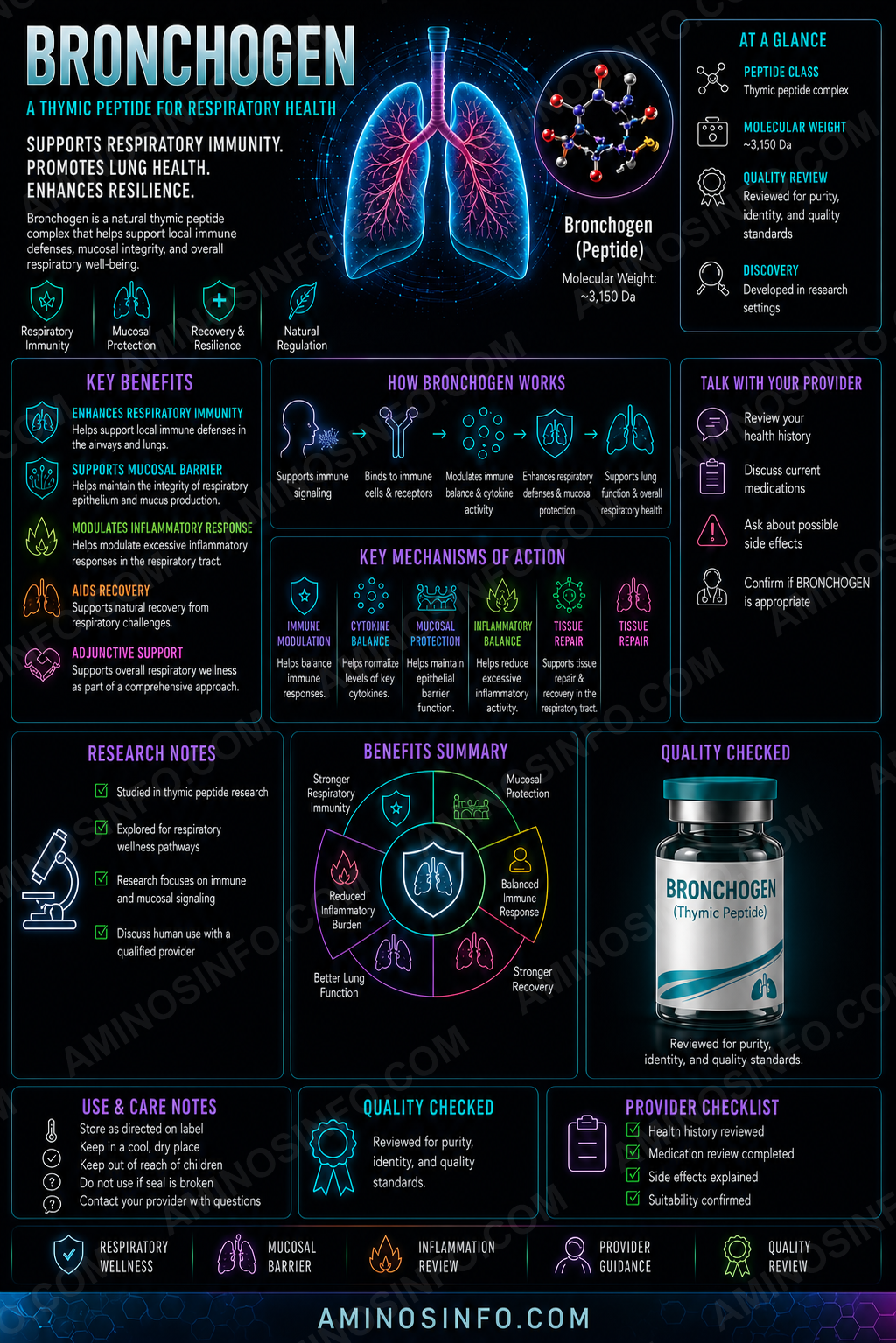
First, Bronchogen is a synthetic tetrapeptide composed of alanine, glutamic acid, aspartic acid, and leucine. Its sequence is Ala–Glu–Asp–Leu, abbreviated AEDL.
However, peer-reviewed literature sometimes prints the sequence as ADEL, reflecting the three-letter order Ala–Asp–Glu–Leu. This creates a nomenclature inconsistency. Commercial and analytical suppliers most commonly identify Bronchogen as H-Ala-Glu-Asp-Leu-OH. Any research material should therefore be verified by sequence-specific analytical testing rather than by name alone.
Bronchogen
Ala–Glu–Asp–Leu
AEDL
Linear tetrapeptide
Bronchial epithelial regulation
No
🧬 Molecular Structure
First, the commonly marketed and analytically listed form of Bronchogen is a linear tetrapeptide composed of L-alanine, L-glutamic acid, L-aspartic acid, and L-leucine, with free N- and C-termini.
🧪 Amino-Acid Sequence
H-Ala-Glu-Asp-Leu-OH
One-letter notation: AEDL
| Residue | Chemical feature | Analytical relevance |
|---|---|---|
| Alanine | For example, Small nonpolar methyl side chain | Meanwhile, Defines the N-terminal residue. |
| Glutamic acid | Likewise, Acidic side-chain carboxyl group | In addition, Can contribute to sequence isomers and hydrolysis-related impurities. |
| Aspartic acid | Moreover, Acidic side-chain carboxyl group | By contrast, Can undergo isomerization or form isoaspartyl-related degradants. |
| Leucine | Also, Hydrophobic branched-chain side chain | Consequently, Contributes hydrophobicity and helps chromatographic separation. |
⚛️ Molecular Weight and 🧫 Formula
| Neutral molecular formula | However, C18H30N4O9 |
|---|---|
| Average molecular weight | Approximately 446.45 g/mol |
| Peptide length | Tetrapeptide; four residues |
| Expected terminal form | Therefore, Free N-terminus and free C-terminal carboxyl group |
| Common analytical listing | H-AEDL-OH |
Importantly, AEDL and ADEL have identical elemental composition and molecular mass but different amino-acid order. An intact-mass result alone cannot resolve this discrepancy.
📅 Discovery Timeline and Research History
1970s–1990s: Respiratory peptide complexes investigated
First, Russian and Eastern European programs studied peptide fractions derived from bronchial mucosa and lung tissue.
1990s–2000s: Defined tetrapeptide introduced
Next, researchers synthesized and studied a short tetrapeptide associated with bronchial tissue under the name Bronchogen.
2010–2011: DNA-thermostability research
Moreover, a study examined Bronchogen’s effect on DNA thermal stability, supporting a possible physical interaction with nucleic acids under experimental conditions.
2014: Human bronchial epithelial gene-expression study
In addition, research reported regulation of Ki-67, Mcl-1, p53, CD79, NOS3, NKX2-1, SCGB1A1, SCGB3A2, FOXA1, and FOXA2 in cultured human bronchial epithelium.
2015: COPD epithelial-remodeling study
Likewise, a regional study reported that one month of Bronchogen treatment reduced or normalized selected remodeling features in bronchial epithelium and lung tissue in COPD.
2017: Anti-inflammatory and regenerative study
Meanwhile, further research examined structural and functional bronchial epithelium and inflammatory activity in experimental lung pathology.
2020–2022: Respiratory and peptide-regulation reviews
Moreover, reviews discussed Bronchogen in relation to lung tissue, gene regulation, COVID-era respiratory research, and ultrashort-peptide transport.
2025: Plant-cell autophagy research
However, AEDL was also studied in tobacco-root meristem cells, where it affected metabolism, autophagy, mitochondrial permeability, and cytochrome-c release. These plant findings are not evidence of lung benefit in humans.
Current status
Finally, Bronchogen remains an unapproved investigational peptide without a large independent clinical-development program.
Bronchial Epithelial Biology
Barrier function
First, bronchial epithelial cells form a physical barrier against pathogens, smoke, pollution, allergens, and chemical exposure.
Mucociliary clearance
Next, ciliated cells propel mucus out of the airways, while goblet and secretory cells produce mucins and protective proteins.
Basal-cell progenitors
Moreover, basal cells can regenerate ciliated and secretory cell populations after injury.
Club-cell proteins
In addition, researchers associate SCGB1A1 and SCGB3A2 with secretory club-cell identity and airway protection.
NKX2-1, FOXA1, and FOXA2
Likewise, these transcription factors participate in lung epithelial identity, differentiation, surfactant-associated programs, and secretory-cell function.
COPD remodeling
Finally, COPD can involve epithelial injury, goblet-cell hyperplasia, mucus overproduction, reduced ciliation, basal-cell abnormalities, squamous metaplasia, small-airway fibrosis, and emphysema.
🧠 Proposed Mechanisms of Action
Importantly, researchers have not established a validated high-affinity receptor or single molecular mechanism for Bronchogen.
Clinical respiratory benefit remains unproven
1. Proliferation signaling
First, Bronchogen increased Ki-67 and Mcl-1 expression most strongly in older-passage bronchial epithelial cultures.
2. Differentiation-gene regulation
Next, the peptide altered expression of NKX2-1, SCGB1A1, SCGB3A2, FOXA1, and FOXA2—genes associated with airway epithelial identity and maturation.
3. Apoptosis and survival signaling
Moreover, investigators interpreted changes in p53 and Mcl-1 as possible effects on cell survival and apoptosis.
4. Nitric-oxide-related signaling
In addition, NOS3 protein regulation was reported. The physiological meaning in bronchial epithelium and human lung disease remains uncertain.
5. DNA-interaction hypothesis
However, biophysical research reported effects on DNA thermostability. Physical interaction does not establish selective gene activation in living lung tissue.
🎯 Target and Pathway Profile
| Marker or pathway | Evidence status |
|---|---|
| Ki-67 | For example, Increased in cultured human bronchial epithelial cells, especially older cultures. |
| Mcl-1 | Meanwhile, Regulated in epithelial cultures; associated with cell survival. |
| p53 | Likewise, Regulated in epithelial cultures; role is context dependent. |
| CD79 | In addition, Reported protein regulation; bronchial significance remains uncertain. |
| NOS3 | Moreover, Reported protein regulation; functional airway effects remain uncertain. |
| NKX2-1 | Gene-expression regulation reported. |
| In addition, SCGB1A1 and SCGB3A2 | By contrast, Club-cell-associated gene regulation reported. |
| FOXA1 and FOXA2 | Also, Airway epithelial differentiation-gene regulation reported. |
| Specific lung receptor | None established. |
Cell Proliferation and Differentiation Research
Human bronchial epithelial cultures
First, a 2014 study evaluated cultures at different passages as a model of cellular aging.
Older cultures responded most strongly
Next, investigators observed the largest Ki-67 and Mcl-1 increases in older-passage cultures and proposed a geroprotective effect.
Differentiation markers
Moreover, regulation of NKX2-1, SCGB1A1, SCGB3A2, FOXA1, and FOXA2 suggests that the peptide can influence epithelial-cell identity programs in vitro.
Functional maturity remains unproven
However, gene-expression changes do not prove restoration of normal cilia, mucus transport, barrier resistance, pathogen defense, or gas exchange.
Proliferation may have risks
Finally, promoting proliferation can support repair, but excessive or poorly controlled growth could contribute to metaplasia, fibrosis, or neoplasia.
COPD and Bronchial-Remodeling Research
2015 regional study
First, a study reported that a month of Bronchogen treatment eliminated or reduced morphological features of bronchial epithelial and lung-tissue remodeling associated with COPD.
Reported cellular changes
Next, summaries describe normalization of ciliated, goblet, basal, and other epithelial-cell populations and changes in bronchial mucosa and lung tissue.
Important limitations
- First, Small and regional evidence base
- Next, Limited public detail on randomization and blinding
- Also, Unclear independent replication
- Moreover, Limited reporting of spirometry and exacerbations
- In addition, No established effect on hospitalization or mortality
Not a replacement for COPD therapy
Finally, smoking cessation, vaccination, pulmonary rehabilitation, bronchodilators, inhaled corticosteroids in selected patients, oxygen when indicated, and guideline-directed care remain the evidence-based approach.
Inflammation and Tissue-Repair Claims
Bronchoprotective research
First, animal and regional studies describe anti-inflammatory and regenerative effects in damaged bronchial epithelium and lung tissue.
Inflammation is context dependent
However, suppressing inflammation may reduce tissue damage but can impair pathogen clearance or repair if excessive.
Cytokine evidence
Moreover, unlike Chonluten’s THP-1 study, Bronchogen’s strongest direct evidence centers on epithelial morphology and gene expression rather than a clearly defined TNF/IL-6 mechanism.
Repair versus remodeling
In addition, healthy repair restores organized ciliated and secretory epithelium. Maladaptive remodeling can produce mucus hypersecretion, fibrosis, squamous metaplasia, and impaired clearance.
No established antifibrotic effect
Finally, direct modern evidence showing reduced collagen, fibroblast activation, or pulmonary-fibrosis progression remains limited.
DNA Interaction and Thermostability Research
Biophysical experiment
First, a study reported that Bronchogen altered DNA thermostability, suggesting peptide–DNA interaction under laboratory conditions.
Sequence ambiguity matters
However, some publications label the sequence ADEL rather than AEDL. These are distinct peptides and should not be assumed interchangeable without analytical confirmation.
From binding to transcription
Moreover, even if a peptide binds DNA, physiological gene regulation requires cellular uptake, nuclear access, relevant concentration, sequence selectivity, chromatin context, and reproducibility.
No proven genomic targeting
Finally, no clinically validated promoter or transcriptional target explains all reported respiratory effects.
Lung Aging and Cellular-Senescence Claims
Age-related epithelial decline
First, aging can reduce epithelial repair, alter ciliary function, increase senescence, change immune responses, and impair resilience after injury.
Old-passage culture model
Next, the stronger Ki-67 and Mcl-1 response in old-passage cells supports a hypothesis of age-dependent activity.
Passage number is not whole-organ aging
However, replicative aging in culture does not reproduce the full complexity of aged human lung tissue.
No proof of lung rejuvenation
Moreover, no evidence establishes reversal of age-related lung-function decline, restoration of youthful spirometry, or prevention of respiratory disease.
Senescence may be protective
Finally, cellular senescence can suppress damaged-cell proliferation. indiscriminate reversal could theoretically increase cancer risk.
Evidence Limitations and Clinical Interpretation
Direct but limited cell evidence
First, Bronchogen has more direct bronchial epithelial research than many vendor-defined bioregulators.
Regional clinical evidence
Next, COPD-related observations are intriguing but not equivalent to large multicenter randomized trials.
Nomenclature inconsistency
Moreover, AEDL-versus-ADEL reporting creates a significant identity issue that analysts must resolve.
No established patient-centered outcomes
However, no robust evidence demonstrates improved FEV1, fewer exacerbations, reduced hospitalization, improved exercise tolerance, or longer survival.
No FDA-approved dose or route
Finally, there is no validated prescribing information, pharmacokinetic profile, or standard monitoring protocol.
Safety and Regulatory Considerations
No standardized human safety profile
First, no FDA-approved label defines dose, route, pharmacokinetics, contraindications, interactions, pregnancy safety, or long-term adverse effects.
Proliferation and cancer concern
Moreover, any compound increasing Ki-67 or cell survival requires careful evaluation for dysplasia, tumor promotion, or abnormal airway remodeling.
p53 and apoptosis uncertainty
In addition, changing p53 or Mcl-1 can alter damaged-cell survival and cancer-related pathways.
Respiratory emergencies
However, Bronchogen must not replace inhalers, corticosteroids, antibiotics, oxygen, pulmonary rehabilitation, or emergency care.
Product-quality risk
Likewise, unapproved material may contain the wrong sequence, sequence isomers, free amino acids, residual solvents, microbial contamination, endotoxin, or inaccurate content.
Regulatory status
Finally, Bronchogen is not FDA approved as a drug or biologic.
🧪 Laboratory Testing Methods
Identity, Sequence, and Stability Testing
| Method | Purpose | Important limitation |
|---|---|---|
| Consequently, RP-HPLC, ion-pair HPLC, or UPLC | However, Separates Bronchogen from deletion peptides, amino acids, and degradants. | Therefore, Small acidic peptides require validated methods. |
| LC-MS / HRMS | For example, Confirms intact molecular mass. | Meanwhile, Cannot distinguish AEDL from ADEL or other sequence isomers by mass alone. |
| MS/MS sequencing | Likewise, Confirms exact amino-acid order. | In addition, Essential because literature and commercial naming are inconsistent. |
| Chiral amino-acid analysis | Moreover, Confirms L-Ala, L-Glu, L-Asp, and L-Leu. | By contrast, Hydrolysis may create artifacts. |
| Net peptide-content assay | Also, Measures actual peptide concentration. | Consequently, analysts must not infer net peptide content from HPLC area purity. |
| Sequence-isomer analysis | However, Detects AEDL, ADEL, and other permutations. | Therefore, Isomers may have identical mass and similar chromatography. |
| Isoaspartate analysis | Evaluates Asp isomerization. | For example, analysts may need specialized LC-MS methods. |
| Free amino-acid analysis | Meanwhile, Detects hydrolysis or incomplete synthesis. | Likewise, Requires adequate chromatographic resolution. |
| In addition, Bronchial epithelial proliferation assay | Moreover, Measures Ki-67, cell count, and growth. | By contrast, Proliferation does not prove healthy repair. |
| Gene-expression assay | Also, Measures NKX2-1, SCGB1A1, SCGB3A2, FOXA1, and FOXA2. | Consequently, researchers must pair gene-expression testing with functional epithelial outcomes. |
| However, Barrier and mucociliary assays | Therefore, Evaluate transepithelial resistance, cilia, mucus, and wound closure. | For example, Needed to establish true epithelial repair. |
| Meanwhile, DNA-binding or thermal-melting assay | Likewise, Evaluates peptide effects on DNA stability. | In addition, Does not prove physiological gene regulation. |
| Moreover, Microbial limits, sterility, and endotoxin | By contrast, Evaluate route-specific microbiological quality. | Also, Requirements differ by intended use. |
| Stability testing | Consequently, Tracks hydrolysis, isomerization, assay, moisture, and appearance. | However, Must reflect final formulation and storage conditions. |
📄 How to Interpret a Bronchogen COA
COA Review and Route-Specific Quality
- Therefore, Verify the exact sequence: The commonly listed commercial form is H-Ala-Glu-Asp-Leu-OH, or AEDL.
- Resolve Moreover, AEDL versus ADEL: Because papers use both orders, require MS/MS sequence confirmation.
- For example, Verify stereochemistry: Expected research material generally uses L-amino acids.
- Meanwhile, Check terminal chemistry: Acetylated, amidated, or salt-modified forms are different materials.
- Likewise, Separate identity, purity, and net content: These are different analytical measurements.
- In addition, Review sequence isomers, isoaspartate, free amino acids, water, counterions, and residual solvents.
- Moreover, Match testing to intended route: Raw-powder purity does not establish oral, injectable, nasal, or inhaled suitability.
- By contrast, Do not infer respiratory efficacy: A passing COA cannot prove epithelial repair, reduced COPD remodeling, better lung function, or clinical safety.
📊 Bronchogen vs Chonluten vs Thymalin vs Epitalon
Sequence and Respiratory-Research Differences
| Feature | Bronchogen | Chonluten | Thymalin | Epitalon |
|---|---|---|---|---|
| Sequence or composition | Also, AEDL commonly listed; ADEL in some papers | EDG | Consequently, Complex of thymic peptides | AEDG |
| Length | Tetrapeptide; four residues | 3 amino acids | Mixture | Tetrapeptide; four residues |
| However, Main direct research association | Therefore, Bronchial epithelial proliferation and differentiation | Monocyte/macrophage cytokine signaling | Immune regulation | For example, Pineal and aging research |
| FDA approved? | For example, Regulators have not approved this compound. | Moreover, No approved indication exists. | This remains unapproved. | In addition, No FDA authorization applies. |
Bronchogen vs Approved COPD Treatments
Experimental Peptide Versus Established COPD Care
| Therapy class | Established role | Difference from Bronchogen |
|---|---|---|
| Long-acting bronchodilators | Meanwhile, Improve airflow and symptoms | Likewise, Defined receptor pharmacology and clinical trials |
| Inhaled corticosteroids | In addition, Reduce exacerbations in selected patients | Moreover, Established dosing and safety guidance |
| Pulmonary rehabilitation | By contrast, Improves exercise capacity and quality of life | Strong clinical evidence |
| Finally, smoking cessation | Also, Slows disease progression and reduces risk | Core evidence-based intervention |
| Bronchogen | No approved indication | Consequently, Experimental peptide with limited evidence |
Bronchogen vs Airway-Regeneration Research
| Approach | Main research goal | Same as Bronchogen? |
|---|---|---|
| Basal-cell organoids | However, Model airway epithelial regeneration | However, Regulators have not approved this compound. |
| Air-liquid-interface cultures | Therefore, Measure ciliation, mucus, and barrier function | Therefore, No approved indication exists. |
| For example, Growth factors and morphogens | Direct lineage differentiation | This remains unapproved. |
| Bronchogen | Experimental short-peptide regulation | Distinct approach |
🔗 Related Peptides and Respiratory Pathways
- Chonluten: First, EDG tripeptide studied in inflammatory-signaling models.
- NKX2-1: Next, Lung epithelial lineage and differentiation transcription factor.
- In addition, SCGB1A1 and SCGB3A2: Secretory club-cell-associated genes.
- FOXA1 and FOXA2: Moreover, Transcription factors involved in airway differentiation.
- Ki-67: In addition, Proliferation marker used in Bronchogen studies.
- Mcl-1 and p53: Likewise, Cell-survival and apoptosis-related proteins.
- Basal cells: Finally, Airway epithelial progenitors involved in repair.
🖼️ Original Diagram Specifications
Diagram 1: Bronchogen molecular structure
Meanwhile, Show H-Ala-Glu-Asp-Leu-OH with alanine’s methyl group, two acidic side chains, leucine’s branched side chain, peptide bonds, and free termini.
Diagram 2: Moreover, AEDL versus ADEL identity issue
Likewise, Show both sequence orders, identical formula and mass, and the need for MS/MS confirmation.
Diagram 3: Bronchial epithelial cell types
In addition, Show basal, ciliated, goblet, club, and neuroendocrine cells with their roles in barrier function and repair.
Diagram 4: Gene-regulation map
Moreover, Show Ki-67, Mcl-1, p53, NOS3, NKX2-1, SCGB1A1, SCGB3A2, FOXA1, and FOXA2 with all effects labeled experimental.
Diagram 5: COPD remodeling
By contrast, Compare healthy airway epithelium with goblet-cell hyperplasia, ciliary loss, basal-cell abnormalities, mucus accumulation, and small-airway fibrosis.
Diagram 6: Evidence ladder
Also, Show chemistry, DNA biophysics, epithelial cell culture, regional COPD study, large randomized trials, and FDA approval. Place Bronchogen below confirmatory clinical evidence.
Diagram 7: COA workflow
Consequently, Show intact mass, MS/MS sequence, stereochemistry, sequence isomers, isoaspartate, free amino acids, net content, microbiology, and stability.
❓ Frequently Asked Questions
Is Bronchogen a peptide?
However, Yes. It is a synthetic tetrapeptide.
What is the commonly listed sequence?
H-Ala-Glu-Asp-Leu-OH, abbreviated AEDL.
Why do some papers say ADEL?
The literature contains inconsistent sequence ordering. Because Importantly, AEDL and ADEL have the same formula and mass, sequence-specific testing is required.
What is its molecular weight?
Approximately 446.45 g/mol.
Is Bronchogen FDA approved?
No.
Does Bronchogen stimulate bronchial epithelial cells?
Therefore, Cell studies reported increased proliferation and changes in epithelial differentiation genes.
Does it treat COPD?
For example, Small regional studies reported remodeling changes, but no large independent trial establishes clinical efficacy.
Does Bronchogen reduce inflammation?
Meanwhile, experimental studies describe anti-inflammatory effects, but the mechanism and human relevance remain uncertain.
Does it repair lung tissue?
Likewise, cellular and regional findings suggest possible remodeling effects, but researchers have not proven clinically meaningful lung repair.
Is Bronchogen the same as Chonluten?
In addition, No. Bronchogen is a tetrapeptide commonly listed as AEDL, while Chonluten is EDG.
Does it reverse lung aging?
Moreover, no evidence establishes reversal of age-related lung decline.
Does 99% HPLC purity prove activity?
Moreover, No. Exact sequence, stereochemistry, net content, functional potency, pharmacokinetics, safety, and clinical outcomes must be established separately.
Bronchogen Scientific Overview: Final Thoughts
In conclusion, Bronchogen is a defined respiratory research tetrapeptide commonly listed as Ala–Glu–Asp–Leu. Its strongest direct evidence involves cultured human bronchial epithelium, where it influenced proliferation, survival-related proteins, and genes involved in epithelial differentiation.
However, small regional COPD and lung-pathology studies reported normalization of selected remodeling features, but the evidence is not sufficient to establish treatment of COPD, bronchitis, asthma, pulmonary fibrosis, infection, or lung aging.
Therefore, a critical issue is the inconsistency between Importantly, AEDL and ADEL sequence reporting. Legitimate material should be verified by tandem mass spectrometry for exact residue order, along with stereochemistry, terminal chemistry, sequence-isomer control, degradation testing, net peptide content, route-specific microbiological quality, and stability.
📚 References
- By contrast, Khavinson VK, et al. Peptide regulation of gene expression and protein synthesis in bronchial epithelium. 2014.
- Also, Kuzubova NA, et al. Modulating effect of peptide therapy on bronchial epithelium and lung tissue in COPD. 2015.
- Consequently, Titova ON, et al. Anti-inflammatory and regenerative effect of Bronchogen in lung pathology. 2017.
- However, Monaselidze JR, et al. Effect of peptide Bronchogen on DNA thermostability. Bulletin of Experimental Biology and Medicine. 2011.
- Therefore, Khavinson V, et al. Peptide Regulation of Gene Expression: A Systematic Review. Molecules. 2021.
- For example, Khavinson V, et al. Transport of Biologically Active Ultrashort Peptides Using POT and LAT Carriers. 2022.
- Meanwhile, Khavinson V, et al. Peptides: Prospects for Use in the Treatment of COVID-19. 2020.
- Likewise, Lazareva EM, et al. Peptide AEDL activates metabolism and autophagy in tobacco root meristem cells. 2025.
- In addition, Anisimov VN, Khavinson VK. Peptide bioregulation of aging: results and prospects. Biogerontology. 2010.
- Moreover, Khavinson VK. Peptides and ageing. Neuro Endocrinology Letters. 2002.
- By contrast, Khavinson VK, Kuznik BI. Peptide Bioregulators: The New Class of Geroprotectors. 2014.
- Also, Daniel H. Molecular and integrative physiology of intestinal peptide transport. Annual Review of Physiology.
- Consequently, Brandsch M. Drug transport via the intestinal peptide transporter PepT1. Current Opinion in Pharmacology.
- However, Smith DE, Clémençon B, Hediger MA. Proton-coupled oligopeptide transporter family SLC15. Molecular Aspects of Medicine.
- Therefore, Newstead S. Molecular insights into proton-coupled peptide transport. Trends in Pharmacological Sciences.
- Gao W, Li L, Wang Y, et al. First, bronchial epithelial cells: the key effector cells in COPD. 2015.
- For example, Wang Y, et al. Role of inflammatory cells in airway remodeling in COPD. 2018.
- Meanwhile, Szilasi M, et al. Pathology of chronic obstructive pulmonary disease. 2006.
- Likewise, Kim V, Criner GJ. Chronic bronchitis and COPD. 2013.
- In addition, Hogg JC, Timens W. The pathology of chronic obstructive pulmonary disease. Annual Review of Pathology.
- Moreover, Rock JR, Hogan BLM. Epithelial progenitor cells in lung development, maintenance, repair, and disease. Annual Review of Cell and Developmental Biology.
- By contrast, Hogan BLM, et al. Repair and regeneration of the respiratory system. Cell Stem Cell.
- Also, Whitsett JA, Alenghat T. Respiratory epithelial cells orchestrate pulmonary innate immunity. Nature Immunology.
- Consequently, Hiemstra PS, McCray PB Jr, Bals R. Innate immune function of airway epithelial cells. European Respiratory Journal.
- However, Barkauskas CE, et al. Type 2 alveolar cells are stem cells in adult lung. Journal of Clinical Investigation.
- Therefore, Gohy ST, et al. COPD airway epithelium dedifferentiation and mesenchymal transition. European Respiratory Journal.
- For example, Guo-Parke H, et al. IFN-mediated bronchial epithelial cellular senescence in COPD. 2025.
- Meanwhile, McCluskey ES, et al. Quercetin improves epithelial regeneration from airway basal cells of COPD patients. 2024.
- Likewise, Röder K, et al. Human bronchial epithelial differentiation in air-liquid-interface culture. 2026.
- In addition, Yeo J, et al. RNA-seq analysis of bronchial epithelial cells in COPD. 2018.
- Moreover, Boudewijn IM, et al. Nasal gene expression differentiates COPD and overlaps bronchial epithelial profiles. 2017.
- Likewise, Global Initiative for Chronic Obstructive Lung Disease. Global Strategy for Prevention, Diagnosis and Management of COPD.
- For example, American Thoracic Society and European Respiratory Society. Standards for COPD diagnosis and management.
- Moreover, Global Initiative for Asthma. Global Strategy for Asthma Management and Prevention.
- In addition, Raghu G, et al. ATS/ERS/JRS/ALAT clinical practice guideline for idiopathic pulmonary fibrosis.
- However, International Council for Harmonisation. ICH Q2(R2): Validation of Analytical Procedures.
- Therefore, United States Pharmacopeia. General Chapter <621>, Chromatography.
- Likewise, United States Pharmacopeia. General Chapters <61> and <62>, Microbiological Examination of Nonsterile Products.
- United States Pharmacopeia. General Chapter <71>, Sterility Tests.
- United States Pharmacopeia. General Chapter <85>, Bacterial Endotoxins Test.
- United States Pharmacopeia. General Chapters <232> and <233>, Elemental Impurities.
- International Council for Harmonisation. ICH Q3C: Impurities—Guideline for Residual Solvents.
- International Council for Harmonisation. ICH Q1A(R2): Stability Testing of New Drug Substances and Products.
Bronchogen, Epithelial, and COPD Sources
Airway Biology, Senescence, and Analytical Sources
Identity, molecular properties, epithelial gene-expression evidence, COPD-remodeling research, safety, and regulatory findings were reviewed in July 2026. Finally, Bronchogen remains an unapproved research peptide.