Chonluten Scientific Overview: Identity, Mechanism, Evidence, and Testing
Chonluten scientific overview content should separate the verified Glu–Asp–Gly tripeptide from claims of proven COPD, asthma, bronchitis, fibrosis, hypoxia, antioxidant, or lung-repair benefits. Finally, Chonluten remains an unapproved research peptide.
What Is Chonluten?
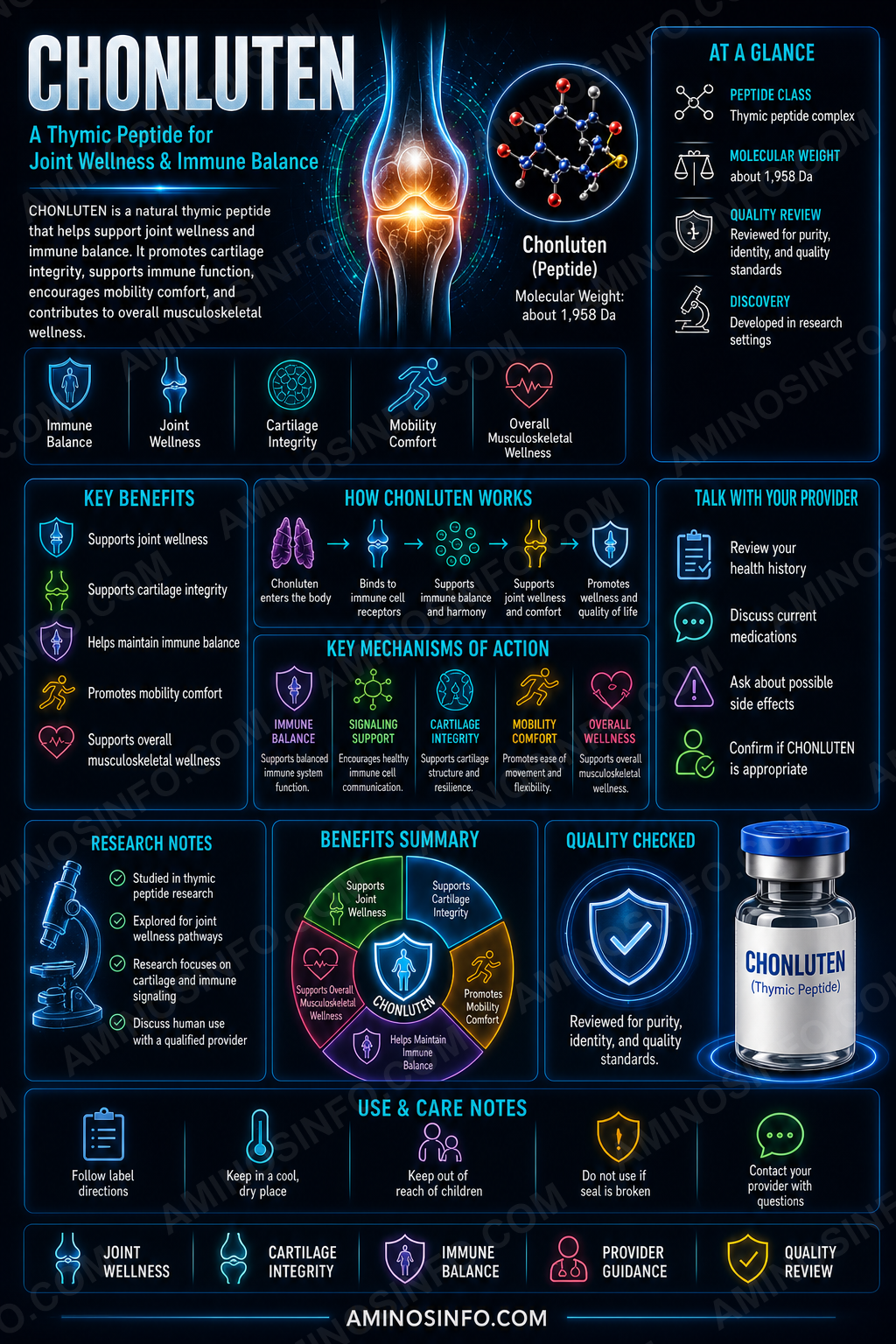
First, Chonluten is a synthetic tripeptide composed of glutamic acid, aspartic acid, and glycine. Its sequence is Glu–Asp–Gly, abbreviated EDG. It is also marketed as Tripeptide T-34.
Next, Chonluten is associated with bronchial, lung, and sometimes gastrointestinal tissue in Khavinson-school peptide literature. The most directly accessible modern study evaluated Chonluten alongside several other peptides in THP-1 monocyte/macrophage cells and reported changes in TNF and IL-6 inflammatory signaling.
Chonluten
T-34
Glu–Asp–Gly
EDG
Linear tripeptide
No
🧬 Molecular Structure
First, Chonluten is a linear tripeptide composed of L-glutamic acid, L-aspartic acid, and glycine. The commonly described research form has a free N-terminus and free C-terminal carboxyl group.
🧪 Amino-Acid Sequence
H-Glu-Asp-Gly-OH
One-letter notation: EDG
| Residue | Chemical feature | Analytical relevance |
|---|---|---|
| Glutamic acid | For example, Acidic side-chain carboxyl group | Meanwhile, Can undergo N-terminal cyclization to pyroglutamate. |
| Aspartic acid | Likewise, Acidic side-chain carboxyl group | In addition, Can isomerize or form isoaspartyl-related degradants. |
| Glycine | Moreover, Small achiral amino acid | By contrast, Provides conformational flexibility and lacks a chiral center. |
⚛️ Molecular Weight and 🧫 Formula
| Neutral molecular formula | Also, C11H17N3O8 |
|---|---|
| Average molecular weight | Approximately 319.27 g/mol |
| Peptide length | 3 amino acids |
| Expected terminal form | Consequently, Free N-terminus and free C-terminal carboxyl group |
| Commonly listed CAS number | 75007-24-8 |
Importantly, EDG, EGD, DEG, DGE, GED, and GDE share the same elemental formula and nominal mass. Exact sequence order therefore requires tandem mass spectrometry or another sequence-specific method.
📅 Discovery Timeline and Research History
1970s–1990s: Tissue peptide-bioregulator programs develop
First, Russian and Eastern European researchers investigated low-molecular-weight peptide fractions from lung, bronchial, thymic, pineal, vascular, and other tissues.
1990s–2000s: Defined respiratory peptides introduced
Next, EDG and AEDL became associated with respiratory research under the names Chonluten and Bronchogen.
2020: COVID-19 peptide review
Moreover, a review described EDG and AEDL as oral respiratory peptide bioregulators and referenced regional bronchopulmonary and hypoxia-related observations. These statements were not based on large modern controlled trials.
2022: THP-1 inflammation study
In addition, researchers tested Chonluten with Epitalon, Vilon, Thymogen, and Thymalin in human THP-1 leukemia-derived monocytes and macrophage-like cells. Moreover, the study reported modulation of TNF and IL-6 responses after lipopolysaccharide stimulation.
2023 onward: Respiratory peptide reviews expand
However, broader reviews have discussed peptide approaches for acute lung injury, pulmonary fibrosis, and lung cancer, but most do not provide direct Chonluten efficacy evidence.
Current status
Finally, Chonluten remains an unapproved research peptide with no large independent respiratory clinical-development program.
Respiratory and Bronchial Biology
Airway epithelium
First, the airway epithelium forms a physical and immune barrier, clears mucus through cilia, secretes antimicrobial molecules, senses environmental exposure, and coordinates inflammatory responses.
Club and basal cells
Next, basal cells serve as progenitors in larger airways, while club cells participate in detoxification, secretion, and epithelial repair in smaller airways.
Alveolar epithelium
Moreover, type I alveolar cells support gas exchange, while type II cells produce surfactant and can act as progenitors after injury.
Airway inflammation
In addition, macrophages, neutrophils, eosinophils, lymphocytes, epithelial cells, fibroblasts, and vascular cells contribute differently across asthma, COPD, infection, and fibrosis.
Tissue specificity remains unproven
However, no validated transporter or receptor proves that EDG selectively accumulates in bronchial epithelium or lung tissue.
🧠 Proposed Mechanisms of Action
Importantly, researchers have not established a validated high-affinity receptor or single molecular mechanism for Chonluten.
Clinical respiratory benefit remains unproven
1. Monocyte and macrophage priming
First, in the THP-1 model, Chonluten induced a low-level TNF response in undifferentiated monocytes but reduced TNF and IL-6 responses after subsequent inflammatory stimulation in differentiated macrophage-like cells.
2. Endotoxin-tolerance hypothesis
Next, the investigators interpreted lower cytokine release after lipopolysaccharide exposure as a tolerance-like regulatory response rather than simple global immune suppression.
3. Gene-expression hypothesis
Moreover, broader ultrashort-peptide literature proposes interactions with DNA, histones, transcription factors, or peptide transporters. Chonluten-specific respiratory genomic targets remain uncertain.
4. Oxidative-stress hypothesis
However, commercial summaries propose effects on heat-shock proteins and antioxidant enzymes. Direct peer-reviewed EDG-specific evidence for HSP70 or superoxide dismutase regulation is limited.
5. Tissue-repair hypothesis
Finally, marketers often extrapolate airway-repair claims from EDG's respiratory association or from Bronchogen studies rather than direct Chonluten evidence.
🎯 Target and Pathway Profile
| Target or pathway | Evidence status |
|---|---|
| TNF | However, Modulated in THP-1 monocyte/macrophage experiments. |
| IL-6 | Therefore, Reduced after LPS stimulation across the tested peptide panel. |
| LPS tolerance | For example, Proposed interpretation of reduced secondary inflammatory response. |
| HSP70 | Meanwhile, this remains a common claim, but direct Chonluten-specific evidence is limited. |
| Superoxide dismutase | Likewise, this remains a common antioxidant hypothesis, but direct EDG evidence is limited. |
| Specific lung receptor | None established. |
| DNA or chromatin | In addition, General short-peptide hypothesis; Chonluten-specific targets remain uncertain. |
Inflammation and Cytokine Research
THP-1 cell model
First, THP-1 is a human leukemia-derived monocytic cell line that can be differentiated into macrophage-like cells. It is widely used for inflammatory research but is not equivalent to normal human lung macrophages.
TNF response
Next, Chonluten produced a low-level TNF response in monocytes and a lower TNF response after LPS stimulation in differentiated cells.
IL-6 response
Moreover, the study reported inhibition of LPS-stimulated IL-6 expression across the tested peptide preparations.
Potential interpretation
However, the pattern may indicate immune priming or tolerance. Such a response could theoretically reduce excessive inflammation, but it could also impair pathogen defense depending on timing and context.
Not a COPD or asthma trial
Finally, the experiment did not measure lung function, airway remodeling, exacerbations, mucus, oxygenation, exercise capacity, hospitalization, or patient symptoms.
Oxidative-Stress and Antioxidant Claims
Respiratory oxidative stress
First, cigarette smoke, pollution, infection, inflammation, hyperoxia, and mitochondrial dysfunction can generate reactive oxygen species in lung tissue.
Heat-shock proteins
Next, HSP70 and related proteins support protein folding and stress recovery. Reliable Chonluten-specific studies demonstrating HSP70 regulation were not identified in the core literature reviewed.
Superoxide dismutase
Moreover, SOD enzymes convert superoxide radicals into hydrogen peroxide. Chonluten is frequently linked to SOD in commercial descriptions, but direct validated evidence remains sparse.
Required evidence
In addition, strong antioxidant claims would require direct measurement of ROS, lipid oxidation, glutathione status, SOD activity, catalase, mitochondrial respiration, DNA damage, and functional tissue outcomes.
Antioxidant is not always beneficial
However, reactive oxygen species also participate in immune defense and cell signaling. Broad suppression can interfere with normal physiology.
Hypoxia and Functional-Resilience Claims
Regional observations
First, a 2020 review stated that oral EDG improved a physical-performance index and normalized functional state under low oxygen partial pressure.
Methodological limitations
However, the underlying evidence is not widely available as a large, modern, independently replicated controlled trial.
Possible mechanisms
Moreover, hypoxia adaptation can involve ventilation, hemoglobin, circulation, mitochondrial metabolism, HIF signaling, autonomic responses, and training status.
No established oxygenation therapy
Finally, researchers have not shown that Chonluten treats hypoxemia, respiratory failure, altitude illness, pulmonary hypertension, or sleep apnea.
COPD, Bronchitis, Fibrosis, and Repair Claims
COPD
First, regional literature associates EDG and AEDL with chronic bronchopulmonary pathology. No large independent trial establishes improved FEV1, fewer exacerbations, reduced hospitalization, or slower disease progression with Chonluten.
Chronic bronchitis
Next, there is no validated evidence that Chonluten reliably reduces cough, sputum, mucus-gland enlargement, or bacterial infection.
Asthma
Moreover, no established evidence shows reduced eosinophilic inflammation, airway hyperresponsiveness, steroid requirements, or asthma attacks.
Pulmonary fibrosis
However, direct antifibrotic Chonluten evidence is lacking. Fibrosis claims should not be borrowed from unrelated experimental peptides.
Epithelial repair
In addition, Bronchogen has more direct bronchial-remodeling literature than Chonluten. Results involving AEDL cannot automatically be assigned to EDG.
Lung cancer
Finally, Chonluten has no validated role in prevention or treatment of lung cancer.
Evidence Limitations and Clinical Interpretation
Small direct evidence base
First, the strongest accessible modern Chonluten-specific study is an in vitro inflammatory-signaling experiment.
Multiple peptides tested together
Next, the 2022 study evaluated five peptide preparations. Some cytokine findings applied to the entire panel rather than uniquely to Chonluten.
Cancer-derived cell line
Moreover, THP-1 cells originate from acute monocytic leukemia and may not reproduce normal airway macrophage biology.
Bronchogen evidence is not Chonluten evidence
However, marketers present both as respiratory peptides, even though EDG and AEDL are chemically distinct compounds.
No established clinical respiratory outcomes
Finally, no robust evidence demonstrates improved spirometry, oxygenation, exacerbation rate, exercise tolerance, fibrosis, infection risk, or survival.
Safety and Regulatory Considerations
No standardized human safety profile
First, no FDA-approved label defines dose, route, pharmacokinetics, contraindications, interactions, pregnancy safety, or long-term adverse effects.
Immune-tolerance uncertainty
Moreover, reducing TNF and IL-6 after inflammatory stimulation could theoretically reduce damaging inflammation or impair antimicrobial defense.
Autoimmune and immunosuppressed populations
In addition, effects may be unpredictable in autoimmune disease, transplant recipients, cancer patients, or people taking immunomodulatory drugs.
Respiratory emergencies
However, Chonluten must not replace inhalers, corticosteroids, oxygen, antibiotics, antifibrotic therapy, or emergency care.
Product-quality risk
Likewise, unapproved products may contain the wrong sequence, sequence isomers, free amino acids, residual solvents, microbial contamination, endotoxin, or inaccurate content.
Regulatory status
Finally, Chonluten/EDG is not FDA approved as a drug or biologic.
🧪 Laboratory Testing Methods
Identity, Sequence, and Stability Testing
| Method | Purpose | Important limitation |
|---|---|---|
| Moreover, RP-HPLC, ion-pair HPLC, or UPLC | By contrast, Separates EDG from amino acids, sequence isomers, and degradants. | Also, Small acidic peptides require validated methods. |
| LC-MS / HRMS | Consequently, Confirms intact molecular mass. | However, Cannot distinguish sequence permutations by mass alone. |
| MS/MS sequencing | Confirms Glu–Asp–Gly order. | Therefore, Requires validated fragmentation and authentic standards. |
| Chiral amino-acid analysis | For example, Confirms L-Glu and L-Asp; glycine is achiral. | Meanwhile, Hydrolysis can create artifacts. |
| Net peptide-content assay | Likewise, Measures actual EDG concentration. | In addition, analysts must not infer net peptide content from HPLC area purity. |
| Sequence-isomer analysis | Moreover, Detects EGD, DEG, DGE, GED, and GDE. | By contrast, Isomers may have identical mass and similar retention. |
| Pyroglutamate analysis | Also, Detects N-terminal Glu cyclization. | Consequently, analysts may need specialized LC-MS methods. |
| Isoaspartate analysis | Evaluates Asp isomerization. | However, Can be challenging in a short peptide. |
| Free amino-acid analysis | Therefore, Detects hydrolysis or incomplete synthesis. | For example, Requires adequate chromatographic separation. |
| Meanwhile, TNF and IL-6 assays | Likewise, Measure inflammatory signaling after LPS stimulation. | In addition, Cell-line results do not prove clinical respiratory efficacy. |
| Airway epithelial assays | Moreover, Could evaluate barrier integrity, cilia, mucus, wound closure, and cytokines. | By contrast, Direct Chonluten evidence remains limited. |
| Oxidative-stress assays | Also, Measure ROS, SOD, glutathione, lipid oxidation, and DNA damage. | Consequently, Needed to substantiate antioxidant claims. |
| However, Microbial limits, sterility, and endotoxin | Therefore, Evaluate route-specific microbiological quality. | For example, Requirements differ by intended use. |
| Stability testing | Meanwhile, Tracks hydrolysis, cyclization, isomerization, assay, and appearance. | Likewise, Must reflect final formulation and storage conditions. |
📄 How to Interpret a Chonluten COA
COA Review and Route-Specific Quality
- In addition, Verify the exact sequence: H-Glu-Asp-Gly-OH or EDG.
- Moreover, Check amino-acid names: E is glutamic acid and D is aspartic acid—not glutamine and asparagine.
- By contrast, Confirm sequence order: Mass alone cannot distinguish EDG from its five sequence isomers.
- Also, Verify stereochemistry: Expected material generally uses L-Glu and L-Asp.
- Consequently, Separate identity, purity, and net content: These are different analytical measurements.
- However, Review pyroglutamate, isoaspartate, free amino acids, water, and residual solvents.
- Therefore, Match testing to the intended route: Raw-powder purity does not establish injectable, oral, or inhaled suitability.
- For example, Do not infer lung efficacy: A COA cannot prove reduced inflammation, improved lung function, tissue repair, hypoxia resistance, or clinical safety.
📊 Chonluten vs Bronchogen vs Thymalin vs Epitalon
Sequence and Respiratory-Research Differences
| Feature | Chonluten | Bronchogen | Thymalin | Epitalon |
|---|---|---|---|---|
| Sequence or composition | EDG | AEDL | Meanwhile, Complex of thymic peptides | AEDG |
| Length | 3 amino acids | Tetrapeptide; four residues | Mixture | Tetrapeptide; four residues |
| Likewise, Main direct research association | Monocyte/macrophage inflammatory signaling | In addition, Bronchial remodeling and respiratory tissue | Immune regulation | Moreover, Pineal and aging research |
| FDA approved? | For example, Regulators have not approved this compound. | Moreover, No approved indication exists. | This remains unapproved. | In addition, No FDA authorization applies. |
Chonluten vs Approved Respiratory Treatments
Experimental Peptide Versus Established Respiratory Therapies
| Therapy class | Established role | Difference from Chonluten |
|---|---|---|
| Bronchodilators | By contrast, Improve airflow and symptoms in asthma or COPD | Also, Defined airway receptor pharmacology |
| Inhaled corticosteroids | Consequently, Reduce airway inflammation in selected patients | However, Extensive clinical evidence and dosing guidance |
| Biologic therapies | Therefore, Target IgE, IL-5, IL-4R, TSLP, or other pathways | For example, Defined molecular targets and approved indications |
| Antifibrotic drugs | Meanwhile, Slow decline in selected pulmonary-fibrosis patients | Controlled clinical evidence |
| Chonluten | No approved indication | Likewise, Experimental peptide with uncertain mechanism |
Chonluten vs Other Experimental Lung Peptides
| Compound | Main research focus | Same as Chonluten? |
|---|---|---|
| Bronchogen | Bronchial epithelial remodeling | However, Regulators have not approved this compound. |
| Caveolin-1-derived peptides | In addition, Smoke-induced airway and alveolar injury | Therefore, No approved indication exists. |
| Antimicrobial peptides | Moreover, Pathogen defense and immune modulation | This remains unapproved. |
| Thy-1 peptide mimics | Experimental fibrosis-resolution signaling | Likewise, No FDA authorization applies. |
🔗 Related Peptides and Respiratory Pathways
- Bronchogen: First, AEDL tetrapeptide with more direct bronchial-remodeling literature.
- TNF: Next, Central inflammatory cytokine measured in Chonluten THP-1 research.
- IL-6: Also, Proinflammatory and acute-phase cytokine measured after LPS stimulation.
- Airway epithelial barrier: Moreover, Major defense and repair system in respiratory tissue.
- Alveolar type II cells: In addition, Surfactant-producing cells involved in alveolar repair.
- Macrophages: Likewise, Innate immune cells central to infection, inflammation, and tissue repair.
🖼️ Original Diagram Specifications
Diagram 1: Chonluten molecular structure
By contrast, Show H-Glu-Asp-Gly-OH with two acidic side chains, glycine, peptide bonds, and free termini.
Diagram 2: EDG identity correction
Also, Show E = glutamic acid, D = aspartic acid, and G = glycine, correcting commercial glutamine/asparagine errors.
Diagram 3: Airway and alveolar epithelium
Consequently, Show basal cells, club cells, ciliated cells, goblet cells, type I and type II alveolar cells, macrophages, and mucus clearance.
Diagram 4: THP-1 inflammation experiment
However, Show monocyte differentiation, peptide exposure, LPS stimulation, TNF and IL-6 responses, and the proposed tolerance-like interpretation.
Diagram 5: Chonluten vs Bronchogen
Therefore, Contrast EDG inflammatory-signaling evidence with AEDL bronchial-remodeling evidence and warn against citation transfer.
Diagram 6: Evidence ladder
For example, Show chemistry, THP-1 cells, airway models, animal lung studies, controlled human respiratory trials, and FDA approval. Place Chonluten near early-stage evidence.
Diagram 7: COA workflow
Meanwhile, Show exact mass, MS/MS sequence, stereochemistry, sequence isomers, pyroglutamate, isoaspartate, free amino acids, net content, microbiology, and stability.
❓ Frequently Asked Questions
Is Chonluten a peptide?
Likewise, Yes. It is a synthetic tripeptide.
What is the correct sequence?
H-Glu-Asp-Gly-OH, abbreviated EDG.
Is Chonluten also called T-34?
In addition, Yes. T-34 is a commonly used commercial or research synonym.
What is its molecular weight?
Moreover, Approximately 319.27 g/mol for neutral EDG.
Is Chonluten FDA approved?
No.
Does Chonluten reduce TNF and IL-6?
By contrast, a THP-1 cell study reported TNF modulation and lower LPS-stimulated TNF and IL-6 responses, but researchers have not proven human clinical effects.
Does it treat COPD?
Also, No large independent clinical evidence establishes COPD benefit.
Does it repair lung tissue?
Consequently, direct tissue-repair evidence specific to Chonluten remains limited.
Is Chonluten the same as Bronchogen?
However, No. Chonluten is EDG, while Bronchogen is AEDL.
Does it improve oxygen levels?
Therefore, No validated evidence establishes treatment of hypoxemia or respiratory failure.
Is it an antioxidant?
For example, Antioxidant pathways are commonly proposed, but direct Chonluten-specific evidence remains limited.
Does 99% HPLC purity prove respiratory activity?
Meanwhile, No. Sequence, stereochemistry, net content, functional potency, pharmacokinetics, safety, and clinical outcomes must be established separately.
Chonluten Scientific Overview: Final Thoughts
In conclusion, Chonluten is a defined tripeptide with the sequence Glu–Asp–Gly. Its strongest accessible modern evidence involves inflammatory-signaling changes in THP-1 monocyte/macrophage cells, particularly TNF and IL-6 responses after LPS stimulation.
However, these findings do not establish treatment of COPD, asthma, bronchitis, pulmonary fibrosis, hypoxia, infection, or lung aging. Direct respiratory epithelial, antioxidant, and tissue-repair evidence remains limited, and Bronchogen findings should not be assigned automatically to Chonluten.
Therefore, analysts should verify legitimate research material for exact EDG sequence order, L-amino-acid stereochemistry, terminal chemistry, sequence isomers, pyroglutamate, isoaspartate, free amino acids, net peptide content, route-specific microbiological quality, and stability.
📚 References
- Likewise, Avolio F, et al. Peptides Regulating Proliferative Activity and Inflammatory Pathways in the Monocyte/Macrophage THP-1 Cell Line. International Journal of Molecular Sciences. 2022.
- In addition, Avolio F, et al. PubMed record: Peptides regulating proliferative activity and inflammatory pathways. 2022.
- Moreover, Khavinson V, et al. Peptides: Prospects for Use in the Treatment of COVID-19. 2020.
- By contrast, Li S, et al. Therapeutic Peptides for Treatment of Lung Diseases. 2023.
- Also, Kuzubova NA, et al. Modulating effect of peptide therapy on bronchial epithelium and lung tissue in chronic obstructive pulmonary disease. 2015.
- Consequently, Khavinson V, et al. Peptide Regulation of Gene Expression: A Systematic Review. Molecules. 2021.
- However, Khavinson V, et al. Transport of Biologically Active Ultrashort Peptides Using POT and LAT Carriers. 2022.
- Therefore, Anisimov VN, Khavinson VK. Peptide bioregulation of aging: results and prospects. Biogerontology. 2010.
- For example, Khavinson VK. Peptides and ageing. Neuro Endocrinology Letters. 2002.
- Meanwhile, Khavinson VK, Kuznik BI. Peptide Bioregulators: The New Class of Geroprotectors. 2014.
- Likewise, Daniel H. Molecular and integrative physiology of intestinal peptide transport. Annual Review of Physiology.
- In addition, Brandsch M. Drug transport via the intestinal peptide transporter PepT1. Current Opinion in Pharmacology.
- Moreover, Smith DE, Clémençon B, Hediger MA. Proton-coupled oligopeptide transporter family SLC15. Molecular Aspects of Medicine.
- By contrast, Newstead S. Molecular insights into proton-coupled peptide transport. Trends in Pharmacological Sciences.
- Also, Rock JR, Hogan BLM. Epithelial progenitor cells in lung development, maintenance, repair, and disease. Annual Review of Cell and Developmental Biology.
- Consequently, Hogan BLM, et al. Repair and regeneration of the respiratory system. Cell Stem Cell.
- However, Barkauskas CE, et al. Type 2 alveolar cells are stem cells in adult lung. Journal of Clinical Investigation.
- Therefore, Whitsett JA, Alenghat T. Respiratory epithelial cells orchestrate pulmonary innate immunity. Nature Immunology.
- For example, Hiemstra PS, McCray PB Jr, Bals R. The innate immune function of airway epithelial cells in inflammatory lung disease. European Respiratory Journal.
- Meanwhile, Gohy ST, et al. Imprinting of the COPD airway epithelium for dedifferentiation and mesenchymal transition. European Respiratory Journal.
- Likewise, Barnes PJ. Inflammatory mechanisms in patients with chronic obstructive pulmonary disease. Journal of Allergy and Clinical Immunology.
- In addition, Hogg JC, Timens W. The pathology of chronic obstructive pulmonary disease. Annual Review of Pathology.
- Moreover, Global Initiative for Chronic Obstructive Lung Disease. Global Strategy for Prevention, Diagnosis and Management of COPD.
- By contrast, Global Initiative for Asthma. Global Strategy for Asthma Management and Prevention.
- Also, Roca-Ferrer J, et al. Epithelial barrier dysfunction in airway disease. Allergy and respiratory reviews.
- Consequently, Biswas SK, Mantovani A. Macrophage plasticity and interaction with lymphocyte subsets. Nature Immunology.
- However, Murray PJ. Macrophage polarization. Annual Review of Physiology.
- Therefore, Park EK, Jung HS, Yang HI, Yoo MC, Kim C, Kim KS. Optimized THP-1 differentiation. In Vitro Cellular & Developmental Biology.
- For example, Chanput W, Mes JJ, Wichers HJ. THP-1 cell line as an in vitro model for immune modulation. International Immunopharmacology.
- Moreover, Biswas SK, Lopez-Collazo E. Endotoxin tolerance: new mechanisms, molecules and clinical significance. Trends in Immunology.
- In addition, Seeley JJ, Ghosh S. Molecular mechanisms of innate memory and tolerance to LPS. Journal of Leukocyte Biology.
- However, Das DN, et al. Caveolin-1-derived peptide attenuates cigarette smoke-induced airway and alveolar epithelial injury. 2023.
- Therefore, Simon KS, et al. Innovative preclinical peptide data in pulmonary fibrosis. 2023.
- Likewise, Hecker L. Mechanisms and consequences of oxidative stress in lung disease. American Journal of Physiology Lung Cellular and Molecular Physiology.
- For example, Rahman I, MacNee W. Oxidative stress and regulation of glutathione in lung inflammation. European Respiratory Journal.
- Moreover, Ryter SW, Choi AMK. Heat shock proteins in lung disease. International Journal of Hyperthermia.
- In addition, Ley B, Collard HR, King TE Jr. Clinical course and prediction of survival in idiopathic pulmonary fibrosis. American Journal of Respiratory and Critical Care Medicine.
- Raghu G, et al. ATS/ERS/JRS/ALAT clinical practice guideline for idiopathic pulmonary fibrosis.
- International Council for Harmonisation. ICH Q2(R2): Validation of Analytical Procedures.
- United States Pharmacopeia. General Chapter <621>, Chromatography.
- United States Pharmacopeia. General Chapters <61> and <62>, Microbiological Examination of Nonsterile Products.
- United States Pharmacopeia. General Chapter <71>, Sterility Tests.
- United States Pharmacopeia. General Chapter <85>, Bacterial Endotoxins Test.
- United States Pharmacopeia. General Chapters <232> and <233>, Elemental Impurities.
- International Council for Harmonisation. ICH Q3C: Impurities—Guideline for Residual Solvents.
- International Council for Harmonisation. ICH Q1A(R2): Stability Testing of New Drug Substances and Products.
Chonluten, Inflammation, and Respiratory Sources
Airway Biology, Oxidative Stress, and Analytical Sources
Identity, molecular properties, inflammatory-signaling evidence, respiratory claims, safety, and regulatory findings were reviewed in July 2026. Finally, Chonluten remains an unapproved research peptide.