CJC-1295 + Ipamorelin: What It Is, How It Works, Benefits, and Research Overview
A comprehensive, evidence-graded review of the commercial CJC-1295/ipamorelin blend, which combines a growth hormone-releasing hormone analogue with a ghrelin-receptor agonist to stimulate endogenous growth-hormone and IGF-1 signaling.
What Is CJC-1295 + Ipamorelin?
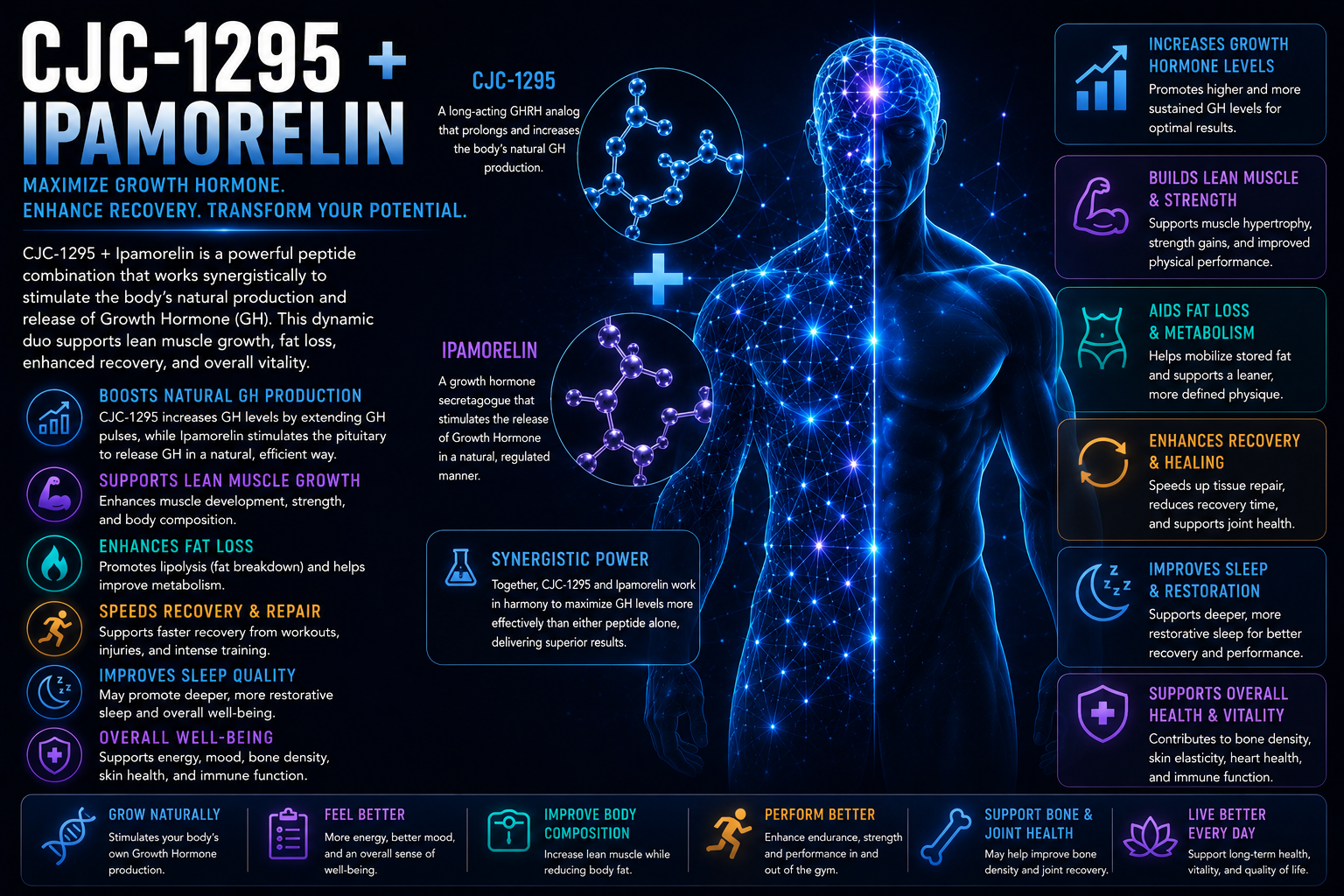
CJC-1295 plus ipamorelin is a nonstandardized commercial research combination intended to stimulate the endogenous growth-hormone axis through two complementary pathways:
- CJC-1295: A long-acting GHRH analogue that activates pituitary GHRH receptors.
- Ipamorelin: A five-residue ghrelin-receptor agonist that activates GHSR-1a.
GHRH receptor
GHSR-1a
Growth hormone
IGF-1
No
No
Commercial naming problem
Some sellers use “CJC-1295” for both DAC and no-DAC forms. This can create major confusion because true DAC-containing CJC-1295 produces prolonged albumin-linked exposure, while Modified GRF 1-29 produces a much shorter pulse.
CJC-1295 DAC vs “CJC-1295 Without DAC”
| Feature | True CJC-1295 with DAC | Modified GRF 1-29 / no-DAC |
|---|---|---|
| Correct name | CJC-1295 | Modified GRF 1-29 |
| Core length | 29-aa modified GHRH sequence plus Lys30 DAC attachment | 29-aa modified GHRH sequence |
| DAC group | Present | Absent |
| Albumin binding | Covalent in circulation | No DAC-mediated albumin attachment |
| Functional duration | Several days | Short acting |
| Human trial evidence | Yes, limited phase I/II endocrine studies | Very limited as a distinct modern product |
🧬 CJC-1295 with DAC: Structure and Chemistry
Modified GHRH backbone
H-Tyr-D-Ala-Asp-Ala-Ile-Phe-Thr-Gln-Ser-Tyr-Arg-Lys-Val-Leu-Ala-Gln-Leu-Ser-Ala-Arg-Lys-Leu-Leu-Gln-Asp-Ile-Leu-Ser-Arg-Lys(DAC)-NH₂
CJC-1295 is based on GHRH(1-29) with substitutions that improve stability:
- D-Ala at position 2
- Gln at position 8
- Ala at position 15
- Leu at position 27
- A C-terminal Lys30 carrying a maleimidopropionyl DAC group
| Core peptide | Modified GHRH(1-29) |
|---|---|
| DAC attachment | Nε-maleimidopropionyl group on Lys30 |
| Approximate free molecular weight | Approximately 3.64 kDa, depending on defined salt form |
| Disulfide bonds | None |
| Primary receptor | GHRH receptor |
| Primary design feature | In-vivo albumin bioconjugation |
DAC mechanism
The maleimide group reacts with a free thiol, primarily cysteine-34 of serum albumin, producing a long-lived albumin conjugate after administration.
Why exact DAC chemistry matters
Hydrolyzed maleimide, prematurely reacted DAC, positional isomers, incomplete substitution, or unconjugated modified GRF can alter albumin binding and duration.
🧬 Modified GRF 1-29: Structure and Chemistry
H-Tyr-D-Ala-Asp-Ala-Ile-Phe-Thr-Gln-Ser-Tyr-Arg-Lys-Val-Leu-Ala-Gln-Leu-Ser-Ala-Arg-Lys-Leu-Leu-Gln-Asp-Ile-Leu-Ser-Arg-NH₂
| Length | 29 amino acids |
|---|---|
| Molecular formula | C152H252N44O42 |
| Average molecular weight | Approximately 3,368 Da |
| C terminus | Amidated |
| DAC group | Absent |
| Primary receptor | GHRH receptor |
Four stabilizing substitutions
The D-Ala2, Gln8, Ala15, and Leu27 substitutions improve resistance to enzymatic degradation compared with sermorelin.
Shorter duration
Without albumin binding, Modified GRF 1-29 produces a shorter receptor stimulus and is more dependent on timing relative to endogenous GH pulses.
🧬 Ipamorelin Structure and Chemistry
H-Aib-His-D-2-Nal-D-Phe-Lys-NH₂
| Length | 5 residues |
|---|---|
| Molecular formula | C38H49N9O5 |
| Molecular weight | Approximately 711.9 Da |
| CAS number | 170851-70-4 |
| C terminus | Amidated |
| Unnatural residues | Aib, D-2-Nal, D-Phe |
| Primary receptor | GHSR-1a |
Selective GH secretagogue design
Ipamorelin was designed to stimulate GH with less ACTH and cortisol release than older GHRPs such as GHRP-2 and GHRP-6.
Analytical complexity
The unnatural residues and stereochemistry require chiral and sequence-specific testing. A correct parent mass alone cannot confirm authentic ipamorelin.
📅 Discovery and Development Timeline
- 1998: Ipamorelin was described as a selective pentapeptide growth-hormone secretagogue.
- 1999: Human pharmacokinetic/pharmacodynamic research showed dose-proportional exposure and a discrete GH pulse after ipamorelin.
- 2005: CJC-1295 was identified as a long-lasting albumin-binding GHRH analogue.
- 2006: Human studies reported prolonged, dose-dependent GH and IGF-1 elevation after CJC-1295.
- 2006: Continuous CJC-1295 exposure was shown to preserve pulsatile GH secretion while increasing trough and mean GH.
- Late 2000s: CJC-1295 clinical development did not progress to approval.
- 2010s: CJC-1295 and ipamorelin became widely marketed in compounded and research-peptide settings.
- 2024: FDA advisory review addressed CJC-1295- and ipamorelin-related bulk substances and raised safety, identity, impurity, and effectiveness concerns.
- 2026: FDA continued to list both substances among compounded bulk drug substances that may present significant safety risks; both remained prohibited in sport.
🧠 How Does the Combination Work?
1. GHRH receptor activation
CJC-1295 activates a Gs-coupled receptor, increasing adenylate cyclase, cAMP, protein kinase A, GH synthesis, and GH release.
2. Ghrelin receptor activation
Ipamorelin activates GHSR-1a, primarily through Gq/11, phospholipase C, intracellular calcium, and pituitary GH release.
3. Complementary pituitary signaling
GHRH and GHSR pathways can amplify one another because they use different second-messenger systems and interact with somatostatin regulation.
4. Downstream IGF-1
GH stimulates liver and tissue production of IGF-1, which mediates many anabolic, growth, and metabolic effects.
5. DAC changes exposure
With true CJC-1295, albumin binding sustains receptor stimulation over days. With Modified GRF 1-29, the stimulus is shorter and more pulse-like.
🎯 Receptor Profile
| Compound | Primary receptor | Main signaling | Key distinction |
|---|---|---|---|
| CJC-1295 | GHRH receptor | Gs → cAMP → PKA | Albumin-binding DAC prolongs exposure |
| Modified GRF 1-29 | GHRH receptor | Gs → cAMP → PKA | Short acting, no DAC |
| Ipamorelin | GHSR-1a | Gq/11 → PLC → calcium | Selective GH secretagogue |
| Released GH | Growth-hormone receptor | JAK2/STAT5 | Drives hepatic IGF-1 |
| IGF-1 | IGF-1 receptor | PI3K/AKT/mTOR and MAPK | Metabolic and mitogenic signaling |
Albumin Binding and the Drug Affinity Complex
Cysteine-34 target
Human serum albumin contains a reactive free cysteine at position 34. The CJC-1295 maleimide group is designed to react with this site.
Bioconjugation after administration
The albumin conjugate forms in vivo and circulates far longer than free GHRH analogues.
Extended GH and IGF-1 effects
Human studies reported GH elevation for several days and IGF-1 elevation for approximately one to two weeks after a single dose.
Preserved pulsatility
Despite prolonged exposure, GH release remained pulsatile, although trough and mean concentrations increased.
Potential downside
Long exposure can make excessive IGF-1, edema, glucose effects, or other adverse reactions slower to reverse.
Growth Hormone and IGF-1 Axis
Normal endocrine control
GHRH stimulates GH, somatostatin inhibits GH, and ghrelin-receptor signaling amplifies release. GH and IGF-1 provide negative feedback.
Pulse amplitude and trough
Modified GRF plus ipamorelin is conceptually intended to increase pulse amplitude. DAC-containing CJC-1295 also raises GH trough levels between pulses.
IGF-1 monitoring
Persistent IGF-1 elevation may increase growth-related, glucose, and mitogenic risks.
Pituitary dependence
The combination requires functioning pituitary somatotrophs and is not equivalent to recombinant GH replacement.
Human CJC-1295 Evidence
Phase I endocrine studies
Healthy-adult studies reported sustained, dose-dependent increases in GH and IGF-1 after subcutaneous CJC-1295.
Magnitude and duration
Published work reported GH increases lasting six days or longer and IGF-1 increases lasting approximately nine to eleven days after a single dose.
Repeated dosing
Multiple doses produced cumulative IGF-1 elevation without eliminating pulsatile GH secretion.
Clinical-outcome gap
These studies measured hormones rather than long-term muscle, fat, sleep, recovery, longevity, or disease outcomes.
Development discontinuation
CJC-1295 did not become an approved medicine. Available clinical development was limited, and later commercial use has greatly exceeded the original evidence base.
Human Ipamorelin Evidence
Healthy-volunteer study
Human research reported dose-proportional pharmacokinetics, an approximate two-hour terminal half-life, and a GH peak around 0.67 hours after administration.
Selective endocrine concept
Early work suggested less ACTH and cortisol release than older GHRPs, but broad human endocrine selectivity remains incompletely characterized.
Postoperative ileus program
Ipamorelin was investigated intravenously for postoperative ileus but did not establish an approved indication.
FDA-reviewed adverse events
FDA briefing materials identified hyperglycemia, hypokalemia, insomnia, nausea, vomiting, abdominal distention, and serious events in prior development, with limited information for modern compounded routes.
Body Composition, Muscle, and Recovery Research
Anabolic pathway rationale
GH and IGF-1 influence protein synthesis, collagen turnover, bone metabolism, adipose tissue, and muscle physiology.
Body-composition evidence
Direct controlled human evidence for the CJC-1295/ipamorelin combination is lacking.
Fat-loss claims
GH can promote lipolysis, but no approved obesity or weight-loss indication exists for either component.
Muscle claims
Hormonal elevation does not prove safe or clinically meaningful gains in strength or muscle function.
Recovery claims
No controlled human trial establishes the blend as a treatment for tendon, ligament, muscle, surgical, or athletic recovery.
Sleep, Nocturnal GH, and Pulsatility Research
GH and slow-wave sleep
Normal GH pulses are linked to slow-wave sleep, especially early in the night.
Short-acting versus DAC logic
Modified GRF 1-29 is conceptually used to amplify a timed pulse, while DAC-containing CJC-1295 produces sustained background stimulation.
No approved sleep indication
The blend is not an approved treatment for insomnia, poor sleep quality, or sleep disorders.
Sleep-apnea concern
Chronic GH/IGF-1 elevation may contribute to soft-tissue growth and potentially worsen obstructive sleep apnea in susceptible people.
Potential Synergy and Its Limitations
Two receptor systems
GHRHR and GHSR-1a signaling can produce a larger GH response together than either pathway alone.
Somatostatin interaction
GHSR activation may reduce functional somatostatin restraint and make GHRH signaling more effective.
No validated commercial ratio
No peer-reviewed trial establishes an optimal CJC-1295-to-ipamorelin mass or molar ratio.
DAC may blunt pulse specificity
True CJC-1295 sustains GH-axis stimulation for days, which differs from a short, intentionally timed pulse.
More hormone is not automatically better
Greater GH and IGF-1 exposure may increase edema, joint symptoms, glucose intolerance, carpal-tunnel effects, and mitogenic risk.
Blend Compatibility and Stability
Very different molecular sizes
CJC-1295 is several kilodaltons, while ipamorelin is approximately 0.71 kDa.
Different chemical liabilities
CJC-1295 requires control of maleimide integrity, DAC substitution, hydrolysis, clipping, oxidation, deamidation, and premature adduct formation. Ipamorelin requires control of epimers, unnatural-residue impurities, amidation, and aggregation.
Maleimide reactivity
True CJC-1295’s DAC group can react with thiol-containing contaminants, excipients, or proteins before administration, reducing albumin-binding capacity.
pH and excipient compatibility
A pH that protects maleimide integrity may not be optimal for every other blend component.
Blend-specific testing required
Separate component stability does not prove one-vial compatibility during lyophilization, storage, reconstitution, or use.
FDA, Compounding, and Anti-Doping Status
FDA approval
Neither CJC-1295 nor ipamorelin is FDA approved for any therapeutic indication.
FDA CJC-1295 concerns
FDA states that compounded CJC-1295 may present immunogenicity and peptide-impurity risks and has been associated with serious adverse events including increased heart rate and systemic vasodilatory reaction.
FDA ipamorelin concerns
FDA identifies aggregation, peptide impurities, unnatural amino-acid characterization, immunogenicity, insufficient effectiveness data, hyperglycemia, and limited safety information.
WADA prohibition
The 2026 WADA Prohibited List explicitly includes CJC-1295 among GHRH analogues and ipamorelin among growth-hormone secretagogues.
Research-use labeling
A research-use label does not establish human safety, legality of administration, or sports compliance.
Potential Side Effects and Safety Considerations
Growth-axis effects
- Elevated IGF-1
- Edema and fluid retention
- Arthralgia and myalgia
- Carpal-tunnel-type symptoms
- Headache
- Soft-tissue growth
- Potential worsening of sleep apnea
Metabolic effects
- Hyperglycemia
- Reduced insulin sensitivity
- Potential diabetes risk
- Electrolyte disturbances such as hypokalemia
Cardiovascular effects
FDA has identified increased heart rate and systemic vasodilatory reactions associated with CJC-1295. Flushing, lightheadedness, palpitations, or blood-pressure changes are plausible concerns.
Malignancy concern
GH and IGF-1 activate growth and survival pathways. Chronic stimulation may be inappropriate in active malignancy or in people with significant oncologic risk.
Immunogenicity
Peptide aggregates, impurities, DAC-related adducts, or unnatural residues may increase anti-drug-antibody risk.
Product-quality risks
- DAC versus no-DAC mislabeling
- Incorrect sequence
- Hydrolyzed or inactive maleimide
- Premature protein or thiol adducts
- Incorrect stereochemistry
- Inaccurate component ratio
- Endotoxin, microbes, or particles
🧪 Laboratory Testing Methods
| Method | Purpose | Important limitation |
|---|---|---|
| Component-specific RP-HPLC / UPLC | Separates CJC species and ipamorelin impurities | One method may not resolve both optimally |
| Intact LC-HRMS | Confirms expected component masses | Does not prove DAC functionality or stereochemistry |
| LC-MS/MS peptide mapping | Confirms modified GHRH and ipamorelin sequences | Requires high sequence coverage |
| DAC presence assay | Distinguishes true CJC-1295 from Modified GRF 1-29 | Must identify intact functional maleimide |
| Maleimide integrity assay | Measures active versus hydrolyzed DAC | Maleimide can change during sample handling |
| Lys30 substitution mapping | Confirms DAC attachment at the intended lysine | Requires site-specific MS analysis |
| Albumin-binding assay | Measures in-vitro bioconjugation to albumin Cys34 | In-vitro conditions may not fully predict in-vivo kinetics |
| Albumin-adduct LC-MS | Confirms actual conjugate formation | Requires intact-protein analysis |
| Chiral amino-acid analysis | Confirms D-Ala2, D-2-Nal, and D-Phe | Hydrolysis can introduce artifacts |
| Aib and 2-Nal identity testing | Confirms ipamorelin unnatural residues | Authentic standards are required |
| C-terminal amidation assays | Confirms both modified GRF and ipamorelin amides | Free-acid impurities may be difficult to resolve |
| Separate net-content assays | Quantifies each component independently | Total vial mass cannot establish blend ratio |
| Counterion and water analysis | Corrects acetate, TFA, moisture, and salts | Gross powder weight may overstate active content |
| SEC-HPLC / DLS | Measures aggregates and particles | Component size differences complicate a single method |
| Oxidation and deamidation panel | Measures modified-GRF degradation | Multiple sites may require peptide mapping |
| GHRHR binding assay | Measures CJC or Modified GRF receptor affinity | Binding does not prove functional duration |
| GHRHR cAMP assay | Measures GHRH-analogue potency | Cell background affects results |
| GHSR-1a binding assay | Measures ipamorelin receptor affinity | Constitutive receptor signaling complicates interpretation |
| Calcium or IP1 assay | Measures ipamorelin functional signaling | Not unique to GH release |
| Pituitary GH-release assay | Measures individual and combined endocrine potency | Cell or animal models may not predict humans |
| Combination-response matrix | Tests additivity, synergy, or antagonism | Requires full concentration-response design |
| Sterility, endotoxin, and particles | Required for finished injectable evaluation | Raw purity cannot establish injectable safety |
| Stability-indicating assay | Tracks hydrolysis, clipping, oxidation, deamidation, epimerization, aggregation, and DAC loss | Requires validated forced-degradation studies |
📄 How to Interpret a CJC-1295 + Ipamorelin COA
- Determine whether the GHRH component contains DAC.
- If DAC is present, identify the product as true CJC-1295.
- If DAC is absent, identify it as Modified GRF 1-29.
- Confirm the complete modified GHRH sequence.
- Confirm D-Ala2, Gln8, Ala15, and Leu27 substitutions.
- For true CJC-1295, confirm Lys30 maleimidopropionyl attachment.
- Measure intact versus hydrolyzed maleimide.
- Demonstrate albumin Cys34 conjugation capacity.
- Confirm ipamorelin as Aib-His-D-2-Nal-D-Phe-Lys-NH₂.
- Confirm D stereochemistry and C-terminal amidation.
- Report separate net-content results for both components.
- Correct for acetate, TFA, water, and other counterions.
- Do not accept one combined HPLC purity value.
- Measure clipping, deamidation, oxidation, epimers, aggregates, and premature adducts.
- Use separate GHRHR and GHSR-1a potency assays.
- Use albumin-binding testing for DAC-containing CJC-1295.
- Use a combination GH-release assay to evaluate interaction.
- Perform blend-specific lyophilized and reconstituted stability studies.
- For finished injectables, require sterility, endotoxin, particles, pH, osmolality, fill accuracy, and container closure.
- A COA does not establish FDA approval, human safety, or clinical efficacy.
📊 Comparison Tables
CJC-1295 DAC vs Modified GRF 1-29
| Feature | CJC-1295 with DAC | Modified GRF 1-29 |
|---|---|---|
| Albumin binding | Yes | No |
| Duration | Several days | Short acting |
| GH pattern | Raises trough and mean while preserving pulses | Brief pulse amplification |
| Analytical requirement | DAC identity and albumin-binding assay | Sequence and short-peptide potency |
CJC-1295 + Ipamorelin vs Tesamorelin + Ipamorelin
| Feature | CJC-1295 + Ipamorelin | Tesamorelin + Ipamorelin |
|---|---|---|
| GHRH component | Unapproved modified GHRH analogue | FDA-approved tesamorelin molecule |
| Duration | Long with DAC; short without DAC | Short acting |
| Approved combination | No | No |
| Strongest human evidence | Hormone elevation studies | Tesamorelin visceral-fat trials |
CJC-1295 + Ipamorelin vs Sermorelin + Ipamorelin
| Feature | CJC-1295 + Ipamorelin | Sermorelin + Ipamorelin |
|---|---|---|
| GHRH stability | Higher | Lower |
| DAC option | Yes | No |
| Historical FDA status | Never approved | Sermorelin had prior approvals |
| Current approval | No | No marketed sermorelin product |
Research Blend vs Recombinant Growth Hormone
| Feature | CJC-1295 + Ipamorelin | Recombinant GH |
|---|---|---|
| Mechanism | Stimulates endogenous pituitary GH | Supplies GH directly |
| Pituitary required | Yes | No |
| Release profile | Pulse-based with sustained effect if DAC | Injection-driven pharmacology |
| FDA approval | No | Yes for specific indications |
🖼️ Original Diagram Specifications
- Identity diagram: True CJC-1295 with DAC versus Modified GRF 1-29 without DAC.
- Sequence architecture: Modified GHRH substitutions, Lys30 DAC group, and ipamorelin unnatural residues.
- Albumin pathway: Maleimide reaction with albumin Cys34 and prolonged circulation.
- Dual-receptor mechanism: GHRHR and GHSR-1a converging on pituitary GH release.
- GH–IGF-1 axis: Pituitary, liver, muscle, adipose tissue, and feedback loops.
- Risk map: IGF-1 elevation, hyperglycemia, edema, tachycardia, vasodilation, malignancy, and immunogenicity.
- COA workflow: DAC identity, albumin binding, two sequences, two potencies, sterility, and stability.
❓ Frequently Asked Questions
Is CJC-1295 + ipamorelin one peptide?
No. It is a two-component blend.
What is true CJC-1295?
A modified GHRH analogue with a maleimide Drug Affinity Complex that binds albumin.
What is “CJC-1295 without DAC”?
It is more accurately called Modified GRF 1-29.
Why is the distinction important?
DAC-containing CJC-1295 lasts for days, while Modified GRF 1-29 is short acting.
What is ipamorelin?
A five-residue GHSR-1a agonist with the sequence Aib-His-D-2-Nal-D-Phe-Lys-NH₂.
How does the blend work?
CJC-1295 activates GHRH receptors, while ipamorelin activates ghrelin receptors; both signals converge on pituitary GH release.
Does CJC-1295 preserve GH pulses?
Human research found that pulsatility persisted, although mean and trough GH increased.
Is the blend FDA approved?
No.
Does it build muscle or reduce fat?
The pathway is biologically relevant, but controlled human combination evidence for these outcomes is lacking.
Can it raise IGF-1?
Yes. CJC-1295 human studies showed sustained IGF-1 elevation.
Can it raise blood glucose?
Yes. GH-axis stimulation may reduce insulin sensitivity, and FDA has identified hyperglycemia with ipamorelin development.
Can it affect heart rate or blood pressure?
Yes. FDA has identified increased heart rate and systemic vasodilatory reactions with CJC-1295.
Is it prohibited in sports?
Yes. Both compounds are prohibited by WADA.
Does 99% HPLC purity prove the blend is authentic?
No. DAC identity, maleimide integrity, albumin binding, exact sequences, stereochemistry, content, potency, sterility, and stability all matter.
What is the most important COA question?
Whether the CJC component truly contains a functional DAC group or is actually Modified GRF 1-29.
Final Thoughts
CJC-1295 plus ipamorelin combines two distinct growth-hormone-release pathways. CJC-1295 activates the pituitary GHRH receptor, while ipamorelin activates the ghrelin receptor. Their signaling can be complementary and can increase endogenous GH and downstream IGF-1.
The most important scientific issue is identity. True CJC-1295 contains a functional maleimide DAC group attached through Lys30 and forms an albumin conjugate in circulation. “CJC-1295 without DAC” is Modified GRF 1-29 and has a much shorter duration.
Human CJC-1295 studies demonstrate prolonged GH and IGF-1 elevation, but they do not establish long-term improvements in body composition, recovery, sleep, or healthy aging. Ipamorelin has limited human pharmacology and no approved indication. No controlled trial validates the commercial combination.
FDA currently identifies significant safety and characterization concerns for both compounds, and WADA prohibits both. Quality evaluation requires exact form identification, sequence mapping, DAC integrity, albumin-binding capacity, unnatural-residue stereochemistry, separate content and potency testing, sterility, and blend-specific stability.
📚 References
- Jetté L, et al. Human Growth Hormone-Releasing Factor 1-29 Albumin Bioconjugates Activate the GRF Receptor: Identification of CJC-1295 as a Long-Lasting GRF Analogue. Endocrinology. 2005.
- Teichman SL, et al. Prolonged Stimulation of Growth Hormone and Insulin-Like Growth Factor I Secretion by CJC-1295 in Healthy Adults. Journal of Clinical Endocrinology & Metabolism. 2006.
- Ionescu M, Frohman LA. Pulsatile Secretion of Growth Hormone Persists During Continuous Stimulation by CJC-1295. Journal of Clinical Endocrinology & Metabolism. 2006.
- Alba M, et al. Once-Daily Administration of CJC-1295 Normalizes Growth in GHRH Knockout Mice. American Journal of Physiology. 2006.
- Sackmann-Sala L, et al. Activation of the GH/IGF-1 Axis by CJC-1295 Results in Serum Protein Profile Changes. Growth Hormone & IGF Research. 2009.
- Henninge J, et al. Identification of CJC-1295 in an Unknown Pharmaceutical Preparation. Drug Testing and Analysis. 2010.
- Memdouh S, et al. Advances in the Detection of Growth Hormone-Releasing Hormone Synthetic Analogues. Drug Testing and Analysis. 2021.
- Raun K, et al. Ipamorelin, the First Selective Growth Hormone Secretagogue. European Journal of Endocrinology. 1998.
- Gobburu JV, et al. Pharmacokinetic-Pharmacodynamic Modeling of Ipamorelin in Healthy Volunteers. 1999.
- Johansen PB, et al. Ipamorelin in Experimental Growth and GH-Release Models. 1999.
- PubChem. Ipamorelin, CID 9831659.
- PubChem. CJC1295 Without DAC, CID 91976842.
- U.S. Food and Drug Administration. Certain Bulk Drug Substances for Use in Compounding That May Present Significant Safety Risks: CJC-1295 and Ipamorelin.
- U.S. Food and Drug Administration. Pharmacy Compounding Advisory Committee Briefing Documents for CJC-1295-Related and Ipamorelin-Related Bulk Drug Substances. 2024.
- U.S. Food and Drug Administration. Warning Letter to Tailor Made Compounding LLC. 2020.
- World Anti-Doping Agency. 2026 Prohibited List.
- USADA. Growth Hormone-Releasing Factors and Secretagogues Guidance.
- International Council for Harmonisation. ICH Q1A(R2), Q2(R2), Q3A, Q3B, Q3C, Q5C, and Q6B.
- United States Pharmacopeia General Chapters <621>, <71>, <85>, and <788>.
Identity, chemistry, human evidence, FDA and anti-doping status, safety, and analytical recommendations reviewed in July 2026.