Cortagen Scientific Overview: Identity, Mechanism, Evidence, and Testing
Cortagen scientific overview content should separate the verified Ala–Glu–Asp–Pro tetrapeptide from the broader Cortexin mixture and from claims of proven nerve repair, stroke treatment, cognitive enhancement, or brain rejuvenation. Finally, Cortagen remains an unapproved research peptide.
What Is Cortagen?
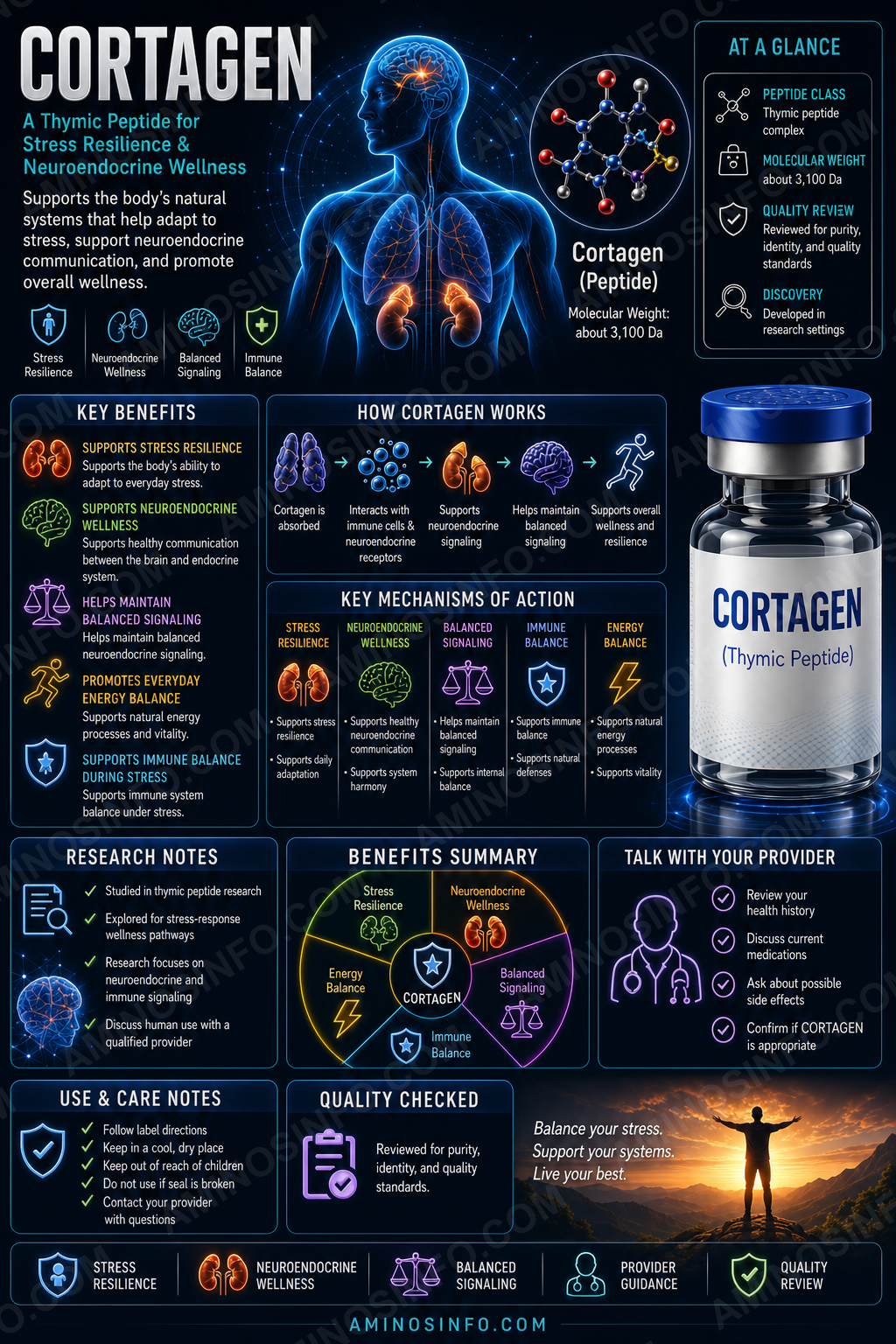
First, Cortagen is a synthetic tetrapeptide composed of alanine, glutamic acid, aspartic acid, and proline. Its sequence is Ala–Glu–Asp–Pro, abbreviated AEDP.
Next, it was developed through directed synthesis based on amino-acid analysis of Cortexin, a complex peptide preparation derived from mammalian cerebral cortex tissue. Cortagen was intended to provide a chemically defined short peptide for studying nervous-system signaling and repair.
Cortagen
Ala–Glu–Asp–Pro
AEDP
Linear tetrapeptide
Nerve repair, ischemia, gene expression
No
🧬 Molecular Structure
First, Cortagen is a linear tetrapeptide composed of L-alanine, L-glutamic acid, L-aspartic acid, and L-proline. The commonly reported research form has a free N-terminus and free C-terminal carboxyl group.
🧪 Amino-Acid Sequence
H-Ala-Glu-Asp-Pro-OH
One-letter notation: AEDP
| Residue | Chemical feature | Analytical relevance |
|---|---|---|
| Alanine | For example, Small nonpolar methyl side chain | Meanwhile, Provides the N-terminal residue and helps distinguish Cortagen from Epitalon. |
| Glutamic acid | Likewise, Acidic side-chain carboxyl group | In addition, Can contribute to cyclization or sequence-related impurities. |
| Aspartic acid | Moreover, Acidic side-chain carboxyl group | By contrast, Can undergo isomerization or form isoaspartyl-related degradants. |
| Proline | Also, Cyclic secondary amino acid | Consequently, Restricts backbone conformation and affects fragmentation and chromatography. |
⚛️ Molecular Weight and 🧫 Formula
| Neutral molecular formula | However, C17H26N4O9 |
|---|---|
| Average molecular weight | Approximately 430.41 g/mol |
| Peptide length | Tetrapeptide; four residues |
| Expected terminal form | Therefore, Free N-terminus and free C-terminal carboxyl group |
| Common research notation | AEDP |
Importantly, sequence permutations containing A, E, D, and P share the same elemental composition and nominal mass. Exact sequence order requires tandem mass spectrometry or another sequence-specific method.
📅 Discovery Timeline and Research History
1980s–1990s: Cortexin and brain peptide complexes studied
First, regional researchers investigated low-molecular-weight peptide preparations derived from mammalian cerebral cortex tissue.
Late 1990s: Cortagen synthesized
Next, researchers produced Cortagen by directed synthesis based on amino-acid analysis of Cortexin.
2000: Sciatic-nerve regeneration study
Moreover, in rats with transected and sutured sciatic nerves, Cortagen increased the rate of nerve-fiber growth during early regeneration.
2002: Delayed nerve-function study
However, a follow-up study evaluated longer-term restoration of injured nerve function and found that structural regeneration did not necessarily translate into clear improvement in conduction speed.
2002: Interleukin-2 mRNA study
In addition, Cortagen activated IL-2 mRNA synthesis in mouse splenocytes in vitro, although the effect was less pronounced than with Vilon or Epitalon.
2004: Gene-expression study
Likewise, a microarray study examined Cortagen-responsive genes in mouse heart. The tissue choice is important: this study does not prove brain-specific genomic targeting.
2011: Chronic brain-ischemia research
Meanwhile, animal studies reported correction of selected functional and metabolic disturbances in chronic brain ischemia.
2016 onward: Ischemic-preconditioning and neuroprotection reviews
Moreover, regional literature continued to discuss Cortagen in relation to hypoxia, ischemia, oxidative stress, and neuroprotection.
Current status
Finally, Cortagen remains an unapproved research peptide without a large independent clinical-development program.
Relationship to Cortexin
Cortexin is a mixture
First, Cortexin is a complex preparation containing multiple low-molecular-weight peptides derived from animal cerebral cortex tissue.
Cortagen is one defined sequence
Next, Cortagen is the single synthetic tetrapeptide AEDP, so researchers should not treat it as chemically equivalent to the full Cortexin mixture.
Evidence Does Not Transfer Automatically
However, researchers cannot automatically assign Cortexin findings to Cortagen, and Cortagen findings cannot establish the effects of the entire Cortexin complex.
Source-material differences matter
Finally, Cortexin products may vary by tissue source, purification, manufacturing, and peptide composition. Cortagen has a defined molecular identity that can be tested directly.
🧠 Proposed Mechanisms of Action
Importantly, researchers have not established a validated receptor-level mechanism for Cortagen.
Human clinical benefit remains unproven
1. Gene-expression modulation
First, microarray research found Cortagen-associated changes in multiple genes in mouse heart tissue. These findings support biological activity but do not define one selective neural pathway.
2. Neural-growth signaling
Next, peripheral nerve studies suggest effects on axonal sprouting or nerve-fiber elongation during early repair.
3. Ischemic-stress adaptation
Moreover, animal studies suggest possible effects on metabolic disturbances, membrane function, oxidative stress, or neuronal tolerance during chronic ischemia.
4. Cytokine regulation
In addition, In addition, Cortagen activated interleukin-2 mRNA in mouse splenocytes in vitro, indicating that it may not be exclusively nervous-system specific.
5. DNA and chromatin hypothesis
However, broader peptide-bioregulator literature proposes that short peptides interact with DNA or chromatin. Direct, sequence-specific, physiologically relevant Cortagen binding remains incompletely established.
🎯 Target and Pathway Profile
| Target or pathway | Evidence status |
|---|---|
| For example, Axonal growth and regeneration | Meanwhile, Reported in rat sciatic-nerve injury models. |
| Neural electrophysiology | Likewise, functional recovery findings remain mixed and less clear than structural growth findings. |
| Ischemic-metabolic pathways | In addition, Reported in animal chronic brain-ischemia studies. |
| Interleukin-2 mRNA | Moreover, Increased in mouse splenocytes in vitro. |
| Gene-expression networks | By contrast, Microarray changes reported in mouse heart. |
| Specific neurotrophin receptor | Also, No established direct agonist or antagonist activity. |
| DNA or chromatin | Consequently, General short-peptide hypothesis; Cortagen-specific targets remain uncertain. |
Peripheral Nerve-Regeneration Research
Sciatic-nerve transection model
Moreover, in rats with transected and surgically repaired sciatic nerves, intramuscular Cortagen during the early post-injury period increased the rate of nerve-fiber growth.
Early structural regeneration
Next, the main reported effect involved faster growth of regenerating fibers during early repair.
Delayed functional recovery
However, later assessment suggested that increased early fiber growth did not clearly produce faster restoration of nerve-conduction velocity.
Why structure and function differ
Moreover, axonal elongation alone does not ensure correct target reinnervation, myelination, conduction, motor control, sensory recovery, or pain-free function.
Clinical interpretation
Finally, no robust human trial establishes benefit after peripheral nerve transection, compression neuropathy, diabetic neuropathy, spinal injury, or surgical nerve repair.
Brain Ischemia and Neuroprotection Research
Chronic brain-ischemia models
Meanwhile, animal studies reported that Cortexin and Cortagen improved selected behavioral, metabolic, or functional measures during chronic cerebral ischemia.
Ischemic preconditioning
Next, later reviews discussed short peptides as possible enhancers of endogenous protective responses to sublethal ischemic stress.
Oxidative stress and apoptosis
However, marketers often describe Cortagen as reducing oxidative injury or apoptosis, while direct Cortagen-specific evidence varies by model and remains less extensive than those summaries suggest.
Stroke limitation
In addition, no evidence establishes Cortagen as acute stroke therapy. Emergency reperfusion, antithrombotic management, imaging, and rehabilitation remain standard care.
Dementia limitation
Finally, there is no large controlled evidence showing prevention or treatment of Alzheimer disease, vascular dementia, or mild cognitive impairment.
Neuronal Differentiation and Developmental Models
Xenopus ectoderm research
First, in an early developmental model using Xenopus laevis tissue, AEDP induced mesenchymal and epidermal development rather than showing a uniquely neuronal differentiation pattern.
Important correction
However, researchers should not describe Cortagen as a straightforward neuron-inducing peptide based on this model.
Stem-cell context
Moreover, short-peptide effects can depend strongly on cell type, developmental stage, concentration, and surrounding signaling environment.
No proof of brain regeneration
Finally, developmental tissue responses do not establish regeneration of mature human neurons or restoration of damaged brain circuits.
Gene-Expression and Chromatin Research
Mouse-heart microarray study
First, Cortagen altered expression of multiple genes in mouse heart tissue. The study was designed to screen molecular targets, not to demonstrate cognitive or neural efficacy.
Tissue specificity remains uncertain
Moreover, gene-expression changes outside the brain suggest Cortagen may have broader systemic activity than the term “cortex-specific peptide” implies.
Chromatin-remodeling studies
In addition, regional research has reported selective effects of AEDP and other short peptides on chromosome heterochromatin in lymphocytes from older individuals.
Selective epigenetic claims need caution
However, chromatin decondensation or heterochromatin changes do not automatically represent healthy rejuvenation and could have context-dependent effects.
No validated genomic target
Finally, no clinically validated promoter, receptor, or transcriptional pathway explains all reported Cortagen effects.
Evidence Limitations and Clinical Interpretation
Predominantly preclinical evidence
First, the evidence base consists mainly of cell studies, rat nerve models, mouse gene-expression experiments, and regional ischemia research.
Limited independent replication
Moreover, many findings originate from related investigators and institutions.
Structural nerve growth is not clinical recovery
In addition, faster axonal elongation does not prove restored movement, sensation, coordination, or reduced neuropathic pain.
No large human cognitive trials
However, no modern randomized trial establishes improvements in memory, executive function, dementia progression, stroke recovery, or quality of life.
No established route or dosing
Finally, there is no FDA-approved formulation, dose, treatment duration, or monitoring protocol.
Safety and Regulatory Considerations
No standardized human safety profile
First, no FDA-approved label defines pharmacokinetics, contraindications, interactions, pregnancy safety, or long-term adverse effects.
Neural-growth uncertainty
Moreover, any compound affecting axonal growth, proliferation, apoptosis, or gene expression requires evaluation for aberrant sprouting, pain sensitization, seizure risk, or tumor-related effects.
Immune effects
In addition, IL-2 mRNA activation suggests possible immune-system activity, which could be relevant in autoimmune disease, transplant recipients, or inflammatory disorders.
Product-quality risk
However, unapproved products may contain incorrect sequence, sequence isomers, free amino acids, residual solvents, microbial contamination, endotoxin, or inaccurate content.
Regulatory status
Finally, Cortagen/AEDP is not FDA approved as a drug or biologic.
🧪 Laboratory Testing Methods
Identity, Sequence, and Stability Testing
| Method | Purpose | Important limitation |
|---|---|---|
| However, RP-HPLC, ion-pair HPLC, or UPLC | Therefore, Separates AEDP from deletion peptides, free amino acids, and degradants. | For example, Small acidic peptides require validated methods. |
| LC-MS / HRMS | Meanwhile, Confirms intact molecular mass. | Likewise, Cannot distinguish sequence permutations by mass alone. |
| MS/MS sequencing | Confirms Ala–Glu–Asp–Pro order. | In addition, Proline affects fragmentation and requires validated interpretation. |
| Chiral amino-acid analysis | Moreover, Confirms L-Ala, L-Glu, L-Asp, and L-Pro. | By contrast, Hydrolysis can create artifacts. |
| Net peptide-content assay | Also, Measures actual AEDP concentration. | Consequently, analysts must not infer net peptide content from HPLC area purity. |
| Sequence-isomer analysis | However, Detects alternative A/E/D/P permutations. | Therefore, Isomers may have identical mass and similar chromatography. |
| For example, Pyroglutamate and isoaspartate analysis | Meanwhile, Evaluates cyclization and isomerization. | Likewise, analysts may need specialized LC-MS methods. |
| Free amino-acid analysis | In addition, Detects hydrolysis or incomplete synthesis. | Moreover, Requires adequate chromatographic resolution. |
| Neurite-outgrowth assay | By contrast, Measures axonal or neurite elongation. | Also, In vitro growth does not prove functional nerve repair. |
| Nerve-conduction testing | Consequently, Measures electrophysiological recovery in animal models. | However, researchers must pair nerve-conduction testing with histology and behavioral outcomes. |
| Gene-expression profiling | Measures transcriptional responses. | Therefore, Tissue and dose strongly influence results. |
| For example, Oxidative-stress and apoptosis assays | Meanwhile, Evaluate cellular injury and survival. | Likewise, Results are model dependent. |
| In addition, Microbial limits, sterility, and endotoxin | Moreover, Evaluates route-specific microbiological quality. | By contrast, Requirements differ by intended use. |
| Stability testing | Also, Tracks hydrolysis, cyclization, isomerization, assay, and appearance. | Consequently, Must reflect final formulation and storage conditions. |
📄 How to Interpret a Cortagen COA
COA Review and Route-Specific Quality
- However, Verify the exact sequence: H-Ala-Glu-Asp-Pro-OH or AEDP.
- Therefore, Confirm sequence order: Mass alone cannot distinguish AEDP from its sequence isomers.
- For example, Verify stereochemistry: Expected research material generally uses L-amino acids.
- Meanwhile, Separate identity, purity, and net content: These are different analytical measurements.
- Likewise, Review sequence isomers, pyroglutamate, isoaspartate, hydrolysis, and free amino acids.
- In addition, Match testing to the intended route: Raw-powder purity does not establish injectable, oral, or intranasal suitability.
- Moreover, Do not infer neuroregenerative efficacy: A COA cannot prove nerve repair, cognitive improvement, stroke protection, or brain rejuvenation.
📊 Cortagen vs Pinealon vs Cortexin vs Epitalon
Sequence and Neuroresearch Differences
| Feature | Cortagen | Pinealon | Cortexin | Epitalon |
|---|---|---|---|---|
| Sequence or composition | AEDP | EDR | By contrast, Complex of brain-derived peptides | AEDG |
| Length | Tetrapeptide; four residues | 3 amino acids | Mixture | Tetrapeptide; four residues |
| Main research association | Also, Nerve repair and ischemia | Neuroplasticity and aging | Broad neurotropic research | Consequently, Pineal and aging research |
| FDA approved? | For example, Regulators have not approved this compound. | Moreover, No approved indication exists. | This remains unapproved. | In addition, No FDA authorization applies. |
Cortagen vs Nerve Growth Factor vs BDNF
Experimental Tetrapeptide Versus Established Neurotrophins
| Feature | Cortagen | NGF | BDNF |
|---|---|---|---|
| Type | Ultrashort tetrapeptide | Neurotrophin protein | Neurotrophin protein |
| Established receptor | None | TrkA and p75NTR | TrkB and p75NTR |
| Main biology | However, Experimental gene and repair signaling | Therefore, Sensory and sympathetic neuron survival/growth | For example, Synaptic plasticity and neuronal survival |
| Human therapeutic use | None approved | Meanwhile, Limited specialized research/therapeutic contexts | Likewise, No routine approved systemic therapy |
Cortagen vs Standard Peripheral Nerve Repair
| Approach | Established role | Difference from Cortagen |
|---|---|---|
| In addition, Surgical repair or grafting | Moreover, Restores continuity in selected nerve injuries | Mechanical/anatomical correction |
| Rehabilitation | By contrast, Supports functional recovery and prevents secondary complications | Evidence-based functional therapy |
| Also, Nerve conduits and biomaterials | Consequently, Used or studied for guided regeneration | However, Structural support for axonal growth |
| Cortagen | No approved indication | Experimental signaling peptide |
🔗 Related Peptides and Neural Pathways
- Pinealon: First, EDR tripeptide associated with neuroplasticity research.
- Cortexin: Next, Complex peptide preparation distinct from Cortagen.
- Epitalon: Also, AEDG tetrapeptide associated with pineal and aging research.
- NGF: Moreover, Neurotrophin involved in peripheral-neuron survival and growth.
- BDNF: In addition, Neurotrophin involved in synaptic plasticity and neuronal survival.
- Schwann cells: Likewise, Support peripheral axonal regeneration and remyelination.
- Interleukin-2: Finally, an immune cytokine whose mRNA changed in splenocyte studies.
🖼️ Original Diagram Specifications
Diagram 1: Cortagen molecular structure
Therefore, Show H-Ala-Glu-Asp-Pro-OH with alanine’s methyl group, two acidic side chains, proline ring, peptide bonds, and free termini.
Diagram 2: Cortexin vs Cortagen
For example, Show Cortexin as a complex brain-derived peptide mixture and Cortagen as one defined synthetic AEDP tetrapeptide.
Diagram 3: Peripheral nerve regeneration
Meanwhile, Show nerve transection, surgical repair, axonal sprouts, Schwann cells, remyelination, target reinnervation, and the distinction between fiber growth and functional recovery.
Diagram 4: Chronic brain ischemia
Likewise, Show reduced blood flow, ATP depletion, oxidative stress, mitochondrial dysfunction, inflammation, apoptosis, and experimentally proposed Cortagen effects.
Diagram 5: Gene-expression evidence
In addition, Show mouse-heart microarray findings and clearly label that these do not prove brain-specific genomic targeting.
Diagram 6: Evidence ladder
Moreover, Show chemistry, cell studies, rodent nerve models, ischemia studies, controlled human trials, and FDA approval. Place Cortagen below confirmatory clinical evidence.
Diagram 7: COA workflow
By contrast, Show exact mass, MS/MS sequence, stereochemistry, sequence isomers, pyroglutamate, isoaspartate, free amino acids, net content, microbiology, and stability.
❓ Frequently Asked Questions
Is Cortagen a peptide?
Also, Yes. It is a synthetic tetrapeptide.
What is the correct sequence?
H-Ala-Glu-Asp-Pro-OH, abbreviated AEDP.
What is its molecular weight?
Consequently, Approximately 430.41 g/mol for neutral AEDP.
Is Cortagen FDA approved?
No.
Is Cortagen derived from Cortexin?
Next, researchers developed it by directed synthesis after analyzing Cortexin amino acids, but it is not chemically equivalent to the full mixture.
Does Cortagen regrow nerves?
However, Rat studies reported faster early sciatic-nerve fiber growth, but functional recovery was less clear and human evidence is lacking.
Does it improve nerve-conduction speed?
Therefore, Later animal work did not clearly establish faster conduction recovery.
Does Cortagen protect the brain from ischemia?
Moreover, animal studies suggest possible effects, but it is not an approved stroke or ischemia treatment.
Does Cortagen improve cognition?
Finally, no robust human trial establishes cognitive improvement.
Is Cortagen a neurotrophin?
For example, No. It has no established Trk receptor activity like NGF or BDNF.
Does it directly bind DNA?
Meanwhile, Short-peptide DNA interaction is a research hypothesis; physiologically relevant Cortagen binding has not been fully established.
Does 99% HPLC purity prove activity?
Likewise, No. Sequence, stereochemistry, net content, functional potency, pharmacokinetics, safety, and clinical outcomes must be established separately.
Cortagen Scientific Overview: Final Thoughts
In conclusion, Cortagen is a defined tetrapeptide with the sequence Ala–Glu–Asp–Pro. Its strongest direct evidence involves early peripheral nerve-fiber growth in rats, chronic brain-ischemia models, cytokine-gene effects, and broad gene-expression research.
However, the evidence does not establish clinically proven nerve regeneration, stroke treatment, cognitive enhancement, dementia prevention, or brain rejuvenation. The microarray study was performed in mouse heart, which also argues against oversimplifying Cortagen as exclusively cortex specific.
Therefore, analysts should verify legitimate research material for exact AEDP sequence order, L-amino-acid stereochemistry, terminal chemistry, sequence isomers, pyroglutamate, isoaspartate, free amino acids, net peptide content, route-specific microbiological quality, and stability.
📚 References
- In addition, Turchaninova LN, et al. Effect of tetrapeptide Cortagen on regeneration of sciatic nerve. Bulletin of Experimental Biology and Medicine. 2000.
- Moreover, Kolosova LI, et al. The delayed effect of Cortagen on restoration of injured nerve function. Doklady Biological Sciences. 2002.
- By contrast, Anisimov SV, et al. Elucidation of the effect of brain cortex tetrapeptide Cortagen on gene expression in mouse heart by microarray. Neuro Endocrinology Letters. 2004.
- Also, Zarubina IV, et al. Cortexin and Cortagen as correcting agents in functional and metabolic disorders in chronic brain ischemia. 2011.
- Consequently, Kazakova TB, et al. In vitro effect of short peptides on interleukin-2 mRNA synthesis in mouse splenocytes. 2002.
- However, Caputi S, et al. Effect of short peptides on neuronal differentiation of stem cells. 2019.
- Therefore, Khavinson V, et al. Neuroprotective effects of peptides in the brain. 2020.
- For example, Adriani W, et al. Modulatory effects of Cortexin and Cortagen on locomotor and anxiety-related behavior in mice. Open Neuropsychopharmacology Journal.
- Meanwhile, Khavinson V, et al. Epigenetic modification under the influence of short peptide bioregulators. 2023.
- Likewise, Khavinson V, et al. Peptide regulation of gene expression: a systematic review. Molecules. 2021.
- In addition, Anisimov VN, Khavinson VK. Peptide bioregulation of aging: results and prospects. Biogerontology. 2010.
- Moreover, Khavinson VK, Kuznik BI. Peptide Bioregulators: The New Class of Geroprotectors. 2014.
- By contrast, Solovyev AY, et al. Interaction of amino acids, peptides, and proteins with DNA. 2015.
- Also, Daniel H. Molecular and integrative physiology of intestinal peptide transport. Annual Review of Physiology.
- Consequently, Brandsch M. Drug transport via the intestinal peptide transporter PepT1. Current Opinion in Pharmacology.
- However, Smith DE, Clémençon B, Hediger MA. Proton-coupled oligopeptide transporter family SLC15. Molecular Aspects of Medicine.
- Therefore, Newstead S. Molecular insights into proton-coupled peptide transport. Trends in Pharmacological Sciences.
- For example, Jessen KR, Mirsky R. The repair Schwann cell and its function in regenerating nerves. Journal of Physiology.
- Meanwhile, Gordon T. Peripheral nerve regeneration and muscle reinnervation. International Journal of Molecular Sciences.
- Likewise, Grinsell D, Keating CP. Peripheral nerve reconstruction after injury. Biomedical Research International.
- In addition, Menorca RMG, Fussell TS, Elfar JC. Nerve physiology and mechanisms of injury and recovery. Hand Clinics.
- Moreover, Stocco E, et al. Self-assembling peptides for sciatic nerve regeneration. 2025.
- By contrast, Jin MY, et al. Neuromodulation for peripheral nerve regeneration. Biomedicines. 2023.
- Also, Lo EH, Dalkara T, Moskowitz MA. Mechanisms, challenges, and opportunities in stroke. Nature Reviews Neuroscience.
- Consequently, Dirnagl U, Iadecola C, Moskowitz MA. Pathobiology of ischaemic stroke. Trends in Neurosciences.
- However, Kalogeris T, et al. Cell biology of ischemia/reperfusion injury. International Review of Cell and Molecular Biology.
- Therefore, Yuan J, Yankner BA. Apoptosis in the nervous system. Nature.
- However, Thoenen H. Neurotrophins and neuronal plasticity. Science.
- Therefore, Huang EJ, Reichardt LF. Trk receptors and neurotrophin function. Annual Review of Biochemistry.
- Likewise, Park H, Poo MM. Neurotrophin regulation of neural circuit development and function. Nature Reviews Neuroscience.
- For example, Kurkin DV, et al. Neurotropic effects of Cortexin in developmental-delay models. 2025.
- Moreover, International Council for Harmonisation. ICH Q2(R2): Validation of Analytical Procedures.
- In addition, United States Pharmacopeia. General Chapter <621>, Chromatography.
- However, United States Pharmacopeia. General Chapters <61> and <62>, Microbiological Examination of Nonsterile Products.
- Therefore, United States Pharmacopeia. General Chapter <71>, Sterility Tests.
- Likewise, United States Pharmacopeia. General Chapter <85>, Bacterial Endotoxins Test.
- For example, United States Pharmacopeia. General Chapters <232> and <233>, Elemental Impurities.
- Moreover, International Council for Harmonisation. ICH Q3C: Impurities—Guideline for Residual Solvents.
- In addition, International Council for Harmonisation. ICH Q1A(R2): Stability Testing of New Drug Substances and Products.
Cortagen, Nerve-Regeneration, and Ischemia Sources
Neural Biology, Gene Expression, and Analytical Sources
Identity, molecular properties, nerve-regeneration, ischemia, gene-expression, developmental-model, safety, and regulatory findings were reviewed in July 2026. Finally, Cortagen remains an unapproved research peptide.