Crystagen Scientific Overview: Identity, Mechanism, Evidence, and Testing
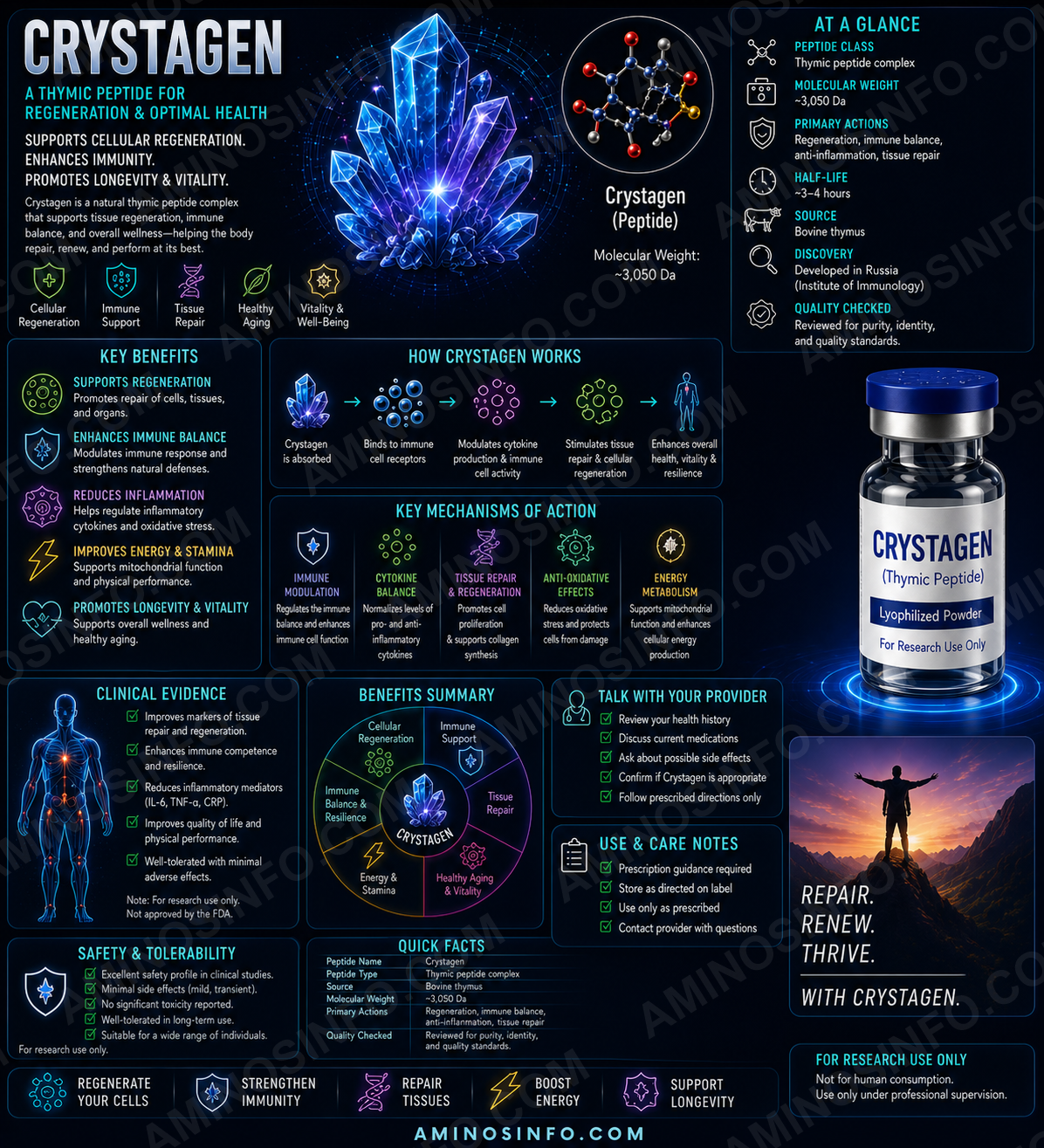
Crystagen scientific overview content should distinguish the verified Glu–Asp–Pro tripeptide from the unsupported TKD identity and from claims of proven immune, antiviral, anticancer, thymic, or anti-aging benefit. Finally, Crystagen remains an unapproved research peptide.
Important Scientific Correction
| Name | Correct identity | Research association |
|---|---|---|
| Crystagen | EDP — Glu–Asp–Pro | For example, Immune-cell differentiation, B-cell activation, apoptosis and proliferation |
| TKD | Thr–Lys–Asp | Meanwhile, Not the established Crystagen sequence in the primary literature reviewed |
| Thymogen | EW — Glu–Trp | Likewise, Thymic and immune research |
| Vilon | KE — Lys–Glu | In addition, Immune-cell and gene-regulation research |
Importantly, peer-reviewed articles discussing Crystagen explicitly refer to it as the EDP peptide. Commercial pages that list TKD, EDG, or other sequences are inconsistent with this literature.
What Is Crystagen?
First, Crystagen is a synthetic tripeptide composed of glutamic acid, aspartic acid, and proline. Its sequence is Glu–Asp–Pro, abbreviated EDP.
Next, it belongs to the broader class of ultrashort peptide bioregulators studied in Russian and Eastern European gerontology and immunology research. Published work has examined effects on lymphocytes, spleen cells, B-cell populations, apoptosis, cell proliferation, immune-cell differentiation, and selected immortalized cell lines.
Crystagen
Glu–Asp–Pro
EDP
Linear tripeptide
Immune-cell regulation
No
🧬 Molecular Structure
First, Crystagen is a linear tripeptide composed of L-glutamic acid, L-aspartic acid, and L-proline. The standard research form is generally represented with a free N-terminus and free C-terminal carboxyl group.
🧪 Amino-Acid Sequence
H-Glu-Asp-Pro-OH
One-letter notation: EDP
| Residue | Chemical feature | Analytical relevance |
|---|---|---|
| Glutamic acid | Moreover, Acidic side-chain carboxyl group | By contrast, Can form pyroglutamate-related impurities through N-terminal cyclization. |
| Aspartic acid | Also, Acidic side-chain carboxyl group | Consequently, Can undergo isomerization or form isoaspartyl-related degradants. |
| Proline | However, Cyclic secondary amino acid | Therefore, Restricts backbone conformation and affects fragmentation and chromatography. |
⚛️ Molecular Weight and 🧫 Formula
| Neutral molecular formula | For example, C14H21N3O8 |
|---|---|
| Average molecular weight | Approximately 359.34 g/mol |
| Peptide length | 3 amino acids |
| Expected terminal form | Meanwhile, Free N-terminus and free C-terminal carboxyl group |
| Common research notation | EDP |
Importantly, EDP, EPD, DEP, DPE, PED, and PDE share the same elemental composition and nominal mass. Sequence-order testing is essential.
📅 Research Timeline and History
1970s–1990s: Thymic peptide research develops
First, researchers studied thymus-derived peptide complexes such as Thymalin and later defined short sequences including Thymogen, Vilon, and Crystagen.
2000s: Immune-cell and aging models expand
Next, researchers examined Crystagen in lymphoid tissues, spleen-cell cultures, lymphocytes, and stem-cell differentiation systems.
2011: Tripeptide effects on lymphoid and stem cells
Moreover, research reported that Crystagen affected proliferation and apoptosis in normal and immortalized immune-cell models.
2014: Molecular aspects of immunoprotective activity
In addition, a study reported B-cell activation and age-dependent effects in spleen-cell systems.
2021: Thymalin and short thymic peptides reviewed
Likewise, a review summarized evidence that Crystagen, Thymogen, and Vilon influence differentiation, viability, proliferation, and apoptosis in selected immune-cell populations.
2022: Broader peptide inflammatory research
Meanwhile, reviews of Khavinson peptides discussed interactions with inflammatory signaling and cellular tolerance, although Crystagen-specific mechanisms remained incompletely defined.
Current status
Finally, Crystagen remains an unapproved research peptide without a large independent clinical-development program.
Immune-System and Thymic Biology
What the thymus does
First, the thymus supports T-cell development, positive and negative selection, self-tolerance, and establishment of a functional adaptive immune repertoire.
B cells and spleen
Next, B cells develop mainly in bone marrow and undergo activation and differentiation in secondary lymphoid organs such as the spleen and lymph nodes.
Adaptive immunity
Moreover, T cells coordinate cellular immunity, while B cells produce antibodies and support antigen presentation and immune memory.
Immunosenescence
In addition, thymic involution, reduced naïve T-cell output, altered memory-cell populations, impaired vaccine responses, chronic inflammation, and B-cell changes accompany aging.
Where Crystagen may act
However, published Crystagen findings involve both B-cell and broader lymphoid-cell responses. This means the compound should not be described solely as a T-cell or thymus-specific peptide.
🧠 Proposed Mechanisms of Action
Importantly, researchers have not established a validated receptor-level mechanism for Crystagen.
Clinical immune protection remains unproven
1. Immune-cell differentiation
First, researchers have reported Crystagen to promote differentiation or functional maturation in selected lymphoid and stem-cell systems.
2. Apoptosis regulation
Next, studies report reduced apoptosis in some normal immune-cell populations, potentially supporting cell survival under experimental conditions.
3. Proliferation regulation
Moreover, Crystagen may stimulate proliferation in normal lymphocytes while inhibiting proliferation in selected immortalized cells. This context-dependent behavior requires careful interpretation.
4. B-cell activation
In addition, a study reported activation of B-cell immune responses and effects on spleen-cell proliferation.
5. Gene-regulation hypothesis
However, broader ultrashort-peptide literature proposes interactions with DNA, histones, transcription factors, or peptide transporters. Crystagen-specific genomic targets remain uncertain.
🎯 Target and Pathway Profile
| Target or pathway | Evidence status |
|---|---|
| B-cell activation | Likewise, Reported in experimental immune and aging models. |
| Lymphocyte proliferation | In addition, context-dependent effects reported in normal and immortalized cells. |
| Apoptosis | In addition, Reduced apoptosis reported in selected immune-cell populations. |
| Stem-cell differentiation | Moreover, Discussed in short-peptide differentiation research. |
| T-cell receptor | By contrast, No established direct agonist or antagonist activity. |
| Toll-like receptors | Also, No validated direct receptor mechanism. |
| DNA or chromatin | Consequently, General ultrashort-peptide hypothesis; EDP-specific targets remain unclear. |
Immune-Cell Differentiation and Proliferation Research
Normal lymphocytes
First, researchers reported that Crystagen to increase spontaneous proliferative activity in normal human lymphocytes under experimental conditions.
Stem-cell models
Next, reviews describe thymic short peptides as affecting differentiation of progenitor and immune-related cell populations.
Cell viability
Moreover, researchers have associated Crystagen with increased viability and reduced apoptosis in selected immune-cell subsets.
Context matters
However, immune-cell proliferation may be helpful during immune suppression but harmful in autoimmunity, lymphoproliferative disease, or uncontrolled inflammation.
No proof of immune restoration
Finally, cell-culture changes do not prove improved vaccine response, fewer infections, better cancer immunity, or reversal of immunosenescence in humans.
Immunosenescence and Stress Research
Age-related immune decline
First, older immune systems often show reduced naïve T-cell output, altered B-cell repertoires, chronic low-grade inflammation, and impaired adaptive responses.
Spleen-cell findings
Next, Crystagen activated B-cell immunity but reportedly did not restore age-related cellular renewal in spleen tissue.
Athlete and stress studies
Moreover, reviews mention oral Crystagen used with other short peptides in athletes, with reported normalization of immunity and improved stress resistance. Combination treatment and limited methodological detail make Crystagen-specific conclusions difficult.
No established anti-aging benefit
However, no reliable evidence shows that Crystagen reverses thymic involution, restores a youthful T-cell repertoire, extends lifespan, or prevents age-related disease.
Immortalized-Cell and Antitumor Hypotheses
Immortalized-cell proliferation
First, Crystagen inhibited proliferation in selected immortalized cell models while stimulating normal lymphocytes.
Possible selectivity hypothesis
However, researchers have interpreted this difference as potential antitumor activity. However, transformed-cell growth inhibition in vitro is not equivalent to cancer treatment.
No validated oncology role
Moreover, no large animal or human evidence establishes tumor shrinkage, prolonged survival, reduced recurrence, or synergy with chemotherapy.
Immune stimulation can be complex in cancer
Finally, some cancers exploit inflammatory or immune pathways. Broad immune activation is not automatically beneficial and may interact unpredictably with immunotherapy.
Evidence Limitations and Clinical Interpretation
Limited research network
First, most Crystagen data come from a small number of investigators and related peptide-bioregulator programs.
Predominantly preclinical evidence
Next, the evidence base includes cell cultures, spleen models, immune-cell phenotyping, and reviews rather than modern large randomized trials.
No established infection outcome
Moreover, no robust trial demonstrates fewer respiratory infections, shorter illness, reduced hospitalization, or improved vaccine effectiveness.
No established autoimmune benefit
However, researchers have not proven that Crystagen treats rheumatoid arthritis, lupus, inflammatory bowel disease, multiple sclerosis, or other autoimmune conditions.
No established cancer benefit
Finally, in vitro antiproliferative findings do not establish human antitumor activity.
Safety and Regulatory Considerations
No standardized human safety profile
First, no FDA-approved label defines dose, route, pharmacokinetics, contraindications, interactions, pregnancy safety, or long-term adverse effects.
Immune stimulation risk
Moreover, potential immune activation could theoretically worsen autoimmunity, inflammatory disease, transplant rejection, cytokine-mediated injury, or some malignancies.
Immune suppression risk
In addition, context-dependent effects on apoptosis or proliferation could also impair immune balance in unexpected ways.
Cancer uncertainty
Likewise, any compound affecting proliferation, apoptosis, or differentiation requires careful oncologic safety evaluation.
Product-quality risk
However, unapproved products may contain the wrong sequence, sequence isomers, free amino acids, residual solvents, microbial contamination, endotoxin, or inaccurate content.
Regulatory status
Finally, Crystagen/EDP is not FDA approved as a drug or biologic.
🧪 Laboratory Testing Methods
Identity, Sequence, and Stability Testing
| Method | Purpose | Important limitation |
|---|---|---|
| However, RP-HPLC, ion-pair HPLC, or UPLC | Therefore, Separates EDP from deletion peptides, amino acids, and degradants. | For example, Small acidic peptides require validated methods. |
| LC-MS / HRMS | Meanwhile, Confirms intact molecular mass. | Likewise, Cannot distinguish sequence permutations by mass alone. |
| MS/MS sequencing | Confirms Glu–Asp–Pro order. | In addition, Proline can produce distinctive but method-dependent fragmentation. |
| Chiral amino-acid analysis | Moreover, Confirms L-Glu, L-Asp, and L-Pro. | By contrast, Hydrolysis can introduce artifacts. |
| Net peptide-content assay | Also, Measures actual EDP concentration. | Consequently, analysts must not infer net peptide content from HPLC area purity. |
| Sequence-isomer analysis | However, Detects EPD, DEP, DPE, PED, and PDE. | Therefore, Isomers may have identical mass and similar chromatography. |
| Pyroglutamate analysis | For example, Detects N-terminal Glu cyclization. | Meanwhile, analysts may need specialized LC-MS methods. |
| Isoaspartate analysis | Evaluates Asp isomerization. | Likewise, Can be challenging in a short peptide. |
| Free amino-acid analysis | In addition, Detects hydrolysis or incomplete synthesis. | Requires adequate separation. |
| Flow cytometry | Moreover, Measures B-cell, T-cell, apoptosis, and differentiation markers. | By contrast, Marker changes do not prove clinical immune benefit. |
| Proliferation assay | Also, Measures normal or immortalized-cell growth. | Consequently, Results depend heavily on cell line and exposure conditions. |
| Cytokine panel | However, Evaluates inflammatory or immune-signaling changes. | Therefore, Isolated cytokine shifts can be difficult to interpret. |
| For example, Microbial limits, sterility, and endotoxin | Meanwhile, Evaluates route-specific microbiological quality. | Likewise, Requirements differ by intended use. |
| Stability testing | In addition, Tracks hydrolysis, cyclization, isomerization, assay, and appearance. | Moreover, Must reflect final formulation and storage conditions. |
📄 How to Interpret a Crystagen COA
COA Review and Route-Specific Quality
- By contrast, Verify the exact sequence: H-Glu-Asp-Pro-OH or EDP.
- Also, Reject TKD labeling: TKD is not the established Crystagen sequence in the literature reviewed.
- Consequently, Confirm sequence order: Mass alone cannot distinguish EDP from its five sequence isomers.
- However, Verify stereochemistry: Expected material generally uses L-amino acids.
- Therefore, Separate identity, purity, and net content: These are different analytical measurements.
- For example, Review pyroglutamate, isoaspartate, free amino acids, and hydrolysis products.
- Meanwhile, Match testing to intended route: Raw-powder purity does not establish injectable or oral suitability.
- Likewise, Do not infer immune efficacy: A COA cannot prove stronger immunity, fewer infections, cancer benefit, thymus regeneration, or healthy aging.
📊 Crystagen vs Thymogen vs Vilon vs Thymalin
Sequence and Immune-Research Differences
| Feature | Crystagen | Thymogen | Vilon | Thymalin |
|---|---|---|---|---|
| Sequence or composition | EDP | EW | KE | In addition, Complex of thymic peptides |
| Length | 3 amino acids | Dipeptide; two residues | Dipeptide; two residues | Mixture |
| Main research association | Moreover, Immune-cell differentiation and B-cell activity | By contrast, Thymic and immune regulation | Also, Immune-cell and gene-regulation research | Consequently, Broad thymic peptide effects |
| FDA approved? | For example, Regulators have not approved this compound. | Moreover, No approved indication exists. | This remains unapproved. | In addition, No FDA authorization applies. |
Crystagen vs Thymosin Alpha-1
Ultrashort Tripeptide Versus Larger Thymic Peptide
| Feature | Crystagen | Thymosin Alpha-1 |
|---|---|---|
| Structure | EDP tripeptide | 28-amino-acid peptide |
| Mechanism certainty | Low | However, Broader innate and adaptive immune research with more defined pathways |
| Human clinical evidence | Very limited | Therefore, Substantial international clinical research |
| US FDA approval | However, Regulators have not approved this compound. | Therefore, No approved indication exists. |
Crystagen vs General Immune Therapies
| Approach | Established role | Difference from Crystagen |
|---|---|---|
| Vaccination | For example, Induces antigen-specific immune memory | Meanwhile, Defined preventive immune intervention |
| Monoclonal antibodies | Likewise, Target specific immune or disease pathways | Defined molecular targets |
| Colony-stimulating factors | In addition, Increase selected blood-cell lineages | Approved receptor-based pharmacology |
| Crystagen | No approved indication | Moreover, Experimental short peptide with uncertain mechanism |
🔗 Related Peptides and Immune Pathways
- Thymogen: First, EW dipeptide associated with thymic and immune research.
- Vilon: Next, KE dipeptide studied in immune and gene-regulation models.
- Thymalin: Also, Thymus-derived peptide complex.
- Thymosin Alpha-1: Moreover, Larger thymic peptide with broader clinical research.
- B-cell receptor signaling: In addition, Central to antibody-producing cell activation.
- T-cell selection: Likewise, Thymic process establishing immune competence and tolerance.
- Apoptosis pathways: Finally, Important in immune-cell survival and homeostasis.
🖼️ Original Diagram Specifications
Diagram 1: Crystagen molecular structure
By contrast, Show H-Glu-Asp-Pro-OH with the two acidic side chains, cyclic proline ring, peptide bonds, and free termini.
Diagram 2: Identity correction
Also, Contrast verified Crystagen EDP with unsupported TKD and other inconsistent vendor sequences.
Diagram 3: Adaptive immune system overview
Consequently, Show thymus, bone marrow, T cells, B cells, spleen, lymph nodes, antibody production, and immune memory.
Diagram 4: Proposed Crystagen effects
However, Show differentiation, proliferation, apoptosis reduction, and B-cell activation, with all pathways labeled experimental.
Diagram 5: Normal vs immortalized cells
Therefore, illustrate stimulation of normal lymphocyte proliferation and inhibition of selected immortalized-cell proliferation while emphasizing that antitumor benefit remains unproven.
Diagram 6: Evidence ladder
For example, Show chemistry, cell culture, spleen models, small combination studies, controlled human trials, and FDA approval. Place Crystagen below confirmatory clinical evidence.
Diagram 7: COA workflow
Meanwhile, Show exact mass, MS/MS sequence, stereochemistry, sequence isomers, pyroglutamate, isoaspartate, free amino acids, net content, microbiology, and stability.
❓ Frequently Asked Questions
Is Crystagen a peptide?
Likewise, Yes. It is a synthetic tripeptide.
What is the correct sequence?
H-Glu-Asp-Pro-OH, abbreviated EDP.
Is Crystagen TKD?
In addition, No. Peer-reviewed Crystagen literature identifies it as EDP.
What is its molecular weight?
Moreover, Approximately 359.34 g/mol for neutral EDP.
Is Crystagen FDA approved?
No.
Does Crystagen stimulate T cells?
By contrast, It has broad immune-cell research, but no validated direct T-cell receptor mechanism or proven clinical T-cell benefit.
Does it activate B cells?
Also, Experimental research reported B-cell activation.
Does Crystagen improve immunity?
Consequently, No robust clinical evidence establishes fewer infections or improved vaccine responses.
Does it reverse immune aging?
However, No. It has not been shown to restore a youthful immune system or thymus.
Is Crystagen anticancer?
Therefore, It inhibited proliferation in selected immortalized cells, but this does not establish cancer treatment.
Is it the same as Thymalin?
For example, No. Crystagen is one defined tripeptide; Thymalin is a mixture of thymus-derived peptides.
Does 99% HPLC purity prove immune activity?
Meanwhile, No. Sequence, stereochemistry, net content, functional potency, pharmacokinetics, safety, and clinical outcomes must be established separately.
Crystagen Scientific Overview: Final Thoughts
In conclusion, the original article assigned Crystagen the wrong sequence. Peer-reviewed Crystagen research identifies it as the tripeptide Glu–Asp–Pro, abbreviated EDP.
However, its published research includes B-cell activation, immune-cell differentiation, context-dependent proliferation, apoptosis regulation, spleen-cell aging models, and effects on selected immortalized cell lines. These findings are mechanistically interesting but do not establish Crystagen as a clinically proven immune, antiviral, anticancer, thymic, or anti-aging therapy.
Therefore, analysts should verify legitimate research material for exact EDP sequence order, L-amino-acid stereochemistry, terminal chemistry, sequence isomers, pyroglutamate, isoaspartate, free amino acids, net peptide content, route-specific microbiological quality, and stability.
📚 References
- Likewise, Chervyakova NA, et al. Molecular aspects of immunoprotective activity of peptides in aging. Advances in Gerontology. 2014.
- In addition, Khavinson VK, et al. The use of Thymalin for immunocorrection and molecular aspects of thymic peptides. 2021.
- Moreover, Khavinson V, et al. Peptide Regulation of Gene Expression: A Systematic Review. Molecules. 2021.
- By contrast, Khavinson V, et al. Transport of Biologically Active Ultrashort Peptides Using POT and LAT Carriers. 2022.
- Also, Khavinson VK, et al. Effect of tripeptides on lymphoid and stem cells. Bulletin of Experimental Biology and Medicine. 2011.
- Consequently, Avolio F, et al. Peptides regulating proliferative activity and inflammatory pathways. 2022.
- However, Anisimov VN, Khavinson VK. Peptide bioregulation of aging: results and prospects. Biogerontology. 2010.
- Therefore, Khavinson VK. Peptides and ageing. Neuro Endocrinology Letters. 2002.
- For example, Khavinson VK, Kuznik BI. Peptide Bioregulators: The New Class of Geroprotectors. 2014.
- Meanwhile, Khavinson VK. Peptides, Genome, and Aging. Research monograph.
- Likewise, Solovyev AY, et al. Interaction of amino acids, peptides, and proteins with DNA. 2015.
- In addition, Daniel H. Molecular and integrative physiology of intestinal peptide transport. Annual Review of Physiology.
- Moreover, Brandsch M. Drug transport via the intestinal peptide transporter PepT1. Current Opinion in Pharmacology.
- By contrast, Smith DE, Clémençon B, Hediger MA. Proton-coupled oligopeptide transporter family SLC15. Molecular Aspects of Medicine.
- Also, Newstead S. Molecular insights into proton-coupled peptide transport. Trends in Pharmacological Sciences.
- Consequently, Thapa P, Farber DL. The role of the thymus in the immune response. Thoracic Surgery Clinics.
- However, Palmer DB. The effect of age on thymic function. Frontiers in Immunology.
- Therefore, Thomas R, Wang W, Su DM. Contributions of age-related thymic involution to immunosenescence and inflammaging. Immunity & Ageing.
- For example, Goronzy JJ, Weyand CM. Understanding immunosenescence to improve responses to vaccines. Nature Immunology.
- Meanwhile, Montecino-Rodriguez E, Berent-Maoz B, Dorshkind K. Causes, consequences, and reversal of immune-system aging. Journal of Clinical Investigation.
- Likewise, Nikolich-Žugich J. The twilight of immunity: emerging concepts in aging of the immune system. Nature Immunology.
- In addition, Cyster JG, Allen CDC. B cell responses: cell interaction dynamics and decisions. Cell.
- Moreover, Victora GD, Nussenzweig MC. Germinal centers. Annual Review of Immunology.
- Likewise, Murphy K, Weaver C. Janeway's Immunobiology. Garland Science.
- For example, Elmore S. Apoptosis: a review of programmed cell death. Toxicologic Pathology.
- Moreover, Hanahan D. Hallmarks of Cancer: new dimensions. Cancer Discovery.
- In addition, Pugliese A. Peptide-based treatment for autoimmune diseases. Journal of Clinical Investigation. 2003.
- However, Gokhale AS, et al. Peptides and peptidomimetics as immunomodulators. 2014.
- Therefore, Ohigashi I, et al. Peptides for T-cell selection in the thymus. 2021.
- Likewise, International Council for Harmonisation. ICH Q2(R2): Validation of Analytical Procedures.
- For example, United States Pharmacopeia. General Chapter <621>, Chromatography.
- Moreover, United States Pharmacopeia. General Chapters <61> and <62>, Microbiological Examination of Nonsterile Products.
- In addition, United States Pharmacopeia. General Chapter <71>, Sterility Tests.
- United States Pharmacopeia. General Chapter <85>, Bacterial Endotoxins Test.
- United States Pharmacopeia. General Chapters <232> and <233>, Elemental Impurities.
- International Council for Harmonisation. ICH Q3C: Impurities—Guideline for Residual Solvents.
- International Council for Harmonisation. ICH Q1A(R2): Stability Testing of New Drug Substances and Products.
Crystagen, Immune-Cell, and Thymic Sources
Immunosenescence, Cancer, and Analytical Sources
Identity, molecular properties, immune-cell findings, aging research, safety limitations, and regulatory status were reviewed in July 2026. Finally, Crystagen remains an unapproved research peptide.