Epitalon Scientific Overview: Identity, Mechanism, Evidence, and Testing
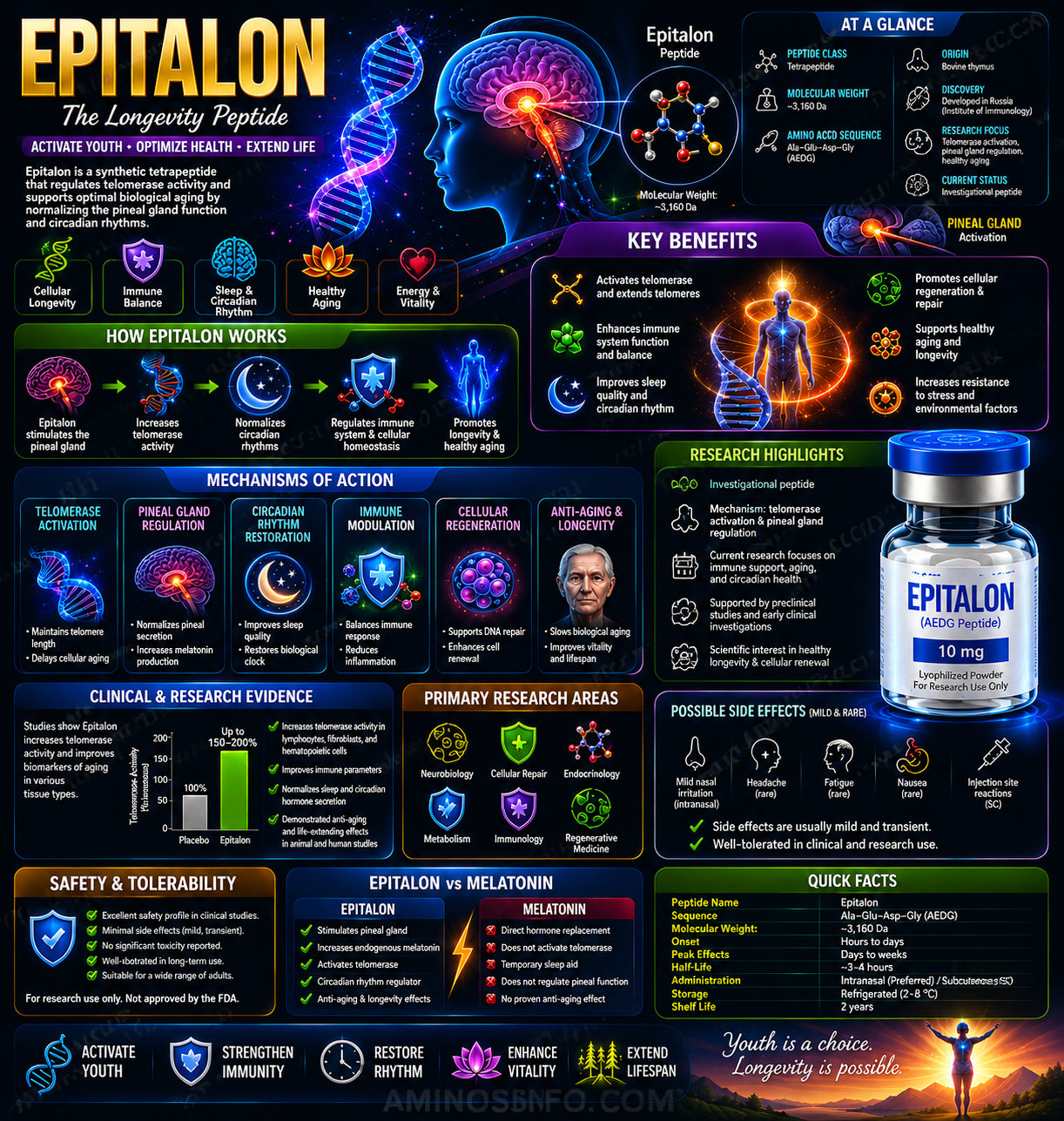
Epitalon scientific overview content should distinguish the defined Ala–Glu–Asp–Gly tetrapeptide from Epithalamin, the complex bovine pineal extract. The article also separates cell and animal findings from claims of proven human anti-aging, sleep, telomere, cancer-prevention, or lifespan benefits.
Important Scientific Corrections
| Original wording | Evidence-based correction |
|---|---|
| Epitalon is also called Epithalamin | For example, Epitalon/Epithalon is a defined synthetic tetrapeptide. Epithalamin is a complex pineal-gland extract. |
| AEAG / AEDG | Meanwhile, The correct one-letter sequence is AEDG. AEAG would be a different peptide. |
| Likewise, Derived from a naturally occurring Epitalon peptide | In addition, researchers synthesized Epitalon from the amino-acid composition of Epithalamin and later discussed it as a component or active motif of pineal peptide preparations. |
| Moreover, Proven telomere maintenance in aging humans | By contrast, cell studies provide most support for telomerase and telomere effects, while human anti-aging efficacy remains unproven. |
| Established lifespan extension | Also, Animal findings vary by species, strain, schedule, and endpoint. One mouse study found no increase in mean lifespan. |
What Is Epitalon?
First, Epitalon is a synthetic linear tetrapeptide composed of alanine, glutamic acid, aspartic acid, and glycine. It is commonly spelled Epitalon, Epithalon, or Epithalone and abbreviated AEDG.
Next, researchers developed it by Vladimir Khavinson and colleagues from research on Epithalamin, a peptide complex isolated from bovine pineal tissue. Epitalon was intended to reproduce selected neuroendocrine, circadian, retinal, and gerontological effects of the broader extract using one chemically defined sequence.
Epitalon
Epithalon, Epithalone
Ala–Glu–Asp–Gly
AEDG
Linear tetrapeptide
No
🧬 Molecular Structure
First, Epitalon is a linear tetrapeptide composed of L-alanine, L-glutamic acid, L-aspartic acid, and glycine. The conventional research structure has a free N-terminus and free C-terminal carboxyl group.
🧪 Amino-Acid Sequence
H-Ala-Glu-Asp-Gly-OH
One-letter notation: AEDG
| Residue | Chemical feature | Analytical relevance |
|---|---|---|
| Alanine | Consequently, Small nonpolar methyl side chain | However, Defines the N-terminal residue. |
| Glutamic acid | Therefore, Acidic side-chain carboxyl group | For example, Can contribute to sequence isomers and hydrolysis-related impurities. |
| Aspartic acid | Meanwhile, Acidic side-chain carboxyl group | Likewise, Can undergo isomerization or form isoaspartyl-related degradants. |
| Glycine | In addition, Small achiral amino acid | Moreover, Provides flexibility and has no stereocenter. |
⚛️ Molecular Weight and 🧫 Formula
| Neutral molecular formula | By contrast, C14H22N4O9 |
|---|---|
| Average molecular weight | Approximately 390.35 g/mol |
| Peptide length | Tetrapeptide; four residues |
| Expected terminal form | Also, Free N-terminus and free C-terminal carboxyl group |
| Common research notation | AEDG |
Importantly, AEDG and other permutations of A, E, D, and G have the same elemental composition and nominal mass. Exact sequence order requires tandem mass spectrometry or another sequence-specific technique.
📅 Discovery Timeline and Research History
1970s–1980s: Epithalamin research begins
First, researchers studied peptide fractions isolated from bovine pineal tissue for neuroendocrine, circadian, reproductive, and aging-related effects.
1980s–1990s: AEDG synthesized
Next, researchers designed Epitalon from the amino-acid composition of Epithalamin as a defined synthetic pineal tetrapeptide.
2001: Circadian research in aged rhesus monkeys
Moreover, Next, Epitalon increased evening melatonin synthesis and normalized selected cortisol-rhythm disturbances in senescent monkeys.
2002–2003: Lifespan, cancer, retinal, and telomerase studies
In addition, animal studies examined longevity and tumor development, retinal studies evaluated degenerative disease models, and a human-cell study reported telomerase activation and telomere elongation.
2003: Mixed mouse lifespan findings
However, a lifelong dosing study in female mice found no change in mean lifespan, although investigators evaluated several aging biomarkers and tumor endpoints.
2005–2007: Metabolic and melatonin studies
Likewise, older-primate and elderly-human research examined melatonin rhythms, glucose and insulin measures, and pineal function.
2020: Gene-expression and differentiation review
Meanwhile, reviews summarized AEDG research across pineal, retinal, neural, stem-cell, and gene-expression systems.
2025: New telomere and cellular studies
Moreover, independent investigators reported increased telomere length in human cell lines through telomerase upregulation or alternative lengthening pathways. Additional studies examined retinal-cell wound healing and oxidative stress.
Current status
Finally, Epitalon remains investigational, without FDA approval or a validated human longevity indication.
Telomerase and Telomere Research
What telomeres are
First, telomeres are repetitive DNA–protein structures at chromosome ends. They protect chromosomes from being recognized as broken DNA and generally shorten during repeated cell division.
What telomerase does
Next, telomerase is a ribonucleoprotein enzyme that adds telomeric repeats. It is active in germ cells, selected stem cells, activated immune cells, and most cancers but is low or absent in many normal somatic cells.
2003 human-cell study
Moreover, researchers reported that Epitalon to induce telomerase activity and elongate telomeres in human somatic-cell cultures.
2025 independent cell-line study
In addition, a later study reported increased telomere length in multiple human cell lines. Depending on the cell line, the effect appeared to involve telomerase upregulation or an alternative lengthening of telomeres pathway.
Important limitations
- First, Cell-culture exposure does not establish oral or injected human pharmacology.
- Next, Longer telomeres are not automatically equivalent to slower whole-body aging.
- Also, Telomere length varies by cell type and measurement method.
- However, telomerase activation can support tissue renewal but is also a hallmark of most cancers.
No proven human telomere therapy
However, no large randomized trial establishes durable telomere lengthening, reduced age-related disease, or longer human lifespan after Epitalon treatment.
Pineal Gland, Melatonin, and Circadian Research
Pineal physiology
First, the pineal gland produces melatonin mainly at night under control of the suprachiasmatic nucleus and environmental light–dark signals.
Aged rhesus-monkey studies
Moreover, Next, Epitalon increased evening or nighttime melatonin levels and normalized selected circadian disturbances in old monkeys.
Cortisol rhythm
Moreover, a 2001 study reported normalization of altered cortisol rhythm alongside increased melatonin synthesis.
Elderly-human pineal research
In addition, regional reports describe increased nighttime melatonin in older adults with reduced pineal function after Epitalon or Epithalamin treatment.
Stress-dependent effects
However, rat pinealocyte research suggested that Epitalon modulated secretion more strongly under stress than under normal conditions.
Not an established sleep medicine
Finally, melatonin changes do not prove treatment of insomnia, circadian-rhythm sleep disorders, sleep apnea, or shift-work disorder.
Animal Lifespan and Healthy-Aging Research
Reported lifespan extension
First, some studies and reviews report longer maximum lifespan or reduced mortality in flies, rodents, and other experimental models.
Negative or mixed findings
However, a study that dosed female outbred mice monthly from three months of age found no increase in mean lifespan.
Mean versus maximum lifespan
Moreover, increasing maximum lifespan in a subset of animals is different from increasing average survival across the group.
Healthspan endpoints
In addition, research has examined tumors, estrous function, retinal health, circadian rhythms, metabolic measures, and age-associated biomarkers.
No proven human lifespan extension
Finally, human studies involving Epithalamin or mixed peptide programs cannot establish that pure Epitalon extends life, and no modern randomized trial demonstrates longer human survival.
🧠 Proposed Mechanisms of Action
Importantly, Epitalon has no established high-affinity cell-surface receptor that explains all reported effects.
Whole-body anti-aging efficacy remains unproven
1. Telomerase regulation
First, cell studies report increased telomerase activity or telomere-maintenance pathways.
2. Pineal and circadian signaling
Next, animal and regional human research suggests modulation of melatonin secretion and circadian hormone rhythms.
3. Gene-expression regulation
Moreover, researchers have associated AEDG with changes in pineal, retinal, neural, and differentiation-related genes.
4. Chromatin remodeling
In addition, studies in lymphocytes from older individuals report selective heterochromatin and deheterochromatin changes.
5. Antioxidant and stress-response pathways
However, reports describe effects on superoxide dismutase, ceruloplasmin, reactive oxygen species, and cellular repair under stress.
🎯 Target and Pathway Profile
| Target or pathway | Evidence status |
|---|---|
| Telomerase | Consequently, Activated or upregulated in selected human cell studies. |
| However, Alternative lengthening of telomeres | Therefore, Suggested in selected telomerase-negative cell lines in 2025 research. |
| Melatonin secretion | For example, Increased in aged primates and selected elderly-human studies. |
| Cortisol circadian rhythm | Meanwhile, Normalization reported in aged rhesus monkeys. |
| Chromatin organization | Likewise, Selective changes reported in aged human lymphocytes. |
| Antioxidant enzymes | In addition, Reported in regional experimental literature. |
| Specific membrane receptor | None established. |
Oxidative Stress and Cellular Repair
Antioxidant-enzyme findings
First, researchers have reported that Epitalon and Epithalamin influence antioxidant systems, including superoxide dismutase and ceruloplasmin.
Retinal-cell study
Next, a 2025 study in high-glucose-injured retinal pigment epithelial cells reported reduced reactive oxygen species and improved delayed wound healing.
Oocyte aging research
Moreover, mouse-oocyte experiments reported improved mitochondrial activity and lower oxidative stress during post-ovulatory aging in vitro.
DNA protection
In addition, reduced oxidative stress may indirectly lower DNA damage, but researchers have not established direct whole-body DNA-repair enhancement in humans.
Mitochondrial claims
However, effects appear cell- and model-dependent. Epitalon should not be described as a validated mitochondrial therapy.
Immune Function and Thymic Aging Claims
Pineal–thymic interaction
First, regional reviews describe bidirectional signaling between the pineal gland and thymus during aging.
Thymic involution models
Next, researchers have reported that Epitalon and Epithalamin influence age-related thymic changes in experimental systems.
Immune-cell telomerase
Moreover, activated lymphocytes naturally use telomerase, making immune-cell responses to telomere-active compounds especially complex.
No proven immune rejuvenation
However, no robust clinical trial establishes improved vaccine response, fewer infections, restored naïve T-cell output, or reversal of immunosenescence.
Not the same as thymic peptides
Finally, Epitalon is a pineal-associated tetrapeptide, while Thymalin, Thymogen, Vilon, Thymosin Alpha-1, and Thymulin are distinct compounds.
Cancer and Telomerase Safety Considerations
Why telomerase matters in cancer
First, most malignant cells activate telomerase or alternative telomere-maintenance mechanisms to support continued division.
Animal tumor studies
Next, some rodent studies reported reduced spontaneous or chemically induced tumor development after Epitalon.
These findings do not remove concern
However, antitumor effects in selected animal models do not establish safety in people with occult tumors or cancer predisposition.
Context-dependent biology
Moreover, a compound could theoretically improve telomere maintenance in normal cells while affecting cancer pathways differently. This must be demonstrated, not assumed.
No cancer-prevention indication
Finally, Epitalon is not approved to prevent or treat cancer and should not replace screening, oncology treatment, or genetic counseling.
Evidence Limitations and Clinical Interpretation
Research-group concentration
First, a substantial portion of the literature originates from Khavinson and affiliated institutions.
Small or regional human studies
Next, many reports have limited publicly available detail on randomization, blinding, product characterization, and long-term follow-up.
Epithalamin data are not automatically Epitalon data
Moreover, the extract contains multiple peptides, while Epitalon is one defined sequence.
Cell effects are not clinical outcomes
However, telomerase activation, telomere elongation, gene-expression changes, and antioxidant effects do not prove longer or healthier human life.
No validated anti-aging endpoint
Finally, there is no accepted FDA indication or validated trial showing reduced all-cause mortality, disability, dementia, cardiovascular disease, or frailty.
Safety and Regulatory Considerations
No standardized prescribing information
First, no FDA-approved label defines dose, route, pharmacokinetics, contraindications, interactions, pregnancy safety, or long-term adverse effects.
Telomerase uncertainty
Moreover, long-term stimulation could have different effects in normal, precancerous, and malignant cells.
Circadian effects
In addition, changes in melatonin or hormone rhythms could theoretically affect sleep timing, mood, endocrine function, medication response, or daytime alertness.
Immune and proliferative effects
Likewise, gene-expression, chromatin, and cell-survival effects require careful evaluation in autoimmune disease, cancer, transplantation, pregnancy, and endocrine disorders.
Product-quality risk
However, unapproved material may contain the wrong sequence, sequence isomers, deletion peptides, residual solvents, microbial contamination, endotoxin, or inaccurate peptide content.
Regulatory status
Finally, Epitalon is not FDA approved as a drug or biologic.
🧪 Laboratory Testing Methods
Identity, Sequence, and Telomere-Related Testing
| Method | Purpose | Important limitation |
|---|---|---|
| Moreover, RP-HPLC, ion-pair HPLC, or UPLC | By contrast, Separates AEDG from deletion peptides, free amino acids, and degradants. | Also, Small acidic peptides require validated methods. |
| LC-MS / HRMS | Consequently, Confirms intact molecular mass. | However, Cannot distinguish sequence permutations by mass alone. |
| MS/MS sequencing | Confirms Ala–Glu–Asp–Gly order. | Therefore, Requires validated fragmentation and authentic standards. |
| Chiral amino-acid analysis | For example, Confirms L-Ala, L-Glu, and L-Asp; glycine is achiral. | Meanwhile, Hydrolysis can introduce artifacts. |
| Net peptide-content assay | Likewise, Measures actual AEDG concentration. | In addition, analysts must not infer net peptide content from HPLC area purity. |
| Sequence-isomer analysis | Moreover, Detects alternative A/E/D/G permutations. | By contrast, Isomers may have identical mass and similar chromatography. |
| Isoaspartate analysis | Evaluates Asp isomerization. | Also, analysts may need specialized LC-MS methods. |
| Free amino-acid analysis | Consequently, Detects hydrolysis or incomplete synthesis. | Requires adequate separation. |
| TRAP assay | Measures telomerase activity. | However, Does not prove safe or beneficial telomere maintenance. |
| Telomere-length testing | Therefore, Uses qPCR, Southern blot, Q-FISH, or related methods. | For example, different methods produce different estimates, and cell mixtures can affect the results. |
| TERT-expression assay | Meanwhile, Measures telomerase catalytic-subunit transcription or protein. | Likewise, Expression does not guarantee enzymatic activity. |
| Circadian-hormone profiling | In addition, Measures timed melatonin and cortisol rhythms. | Moreover, Requires controlled light, sleep, and sampling conditions. |
| Oxidative-stress assays | By contrast, Measure ROS, antioxidant enzymes, lipid oxidation, and DNA damage. | Also, Model-dependent and not equivalent to clinical benefit. |
| Consequently, Microbial limits, sterility, and endotoxin | However, Evaluate route-specific microbiological quality. | Therefore, Requirements differ by intended route. |
| Stability testing | For example, Tracks hydrolysis, isomerization, assay, moisture, and appearance. | Meanwhile, Must reflect final formulation and storage conditions. |
📄 How to Interpret an Epitalon COA
COA Review and Route-Specific Quality
- Likewise, Verify the exact identity: H-Ala-Glu-Asp-Gly-OH, abbreviated AEDG.
- In addition, Reject AEAG labeling: AEAG is a different sequence.
- Moreover, Distinguish Epitalon from Epithalamin: A COA for a defined tetrapeptide cannot certify a complex pineal extract, and vice versa.
- By contrast, Confirm sequence order: Intact mass alone cannot distinguish AEDG from sequence isomers.
- Also, Verify stereochemistry: Expected material generally uses L-amino acids.
- Consequently, Separate identity, purity, and net content: These are distinct analytical measurements.
- However, Review sequence isomers, isoaspartate, free amino acids, water, counterions, and residual solvents.
- Therefore, Match testing to intended route: Raw-powder purity does not establish injectable, oral, or intranasal suitability.
- For example, Do not infer longevity efficacy: A COA cannot prove telomerase activation, telomere lengthening, better sleep, slower aging, cancer prevention, or longer life.
📊 Epitalon vs Epithalamin vs Melatonin
Defined Tetrapeptide Versus Pineal Extract
| Feature | Epitalon | Epithalamin | Melatonin |
|---|---|---|---|
| Composition | Defined AEDG tetrapeptide | Meanwhile, Complex bovine pineal peptide extract | Indoleamine hormone |
| Main research association | Likewise, Telomeres, circadian signaling, aging | In addition, Pineal and gerontology research | Moreover, Circadian timing and sleep signaling |
| Established receptor | None | No single receptor | MT1 and MT2 |
| FDA status | Not approved | Not approved | By contrast, Regulated differently; available as supplement in the US |
Epitalon vs Vilon vs Thymogen vs Thymalin
| Feature | Epitalon | Vilon | Thymogen | Thymalin |
|---|---|---|---|---|
| Sequence or composition | AEDG | KE | EW | Also, Complex thymic peptide mixture |
| Main research focus | Pineal, circadian, telomere | Consequently, Immune and gene regulation | Thymic immune signaling | However, Broad thymic immune research |
| FDA approved? | For example, Regulators have not approved this compound. | Moreover, No approved indication exists. | This remains unapproved. | In addition, No FDA authorization applies. |
Epitalon vs Telomerase-Activating Strategies
Experimental Telomere Strategies and Limitations
| Approach | Research concept | Major limitation |
|---|---|---|
| Epitalon | Therefore, Short-peptide modulation of telomerase or ALT pathways | For example, Limited human efficacy and safety data |
| TERT gene therapy | Meanwhile, Direct genetic increase in telomerase | Likewise, Delivery, control, and cancer risk |
| Small-molecule activators | In addition, Indirect telomerase pathway modulation | Moreover, Target specificity and clinical validation |
| By contrast, Lifestyle and disease control | Also, May influence telomere attrition indirectly | Consequently, Does not selectively activate telomerase |
Epitalon vs Established Sleep and Circadian Treatments
| Approach | Established role | Difference from Epitalon |
|---|---|---|
| Timed light exposure | Shifts circadian phase | Direct zeitgeber-based intervention |
| However, Melatonin or melatonin agonists | Therefore, Used for selected circadian and sleep conditions | Defined receptor pharmacology |
| CBT-I | First-line treatment for chronic insomnia | Strong clinical evidence |
| Epitalon | For example, No approved sleep indication | Experimental pineal peptide |
🔗 Related Peptides and Pathways
- Epithalamin: First, a complex pineal extract from which researchers developed Epitalon.
- Telomerase reverse transcriptase: Next, Catalytic telomerase subunit.
- Alternative lengthening of telomeres: Also, Telomerase-independent telomere-maintenance pathway.
- Melatonin: Moreover, Pineal hormone controlling circadian timing.
- Suprachiasmatic nucleus: In addition, Central circadian pacemaker.
- Thymalin, Vilon, and Thymogen: Likewise, Distinct thymic or immune peptide preparations.
- Retinalamin: Finally, Tissue-derived retinal peptide complex distinct from AEDG.
🖼️ Original Diagram Specifications
Diagram 1: Epitalon molecular structure
Meanwhile, Show H-Ala-Glu-Asp-Gly-OH with alanine’s methyl group, two acidic side chains, glycine, peptide bonds, and free termini.
Diagram 2: Epitalon versus Epithalamin
Likewise, Show Epitalon as one defined AEDG molecule and Epithalamin as a complex bovine pineal peptide mixture.
Diagram 3: Telomere and telomerase pathway
In addition, Show chromosome ends, telomere shortening, telomerase, TERT, telomerase RNA, and alternative lengthening pathways.
Diagram 4: Circadian pathway
Moreover, Show light input, retina, suprachiasmatic nucleus, sympathetic pathway, pineal gland, melatonin, sleep timing, and cortisol rhythm.
Diagram 5: Evidence correction
By contrast, Contrast cell-culture telomerase activation with the absence of proven human lifespan extension.
Diagram 6: Cancer-risk balance
Also, Show potential benefits of telomere maintenance in normal cells alongside the role of telomerase and ALT in malignant-cell immortality.
Diagram 7: COA workflow
Consequently, Show intact mass, MS/MS sequence, stereochemistry, sequence isomers, isoaspartate, free amino acids, net content, microbiology, and stability.
❓ Frequently Asked Questions
Is Epitalon a peptide?
However, Yes. It is a synthetic tetrapeptide.
What is the correct sequence?
H-Ala-Glu-Asp-Gly-OH, abbreviated AEDG.
Is AEAG correct?
Therefore, No. AEAG would be a different peptide.
Is Epitalon the same as Epithalamin?
For example, No. Epitalon is one defined synthetic tetrapeptide; Epithalamin is a complex bovine pineal peptide extract.
What is its molecular weight?
Meanwhile, Approximately 390.35 g/mol for neutral AEDG.
Does Epitalon activate telomerase?
Likewise, Selected human cell studies report telomerase activation or upregulation.
Does Epitalon lengthen telomeres?
First, cell studies report telomere-length increases, but researchers have not proven durable clinical effects in humans.
Does Epitalon extend lifespan?
In addition, Some animal studies report longevity-related effects, while at least one mouse study found no increase in mean lifespan. Human lifespan extension has not been established.
Does it improve melatonin or sleep?
Moreover, Older-primate and regional elderly-human studies reported nighttime melatonin changes. This does not establish treatment of insomnia.
Is Epitalon FDA approved?
No.
Does telomerase activation cause cancer?
Next, telomerase is used by most cancers, but the relationship between a short experimental exposure and cancer risk is unknown. Long-term safety requires careful study.
Does 99% HPLC purity prove anti-aging activity?
By contrast, No. Sequence, stereochemistry, net content, biological potency, pharmacokinetics, safety, and clinical outcomes must be established separately.
Epitalon Scientific Overview: Final Thoughts
In conclusion, Epitalon is a defined synthetic tetrapeptide with the sequence Ala–Glu–Asp–Gly. It should not be confused with Epithalamin, the complex bovine pineal extract from which it was developed.
However, its strongest scientific themes include telomerase and telomere effects in cultured human cells, circadian and melatonin changes in aged primates and regional human studies, gene-expression and chromatin research, and mixed animal longevity findings. None of these establishes clinically proven slowing of human aging or extension of human lifespan.
Therefore, analysts should verify legitimate research material for exact AEDG sequence order, L-amino-acid stereochemistry, terminal chemistry, sequence isomers, isoaspartate, free amino acids, net peptide content, route-specific microbiological quality, and stability.
📚 References
- Also, Araj SK, et al. Overview of Epitalon—Highly Bioactive Pineal Tetrapeptide with Promising Properties. 2025.
- Consequently, Araj SK, et al. Full-text overview of Epitalon. 2025.
- However, Khavinson VK, Bondarev IE, Butyugov AA. Epithalon peptide induces telomerase activity and telomere elongation in human somatic cells. 2003.
- Therefore, Al-Dulaimi S, et al. Epitalon increases telomere length in human cell lines through telomerase upregulation or ALT activity. Biogerontology. 2025.
- For example, Al-Dulaimi S, et al. Full-text telomere-length study. 2025.
- Meanwhile, Anisimov VN, et al. Effect of Epitalon on biomarkers of aging, life span and spontaneous tumor incidence in female mice. 2003.
- Likewise, Khavinson VK, et al. Synthetic tetrapeptide Epitalon restores disturbed neuroendocrine regulation in senescent monkeys. 2001.
- In addition, Goncharova ND, et al. Pineal peptides restore age-related disturbances in hormonal functions of the pancreas in monkeys. 2005.
- Moreover, Korkushko OV, et al. Normalizing effect of pineal peptides on daily melatonin rhythm in elderly people. 2007.
- By contrast, Sibarov DA, et al. Epitalon influences pineal secretion in stress-exposed rats. 2002.
- Also, Khavinson VK. Peptides and ageing. 2002.
- Consequently, Khavinson V, et al. AEDG peptide stimulates gene expression and protein synthesis during neurogenesis. 2020.
- However, Khavinson V, et al. Full-text AEDG gene-expression review. 2020.
- Therefore, Khavinson V, et al. Epigenetic modification under the influence of short peptide bioregulators. 2023.
- For example, Kozina LS, et al. Antioxidant properties of geroprotective peptides of the pineal gland. 2007.
- Meanwhile, Gatta M, et al. Epitalon enhances delayed wound healing in high-glucose-injured retinal pigment epithelial cells. 2025.
- Likewise, Gatta M, et al. Full-text retinal-cell study. 2025.
- In addition, Yue X, et al. Epitalon protects against post-ovulatory aging-related damage in mouse oocytes in vitro. 2022.
- Moreover, Anisimov VN, et al. Inhibitory effect of Epitalon on colon carcinogenesis in rats. 2002.
- By contrast, Kossoy G, et al. Effect of Epitalon on spontaneous tumorigenesis in mice. 2006.
- Also, Anisimov VN. The role of pineal gland peptides in breast-cancer development. 2003.
- Consequently, Khavinson VK, et al. Epitalon improves retinal function in retinal-degeneration models. 2002.
- However, Lin'kova NS, et al. Influence of pineal peptides on thymus function during aging. 2010.
- Therefore, Lin'kova NS, et al. Characteristics of pineal and thymic involution under peptide treatment. 2011.
- However, Kost NV, et al. Effect of Livagen and Epitalon on enkephalin-degrading enzymes. 2003.
- Therefore, Arutjunyan A, et al. Melatonin and pineal peptides correct disturbed circadian dopamine rhythms. 2012.
- Likewise, Sibarov DA, et al. Effects of intranasal Epitalon on cortical neuron activity in rats. 2007.
- For example, Khavinson V, et al. Peptide Regulation of Gene Expression: A Systematic Review. 2021.
- Moreover, Anisimov VN, Khavinson VK. Peptide bioregulation of aging: results and prospects. Biogerontology. 2010.
- In addition, Khavinson VK, et al. Peptide bioregulators: the new class of geroprotectors. 2013.
- However, Harley CB, et al. Telomerase and human aging. Cold Spring Harbor Perspectives in Medicine.
- Therefore, Blackburn EH, Epel ES, Lin J. Human telomere biology: a contributory and interactive factor in aging and disease. Science.
- Likewise, de Lange T. How shelterin solves the telomere end-protection problem. Cell.
- For example, Shay JW, Wright WE. Telomeres and telomerase in normal and cancer stem cells. FEBS Letters.
- Moreover, Kim NW, et al. Specific association of human telomerase activity with immortal cells and cancer. Science.
- In addition, Hanahan D. Hallmarks of Cancer: new dimensions. Cancer Discovery.
- Reppert SM, Weaver DR. Coordination of circadian timing in mammals. Nature.
- Arendt J. Melatonin and the mammalian pineal gland. Chapman & Hall.
- Brzezinski A. Melatonin in humans. New England Journal of Medicine.
- American Academy of Sleep Medicine. Clinical practice guidance for circadian rhythm sleep-wake disorders.
- International Council for Harmonisation. ICH Q2(R2): Validation of Analytical Procedures.
- United States Pharmacopeia. General Chapter <621>, Chromatography.
- United States Pharmacopeia. General Chapters <61> and <62>, Microbiological Examination of Nonsterile Products.
- United States Pharmacopeia. General Chapter <71>, Sterility Tests.
- United States Pharmacopeia. General Chapter <85>, Bacterial Endotoxins Test.
- United States Pharmacopeia. General Chapters <232> and <233>, Elemental Impurities.
- International Council for Harmonisation. ICH Q3C: Impurities—Guideline for Residual Solvents.
- International Council for Harmonisation. ICH Q1A(R2): Stability Testing of New Drug Substances and Products.
Epitalon, Telomere, Circadian, and Longevity Sources
Telomere Biology, Sleep, and Analytical Sources
Identity, molecular properties, telomerase, telomere, circadian, longevity, antioxidant, safety, and regulatory findings were reviewed in July 2026. Epitalon remains an unapproved research peptide.