HGH Fragment 176–191: What It Is, How It Works, Benefits, and Research Overview
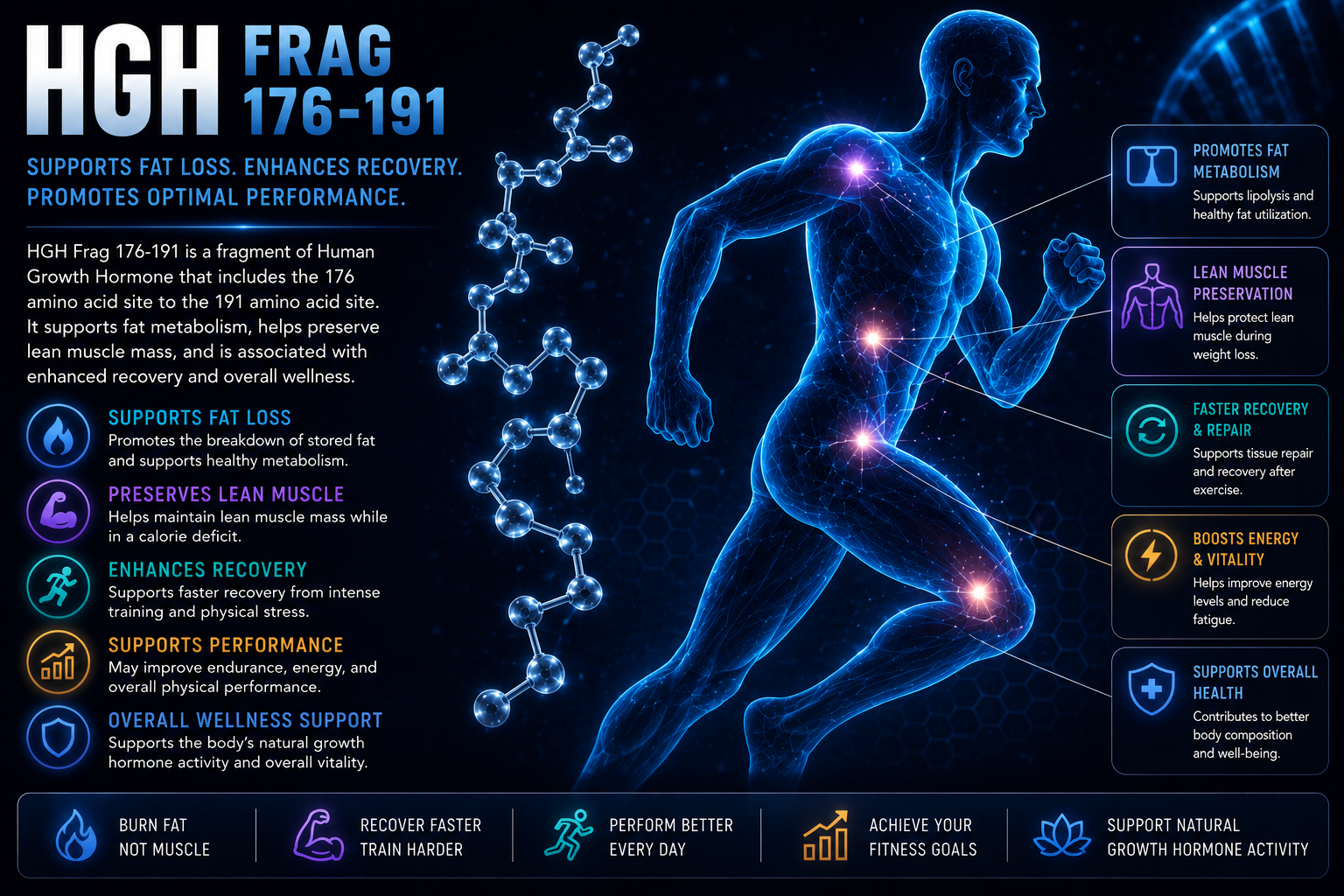
A comprehensive, evidence-graded review of human growth hormone fragment 176–191, a cyclic 16-amino-acid peptide corresponding to the C-terminal region of native human growth hormone and investigated primarily for adipocyte, lipolysis, lipogenesis, glucose, insulin, and metabolic signaling.
What Is HGH Fragment 176–191?
HGH Fragment 176–191, also called somatotropin 176–191 or hGH 176–191, is a synthetic version of the final 16 amino acids of native 191-residue human growth hormone.
16 amino acids
FLRIVQCRSVEGSCGF
Cys7–Cys14
Approximately 1,799.1 Da
Fat-cell metabolism
No
Major research themes
- Lipolysis, or release of stored fatty acids
- Lipogenesis, or storage and synthesis of fat
- Adipocyte metabolism
- Beta-adrenergic signaling
- Glucose and insulin responses
- Separation of metabolic from growth-promoting GH domains
- Analytical distinction from AOD-9604
🧬 Structure, Sequence, and Molecular Properties
🧪 Native hGH 176–191 sequence
H-Phe-Leu-Arg-Ile-Val-Gln-Cys-Arg-Ser-Val-Glu-Gly-Ser-Cys-Gly-Phe-OH
FLRIVQCRSVEGSCGF
| Length | 16 amino acids |
|---|---|
| Molecular formula | C78H123N23O22S2 |
| Average molecular weight | Approximately 1,799.1 g/mol |
| CAS number | 66004-57-7 |
| PubChem CID | 16131230 |
| N terminus | Free phenylalanine amino group |
| C terminus | Free phenylalanine carboxyl group |
| Disulfide bond | Cys7–Cys14 |
| Structure type | Disulfide-cyclized peptide loop with terminal extensions |
Disulfide requirement
The two cysteines form an intramolecular disulfide bridge. Reduced, scrambled, intermolecularly linked, or overoxidized cysteine species may have different conformation, stability, and biological activity.
Free-acid termini
The native fragment has a free N terminus and a free C-terminal carboxyl group. Acetylation, amidation, or other terminal modifications create different molecules.
Salt forms
Commercial material may be supplied as acetate or TFA salt. Gross powder weight can include counterions, water, and residual solvents and therefore does not equal net peptide content.
HGH Fragment 176–191 vs AOD-9604
| Feature | Native hGH Frag 176–191 | AOD-9604 |
|---|---|---|
| Sequence | FLRIVQCRSVEGSCGF | YLRIVQCRSVEGSCGF |
| First residue | Phenylalanine | Tyrosine |
| Construction | Native GH residues 176–191 | Tyr added to hGH residues 177–191 |
| Formula | C₇₈H₁₂₃N₂₃O₂₂S₂ | C₇₈H₁₂₃N₂₃O₂₃S₂ |
| Molecular weight | Approximately 1,799.1 Da | Approximately 1,815.1 Da |
| Human obesity trials | Not established | Yes, but pivotal efficacy was inadequate |
| Interchangeable? | No | |
Why the names are confused
Commercial websites often use HGH Frag 176–191, Tyr-hGH177–191, and AOD-9604 as synonyms. This collapses two distinct sequences into one category.
Evidence-transfer problem
Animal and human results obtained with AOD-9604 should not automatically be assigned to native FLRIVQCRSVEGSCGF.
COA implication
MS/MS sequencing must confirm whether residue 1 is phenylalanine or tyrosine. HPLC purity alone cannot resolve an incorrect identity claim.
Relationship to Full-Length Human Growth Hormone
Parent hormone
Human growth hormone is a 191-amino-acid protein with two disulfide bonds and a molecular weight of approximately 22 kDa.
C-terminal domain hypothesis
Early research proposed that GH’s C-terminal region contained metabolic activity separable from its growth-promoting domain.
Fragment rationale
Researchers synthesized C-terminal peptides to test whether lipolytic or hyperglycemic actions could be retained without full-length GH’s broader receptor-mediated growth effects.
Not simply “mini-HGH”
A 16-residue fragment does not preserve the complete three-dimensional structure or receptor-binding surfaces of full-length GH.
Distinct pharmacology
Any biological activity may occur through different binding partners, membrane effects, adrenergic pathways, or indirect mechanisms rather than classic full-length GH receptor agonism.
📅 Research Timeline
- 1970s: Synthetic C-terminal GH fragments, including residues 176–191, were studied for hyperglycemic and insulin-related effects in animals.
- 1980s–1990s: Researchers explored GH domains associated with fat metabolism and separated them conceptually from growth activity.
- Late 1990s: AOD-9604, the Tyr-hGH177–191 analogue, entered obesity and metabolic development.
- 2000: AOD-9604 metabolic studies were reported in obese Zucker rats.
- 2001: AOD-9604 reduced body weight and fat in obese mice and was linked to beta-adrenergic signaling.
- Early 2000s: Human AOD-9604 obesity trials produced mixed early signals.
- 2007: A pivotal 24-week obesity trial involving more than 500 participants failed to demonstrate sufficient weight loss, and drug development was discontinued.
- 2014: A safety and metabolism review summarized AOD-9604 toxicology and clinical exposure.
- 2022: Native hGH Fragment 176–191 was investigated as part of doxorubicin-loaded nanoparticle research in breast-cancer cells.
- 2026: Native hGH 176–191 remained unapproved, poorly studied in humans, and prohibited under anti-doping rules.
🧠 Proposed Mechanism of Action
1. Adipocyte signaling
The fragment has been investigated for direct or indirect effects on fat cells rather than for classical systemic growth activity.
2. Lipolysis
Preclinical claims center on increased breakdown of stored triglycerides into glycerol and free fatty acids.
3. Lipogenesis inhibition
Experimental literature also describes reduced conversion or storage of nutrients into triglyceride.
4. Adrenergic sensitization
AOD-9604 studies suggested enhanced sensitivity to beta-adrenergic lipolytic signaling, particularly beta-3 pathways in rodent adipose tissue.
5. Unresolved direct target
No universally accepted high-affinity receptor or direct molecular target has been validated for native HGH Frag 176–191.
Lipolysis and Lipogenesis Research
Fat-cell mobilization
Early GH-fragment work suggested that selected C-terminal sequences could influence fatty-acid mobilization.
Animal weight-loss studies
The best-known body-fat reductions were reported with AOD-9604 rather than definitively authenticated native HGH Frag 176–191.
Human translation failure
Although an early AOD-9604 study reported a modest placebo-adjusted weight-loss signal, the larger 24-week trial failed its primary endpoint.
No established localized fat loss
There is no reliable evidence that injecting the fragment near a body area selectively reduces fat in that location.
No proof of clinically meaningful monotherapy
Current evidence does not establish native HGH Frag 176–191 as an effective obesity treatment.
Beta-Adrenergic and Adipocyte Signaling
Beta-3 adrenergic pathway
Rodent AOD-9604 studies linked metabolic effects to beta-3 adrenergic receptor signaling, a pathway involved in adipose lipolysis and thermogenesis.
Species differences
Human adipose tissue differs from rodent tissue in beta-3 receptor expression and physiological importance.
Catecholamine sensitivity
AOD-9604 appeared to increase lipolytic responsiveness in obese mice, but whether native HGH Frag produces the same effect in humans is unknown.
Not a validated receptor agonist
The fragment is not established as a direct selective beta-3 adrenergic receptor agonist.
Glucose and Insulin Research
Early hyperglycemia findings
A 1978 study found that several synthetic GH C-terminal fragments, including hGH 176–191, produced a short-lived increase in blood glucose and a more sustained increase in plasma insulin in rats.
Conflict with modern marketing
Claims that HGH Frag has no glucose or insulin effects are too absolute given these early findings and the limited human evidence.
AOD-9604 safety studies
Later AOD-9604 development generally did not show the same diabetogenic profile as full-length GH, but this cannot prove metabolic neutrality for native fragment products.
Human uncertainty
Effects may vary with dose, route, fasting, diabetes status, insulin sensitivity, concomitant drugs, and product identity.
Growth-Hormone Receptor, IGF-1, and Anabolic Effects
Incomplete receptor-binding structure
HGH Frag lacks most residues required for full-length GH’s normal receptor dimerization and signaling.
IGF-1 claims
AOD-9604 clinical development did not demonstrate the typical IGF-1 elevation associated with full-length GH. Direct human evidence for native HGH Frag remains absent.
Muscle growth
No controlled human evidence establishes HGH Frag 176–191 as anabolic or muscle building.
Linear growth
The fragment is not an approved treatment for childhood growth failure.
Receptor assay needed
A credible mechanistic study should directly test GH receptor binding, receptor phosphorylation, and IGF-1 output rather than infer absence of activity from sequence length alone.
Animal and Preclinical Evidence
Native fragment studies
Early animal studies evaluated glucose and insulin responses to native C-terminal fragments.
AOD-9604 obesity studies
Obese rodent models showed reduced body weight, body fat, and increased lipolytic sensitivity after AOD-9604.
Cell studies
Research has examined adipocytes, metabolic enzymes, adrenergic response, and more recently drug-delivery and cancer-cell systems.
Translation limits
Rodent fat metabolism, receptor expression, dose scaling, and route of administration differ substantially from human obesity biology.
Identity limits
Many secondary summaries fail to specify whether the tested compound was native FLRIVQCRSVEGSCGF or AOD-9604 YLRIVQCRSVEGSCGF.
Human Evidence
Native HGH Frag 176–191
No robust controlled human intervention trial of authenticated native FLRIVQCRSVEGSCGF has been established.
AOD-9604 evidence
Human studies evaluated AOD-9604, a related tyrosine-substituted analogue. Early studies suggested possible short-term weight change, but a pivotal 24-week trial of approximately 536 participants failed to show statistically significant weight loss for the primary endpoint.
Safety data are not efficacy data
AOD-9604 toxicology and clinical exposure reports may inform questions but do not establish effective obesity treatment or prove safety of native HGH Frag injections.
No approved human protocol
There is no FDA-approved dose, route, duration, monitoring plan, or manufacturing specification for HGH Frag 176–191.
Cancer and Cellular Research
Nanoparticle study
A 2022 study incorporated hGH Fragment 176–191 into chitosan nanoparticles containing doxorubicin and reported increased toxicity against MCF-7 breast-cancer cells.
Interpretive limit
This was an in-vitro drug-delivery experiment, not evidence that HGH Frag itself treats cancer.
Growth-factor context
Because the fragment derives from a growth hormone, direct receptor, proliferation, and survival effects should be evaluated rather than assumed absent.
No oncology indication
HGH Frag 176–191 is not an approved cancer drug, chemotherapy enhancer, or preventive therapy.
Major Evidence Limitations
- Native HGH Frag and AOD-9604 are routinely confused
- Direct human evidence for native FLRIVQCRSVEGSCGF is essentially absent
- Most obesity evidence belongs to AOD-9604
- AOD-9604’s pivotal obesity trial failed
- No validated direct receptor has been established for native fragment action
- Mechanistic claims rely heavily on rodent adipose biology
- Early glucose and insulin findings complicate “metabolically neutral” claims
- No established human pharmacokinetic profile for native fragment
- No approved dose, route, duration, or monitoring framework
- No established long-term cardiovascular, glucose, immune, or cancer safety
- Commercial products may contain AOD-9604 while labeled as HGH Frag, or vice versa
- No FDA-reviewed finished-product specification exists
FDA and Anti-Doping Status
FDA approval
HGH Fragment 176–191 is not FDA approved for any therapeutic indication.
Unapproved drug status
Products marketed for treating obesity, fat loss, or disease without an approved application may be considered unapproved new drugs.
AOD-9604 distinction
AOD-9604’s historical food-ingredient or GRAS-related discussions do not equal FDA approval as an injectable drug and do not transfer to native HGH Fragment 176–191.
WADA prohibition
The World Anti-Doping Agency prohibits growth hormone, its analogues, and its fragments. WADA materials explicitly identify AOD-9604 and hGH 176–191 as prohibited examples.
Research-use labeling
A research-use label does not establish human safety, approved clinical use, or sports compliance.
Potential Side Effects and Safety Considerations
No established native-fragment safety profile
The absence of controlled human exposure data prevents reliable estimates of adverse-event frequency or severity.
Potential metabolic effects
- Transient glucose elevation
- Insulin changes
- Possible effects on fatty-acid mobilization
- Unknown interactions with diabetes drugs
- Unknown effects during fasting or intense exercise
Injection and immune risks
- Injection-site pain, redness, swelling, or infection
- Hypersensitivity
- Anti-peptide antibodies
- Endotoxin or microbial contamination
- Particulates
Disulfide and impurity risks
Reduced peptide, scrambled disulfides, intermolecular dimers, cysteine overoxidation, sequence errors, and incorrect AOD-versus-native identity may change activity and immunogenicity.
Growth and cancer uncertainty
Although the fragment is not expected to reproduce full-length GH signaling, direct long-term human data addressing proliferation, neoplasia, organ growth, or IGF pathways are insufficient.
Pregnancy and pediatric use
Reproductive, developmental, pediatric, and pregnancy safety have not been established.
🧪 Laboratory Testing Methods
| Method | Purpose | Important limitation |
|---|---|---|
| RP-HPLC / UPLC | Separates intact fragment from deletions, epimers, oxidation products, reduced peptide, and dimers | Area purity does not prove sequence or correct disulfide |
| LC-HRMS | Confirms native-fragment mass near 1,799.1 Da | Does not alone prove residue order or disulfide pairing |
| LC-MS/MS peptide mapping | Confirms FLRIVQCRSVEGSCGF sequence | Disulfide-linked fragmentation requires specialized methods |
| Residue-1 identity assay | Distinguishes Phe-native fragment from Tyr-AOD-9604 | HPLC retention alone may be insufficient |
| Disulfide mapping | Confirms Cys7–Cys14 intramolecular linkage | Requires nonreducing digestion or specialized MS |
| Reduced-peptide assay | Measures free-thiol, noncyclized material | Sample preparation can reduce disulfides |
| Scrambled-disulfide assay | Detects incorrect cysteine pairing or intermolecular linkage | Only two cysteines simplify but do not eliminate dimer risk |
| Free-thiol assay | Measures unpaired cysteine | Low-level thiols may require sensitive fluorescence or MS |
| Dimer and oligomer assay | Measures intermolecular disulfide products | SEC can have limited resolution for small peptides |
| Chiral amino-acid analysis | Detects epimers and D-amino-acid contamination | Hydrolysis can introduce racemization artifacts |
| Terminal-group analysis | Confirms free N and C termini | Terminal variants may require orthogonal methods |
| Net peptide-content assay | Measures actual free-base fragment content | Must correct for water, acetate, TFA, and salts |
| Counterion assay | Measures acetate or TFA | Gross vial weight may overstate active peptide |
| Residual-solvent testing | Measures synthesis and purification solvents | Does not establish potency |
| Cysteine-oxidation panel | Measures sulfenic, sulfinic, sulfonic, and mixed-disulfide species | Oxidation can occur during handling |
| Adipocyte lipolysis assay | Measures glycerol or free-fatty-acid release | Cell response does not establish human weight loss |
| Lipogenesis assay | Measures triglyceride synthesis or lipid accumulation | Results depend strongly on cell model |
| Beta-adrenergic interaction assay | Tests catecholamine sensitization and receptor dependence | Rodent beta-3 biology differs from humans |
| GH-receptor assay | Evaluates direct receptor binding and phosphorylation | Negative results must include validated positive controls |
| IGF-1 output assay | Evaluates downstream growth-axis activity | Cell and animal results may not predict humans |
| Glucose and insulin-response assay | Evaluates metabolic off-target effects | Requires appropriate integrated models |
| Sterility, endotoxin, and particles | Required for finished injectable evaluation | Raw peptide purity cannot establish injectable safety |
| Stability-indicating assay | Tracks reduction, disulfide exchange, oxidation, clipping, aggregation, adsorption, and potency loss | Requires validated forced-degradation and real-time studies |
📄 How to Interpret an HGH Frag 176–191 COA
- Confirm the exact native sequence: FLRIVQCRSVEGSCGF.
- Confirm phenylalanine—not tyrosine—at residue 1.
- Verify formula C₇₈H₁₂₃N₂₃O₂₂S₂.
- Verify molecular weight near 1,799.1 Da.
- Confirm the Cys7–Cys14 intramolecular disulfide bond.
- Measure reduced, scrambled, and intermolecular-disulfide species.
- Use MS/MS sequence mapping rather than intact mass alone.
- Confirm all amino acids have the intended L stereochemistry.
- Confirm free N- and C-terminal groups.
- Measure deletion peptides, epimers, cysteine oxidation, and dimers.
- State free base versus acetate or TFA salt.
- Report net peptide content after correcting for counterions and water.
- Use adipocyte lipolysis and lipogenesis assays when metabolic potency is claimed.
- Include direct GH-receptor and IGF-1 pathway testing rather than assuming no activity.
- For finished injectables, require sterility, endotoxin, particles, pH, osmolality, fill accuracy, container closure, and post-reconstitution stability.
- Do not use AOD-9604 reference standards or clinical data as though they prove native-fragment identity or efficacy.
- A COA does not establish FDA approval, human safety, or clinical effectiveness.
📊 Comparison Tables
HGH Frag 176–191 vs AOD-9604
| Feature | HGH Frag 176–191 | AOD-9604 |
|---|---|---|
| Sequence | FLRIVQCRSVEGSCGF | YLRIVQCRSVEGSCGF |
| Residue 1 | Phe | Tyr |
| Molecular weight | ~1,799.1 Da | ~1,815.1 Da |
| Human obesity trials | Not established | Yes; pivotal efficacy failed |
| FDA approved | No | No |
HGH Frag vs Full-Length HGH
| Feature | HGH Frag 176–191 | Full-length hGH |
|---|---|---|
| Length | 16 aa | 191 aa |
| Main research focus | Fat-cell metabolism | Growth, IGF-1, metabolism, body composition |
| GH-receptor activation | Not established as full agonist | Strong canonical agonist |
| Approved products | No | Yes, for specific GH-deficiency and growth indications |
HGH Frag vs GLP-1-Based Obesity Medicines
| Feature | HGH Frag 176–191 | Approved GLP-1 / incretin medicines |
|---|---|---|
| Target | Unresolved metabolic pathway | Defined incretin receptor pathways |
| Human efficacy | Not established | Demonstrated in large controlled trials |
| Approved obesity indication | No | Yes, product dependent |
| Long-term outcome data | Absent | Substantial and expanding |
Basic Product Claim vs Research-Qualified Material
| Attribute | Basic “HGH Frag” claim | Research-qualified native fragment |
|---|---|---|
| Identity | Name only | FLRIVQCRSVEGSCGF by MS/MS |
| AOD distinction | Often ignored | Residue-1 Phe confirmed |
| Structure | Parent mass | Cys7–Cys14 disulfide mapped |
| Content | Gross vial weight | Net peptide corrected for water and counterions |
| Potency | Often untested | Lipolysis, lipogenesis, and receptor-pathway assays |
🖼️ Original Diagram Specifications
- Sequence identity: Native FLRIVQCRSVEGSCGF versus AOD YLRIVQCRSVEGSCGF with residue 1 highlighted.
- Parent-protein map: Full 191-aa hGH with residues 176–191 highlighted at the C terminus.
- Disulfide structure: Cys7–Cys14 loop with free N and C termini.
- Proposed metabolic pathway: Adipocyte, catecholamine signaling, lipolysis, fatty-acid release, and lipogenesis.
- Evidence timeline: Early native-fragment animal studies, AOD rodent work, human AOD trial failure, and current status.
- Evidence pyramid: Chemistry and animal data, limited native-fragment cellular work, absent human native-fragment trials.
- COA workflow: Phe-versus-Tyr identity, sequence, disulfide mapping, net content, potency, sterility, and stability.
❓ Frequently Asked Questions
Is HGH Fragment 176–191 a peptide?
Yes. It is a cyclic 16-amino-acid fragment of human growth hormone.
What is the exact native sequence?
FLRIVQCRSVEGSCGF.
What is its molecular formula?
C₇₈H₁₂₃N₂₃O₂₂S₂.
What is its molecular weight?
Approximately 1,799.1 Da.
Does it contain a disulfide bond?
Yes. Cys7 and Cys14 form an intramolecular disulfide bond.
Is HGH Frag the same as AOD-9604?
No. Native HGH Frag begins with phenylalanine; AOD-9604 begins with tyrosine.
Why are the names often used interchangeably?
Both represent closely related C-terminal GH sequences, but commercial and secondary sources often fail to preserve the residue-1 distinction.
Is HGH Frag FDA approved?
No.
Is it approved for weight loss?
No.
Does it burn fat?
Preclinical studies support a metabolic hypothesis, mainly using AOD-9604, but clinically meaningful human fat loss from native HGH Frag has not been established.
Did AOD-9604 work in human obesity trials?
Early results were mixed, and a pivotal 24-week trial failed to show sufficient statistically significant weight loss.
Does HGH Frag raise IGF-1?
Direct human evidence for the native fragment is absent. It should not be assumed completely inactive without receptor and IGF-pathway testing.
Can it affect glucose?
Early animal research found transient hyperglycemia and sustained insulin elevation with hGH 176–191.
Is it anabolic?
No controlled human evidence establishes muscle-building effects.
Is it prohibited in sport?
Yes. WADA prohibits growth-hormone fragments, including hGH 176–191.
Does 99% HPLC purity prove it is native HGH Frag?
No. Residue-1 identity, full sequence, disulfide mapping, stereochemistry, content, potency, sterility, and stability must also be verified.
Final Thoughts
HGH Fragment 176–191 is the native 16-residue C-terminal segment of human growth hormone, with the sequence FLRIVQCRSVEGSCGF and a Cys7–Cys14 disulfide bond. It was investigated to determine whether selected metabolic actions of GH could be separated from the full protein’s growth-promoting activity.
The most important interpretive issue is the distinction from AOD-9604. AOD-9604 begins with tyrosine and has a molecular mass 16 Da higher than the native phenylalanine-containing fragment. Most modern obesity and lipolysis claims trace back to AOD-9604 studies, not authenticated native HGH Frag 176–191.
Preclinical research suggests possible effects on lipolysis, lipogenesis, adrenergic sensitivity, glucose, and insulin. However, no robust human intervention evidence establishes native HGH Frag as an effective weight-loss treatment. AOD-9604 itself failed to achieve sufficient efficacy in a large pivotal obesity trial.
Analytical authentication requires the exact FLRIVQCRSVEGSCGF sequence, phenylalanine at residue 1, free terminal groups, the Cys7–Cys14 intramolecular disulfide, correct stereochemistry, counterion-corrected content, degradation profiling, metabolic potency assays, and route-specific microbiological quality. HGH Frag 176–191 remains unapproved and prohibited in competitive sport.
📚 References
- PubChem. Somatotropin (176–191), CID 16131230.
- PubChem. HGH Fragment 176–191 Acetate, CID 172966176.
- PubChem. AOD-9604, CID 71300630.
- Ng FM, et al. Hyperglycemic Action of Synthetic C-Terminal Fragments of Human Growth Hormone. Hormone and Metabolic Research. 1978.
- Ng FM, et al. Metabolic Studies of a Synthetic Lipolytic Domain of Human Growth Hormone, AOD-9604, in Obese Zucker Rats. Hormone Research. 2000.
- Heffernan MA, et al. The Effects of Human Growth Hormone and Its Lipolytic Fragment AOD-9604 on Lipolysis and Beta-3-Adrenergic Receptors in Obese Mice. Endocrinology. 2001.
- Moré MI, et al. Safety and Metabolism of AOD9604, a Novel Nutraceutical Ingredient for Improved Metabolic Health. Journal of Endocrinology and Metabolism. 2014.
- Misra M. Obesity Pharmacotherapy: Current Perspectives and Future Directions. Current Cardiology Reviews. 2013.
- Habibullah MM, et al. Human Growth Hormone Fragment 176–191 Peptide Enhances the Toxicity of Doxorubicin-Loaded Chitosan Nanoparticles Against MCF-7 Breast Cancer Cells. Drug Design, Development and Therapy. 2022.
- World Anti-Doping Agency. Prohibited List: Growth Hormone, Its Analogues and Fragments.
- World Anti-Doping Agency. 2026 Prohibited List.
- USADA. Athlete Guidance on the 2026 WADA Prohibited List.
- U.S. Food and Drug Administration. Certain Bulk Drug Substances for Use in Compounding That May Present Significant Safety Risks.
- U.S. Food and Drug Administration. Warning Letters Concerning Unapproved Peptide Products.
- International Council for Harmonisation. ICH Q1A(R2), Q2(R2), Q3A, Q3B, Q3C, and Q6B.
- United States Pharmacopeia General Chapters <621>, <71>, <85>, and <788>.
Sequence, chemistry, AOD-9604 distinction, evidence, regulatory status, safety, and analytical recommendations reviewed in July 2026.