Ipamorelin: What It Is, How It Works, Benefits, and Research Overview
A comprehensive, evidence-graded review of ipamorelin, a synthetic five-residue ghrelin-receptor agonist developed to stimulate endogenous growth-hormone release with greater endocrine selectivity than older growth hormone-releasing peptides.
What Is Ipamorelin?
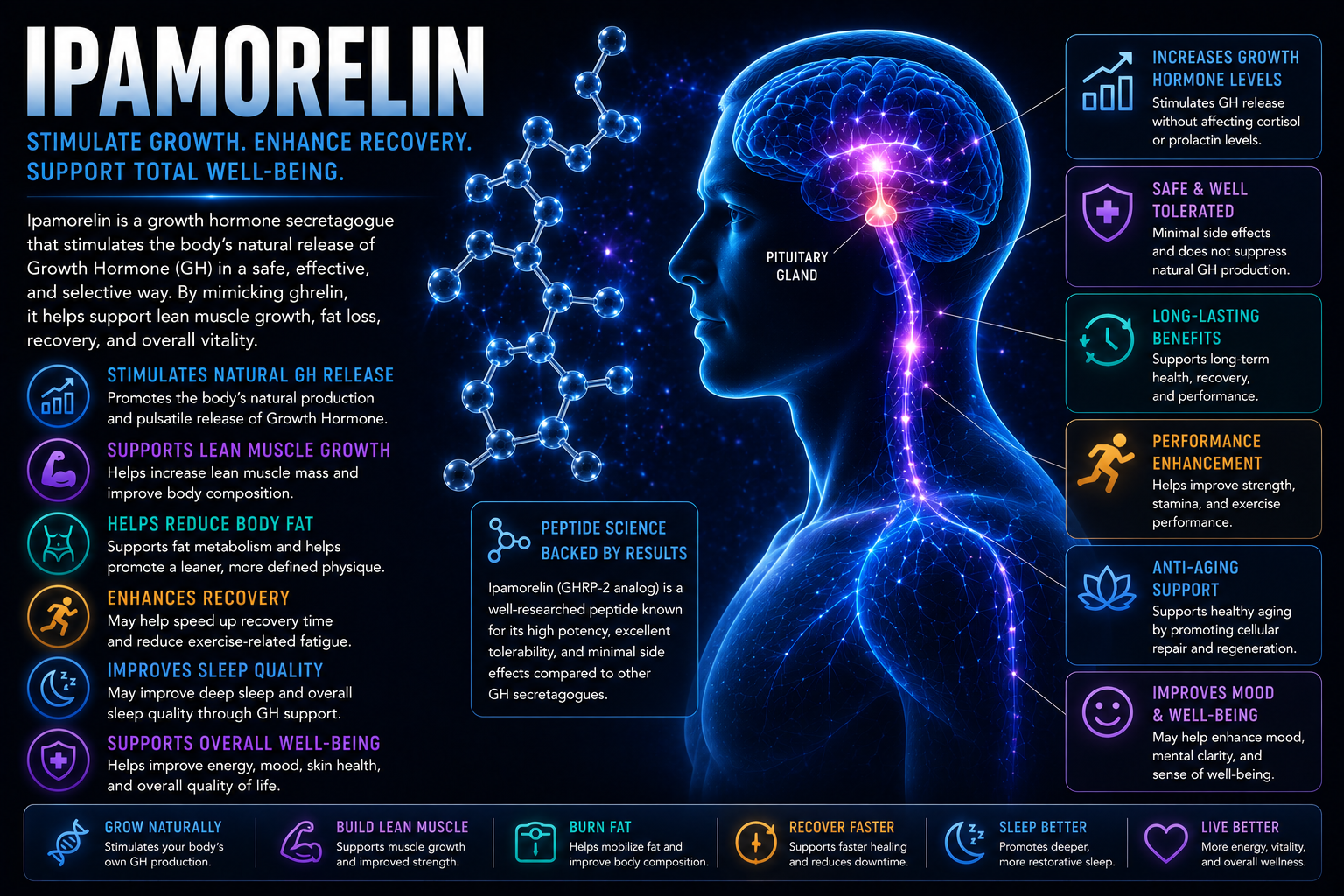
Ipamorelin is a synthetic pentapeptide that mimics selected growth-hormone-releasing effects of ghrelin. It binds the growth hormone secretagogue receptor type 1a, abbreviated GHSR-1a, and stimulates growth-hormone release from the pituitary.
5 residues
GHSR-1a
Growth-hormone release
IGF-1
Approximately 711.9 Da
No
Common research themes
- Pituitary growth-hormone release
- Ghrelin-receptor signaling
- GH pulse amplitude
- Growth and bone models
- Gastrointestinal motility
- Postoperative ileus
- Body composition and recovery claims
- Combination research with GHRH analogues
🧬 Structure, Sequence, and Molecular Properties
🧪 Amino-acid sequence
H-Aib-His-D-2-Nal-D-Phe-Lys-NH₂
| Length | 5 residues |
|---|---|
| Molecular formula | C38H49N9O5 |
| Average molecular weight | Approximately 711.9 g/mol |
| Exact mass | Approximately 711.386 Da |
| CAS number | 170851-70-4 |
| PubChem CID | 9831659 |
| C terminus | Amidated lysine |
| Disulfide bonds | None |
| Common salt form | Ipamorelin acetate |
Unnatural residues
- Aib: Alpha-aminoisobutyric acid, a sterically hindered nonproteinogenic amino acid
- D-2-Nal: D-2-naphthylalanine, a bulky aromatic D-amino acid
- D-Phe: D-phenylalanine
Why stereochemistry matters
Replacing a D residue with the L form, using 1-naphthylalanine instead of 2-naphthylalanine, omitting amidation, or introducing epimers can change receptor affinity, selectivity, degradation, and potency even when total mass is similar.
Acetate correction
Commercial material is commonly supplied as an acetate salt. A credible content result must correct gross powder weight for acetate, water, and other nonpeptide mass.
Why Was Ipamorelin Developed?
Older GHRP limitations
Growth hormone-releasing peptides such as GHRP-2 and GHRP-6 can stimulate GH but may also increase ACTH, cortisol, prolactin, or appetite.
Greater GH selectivity
Ipamorelin emerged from a medicinal-chemistry program seeking strong GH release with fewer off-target endocrine effects.
Protease resistance
Aib and D-amino acids improve resistance to enzymatic degradation compared with ordinary short peptides.
Ghrelin mimetic without native ghrelin structure
Ipamorelin is not a fragment of ghrelin and does not contain ghrelin’s octanoylated serine. It is a compact receptor agonist designed to reproduce selected ghrelin-receptor activity.
📅 Discovery and Research Timeline
- 1996: The growth hormone secretagogue receptor was cloned and characterized.
- 1998: Ipamorelin was described as the first selective growth-hormone secretagogue in a series lacking the central Ala-Trp motif of GHRP-1.
- 1999: Animal research reported potent GH release, increased body weight, and increased longitudinal bone growth.
- 1999: A human dose-escalation study characterized intravenous pharmacokinetics and growth-hormone response.
- 2000s: Research expanded into gastrointestinal motility and postoperative ileus.
- 2008–2010s: Intravenous clinical development for postoperative ileus did not establish an approved indication.
- 2010s–2020s: Ipamorelin became widely marketed in compounding and research settings for unapproved body-composition, sleep, and recovery claims.
- October 2024: FDA’s Pharmacy Compounding Advisory Committee reviewed ipamorelin-related substances and voted against inclusion on the 503A Bulks List.
- 2026: FDA continued to identify significant safety risks for compounded ipamorelin; WADA continued to prohibit ipamorelin.
🧠 How Does Ipamorelin Work?
1. GHSR-1a activation
GHSR-1a is the active ghrelin receptor expressed in the hypothalamus, pituitary, gastrointestinal tract, and other tissues.
2. Calcium signaling
Receptor activation increases intracellular calcium, supporting exocytosis of stored growth hormone.
3. Interaction with GHRH
GHSR activation can amplify GHRH-driven GH release and may reduce functional somatostatin inhibition.
4. Pulsatile output
Ipamorelin creates a discrete GH response rather than directly supplying recombinant GH.
5. Downstream IGF-1
Repeated GH pulses may increase hepatic and tissue IGF-1, although human long-term ipamorelin data are limited.
🎯 GHSR-1a Receptor Profile
| Target | Relationship | Potential effect |
|---|---|---|
| GHSR-1a | Primary direct target | GH release, gastrointestinal and neuroendocrine signaling |
| GHRH receptor | No direct agonism | Complementary pathway when combined with GHRH analogues |
| Growth-hormone receptor | Indirectly activated by released GH | JAK2/STAT5 signaling |
| IGF-1 receptor | Indirectly activated by increased IGF-1 | Growth, metabolic, and mitogenic signaling |
Constitutive receptor activity
GHSR-1a displays significant activity even without ligand. Agonists can alter a receptor system that already has baseline signaling, complicating dose-response interpretation.
Broad tissue distribution
GHSR-related signaling extends beyond the pituitary and may influence appetite, motility, glucose physiology, autonomic function, reward pathways, and cardiovascular biology.
Endocrine Selectivity
Animal findings
The original development paper reported potent GH release with little ACTH or cortisol response compared with GHRP-2 and GHRP-6 in animal models.
Prolactin and other hormones
Ipamorelin is often described as having less prolactin and ACTH activity than older GHRPs, but comprehensive modern human endocrine profiling is limited.
Appetite effects
It may produce less appetite stimulation than ghrelin or GHRP-6, but absence of appetite effect has not been established across doses, routes, and populations.
Selective does not mean risk free
A more selective GH response does not eliminate glucose, growth, cardiac, fluid-retention, immunogenicity, or gastrointestinal risks.
Growth Hormone and IGF-1 Axis
Normal regulation
GHRH stimulates GH, somatostatin inhibits GH, and ghrelin-receptor activity amplifies release. GH and IGF-1 feed back to limit the axis.
Dependence on pituitary reserve
Ipamorelin requires functioning somatotroph cells and is not equivalent to recombinant GH replacement.
Pulse timing
The GH response depends on dose, infusion rate, endogenous GHRH, somatostatin tone, age, nutritional status, sex, sleep, and pituitary health.
Potential IGF-1 elevation
Repeated secretagogue exposure may elevate IGF-1, creating anabolic and metabolic effects along with mitogenic and glucose-related concerns.
Human Pharmacokinetics and Growth-Hormone Response
Dose-escalation design
A 1999 study administered five intravenous infusion rates to groups of healthy male volunteers and measured ipamorelin and GH concentrations.
Linear pharmacokinetics
Systemic exposure increased approximately in proportion to dose.
Terminal half-life
The model estimated a terminal half-life of roughly two hours after intravenous administration.
GH peak timing
The growth-hormone response peaked approximately 0.67 hours after the infusion began.
Short human observation window
This study established acute pharmacology, not chronic safety, body-composition benefit, recovery, sleep improvement, or optimal subcutaneous use.
Postoperative Ileus and Gastrointestinal Development
Why it was studied
Ghrelin-receptor agonism can influence gastrointestinal motility, making ipamorelin a candidate for postoperative ileus.
Clinical route
Development used intravenous administration, which differs from common compounded subcutaneous marketing.
Effectiveness outcome
The program did not establish sufficient clinical effectiveness for FDA approval.
FDA-reviewed safety findings
FDA briefing materials describe adverse events including:
- Hypokalemia
- Hyperglycemia
- Insomnia
- Nausea
- Vomiting
- Abdominal distention
- Serious adverse events and deaths in treated subjects, with uncertain causality for the deaths
Translation limitation
Failure in postoperative ileus does not prove ineffectiveness for every biological question, but it provides important human safety information that should not be omitted from research summaries.
Growth, Bone, and Animal Research
Longitudinal bone growth
Rat studies reported dose-dependent increases in longitudinal bone growth after repeated administration.
Body-weight gain
Animal studies also reported increased body weight, consistent with GH-axis activation.
Bone-turnover rationale
GH and IGF-1 regulate osteoblast activity, bone remodeling, and longitudinal growth.
Human osteoporosis claims
No robust clinical evidence establishes ipamorelin as a safe or effective osteoporosis or fracture-healing treatment.
Pediatric concern
A growth-promoting signal should not be used in children outside formal pediatric endocrine research and approved medical care.
Body Composition, Muscle, and Recovery Claims
Biological rationale
GH and IGF-1 influence protein synthesis, connective tissue, lipolysis, muscle, and bone.
Human evidence gap
No controlled trial establishes ipamorelin monotherapy as effective for increasing muscle, reducing body fat, accelerating injury recovery, or improving athletic performance.
Hormone response versus outcome
An acute rise in GH does not prove sustained increases in strength, functional muscle, collagen quality, or health.
Combination products
Ipamorelin is commonly combined with CJC-1295, Modified GRF 1-29, sermorelin, or tesamorelin, but these blends lack validated dosing ratios and direct outcome trials.
Glucose tradeoff
Any anabolic or lipolytic effects may be accompanied by reduced insulin sensitivity or hyperglycemia.
Sleep and Nocturnal Growth-Hormone Research
Natural nocturnal GH
The largest physiologic GH pulses often occur during early slow-wave sleep.
Timing rationale
Commercial protocols often time secretagogues near bedtime to align with nocturnal physiology, but this is not a validated approved treatment strategy.
No insomnia indication
Ipamorelin has not been proven to improve sleep quality, insomnia, circadian rhythm, or sleep architecture.
Insomnia signal
Insomnia was among adverse events noted in intravenous clinical development.
Sleep-apnea concern
Chronic GH and IGF-1 elevation may contribute to soft-tissue growth and potentially worsen obstructive sleep apnea in susceptible individuals.
Appetite, Gastric Motility, and Broader Ghrelin Biology
Ghrelin receptor biology
Native ghrelin affects hunger, reward, gastric motility, glucose, autonomic regulation, and GH release.
Ipamorelin is not identical to ghrelin
Its receptor bias and compact structure may produce a different activity profile than endogenous acyl-ghrelin.
Motility effects
GHSR agonism provides a mechanistic basis for gastrointestinal-motility research.
Appetite uncertainty
Claims that ipamorelin never increases hunger are stronger than the available human evidence supports.
Glucose complexity
Ghrelin-receptor agonism and GH release can each influence glucose regulation, sometimes in opposing or context-dependent ways.
Human Evidence
What human research establishes
- Intravenous ipamorelin produces a dose-related GH response
- Acute pharmacokinetics are approximately dose proportional
- The estimated intravenous terminal half-life is roughly two hours
- Clinical gastrointestinal development generated important safety data
What human research does not establish
- Long-term subcutaneous safety
- Effective treatment for GH deficiency
- Improved muscle mass or strength
- Clinically meaningful fat loss
- Improved sleep
- Accelerated injury recovery
- Anti-aging or longevity benefit
- Safe combination with GHRH analogues
Major Evidence Limitations
- Very limited modern human research
- Human studies primarily used intravenous administration
- No FDA-approved indication
- No validated subcutaneous dosing regimen
- No established long-term pharmacokinetics
- No controlled monotherapy trial for body composition or recovery
- Animal endocrine selectivity may not fully translate to humans
- GHSR signaling extends beyond GH release
- Long-term IGF-1, glucose, cardiac, and cancer risks are uncertain
- Commercial products may contain incorrect stereochemistry or impurities
- No FDA-reviewed current finished-product specification exists
FDA, Compounding, and Anti-Doping Status
FDA approval
Ipamorelin is not FDA approved for any indication.
503A review
FDA evaluated ipamorelin free base and acetate for proposed uses including growth-hormone deficiency and postoperative ileus. The Pharmacy Compounding Advisory Committee voted against inclusion on the 503A Bulks List.
FDA safety concerns
FDA cites aggregation, immunogenicity, peptide-related impurities, unnatural-amino-acid characterization, insufficient evidence of effectiveness, hyperglycemia, hypokalemia, serious adverse events, and inadequate safety information.
WADA prohibition
The 2026 World Anti-Doping Agency Prohibited List explicitly names ipamorelin among prohibited growth-hormone secretagogues and ghrelin mimetics.
Research-use labeling
A research-use label does not establish human safety, legal clinical use, or anti-doping compliance.
Potential Side Effects and Safety Considerations
Observed or FDA-identified concerns
- Hyperglycemia
- Hypokalemia
- Nausea and vomiting
- Abdominal distention
- Insomnia
- Serious adverse events in intravenous development
- Potential immunogenicity from aggregates or impurities
Growth-axis risks
- Elevated IGF-1
- Edema and fluid retention
- Arthralgia and myalgia
- Carpal-tunnel-type symptoms
- Headache
- Soft-tissue growth
- Potential worsening of sleep apnea
Glucose risk
Growth hormone can reduce insulin sensitivity, and hyperglycemia occurred in clinical development.
Malignancy concern
GH and IGF-1 activate growth and survival pathways. Chronic secretagogue use may be inappropriate in active malignancy or significant oncologic risk.
Cardiovascular and autonomic uncertainty
GHSR signaling can influence heart rate, blood pressure, autonomic tone, and vascular physiology. Long-term human cardiovascular safety is not established.
Product-quality risks
- Incorrect Aib or naphthylalanine identity
- D/L stereochemistry errors
- Nonamidated peptide
- Deletion peptides and epimers
- Aggregation
- Incorrect acetate-corrected content
- Endotoxin, microbial contamination, or particles
🧪 Laboratory Testing Methods
| Method | Purpose | Important limitation |
|---|---|---|
| RP-HPLC / UPLC | Separates intact ipamorelin from deletion peptides, epimers, and synthesis impurities | Area purity does not prove sequence or stereochemistry |
| LC-HRMS | Confirms intact mass near 711.9 Da | Isomers and epimers can share the same mass |
| MS/MS peptide mapping | Confirms Aib-His-D-2-Nal-D-Phe-Lys order | Unnatural residues require validated fragmentation interpretation |
| Chiral amino-acid analysis | Confirms D-2-Nal and D-Phe | Hydrolysis may create racemization artifacts |
| Aib identity assay | Confirms alpha-aminoisobutyric acid | Requires authentic standards |
| 2-Nal positional-isomer assay | Distinguishes 2-naphthylalanine from 1-naphthylalanine | Parent mass alone cannot distinguish them |
| C-terminal amidation assay | Confirms Lys-NH₂ rather than free acid | Requires adequate chromatographic or MS resolution |
| N-terminal identity assay | Confirms free Aib N terminus | Only evaluates terminal integrity |
| Net peptide-content assay | Measures actual free-base ipamorelin | Must correct for acetate, water, and excipients |
| Acetate assay | Measures counterion content | Acetate stoichiometry may vary |
| Residual-solvent testing | Measures synthesis and purification solvents | Does not establish potency |
| SEC-HPLC / DLS | Measures aggregates and particles | Very small peptide size can challenge SEC resolution |
| Deletion and epimer panel | Measures failed-sequence and stereochemical impurities | Reference standards may be required |
| GHSR-1a binding assay | Measures receptor affinity | Binding does not prove full agonist signaling |
| Calcium-flux assay | Measures Gq-linked receptor activation | Cell background affects response |
| IP1 / inositol-phosphate assay | Measures downstream GHSR signaling | Constitutive receptor activity complicates interpretation |
| Beta-arrestin assay | Evaluates receptor recruitment and signaling bias | Relevance to GH release requires correlation |
| Pituitary GH-release assay | Measures endocrine potency | Cell or animal systems may not predict human pulses |
| ACTH, cortisol, and prolactin selectivity panel | Evaluates claimed endocrine selectivity | In-vitro systems may not reproduce whole-body feedback |
| Aggregation and immunogenicity assessment | Evaluates immune-risk signals | Predictive assays remain imperfect |
| Sterility, endotoxin, and particles | Required for finished injectable evaluation | Raw peptide purity does not establish injectable safety |
| Stability-indicating assay | Tracks hydrolysis, epimerization, deamidation, aggregation, adsorption, and potency loss | Requires validated forced-degradation and real-time studies |
📄 How to Interpret an Ipamorelin COA
- Confirm the exact sequence: Aib-His-D-2-Nal-D-Phe-Lys-NH₂.
- Confirm molecular formula C₃₈H₄₉N₉O₅.
- Verify molecular weight near 711.9 Da.
- Use MS/MS sequencing rather than intact mass alone.
- Confirm Aib identity.
- Confirm D-2-Nal and distinguish it from D-1-Nal.
- Confirm D-Phe stereochemistry.
- Confirm C-terminal Lys amidation.
- Measure epimers, deletion peptides, and nonamidated material.
- State free base versus acetate salt.
- Report net free-base peptide content after correcting for acetate and water.
- Measure aggregates and particulate matter.
- Use GHSR-1a binding plus calcium or IP1 functional assays.
- Include a pituitary GH-release assay when endocrine potency is claimed.
- Evaluate ACTH, cortisol, and prolactin selectivity rather than assuming it.
- For finished injectables, require sterility, endotoxin, particles, pH, osmolality, fill accuracy, container closure, and post-reconstitution stability.
- A COA does not establish FDA approval, clinical effectiveness, or suitability for human administration.
📊 Comparison Tables
Ipamorelin vs GHRP-2 vs GHRP-6 vs Hexarelin
| Feature | Ipamorelin | GHRP-2 | GHRP-6 | Hexarelin |
|---|---|---|---|---|
| Primary target | GHSR-1a | GHSR-1a | GHSR-1a | GHSR-1a |
| Main design claim | Greater GH selectivity | Potent GH release | GH release plus appetite | Very potent GH release |
| ACTH/cortisol effect | Lower in early animal work | More likely | More likely | Can occur |
| FDA approved | No | No | No | No |
Ipamorelin vs Macimorelin vs Ghrelin
| Feature | Ipamorelin | Macimorelin | Native ghrelin |
|---|---|---|---|
| Type | Peptide GHSR agonist | Oral small-molecule GHSR agonist | Endogenous acylated peptide hormone |
| Main use | Investigational | Approved adult GH-deficiency diagnostic | Physiologic signaling |
| FDA approved | No | Yes, diagnostic use | Not a drug product |
| Appetite signaling | Uncertain/less prominent | Not primary approved purpose | Strong physiologic role |
Ipamorelin vs Sermorelin vs CJC-1295
| Feature | Ipamorelin | Sermorelin | CJC-1295 |
|---|---|---|---|
| Primary receptor | GHSR-1a | GHRHR | GHRHR |
| Pathway | Ghrelin mimetic | GHRH fragment | Stabilized GHRH analogue |
| Duration | Short | Short | Long with DAC |
| Current FDA approval | No | No marketed approved product | No |
Research-Grade Ipamorelin vs Approved Macimorelin
| Attribute | Research-grade ipamorelin | Macimorelin |
|---|---|---|
| Molecule | Unapproved synthetic pentapeptide | Approved oral small molecule |
| Clinical purpose | None approved | Diagnosis of adult GH deficiency |
| Manufacturing | Variable research specifications | FDA-reviewed pharmaceutical manufacturing |
| Interchangeable? | No | |
🖼️ Original Diagram Specifications
- Peptide architecture: Aib-His-D-2-Nal-D-Phe-Lys-NH₂ with unnatural residues and stereochemistry highlighted.
- GHSR pathway: Hypothalamic-pituitary receptor, calcium signaling, GH pulse, liver IGF-1, and peripheral tissues.
- Selectivity comparison: Ipamorelin versus GHRP-2, GHRP-6, and hexarelin for GH, ACTH, cortisol, prolactin, and appetite.
- Human evidence timeline: Healthy-volunteer pharmacology, postoperative-ileus development, FDA review, and current unapproved status.
- Evidence pyramid: Receptor and animal data, small acute human studies, absent long-term outcome trials.
- Risk map: Hyperglycemia, hypokalemia, GI symptoms, insomnia, elevated IGF-1, malignancy, and immunogenicity.
- COA workflow: Sequence, Aib, D-2-Nal, D-Phe, amidation, receptor potency, sterility, and stability.
❓ Frequently Asked Questions
Is ipamorelin a peptide?
Yes. It is a synthetic five-residue peptide.
What is the exact sequence?
Aib-His-D-2-Nal-D-Phe-Lys-NH₂.
What is its molecular formula?
C₃₈H₄₉N₉O₅.
What is its molecular weight?
Approximately 711.9 Da.
What receptor does ipamorelin activate?
The growth hormone secretagogue receptor type 1a, also called the ghrelin receptor.
Is ipamorelin FDA approved?
No.
Does ipamorelin increase growth hormone?
Yes. Acute intravenous studies in healthy men demonstrated a dose-related GH response.
Does it increase IGF-1?
Repeated GH stimulation may raise IGF-1, but long-term human ipamorelin data are limited.
Is ipamorelin selective?
Early animal research found less ACTH and cortisol release than older GHRPs, but this does not establish complete human endocrine selectivity.
Does ipamorelin increase hunger?
It may have less appetite activity than ghrelin or GHRP-6, but claims that it never affects hunger are not fully established.
Does it build muscle or burn fat?
No controlled human trial establishes these outcomes.
Does it improve sleep?
No approved or well-established sleep benefit exists.
Can it raise blood glucose?
Yes. Hyperglycemia occurred in clinical development, and GH can reduce insulin sensitivity.
Why is hypokalemia mentioned?
Hypokalemia was among adverse events identified in FDA’s review of intravenous clinical development.
Is ipamorelin prohibited in sports?
Yes. WADA explicitly prohibits ipamorelin.
Does 99% HPLC purity prove authentic ipamorelin?
No. Stereochemistry, 2-Nal positional identity, amidation, epimers, net content, receptor potency, aggregation, endotoxin, and sterility also matter.
Final Thoughts
Ipamorelin is a compact synthetic GHSR-1a agonist designed to stimulate pituitary growth-hormone release with greater selectivity than older GHRPs. Its Aib, D-2-naphthylalanine, D-phenylalanine, and C-terminal amide create a protease-resistant and analytically distinctive pentapeptide.
The strongest human evidence is limited to acute intravenous pharmacology. Ipamorelin produces dose-related GH release with an estimated terminal half-life around two hours. A later postoperative-ileus program did not establish clinical effectiveness and generated important safety signals, including hyperglycemia, hypokalemia, gastrointestinal symptoms, insomnia, and serious adverse events.
No controlled evidence validates modern claims involving muscle growth, fat loss, recovery, sleep, anti-aging, or chronic subcutaneous “GH optimization.” FDA currently identifies significant safety and quality concerns, and WADA prohibits ipamorelin.
Analytical authentication requires the exact Aib-His-D-2-Nal-D-Phe-Lys-NH₂ sequence, correct D stereochemistry, 2-naphthyl rather than 1-naphthyl identity, C-terminal amidation, acetate-corrected net content, impurity and aggregate profiling, GHSR binding and functional potency, sterility, and stability. A basic HPLC purity result cannot establish pharmaceutical quality or human safety.
📚 References
- Raun K, et al. Ipamorelin, the First Selective Growth Hormone Secretagogue. European Journal of Endocrinology. 1998.
- Gobburu JV, et al. Pharmacokinetic-Pharmacodynamic Modeling of Ipamorelin in Healthy Volunteers. Pharmaceutical Research. 1999.
- Johansen PB, et al. Ipamorelin, a New Growth-Hormone-Releasing Peptide, Induces Longitudinal Bone Growth in Rats. Growth Hormone & IGF Research. 1999.
- Howard AD, et al. A Receptor in Pituitary and Hypothalamus That Functions in Growth Hormone Release. Science. 1996.
- Kojima M, et al. Ghrelin Is a Growth-Hormone-Releasing Acylated Peptide From Stomach. Nature. 1999.
- García JM, et al. Growth Hormone Secretagogues and Ghrelin Receptor Biology. Endocrine Reviews and related literature.
- Sigalos JT, Pastuszak AW. The Safety and Efficacy of Growth Hormone Secretagogues. Sexual Medicine Reviews. 2018.
- PubChem. Ipamorelin, CID 9831659.
- National Cancer Institute Drug Dictionary. Definition of Ipamorelin.
- U.S. Food and Drug Administration. Certain Bulk Drug Substances for Use in Compounding That May Present Significant Safety Risks: Ipamorelin Acetate.
- U.S. Food and Drug Administration. Pharmacy Compounding Advisory Committee Briefing Document: Ipamorelin-Related Bulk Drug Substances. October 2024.
- U.S. Food and Drug Administration. Pharmacy Compounding Advisory Committee Meeting Materials. October 29, 2024.
- U.S. Food and Drug Administration. Bulk Drug Substances Used in Compounding Under Section 503B.
- World Anti-Doping Agency. 2026 Prohibited List.
- World Anti-Doping Agency. Development of Detection Methods for Growth Hormone-Releasing Peptides.
- International Council for Harmonisation. ICH Q1A(R2), Q2(R2), Q3A, Q3B, Q3C, Q5C, and Q6B.
- United States Pharmacopeia General Chapters <621>, <71>, <85>, and <788>.
Sequence, chemistry, human pharmacology, current FDA concerns, anti-doping status, safety, and analytical recommendations reviewed in July 2026.