Livagen Scientific Overview: Identity, Mechanism, Evidence, and Testing
For example, Livagen scientific overview content should separate the verified Lys–Glu–Asp–Ala tetrapeptide identity from claims of proven liver repair, immune rejuvenation, digestive benefit, opioid activity, or anti-aging effects. Livagen remains an unapproved research peptide.
What Is Livagen?
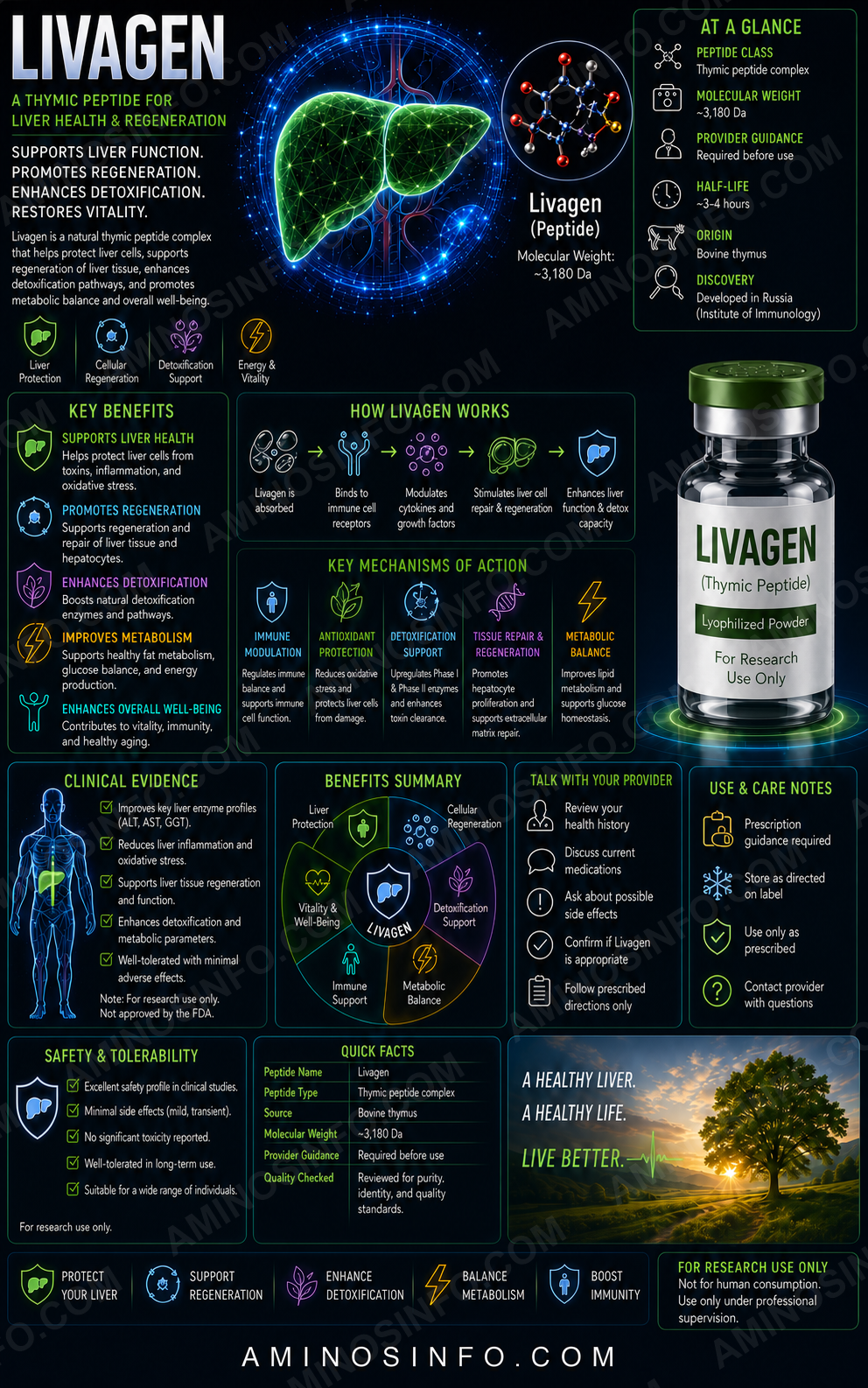
First, Livagen is a synthetic tetrapeptide with the sequence Lys–Glu–Asp–Ala, abbreviated KEDA. It is commonly described within the Khavinson-school peptide literature as a liver-associated bioregulator.
Next, the published research base includes rat-hepatocyte protein-synthesis studies, chromatin-decondensation experiments in lymphocytes from older adults, age-dependent digestive-enzyme studies in rats, inhibition of serum enkephalin-degrading enzymes, and later animal or in vitro liver-pathology reports.
Livagen
Lys–Glu–Asp–Ala
KEDA
Linear tetrapeptide
Liver, chromatin, aging, enzyme regulation
No
🧬 Molecular Structure
First, Livagen is a linear tetrapeptide composed of L-lysine, L-glutamic acid, L-aspartic acid, and L-alanine. The standard research form is generally represented with free N- and C-termini.
🧪 Amino-Acid Sequence
H-Lys-Glu-Asp-Ala-OH
One-letter notation: KEDA
| Residue | Chemical feature | Analytical relevance |
|---|---|---|
| Lysine | Meanwhile, Basic side-chain amino group | Likewise, Contributes positive charge and counterion binding. |
| Glutamic acid | In addition, Acidic side-chain carboxyl group | Moreover, Can contribute to sequence isomers and cyclization-related impurities. |
| Aspartic acid | By contrast, Acidic side-chain carboxyl group | Also, Can isomerize or form isoaspartyl-related degradants. |
| Alanine | Consequently, Small hydrophobic methyl side chain | However, Helps distinguish KEDA from closely related KEDG or KEDW peptides. |
⚛️ Molecular Weight and 🧫 Formula
| Neutral molecular formula | Therefore, C18H31N5O9 |
|---|---|
| Average molecular weight | Approximately 461.47 g/mol |
| Peptide length | 4 amino acids |
| Expected terminal form | For example, Free N-terminus and free C-terminal carboxyl group |
| Common research notation | KEDA |
Importantly, sequence permutations containing K, E, D, and A share the same elemental composition and nominal mass. Exact sequence-order confirmation is therefore essential.
📅 Discovery Timeline
1970s–1990s: Organ-derived peptide complexes investigated
First, Russian and Eastern European research programs studied low-molecular-weight peptide fractions from liver and other organs.
Late 1990s–early 2000s: KEDA synthesized and tested
Next, researchers developed Livagen as a defined tetrapeptide and studied in hepatocyte cultures, lymphocytes, digestive-enzyme systems, and serum peptidases.
2001: Hepatocyte protein-synthesis study
Moreover, researchers reported age-related reductions in protein synthesis in rat hepatocytes and increased synthesis in older hepatocyte cultures after Livagen exposure.
2002: Chromatin activation study
In addition, researchers reported that Livagen to cause de-heterochromatinization in lymphocytes from older adults, interpreted as chromatin activation.
2003: Enkephalin-degrading enzyme study
Likewise, Livagen inhibited serum enzymes involved in enkephalin degradation, with an IC50 reported near 20 micromolar. Direct opioid-receptor binding was not demonstrated.
2005: Digestive-enzyme study
Meanwhile, oral Livagen produced age-dependent changes in digestive-enzyme activity in rats, and researchers reported resistance to intestinal peptide hydrolases.
2007: Pericentromeric and telomeric heterochromatin study
Moreover, further lymphocyte experiments reported reactivation of condensed chromosomal regions in cells from older individuals.
2020: Liver-pathology review and experimental summary
In addition, a later regional publication reported concordant immune, antioxidant, and liver-function effects of a liver peptide complex and KEDA in animal and in vitro hepatitis or fibrosis models.
Current status
Finally, Livagen remains unapproved, with no large independent clinical-development program or recognized standard-of-care use.
Liver and Hepatocyte Research
Hepatocyte protein synthesis
First, a published rat-hepatocyte study evaluated age-related rhythms of protein synthesis. Livagen increased protein synthesis in hepatocyte cultures from older animals toward levels observed in younger cultures.
What this may mean
Next, the finding suggests that KEDA can influence translational activity or cellular metabolism under specific culture conditions.
What it does not prove
- First, Improved liver function in humans
- Next, Reversal of fibrosis or cirrhosis
- Also, Improved detoxification
- Moreover, Lower ALT, AST, bilirubin, or liver fat
- In addition, Reduced risk of liver failure or cancer
Hepatitis and fibrosis models
However, later regional work described hepatoprotective, antioxidant, and immunomodulatory effects in animal and in vitro models. These results need independent replication and modern methodological confirmation.
Chromatin and Lymphocyte Research
Chromatin condensation in aging
First, heterochromatin is a compact chromatin state commonly associated with reduced transcriptional accessibility. Aging can alter chromatin organization, though changes vary by cell type and genomic region.
Livagen de-heterochromatinization findings
Next, studies in cultured lymphocytes from older adults reported reduced heterochromatinization after Livagen exposure, interpreted as activation of previously condensed chromosomal regions.
Ribosomal genes
Moreover, the investigators proposed reactivation of ribosomal genes and other previously inactive regions, potentially supporting protein-synthesis capacity.
Important limitation
However, global chromatin decondensation is not automatically beneficial. Loss of heterochromatin can also increase genomic instability, inappropriate gene expression, transposable-element activity, or cancer risk.
Not equivalent to epigenetic rejuvenation
Finally, microscopic chromatin changes in cultured lymphocytes do not prove reversal of biological aging or restoration of immune function in living humans.
Digestive-Enzyme Research
Resistance to hydrolysis
First, a rat study reported that Livagen was weakly hydrolyzed and was not appreciably broken down by small-intestinal peptide hydrolases under the tested conditions.
In vitro enzyme inhibition
Next, Livagen reduced glycyl-L-leucine dipeptidase activity in small-intestinal preparations by approximately 50% under the reported assay conditions.
Age-dependent effects in rats
Moreover, after two weeks of oral administration, digestive-enzyme activity decreased in young rats and increased in old rats.
Interpretation
However, this bidirectional age-dependent effect is interesting but difficult to translate. It does not establish improved digestion, nutrient absorption, weight control, or gastrointestinal treatment in humans.
Enkephalin-Degrading Enzyme Research
What enkephalins are
First, enkephalins are endogenous opioid peptides involved in pain, stress, reward, autonomic function, and other signaling systems.
Enzyme inhibition
Likewise, Next, Livagen inhibited human-serum enzymes involved in enkephalin degradation in vitro. The reported IC50 was approximately 20 micromolar.
No direct opioid-receptor binding
Moreover, radioreceptor testing did not establish direct opioid-receptor interaction.
Clinical meaning remains unclear
However, inhibiting enkephalin degradation in serum does not prove analgesic, mood, anti-addiction, gastrointestinal, or neuroprotective effects in humans.
🧠 Proposed Mechanisms of Action
Clinical liver and anti-aging effects remain unproven
1. Protein-synthesis regulation
First, Livagen may influence translational activity in aged hepatocyte cultures.
2. Chromatin remodeling
Next, microscopic studies suggest reduced heterochromatinization in lymphocytes from older adults.
3. Peptidase inhibition
Moreover, KEDA can inhibit selected digestive and enkephalin-degrading enzymes in vitro.
4. DNA-binding hypothesis
In addition, broader short-peptide literature proposes that small peptides interact with DNA and regulate transcription. Specific KEDA binding sites and physiological relevance remain incompletely defined.
5. Tissue-selectivity hypothesis
However, no validated receptor or transporter proves preferential delivery of KEDA to hepatocytes or immune cells.
🎯 Target and Pathway Profile
| Target or pathway | Evidence status |
|---|---|
| Hepatocyte protein synthesis | Meanwhile, Reported in aged rat-hepatocyte cultures. |
| Chromatin heterochromatinization | Likewise, Microscopic changes reported in aged human lymphocytes. |
| Ribosomal gene activity | In addition, Proposed as part of chromatin-reactivation interpretation. |
| Glycyl-L-leucine dipeptidase | Inhibited in vitro. |
| Enkephalin-degrading enzymes | Moreover, Inhibited in human serum in vitro. |
| Opioid receptors | By contrast, No direct binding demonstrated. |
| Also, Cytochrome P450 or glutathione pathways | Consequently, No validated direct mechanism. |
Evidence Limitations and Clinical Interpretation
Narrow research base
First, most Livagen studies come from a small number of investigators and regional journals.
Small or preclinical models
Moreover, much of the evidence consists of cell cultures, animal studies, enzyme assays, or cytogenetic observations.
No established clinical liver outcomes
In addition, no large randomized trial shows reduced fibrosis, liver-related hospitalization, transplantation, cancer, or mortality.
No validated immune-aging outcome
Likewise, chromatin changes do not establish improved vaccine response, reduced infection, or restored lymphocyte function.
No established anti-aging benefit
Finally, no evidence shows that Livagen extends human lifespan or reverses aging.
Safety and Regulatory Considerations
No standardized human safety profile
First, no FDA-approved label defines dose, route, pharmacokinetics, contraindications, interactions, pregnancy safety, or long-term adverse effects.
Chromatin-related uncertainty
Moreover, broad chromatin activation could theoretically alter genomic stability or inappropriate gene expression.
Enzyme-interaction uncertainty
In addition, inhibition of peptidases could alter endogenous peptide signaling or interact with medicines.
Liver disease caution
However, people with liver disease may have altered metabolism and coagulation and should not rely on unapproved peptides in place of diagnosis and treatment.
Product-quality risk
Likewise, unapproved material may contain incorrect sequence, sequence isomers, free amino acids, residual solvents, microbial contamination, endotoxin, or inaccurate content.
Regulatory status
Finally, Livagen is not FDA approved as a drug or biologic.
🧪 Laboratory Testing Methods
Identity, Sequence, and Stability Testing
| Method | Purpose | Important limitation |
|---|---|---|
| However, RP-HPLC, ion-pair HPLC, or UPLC | Therefore, Separates KEDA from deletion peptides, free amino acids, and degradants. | For example, Small polar peptides require validated methods. |
| LC-MS / HRMS | Meanwhile, Confirms intact molecular mass. | Likewise, Cannot distinguish all sequence permutations by mass alone. |
| MS/MS sequencing | Confirms Lys–Glu–Asp–Ala order. | In addition, Requires validated fragmentation and authentic standards. |
| Chiral amino-acid analysis | Moreover, Confirms L-Lys, L-Glu, L-Asp, and L-Ala. | By contrast, Hydrolysis can introduce artifacts. |
| Net peptide-content assay | Also, Measures actual KEDA concentration. | Consequently, analysts must not infer net peptide content from HPLC area purity. |
| Sequence-isomer analysis | However, Detects alternative K/E/D/A permutations. | Therefore, Isomers may have identical mass and similar chromatography. |
| For example, Pyroglutamate and isoaspartate analysis | Meanwhile, Evaluates cyclization and isomerization. | Likewise, analysts may need specialized LC-MS methods. |
| Free amino-acid analysis | In addition, Detects hydrolysis or incomplete synthesis. | Requires adequate resolution. |
| Protein-synthesis assay | Moreover, Measures translational activity in hepatocyte cultures. | By contrast, Does not prove clinical liver benefit. |
| Chromatin assay | Also, Evaluates heterochromatin, chromosomal regions, or accessibility. | Consequently, Microscopic changes do not prove healthy epigenetic effects. |
| Peptidase assay | However, Measures digestive or enkephalin-degrading enzyme inhibition. | Therefore, In vitro inhibition may not occur at physiological exposure. |
| For example, Microbial limits, sterility, and endotoxin | Meanwhile, Evaluates route-specific microbiological quality. | Likewise, Requirements differ by intended use. |
| Stability testing | In addition, Tracks hydrolysis, cyclization, isomerization, assay, and appearance. | Moreover, Must reflect final formulation and storage conditions. |
📄 How to Interpret a Livagen COA
COA Review and Route-Specific Quality
- By contrast, Verify the exact sequence: H-Lys-Glu-Asp-Ala-OH or KEDA.
- Also, Confirm sequence order: Mass alone cannot distinguish sequence permutations.
- Consequently, Verify stereochemistry: Expected material generally uses L-amino acids.
- However, Separate identity, purity, and net content: These are different analytical measurements.
- Therefore, Review sequence isomers, pyroglutamate, isoaspartate, hydrolysis, and free amino acids.
- For example, Match testing to the intended route: Raw-powder purity does not establish injectable or oral suitability.
- Meanwhile, Do not infer biological benefit: A COA cannot prove liver repair, chromatin rejuvenation, immune restoration, digestive benefit, or anti-aging activity.
📊 Livagen vs Epitalon vs Vilon vs Thymalin
Sequence and Research-Association Differences
| Feature | Livagen | Epitalon | Vilon | Thymalin |
|---|---|---|---|---|
| Sequence or composition | KEDA | AEDG | KE | Likewise, Complex of thymic peptides |
| Main research association | In addition, Liver, chromatin, enzyme regulation | Pineal, circadian, aging | Moreover, Immune and gene-regulation research | By contrast, Thymic and immune research |
| Single defined peptide? | For example, Yes; Livagen is a defined peptide. | Moreover, Yes; Epitalon has a defined sequence. | In addition, Yes; Vilon is a defined dipeptide. | However, Regulators have not approved this compound. |
| FDA approved? | Therefore, No approved indication exists. | This remains unapproved. | Likewise, No FDA authorization applies. | For example, Regulators have not approved this compound. |
Livagen vs Approved Liver Therapies
Experimental Peptide Versus Established Liver Treatments
| Therapy type | Established role | Difference from Livagen |
|---|---|---|
| Direct-acting antivirals | Also, Cure most hepatitis C infections | Consequently, Defined viral targets and large clinical evidence |
| Nucleos(t)ide analogs | However, Suppress hepatitis B replication | Defined antiviral mechanism |
| Therefore, Weight loss and metabolic treatment | For example, Central to many fatty-liver cases | Evidence-based metabolic intervention |
| Livagen | No approved indication | Meanwhile, Experimental peptide with limited evidence |
Livagen vs Enkephalinase Inhibitors
| Feature | Livagen | Validated enkephalinase-inhibitor drug research |
|---|---|---|
| Primary purpose | Broad bioregulator research | Likewise, Defined inhibition of specific peptidases |
| Target certainty | Limited | Usually characterized biochemically |
| Clinical application | None approved | In addition, Depends on specific drug and indication |
🔗 Related Peptides and Pathways
- Epitalon: First, AEDG tetrapeptide associated with pineal and aging research.
- Vilon: Next, KE dipeptide associated with immune and gene-regulation research.
- Thymalin: Also, Thymic peptide complex distinct from Livagen.
- Heterochromatin: Moreover, Condensed chromatin state evaluated in Livagen lymphocyte studies.
- Ribosomal genes: In addition, Proposed targets of chromatin reactivation.
- Enkephalin-degrading enzymes: Likewise, Inhibited by Livagen in vitro.
- Hepatocyte protein synthesis: Finally, Main cellular endpoint in early liver research.
🖼️ Original Diagram Specifications
Diagram 1: Livagen molecular structure
Moreover, Show H-Lys-Glu-Asp-Ala-OH with the lysine side-chain amine, two acidic side chains, alanine methyl group, peptide bonds, and free termini.
Diagram 2: Hepatocyte protein-synthesis experiment
By contrast, Compare young, aged, and aged-plus-Livagen hepatocyte cultures, marking the reported restoration toward younger protein-synthesis activity.
Diagram 3: Chromatin decondensation
Also, show condensed heterochromatin in an aged lymphocyte and experimentally decondensed chromatin after Livagen exposure, while noting that biological benefit remains unproven.
Diagram 4: Digestive-enzyme findings
Consequently, Show age-dependent effects in young versus old rats and in vitro inhibition of glycyl-L-leucine dipeptidase.
Diagram 5: Enkephalin pathway
However, Show enkephalin release, peptidase degradation, experimental Livagen inhibition, and lack of direct opioid-receptor binding.
Diagram 6: Evidence ladder
Therefore, Show chemistry, enzyme assays, cell culture, animal studies, limited regional studies, large randomized trials, and FDA approval. Place Livagen below confirmatory clinical evidence.
Diagram 7: COA workflow
For example, Show exact mass, MS/MS sequence, stereochemistry, sequence isomers, pyroglutamate, isoaspartate, free amino acids, net content, microbiology, and stability.
❓ Frequently Asked Questions
Is Livagen a peptide?
Meanwhile, Yes. It is a synthetic tetrapeptide.
What is its sequence?
H-Lys-Glu-Asp-Ala-OH, abbreviated KEDA.
What is its molecular weight?
Likewise, Approximately 461.47 g/mol for neutral KEDA.
Is Livagen FDA approved?
No.
Does Livagen repair the liver?
In addition, No strong human clinical evidence establishes liver repair or reversal of fibrosis.
Does it improve protein synthesis?
Moreover, It increased protein-synthesis activity in aged rat-hepatocyte cultures, but human clinical relevance is unknown.
Does Livagen open chromatin?
By contrast, Studies reported de-heterochromatinization in cultured lymphocytes from older adults. This does not prove beneficial epigenetic rejuvenation.
Does Livagen improve immunity?
Also, No validated clinical evidence establishes improved immune outcomes.
Does it affect digestion?
Consequently, rat studies reported age-dependent digestive-enzyme effects, but researchers have not proven human digestive benefit.
Is Livagen an opioid?
However, No. It inhibited enkephalin-degrading enzymes in vitro but did not show direct opioid-receptor binding.
Does 99% HPLC purity prove activity?
Therefore, No. Sequence, stereochemistry, net content, functional potency, pharmacokinetics, safety, and clinical outcomes must be established separately.
Livagen Scientific Overview: Final Thoughts
In conclusion, Livagen is a defined tetrapeptide with the sequence Lys–Glu–Asp–Ala. Its published research includes aged-hepatocyte protein synthesis, chromatin decondensation in lymphocytes, age-dependent digestive-enzyme effects, and inhibition of enkephalin-degrading enzymes.
However, these findings are mechanistically interesting but do not establish treatment of liver disease, immune aging, digestive dysfunction, pain, or general aging. The evidence base remains narrow and largely preclinical.
Therefore, analysts should verify legitimate material for exact KEDA sequence order, L-amino-acid stereochemistry, terminal chemistry, sequence isomers, pyroglutamate, isoaspartate, free amino acids, net peptide content, route-specific microbiological quality, and stability.
📚 References
- For example, Brodskii VI, et al. Rhythm of protein synthesis in cultures of hepatocytes from rats of different ages and the effect of Livagen. 2001.
- Meanwhile, Khavinson VK, et al. Effects of Livagen peptide on chromatin activation in lymphocytes from old people. 2002.
- Likewise, Kost NV, et al. Effect of new peptide bioregulators Livagen and Epitalon on enkephalin-degrading enzymes and opioid receptors. 2003.
- In addition, Khavinson VK, et al. Effect of peptide Livagen on digestive enzymes in rats of different ages. 2005.
- Moreover, Lezhava T, et al. Activation of pericentromeric and telomeric heterochromatin by Livagen in lymphocytes from aged individuals. 2007.
- By contrast, Khavinson V, et al. Peptide Regulation of Gene Expression: A Systematic Review. Molecules. 2021.
- Also, Kuznik BI, et al. Influence of liver peptide complex and KEDA peptide in experimental liver pathology. 2020.
- Consequently, Anisimov VN, Khavinson VK. Peptide bioregulation of aging: results and prospects. Biogerontology. 2010.
- However, Khavinson VK, Kuznik BI. Peptide Bioregulators: The New Class of Geroprotectors. 2014.
- Therefore, Khavinson VK. Peptides, Genome, and Aging. Research monograph.
- For example, Solovyev AY, et al. Interaction of amino acids, peptides, and proteins with DNA. 2015.
- Meanwhile, Daniel H. Molecular and integrative physiology of intestinal peptide transport. Annual Review of Physiology.
- Likewise, Brandsch M. Drug transport via the intestinal peptide transporter PepT1. Current Opinion in Pharmacology.
- In addition, Smith DE, Clémençon B, Hediger MA. Proton-coupled oligopeptide transporter family SLC15. Molecular Aspects of Medicine.
- Moreover, Newstead S. Molecular insights into proton-coupled peptide transport. Trends in Pharmacological Sciences.
- By contrast, Michalopoulos GK, Bhushan B. Liver regeneration: biological and pathological mechanisms. Nature Reviews Gastroenterology & Hepatology.
- Also, Forbes SJ, Newsome PN. Liver regeneration—from models to clinical application. Nature Reviews Gastroenterology & Hepatology.
- Consequently, Taub R. Liver regeneration: from myth to mechanism. Nature Reviews Molecular Cell Biology.
- However, Rinella ME, et al. AASLD practice guidance on metabolic dysfunction-associated steatotic liver disease.
- Therefore, European Association for the Study of the Liver. Clinical practice guidelines for liver disease.
- For example, Allis CD, Jenuwein T. The molecular hallmarks of epigenetic control. Nature Reviews Genetics.
- Meanwhile, Felsenfeld G, Groudine M. Controlling the double helix. Nature.
- Likewise, Loss of heterochromatin and aging literature. Nature Reviews Molecular Cell Biology.
- In addition, Rysztak LG, et al. The role of enkephalinergic systems in substance use disorders. 2022.
- Moreover, Hazato T, et al. Separation and inhibition of enkephalin-degrading enzymes. 1985.
- By contrast, Kim YS, et al. Peptide hydrolases in brush-border and soluble fractions of small intestine. 1972.
- Also, International Council for Harmonisation. ICH Q2(R2): Validation of Analytical Procedures.
- Consequently, United States Pharmacopeia. General Chapter <621>, Chromatography.
- However, United States Pharmacopeia. General Chapters <61> and <62>, Microbiological Examination of Nonsterile Products.
- Therefore, United States Pharmacopeia. General Chapter <71>, Sterility Tests.
- Moreover, United States Pharmacopeia. General Chapter <85>, Bacterial Endotoxins Test.
- In addition, United States Pharmacopeia. General Chapters <232> and <233>, Elemental Impurities.
- However, International Council for Harmonisation. ICH Q3C: Impurities—Guideline for Residual Solvents.
- Therefore, International Council for Harmonisation. ICH Q1A(R2): Stability Testing of New Drug Substances and Products.
Livagen, Hepatocyte, Chromatin, and Enzyme Sources
Liver Biology, Enkephalin, and Analytical Sources
Likewise, Identity, molecular properties, hepatocyte, chromatin, digestive-enzyme, enkephalin, safety, and regulatory findings were reviewed in July 2026. Livagen remains an unapproved research peptide.